


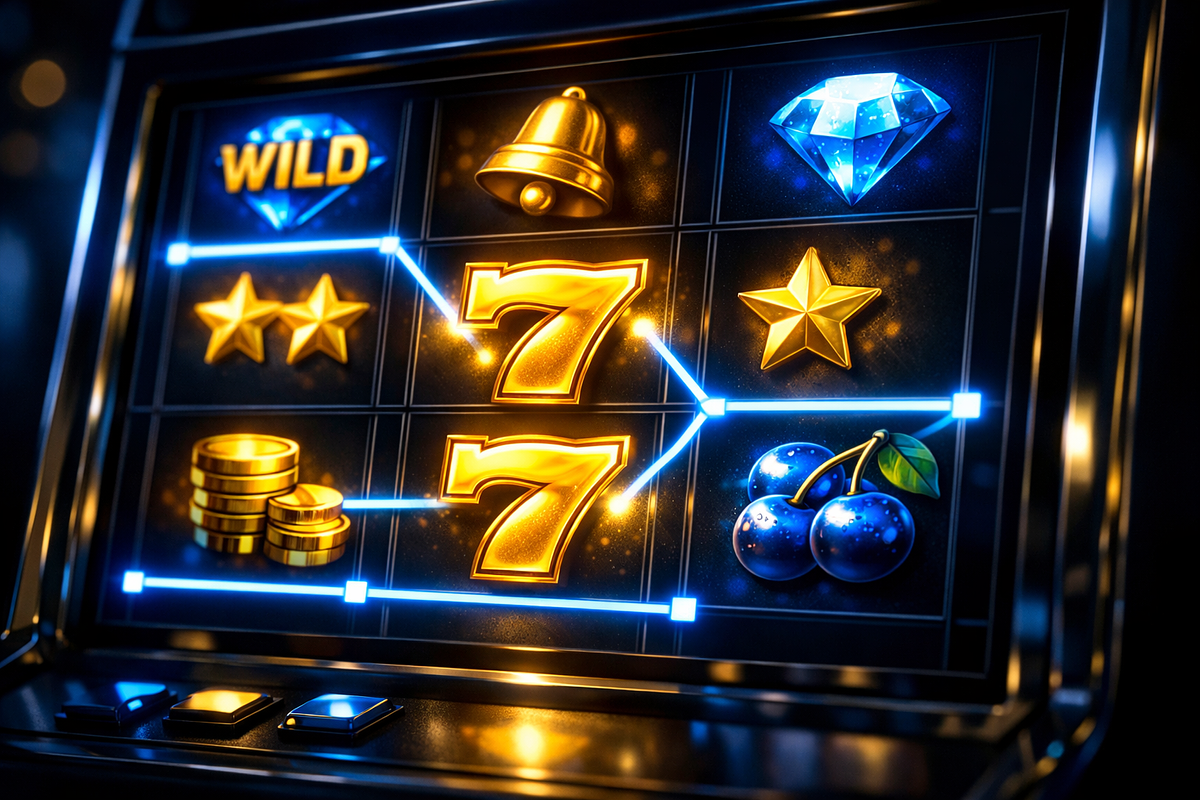
There are three main ways slot games decide what counts as a win: paylines, ways to win, and cluster pays. All three use spinning symbols on a grid, but each applies a different rule for what qualifies as a winning combination. That difference affects how you read the paytable and what you’re actually watching for on screen. By the end of this page, you’ll be able to identify which system a slot uses and know what that means before you play.
The Payline System
The payline system is the original win-calculation model in slot design, going back to the single central horizontal line of mechanical reel machines. It’s still the most widely used framework across land-based and online slots today. A payline is a fixed, predetermined path across the reels where matching symbols must land to produce a win. Every other win-calculation system, including ways to win and cluster pays, departs from this model, so understanding paylines gives you a solid reference point for making sense of how other systems work.
A payline defines a specific sequence of reel positions, and a win only happens when matching symbols occupy each required position along that path. The traditional direction is left-to-right, starting from the first reel on the left, but modern video slots extend this in several ways. Paylines can run horizontally across a single row, diagonally from one corner to another, or in zigzag patterns that jump between rows across consecutive reels. Some slots evaluate lines in both directions at once, left-to-right and right-to-left, which effectively doubles the number of active paths without adding reels.
After every spin, the game checks each active payline against the paytable. Whether a symbol contributes to a win depends entirely on whether it sits on one of these predefined paths. A matching symbol that lands off every active line pays nothing. Once you understand paylines as drawn paths rather than general regions of the grid, you can open a slot’s paytable diagram and see exactly which symbol sequences the game rewards, rather than assuming any cluster of matching symbols anywhere on the reels will trigger a payout.
Fixed-payline slots keep every line active on every spin regardless of bet size, with the total wager spread evenly across all lines automatically. Adjustable-payline slots let you choose how many lines to activate before spinning, with each active line carrying its own share of the total stake. On a 20-payline slot with a total bet of CA$1.00, each active line gets CA$0.05, and any payout listed for that line is calculated against that per-line amount. Payline count doesn’t directly determine RTP, but it does affect how often wins appear and how large individual line wins are relative to your total stake. Knowing whether a slot uses fixed or adjustable paylines tells you how your stake is being split before the reels spin.
| Attribute | Fixed Paylines | Adjustable Paylines |
|---|---|---|
| Number of active lines | Always the full set; cannot be reduced | Varies; player selects how many lines to activate |
| Player control over line count | None | Full control up to the game’s maximum |
| How the total bet is distributed | Spread evenly across all lines automatically | Divided among only the lines the player activates |
| Typical use case in modern slots | Common in contemporary video slots where a simple bet structure is a design priority | More common in older-generation video slots; less prevalent in newer releases |
The Ways-to-Win System
The ways-to-win system removes the fixed path that defines the payline model. Instead of requiring symbols to land on a predetermined line, it pays whenever matching symbols appear on consecutive adjacent reels starting from the leftmost reel, regardless of which row those symbols occupy. This removes the concept of a line entirely: there’s no path drawn across the grid, just a reel sequence to satisfy. On a ways-to-win slot, you stop scanning for lines and start reading the reels as columns of positions, each of which can independently contribute to a win.
Under the ways-to-win rule, a win forms when matching symbols land on consecutive reels starting from reel one, with each symbol allowed to sit in any row position on its reel. The payline model requires a symbol to occupy a specific cell, meaning the correct row on the correct reel. The ways-to-win model only requires that the correct reel is covered. Row position doesn’t matter as long as the reel sequence is unbroken from left to right.
This expands the number of possible winning combinations without changing the visual size of the grid. The “ways” figure is a mathematical count of every possible row-position combination across the active reels, not a collection of drawn paths. On a five-reel grid with three rows, there are three possible symbol positions on each reel, and every combination of those positions across all five reels is a valid winning path. Once you understand this, you stop looking for lines and instead watch for stacks of matching symbols filling adjacent reels from left to right, because any row position on each reel counts equally toward a win.
The most common ways count on a standard five-reel, three-row grid is 243. That figure comes directly from the grid’s structure: three symbol positions on each of five reels produce 3⁵ combinations, which equals 243. A four-row variant on the same five-reel layout raises the count to 1,024, using the same arithmetic applied to the deeper reel height.
A licensed mechanic developed by Big Time Gaming extends this further by randomising the number of rows on each reel with every spin. The mechanic typically runs across six reels, with each reel capable of showing a variable number of symbol positions between a set minimum and maximum on any given spin. Because the ways count is the product of all reel heights, it changes from spin to spin as the row counts shift. The ceiling of 117,649 ways is only reached when every reel simultaneously hits its maximum row height. On most spins, the active ways count sits below that ceiling. Big Time Gaming licenses this mechanic to other studios, which is why it appears across titles from multiple developers. When you see “117,649 ways” advertised for a slot, that figure is the maximum the game can reach under ideal reel conditions, not the fixed number of ways active on every spin.
The Cluster Pays System
Cluster pays is the most recent departure from traditional reel-based win calculation, and it reorganises the logic of how a win forms. Rather than adjusting or extending the reel-and-line framework, it replaces that framework with a symbol grid. The concepts of payline, reel, and left-to-right directionality all disappear, replaced by a single geometric rule: adjacency. On a cluster-pays game, you’re no longer looking for paths across reels but for connected shapes anywhere on a two-dimensional field.
Cluster pays games use a symbol grid in place of reels. Common grid sizes include 5×5, 7×7, and 8×8, though other configurations exist. A win forms when a minimum number of matching symbols, typically five, are directly connected horizontally or vertically. Diagonal connections don’t count under the standard formulation. Because the win condition is purely about adjacency, a qualifying cluster can form anywhere on the grid. There’s no directional constraint and no requirement that the cluster start from a particular edge or column.
Payout scales with cluster size, and larger clusters pay disproportionately more than a cluster that just meets the minimum threshold. This is different from a related mechanic where a win is awarded based on the total count of a symbol appearing anywhere on the grid, regardless of whether those symbols are connected. In that count-based system, position is irrelevant. In cluster pays, position and connection are the entire basis of the win. Once you understand the adjacency rule, you stop scanning for rows or lines and instead read the grid as a two-dimensional connection map, asking which symbols touch rather than where they land relative to a fixed path.
Cascading, also called tumbling or avalanche, is a mechanic where winning symbols are removed from the grid after a cluster resolves, and new symbols drop into the empty positions from above. The newly populated grid is then checked again for clusters, potentially producing more wins from the same original spin. This sequence continues until no new qualifying cluster forms.
Cascading is commonly paired with cluster pays because the grid structure supports it cleanly. Empty positions created by symbol removal are discrete cells, and symbols above them drop in a predictable vertical path. The adjacency-based win rule also supports repeated evaluation naturally, since each new arrangement of symbols after a drop is assessed on the same geometric terms as the first. That said, cascading isn’t universal across cluster-pays titles. Some earlier games in the category used alternative respin mechanics rather than a drop-fill system. A single spin on a cluster-pays slot with cascading isn’t a single evaluation event but a sequence of them, which is why these games typically animate each cascade stage separately before showing a total win figure.
Cluster-pays slots vary in grid size, and that variation affects how many symbols are in play on any given spin and how readily clusters of different sizes can form. The category skews toward medium to high volatility, with lower-volatility titles being the exception. The average RTP across cluster-pays slots as a category is approximately 96.42%. The table below lists titles for which grid size, RTP, and maximum-win figures are confirmed from verified sources.
| Title | Studio | Grid Size | RTP | Maximum Win |
|---|---|---|---|---|
| Reactoonz | Play’n GO | 7×7 | 96.51% | 4,570× |
| Jammin’ Jars 2 | Push Gaming | 8×8 | 96.40% | 50,000× |
| Jammin’ Jars | Push Gaming | 8×8 | 96.83% | 19,998.5× |
Side-by-Side Comparison of the Three Systems
Paylines, ways to win, and cluster pays each have their own internal logic, and the differences become clearest when you put all three next to each other. They split apart across four core areas: grid layout, win-formation rule, positional requirement, and gameplay feel. The table below maps each system onto those dimensions to show exactly how each one decides what counts as a win.
The table arranges all three systems across the dimensions that most directly shape how a win is recognised, from the physical structure of the grid through to the moment-to-moment experience of play.
| Dimension | Paylines | Ways to Win | Cluster Pays |
|---|---|---|---|
| Underlying layout | Traditional reel-and-row grid with a fixed number of columns and rows; lines are drawn across that grid | Traditional reel-and-row grid; row counts may be fixed or variable (as in Megaways, where they change every spin) | Symbol grid without traditional reels; common sizes include 5×5, 7×7, and 8×8 |
| Win-formation rule | Matching symbols must land on a specific predetermined path across the reels in the correct sequence | Matching symbols must appear on consecutive adjacent reels starting from the leftmost reel, in any row position | A minimum number of matching symbols must be directly connected horizontally or vertically anywhere on the grid; most titles require at least five connected symbols |
| Positional requirement | Exact position on the predefined line matters; a symbol one row off the line does not contribute to that line’s win | Row position within each reel is irrelevant; only reel-to-reel adjacency from left to right is required | No fixed position or directional anchor; symbols qualify by adjacency to other matching symbols, not by location on the grid |
| Directional constraint | Direction depends on how each payline is drawn; lines can run left-to-right, right-to-left, diagonally, or in zigzag patterns depending on the game’s configuration | Evaluation runs strictly left to right, from the first reel outward; right-to-left wins are not part of the standard ways-to-win formulation | No directional constraint; clusters can form and extend in any horizontal or vertical direction across the grid, though diagonal connections do not count |
| Typical pairing with cascading mechanic | Cascading reels are used in some payline slots but are not a defining feature of the format | Cascading reels appear in some ways-to-win titles but are not structurally tied to the format | Cascading (also called tumbling or avalanche) reels are commonly paired with cluster pays, removing winning symbols so new ones drop in and enabling chain-reaction wins from a single spin; the pairing is common but not universal |
| Gameplay feel | Wins are discrete and line-specific; multiple lines can pay simultaneously but each is evaluated independently, producing a structured, countable set of outcomes per spin | The high ways count means matching combinations resolve across many simultaneous paths, producing a broader spread of smaller wins with less reliance on exact symbol placement | Wins grow with cluster size and cascade chains, producing a pattern where individual spins can resolve through multiple successive reactions rather than a single evaluation event |
Reading Any Slot’s Information Panel With a Structural Eye
The win-calculation system a slot uses determines how you need to read its paytable. A payline count, a ways figure, and a minimum cluster size are not interchangeable descriptions of the same thing. Each one is the primary unit of a completely different logic. If you can identify which system is in use before you spin, you’re reading the game on its own terms rather than assuming wins form the same way they do in every other slot.