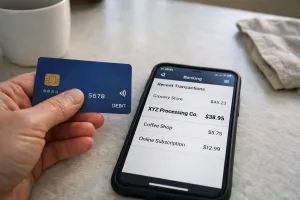


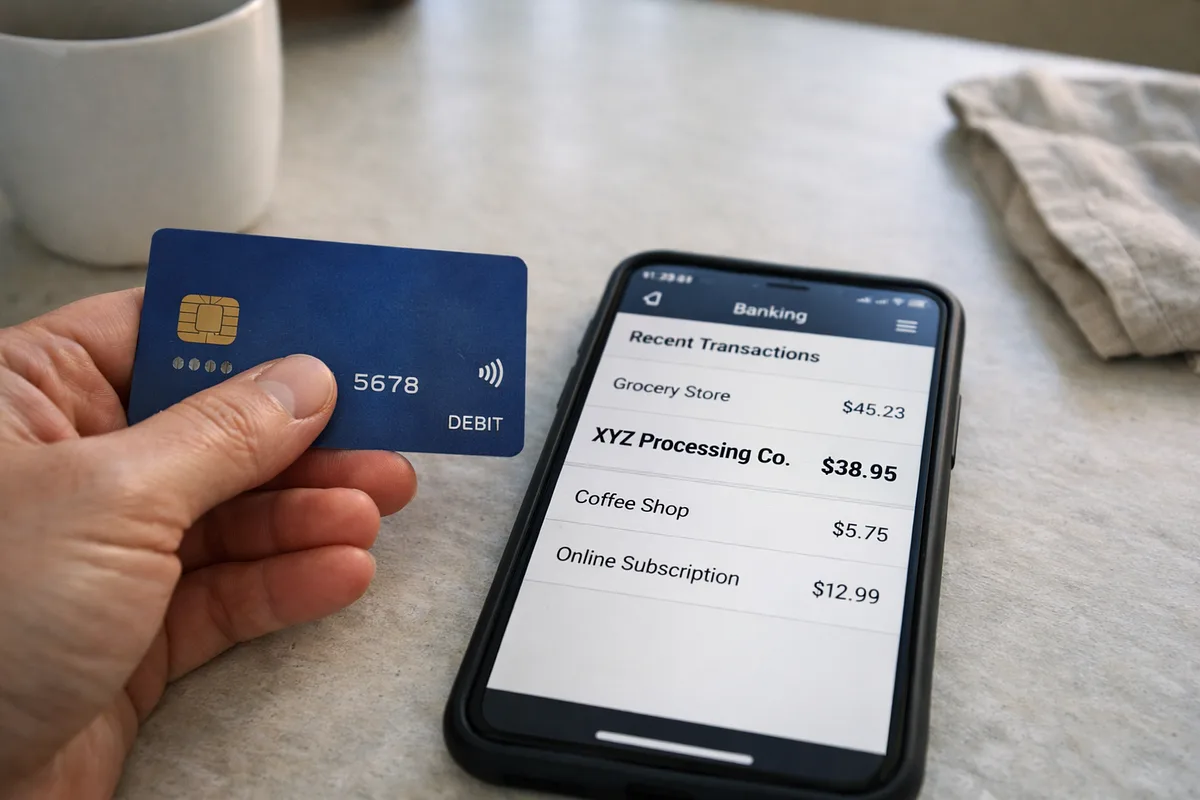
When you make a deposit at an online casino, the name that shows up on your bank statement often looks nothing like the casino you used. This page explains why that happens, what the text actually means, and how to figure out whether an unfamiliar entry is something you need to worry about.
Core Definition of a Payment Descriptor
A payment descriptor is the short text that appears on a bank or card statement to identify the business behind a transaction. Its job is to help you recognize payments you’ve made. When a statement entry shows a name you don’t recognize, knowing what a descriptor is and how it gets generated helps you figure out what that entry actually represents. You’ll also see this field called several different names depending on where you’re looking, but they all refer to the same thing.
Payment processors, card networks, banks, and platform providers all use different words for the same field. There’s no single standard term, so the label you see depends on who wrote the document or built the interface you’re looking at. All of the terms below refer to the same short text string on your statement.
- Billing descriptor, the term most commonly used by payment processors and merchant-facing documentation to describe the identifying text on a statement line item.
- Statement descriptor, the label used by platform providers such as Stripe and by card-network rule documents when referring to the same field in a technical or integration context.
- Merchant descriptor, the term preferred by chargeback-management sources and some issuing banks, emphasizing the merchant as the originating party of the text.
- Transaction descriptor, a broader label used in some processor and global payroll contexts to describe the identifying text attached to an individual charge.
- Soft descriptor, the provisional version of the descriptor that appears while a transaction is still pending, before settlement is complete.
- Hard descriptor, the permanent version of the descriptor that replaces the soft descriptor once a transaction has settled.
Card network rules require the descriptor to show the merchant’s legal name, doing-business-as (DBA) name, or URL, not necessarily the brand name you know. Visa’s merchant data standards say the merchant name should be the one most prominently displayed and recognized by cardholders. Mastercard similarly requires the DBA name as part of the descriptor. If a casino operates under a corporate parent or a licensed entity with a different registered name, that legal or DBA name is what shows up on your statement.
The descriptor might also show a payment processor or intermediary instead of the casino. When the billing entity registered with the card network is a processor or parent company that handles transactions across multiple brands, that entity’s name appears in the descriptor regardless of which casino site took your deposit.
Routing a deposit through an intermediary, such as a digital wallet or a cryptocurrency platform, adds another layer. The intermediary becomes the merchant of record for that part of the transaction, so its name appears on your bank statement instead of the casino’s.
On top of all that, your bank or card network may shorten or reformat whatever descriptor text the merchant originally set up. So what you see on your statement might be a truncated version of an already unfamiliar name. Put all four of these factors together, and a mismatch between the statement entry and the casino’s brand name is just how the payment system works. It doesn’t mean something went wrong.
Descriptor States Across the Transaction Lifecycle
A descriptor isn’t fixed from the moment you make a transaction. It goes through two stages: a temporary version that appears right after your bank authorizes the charge, and a permanent version that replaces it once the transaction clears and settles. Because these two stages can show different text, the same deposit can appear under one name while it’s pending and a different name once it’s posted. Knowing this prevents you from treating a changed or disappeared pending entry as a duplicate charge or an unknown transaction.
A soft descriptor is the text that appears on your account right after your bank authorizes a transaction. At that point the charge hasn’t settled yet, so it sits in the pending section of your transaction log rather than in your posted charges. The text at this stage is temporary. It’s a placeholder while the transaction moves through the settlement process. Because the soft descriptor is generated at authorization rather than at settlement, it may be more generic or abbreviated than what eventually posts to your account. A pending entry with unfamiliar text isn’t automatically an unauthorized charge. The settled entry that replaces it may be clearer or more recognizable. If you contact your bank about an unfamiliar pending descriptor before settlement completes, you may be doing so unnecessarily.
A hard descriptor is the permanent billing descriptor that replaces the soft descriptor once a transaction has cleared and settled. It typically appears in the posted transactions section of your account a few days after the original authorization. The hard descriptor reflects the final settled amount, which may be different from what was shown during the pending stage. When a pending entry disappears and a new posted entry appears under a different name, that’s normal. The soft descriptor has been replaced by the hard descriptor. No duplicate charge has occurred and no reversal has taken place. People who don’t know about this replacement are the most likely to call their bank unnecessarily or dispute a legitimate transaction.
Because of these two stages, a single transaction can produce two different-looking statement entries at different points in time, in different sections of your account, and with different relationships to the final charge amount. When you’re reconciling a statement, match your deposit confirmation against the hard descriptor in the posted transactions list, not the soft descriptor in the pending log. The table below shows how the two stages compare across the details that matter when reading a statement.
| Dimension | Soft Descriptor | Hard Descriptor |
|---|---|---|
| Stage in transaction lifecycle | Authorization (pre-settlement) | Post-settlement / cleared |
| Where it appears in the account view | Pending transactions log | Posted/settled transactions |
| Persistence | Temporary; replaced at settlement | Permanent |
| Typical timing of appearance | Immediately after authorization | A few days after authorization |
| Relationship to the final settled amount | May not reflect final amount | Reflects final settled amount |
Descriptor Formats, Fixed and Variable Text
Separate from where a descriptor sits in the transaction lifecycle, the text itself can be structured in one of two ways: a fixed business name only, or a fixed business name with a variable suffix added per transaction. These two format types work independently from the soft/hard lifecycle stages, so any descriptor can be both soft and static, or both hard and variable, depending on how the merchant set it up. This explains a pattern you might notice on statements: some casino entries look identical across every deposit, while others have a short string of extra characters that changes from one charge to the next.
A static descriptor contains only the fixed business name and doesn’t change from one transaction to the next. Because a single merchant ID corresponds to one descriptor, every transaction processed under that ID produces the same text on your statement. If you make repeated deposits at the same casino, each entry appears under the exact same descriptor line, and the only differences are the date and the amount. Identical text across multiple entries isn’t a formatting error, and it doesn’t mean those transactions are connected to each other in any way beyond sharing the same merchant.
A variable-suffix descriptor lets the merchant add extra text to the fixed business name on a per-transaction basis. That extra text might be a product category, a service description, or a reference code. For casino entries, this means two deposits from the same operator may show slightly different text after the base name. Those differences reflect details about each specific charge, not a different merchant. As long as the base name stays the same, the varying suffix isn’t a sign of unauthorized activity.
Knowing which format a merchant uses helps you read multiple statement entries correctly. You won’t mistake identical entries for duplicates, and you won’t treat a varying suffix as a sign that something is wrong. The table below compares the two formats across the details most relevant to reading a statement.
| Dimension | Static Descriptor | Dynamic Descriptor |
|---|---|---|
| Composition of the text | Fixed business name only | Fixed business name plus variable per-transaction suffix |
| Variation from transaction to transaction | None; identical across all transactions | Suffix varies per charge |
| Transaction-level detail carried in the text | None beyond merchant identity | Product, category, reference code, or other per-charge detail |
| Reader appearance across repeated deposits | Identical descriptor line after line | Same base name; differing tails per entry |
Fields Surrounding the Descriptor on a Statement Line Item
The descriptor text is one field within a structured line item, not the whole record. Several other fields sit alongside it on a bank or card statement, and each one carries different identifying information. Reconciling a transaction accurately means reading those fields together, because the descriptor text alone can be ambiguous, especially when it shows a processor’s or parent company’s name rather than the casino’s brand.
When the descriptor text doesn’t match a name you recognize, the surrounding fields give you the extra detail you need to confirm what the entry is and whether it matches a specific deposit or withdrawal. Each field answers a different question about the transaction.
- Transaction amount: The dollar figure charged or credited. Comparing this against a known deposit amount is often the fastest way to match an unfamiliar descriptor to a specific casino transaction.
- Transaction date: The date the transaction was authorized or posted. Matching this to the date of a casino deposit helps narrow things down when multiple entries appear in the same statement period.
- Payment reference number: A unique alphanumeric string attached to the individual transaction. It doesn’t identify the merchant by name, but you can give it to your bank to pull up the full record for that specific charge.
A company identification number is a persistent identifier attached to the billing entity responsible for a charge, not to any individual transaction. Where this field appears on a statement, it stays the same across every charge processed by the same underlying entity, regardless of what descriptor text is shown. This is useful when a casino charge appears under a processor’s or intermediary’s name: the descriptor text may vary or be cut short, but the company identification number points to the same billing entity every time.
When two statement entries show different descriptor text but carry the same company identification number, both entries come from the same underlying billing entity. For someone reconciling casino transactions, this means a charge labeled with a processor’s name and a charge labeled with a parent company’s abbreviated name can be confirmed as coming from the same source if their company identification numbers match. The number resolves ambiguity that the descriptor text alone can’t.
Contextual Awareness, How Descriptors Are Read by Third Parties
Your bank statement isn’t only read by you. Lenders, mortgage underwriters, and other financial reviewers look at the same statement data as part of credit and affordability assessments. Gambling-related entries carry identifiable signals in that data, and it’s worth understanding what those reviewers can and can’t see.
Gambling-related outflows on a bank statement are identifiable to third parties such as lenders reviewing the statement as part of a loan or mortgage application. Such entries may be flagged as indicators of income allocation risk or spending pattern concerns. This is a property of how descriptors function within the broader financial system, not an inherent judgment about the account holder’s behavior.
How visible the gambling origin is depends directly on what the descriptor text says. When you deposit directly to a casino using a bank card, the descriptor reflects the casino’s legal entity, DBA name, or payment processor, which a reviewer can categorize as gambling-related. When the deposit goes through an intermediary such as a digital wallet or cryptocurrency platform, the descriptor shows the intermediary’s name instead of the casino’s. A reviewer reading a descriptor that names a digital wallet has no direct textual evidence from that entry alone that the money went to a gambling operator. So whether a gambling origin is visible on a statement depends on the descriptor, not on the transaction itself.
We check operator terms, licences and payment details against the casino's own pages and update this content when they change. Read our editorial policy, our transparency statement, or report an error. If gambling stops being fun, see our responsible gambling resources.