

Casino deposits can return to a player in two ways: the casino voluntarily sends the money back, or the player’s bank forces the return through a chargeback. Which one applies determines who controls the process, whether a formal dispute gets triggered, and what consequences the player faces. This article explains how each pathway works, what makes a return valid, and where the limits of each route are.
The Two Pathways by Which Casino Deposits Return to a Player
When a deposited amount comes back to a player’s account, it got there through one of two pathways, and the difference between them matters. The first is an operator-initiated refund, where the casino voluntarily returns the funds. The second is a bank-initiated chargeback, where the player’s bank forces the reversal. These two pathways differ in who sets them in motion, whether the player’s bank is an active party, and what risk the player carries after the funds appear. The terms “refund” and “chargeback” map directly onto these two pathways, and understanding them is the starting point for making sense of any situation where deposited money comes back.
Operator-Initiated Refund as a Voluntary Return of Funds
An operator-initiated refund is a voluntary return of funds processed by the casino through the same payment route the original deposit traveled. The casino initiates the movement without any instruction from the player’s bank. No dispute process is triggered, no bank investigation is opened, and the operator doesn’t incur the processing fees that come with a forced reversal. Because the bank plays no adversarial role, the transaction completes without leaving a dispute record in the player’s banking history.
This matters because the refund pathway is the one that resolves cleanly. The player’s standing with their bank and card issuer is unaffected, and no provisional credit is issued pending an uncertain outcome. When a player sees funds returned to their card through the same route the deposit left on, with no dispute notation, that means the operator processed the refund voluntarily, not that a dispute was filed and won.
Bank-Initiated Chargeback as a Forced Reversal
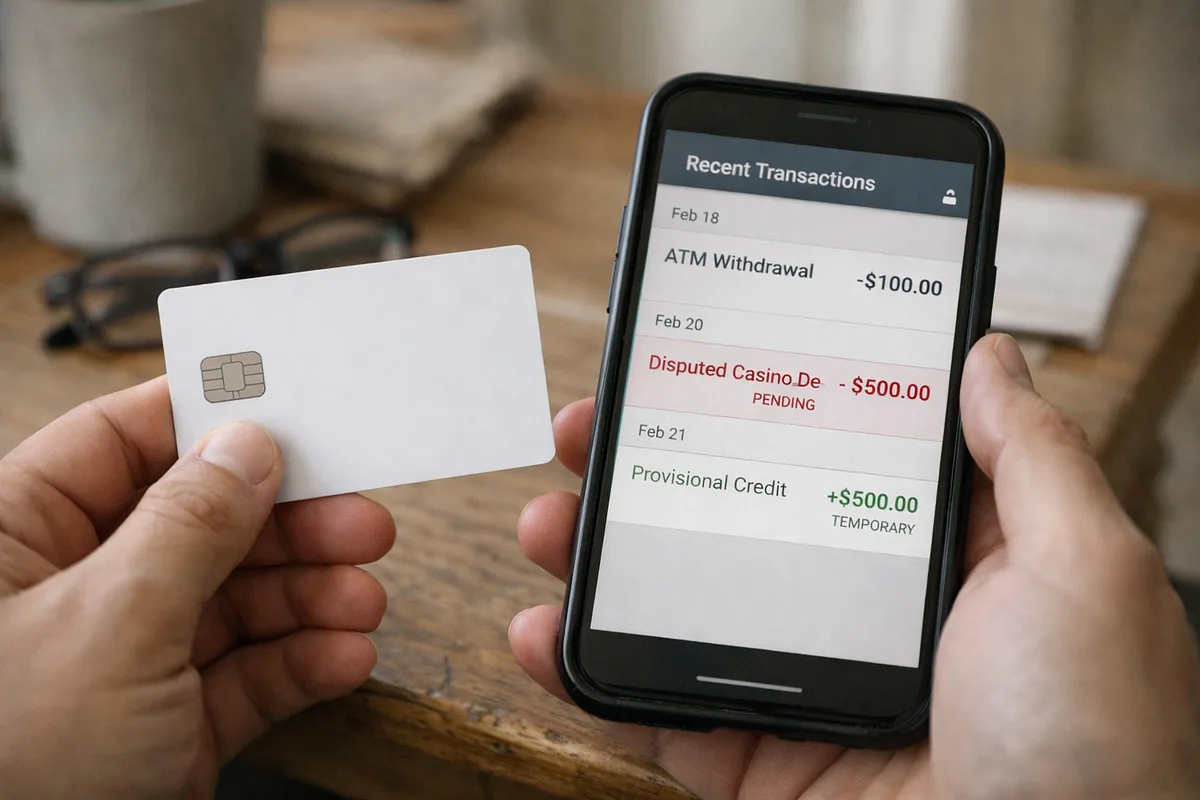
A chargeback is a forced reversal initiated by the player’s bank or card issuer, not by the casino. When the player contacts their bank to dispute a transaction, the bank notifies the casino’s payment processor, and the disputed amount is provisionally credited back to the player’s account while an investigation runs. The casino is compelled to respond through its payment processor rather than being given the option to decide whether to return the funds.
That provisional credit is not a settled outcome. Both the credit to the player and the corresponding debit from the casino’s merchant account stay provisional until the full process concludes. The casino can contest the chargeback by submitting evidence, and the final determination rests on that documentary record, not on the initial credit. A chargeback credit appearing in a player’s account is the start of a process, not the end of it.
Distinguishing the Two Pathways at a Glance
Both pathways result in funds returning to the player, but they differ on who initiates the movement, whether the bank acts as a compelled party, and what the player’s exposure is while the credit sits in their account. The table below contrasts the two pathways across the dimensions that matter most.
| Dimension | Operator-Initiated Refund | Bank-Initiated Chargeback |
|---|---|---|
| Who initiates | The casino operator | The player’s bank or card issuer |
| Bank involvement | None, the bank is not asked to act | Central, the bank drives the process and notifies the casino’s payment processor |
| Dispute process triggered | No | Yes, a formal investigation is opened |
| Processing fees incurred by operator | No fees associated with a forced reversal | Yes, the operator incurs chargeback processing fees on top of the disputed amount |
| Nature of the credit to the player | Settled, funds are returned without a pending investigation | Provisional, the credit can be reversed if the casino’s representment succeeds |
Conditions Under Which a Deposit Reversal Is Considered Valid
Whether a reversal is considered valid, through either pathway, depends entirely on the reason the funds are being sought back. There’s a clear line separating consumer-protection claims from attempts to recover money lost through ordinary play. Card network guidelines draw this line explicitly, limiting chargeback rights for gambling-related transactions to cases where the purchased value or assets did not appear in the player’s account as agreed. Everything outside that boundary is a different category, one where the reversal mechanism isn’t designed to apply. Knowing which side of that line a situation falls on determines both which pathway is available and what outcome is realistic.
Scenarios Commonly Recognised as Valid Grounds
Certain scenarios are consistently cited across payment-compliance and consumer-protection sources as potentially valid grounds for a reversal. Each shares a common thread: either the player did not receive what they paid for, or the transaction should not have been accepted by the operator in the first place.
- Operator error causing duplicate or incorrect charges, a technical fault resulted in the player being charged more than once or for an amount they did not authorise.
- Self-exclusion violation, the operator accepted a deposit from a player who had already self-excluded, rendering any subsequent bets void.
- Operator ineligibility in the player’s jurisdiction, the casino accepted deposits from a player located where it is not licensed to operate.
- Unauthorised transaction, the deposit was made using the player’s card without their consent.
- Refusal to process a legitimate withdrawal, the operator has accepted funds but is not returning balances the player is entitled to withdraw.
Scenarios That Do Not Qualify
Standard gambling losses, meaning money wagered and lost through ordinary play, do not qualify as valid grounds for a reversal under either pathway. Card network guidelines limit chargeback rights for gambling transactions to cases where purchased value or assets did not appear in the player’s account as agreed. Disputes over winnings, losses, or the terms and conditions themselves are explicitly outside that protection. Chargebacks were designed for unauthorised or undelivered purchases, not to recover funds that were spent as intended and simply didn’t produce a favourable outcome. A player who correctly identifies which side of this line their situation falls on can tell the difference between a legitimate consumer-protection claim and a chargeback attempt that will predictably fail and expose them to account closure, bank-side consequences, or further action from the operator.
How the Chargeback Process Actually Runs
Once a chargeback is filed, a defined sequence unfolds between the player’s bank, the card network, the casino’s payment processor, and the casino itself. Each stage operates within fixed time limits set by the card network, and each stage can change the outcome. No single party controls the result. The process does not conclude at the point the player first sees funds reappear in their account.
The Provisional Credit and Merchant-Side Debit
When a chargeback is filed, the casino’s payment processor is notified and the disputed amount is provisionally debited from the casino’s merchant account. At the same time, the player’s bank applies a provisional credit to the player’s account for the same amount. Both movements happen in parallel, and both are provisional until the full process concludes. The casino has not conceded anything yet, and the player has not won anything yet. A player who sees funds return to their account at this stage is seeing the opening of a dispute, not its resolution.
Representment and the Operator’s Response Window
Representment is the stage where the casino submits evidence to its payment processor contesting the chargeback. The casino’s response window runs from 20 to 45 days, depending on which card network governs the transaction. Operators commonly submit terms and conditions clauses, ID verification records, and non-refundable deposit provisions as evidence that the original transaction was authorised and legitimate. The chargeback process doesn’t weigh the player’s account of events on its own. It weighs documentary evidence from both sides, and the operator’s submission during representment is the primary way that evidence enters the record.
Card Network Arbitration as the Final Stage
If both the player’s bank and the casino continue to contest the outcome after representment, the dispute escalates to the card network’s arbitration stage, which is the binding final step. Mastercard’s Chargeback Guide identifies arbitration case filing as a defined stage in the chargeback cycle [VERIFY THIS QUOTE]. If the operator has provided compelling evidence during representment, the chargeback may be reversed and the funds returned to the merchant. If the evidence doesn’t meet the network’s standard, the player keeps the provisional credit as a settled refund. The arbitration outcome, not the provisional credit issued at the start, is what determines where the money finally rests.
Consequences and Risks of Initiating a Chargeback
Filing a chargeback sets a formal dispute process in motion that carries consequences for the player regardless of whether the claim ultimately succeeds. Those consequences fall into distinct categories that affect the player’s standing with the casino, with their own bank, and in some cases with third-party payment providers and credit reporting agencies. The severity of each depends on the nature of the underlying claim, but none of these categories are avoidable simply because the player believes the claim is justified.
Operator-Side Consequences
Operators commonly respond to a chargeback filing with immediate account closure or placement of the player on an internal blacklist, and this typically happens regardless of whether the underlying claim is later found to be valid. The reason is financial: every chargeback costs the operator between $20 and $100 in processing fees on top of the disputed amount itself, making each filing a direct loss before the dispute is even decided. Because that cost hits at the point of filing rather than at the point of resolution, operators treat any chargeback as a breach of the relationship rather than a legitimate grievance to assess on its merits.
Beyond account closure, a casino may pursue a civil lawsuit against the player to recover the disputed funds, and may report the outstanding amount as a debt to credit reporting agencies. A debt report of this kind can affect the player’s credit score, extending the financial impact of the dispute well beyond the original transaction. The practical cost of initiating a chargeback can reach into areas, including creditworthiness and legal exposure, that have no direct connection to the original deposit or the outcome of the dispute itself.
Bank-Side Consequences and the Misuse Distinction
Chargebacks were designed as a consumer protection mechanism for unauthorised or undelivered purchases, not as a way to recover money lost through ordinary gambling. When a player files a chargeback to reverse a losing bet rather than to address a genuine consumer-protection failure, such as an unauthorised transaction or a deposit accepted in violation of a self-exclusion, the filing falls outside the intended scope of the mechanism. Banks and payment providers treat that misuse as a pattern of fraudulent dispute behaviour, and the consequences can include closure of the player’s own bank account or blacklisting by payment providers. That removes access to payment infrastructure that extends well beyond the casino in question. The same action, submitting a chargeback, produces very different consequences depending on whether the underlying claim is a legitimate consumer-protection case or an attempt to recover ordinary gambling losses.
Practical Limitations of Pursuing Reversals Against Casino Operators
A grievance that fits a recognised valid category on paper doesn’t automatically translate into a recoverable sum in practice. Structural factors built into how gambling transactions are classified, how operator contracts are written, and how the regulatory environment around a given operator is enforced create a gap between what a player is theoretically entitled to pursue and what a bank or card network will actually process. The two main sources of that gap are contractual and coding barriers on the transaction side, and jurisdictional variation on the regulatory side.
Transaction Coding and Contractual Barriers
Gambling transactions are commonly coded under a high-risk merchant category code. Visa, for example, identifies gambling as a distinct merchant category group and assigns a four-digit Merchant Category Code to describe a merchant’s primary business type. That classification alone signals elevated risk to a bank’s dispute-handling systems, and can affect how a chargeback claim is assessed before the merits of the underlying dispute are even examined.
Beyond coding, banks may reject chargeback disputes even in cases of alleged fraud if the operator’s terms include provisions that limit the player’s ability to contest the transaction. Operators commonly rely on non-refundable deposit clauses, ID verification requirements that must be satisfied before any withdrawal is processed, bonus wagering requirements that restrict access to funds, and time limits on when a dispute can be raised. Each of these provisions appears in the terms a player accepts at signup, and each can be submitted as documentary evidence during representment to contest a chargeback. The terms accepted at account creation materially shape what recourse remains available when a dispute arises later.
Jurisdictional and Regulatory Framing
The enforceability of any deposit-return claim depends heavily on the regulatory framework the operator sits within. Where a regulator imposes specific, enforceable obligations on operators, players have a defined standard against which to measure operator conduct. Under the UK Gambling Commission’s rules, for instance, operators are required to allow players to withdraw their deposit balance at any time, including when a bonus is active, without first requiring wagering requirements to be met on that deposit balance. Deposit and bonus balances must also be kept separate rather than displayed as a single combined figure. That kind of structural requirement gives a player a concrete regulatory baseline to reference when a withdrawal is refused.
Against operators that sit within loosely enforced regulatory frameworks, the practical avenues for recourse narrow considerably. There’s no equivalent baseline to invoke, no regulator with clear jurisdiction to escalate a complaint to, and no enforcement mechanism that compels the operator to respond. The operator’s regulatory environment is a variable in every recourse outcome, not a background detail that can be set aside once a dispute is underway.
Distinguishing a Cashout Reversal From a Refund or Chargeback
The term “cashout reversal” appears frequently in casino account interfaces and support documentation, often in the same context where players are also reading about refunds and chargebacks. That proximity creates a common misreading: that a cashout reversal is just another name for one of the two return pathways described earlier. It isn’t. A cashout reversal is a separate mechanism with a different initiating party, a different procedural path, and different consequences, none of which overlap with either an operator-initiated refund or a bank-initiated chargeback.
The Cashout Reversal Mechanism
A cashout reversal is an action taken by the player, before a withdrawal has been processed, to cancel a pending withdrawal request. When a player initiates this cancellation, the funds that were queued for transfer back to their payment method instead return to their casino account balance. The entire movement happens within the casino’s own ledger. No bank receives a notification, no card network is contacted, and no dispute process is opened. The funds never leave the casino’s system, so there is no transaction to reverse in the payment-processing sense of the word. When the word “reversal” appears in a casino account context, it doesn’t automatically mean a dispute has been filed or that the operator has returned funds under pressure. Correctly identifying which of the three mechanisms, operator refund, bank chargeback, or player-initiated cashout reversal, is actually in play lets a player assess their situation accurately rather than applying the wrong set of expectations.
We check operator terms, licences and payment details against the casino's own pages and update this content when they change. Read our editorial policy, our transparency statement, or report an error. If gambling stops being fun, see our responsible gambling resources.