


The gambler’s fallacy shows up in roulette, slots, and sports betting in the same basic form: assuming that past results of independent random events tell you something about what happens next. This page explains what that error is, why it persists, and how it plays out differently across casino games and sports wagering. It also covers where streak and pattern logic does and doesn’t legitimately apply. By the end, you’ll be able to spot this reasoning and make better decisions because of it.
Defining the Gambler’s Fallacy
The gambler’s fallacy is the mistaken belief that past outcomes of independent random events influence future probabilities. The American Psychological Association defines it precisely as “a failure to recognize the independence of chance events, leading to the mistaken belief that one can predict the outcome of a chance event on the basis of the outcomes of past chance events.” The fallacy is also known as the Monte Carlo fallacy and the fallacy of the maturity of chances. Academic literature classifies it as both a cognitive bias and a logical fallacy.
The reasoning error at the heart of the fallacy is treating a sequence of outcomes as though it were self-correcting. A bettor who makes this error expects an outcome that hasn’t appeared recently to become more likely, to be, in common parlance, “overdue.” This misreads how probability works for statistically independent events, where each outcome’s probability is unaffected by any prior outcome. A roulette spin, a slot machine spin, or a coin toss has no memory of what came before it. The streak a bettor observes carries no probabilistic weight, and the probability of the next outcome is identical regardless of how long or one-sided the preceding sequence was.
The fallacy comes in two directional forms that are logically identical. In the first, a bettor concludes that an outcome is “due” because it hasn’t appeared during a run. In the second, a bettor concludes that an outcome “won’t repeat” after appearing several times in a row. Both forms rest on the same false premise: that a sequence of independent outcomes must balance itself out.
The gambler’s fallacy is worth contrasting with the hot-hand fallacy, its psychological counterpart documented by Sundali and Croson (2006) in real casino betting behavior. Where the gambler’s fallacy predicts reversal after a streak, the hot-hand fallacy predicts continuation. Figuring out which direction a bettor’s reasoning runs, toward expected reversal or expected continuation, is a reliable way to tell which fallacy is operating in any given case of streak-based reasoning.
The Historical Anchor Case at a European Casino
One documented casino incident from August 1913 has become the most cited illustration of the gambler’s fallacy across academic literature, encyclopedic references, and gambling-industry commentary. Its status as the go-to example comes not just from the scale of the losses, but from how precisely the bettors’ reasoning maps onto the fallacy’s defining structure. The incident is known in some sources as the Monte Carlo fallacy, a label that reflects both its venue and its role as the reference point for this error. Looking at it in detail gives you a concrete template to measure the same reasoning pattern wherever it appears.
On 18 August 1913, at the Monte Carlo Casino in Monaco, the roulette ball landed on black 26 consecutive times. On a single-zero wheel, the probability of that exact sequence occurring is approximately 1 in 67 million. As the streak extended, bettors crowded the table and placed progressively larger wagers on red, reasoning that the run of blacks had created a statistical imbalance the wheel was now obligated to correct. They lost millions of francs. The streak ended only when the ball finally landed on red, but by that point the losses were already incurred.
The reasoning those bettors applied is the classic form of the gambler’s fallacy: the belief that a sequence of independent outcomes accumulates a kind of debt, making the absent outcome increasingly overdue. Each spin of the wheel is mechanically isolated from every prior spin. No physical or probabilistic connection exists between one result and the next. The 26th spin carried exactly the same probability distribution as the first. Recognizing this incident helps you identify the same reasoning structure whenever a streak in any independent-outcome game, however extreme, is used to justify a bet on reversal.
The Fallacy in Roulette
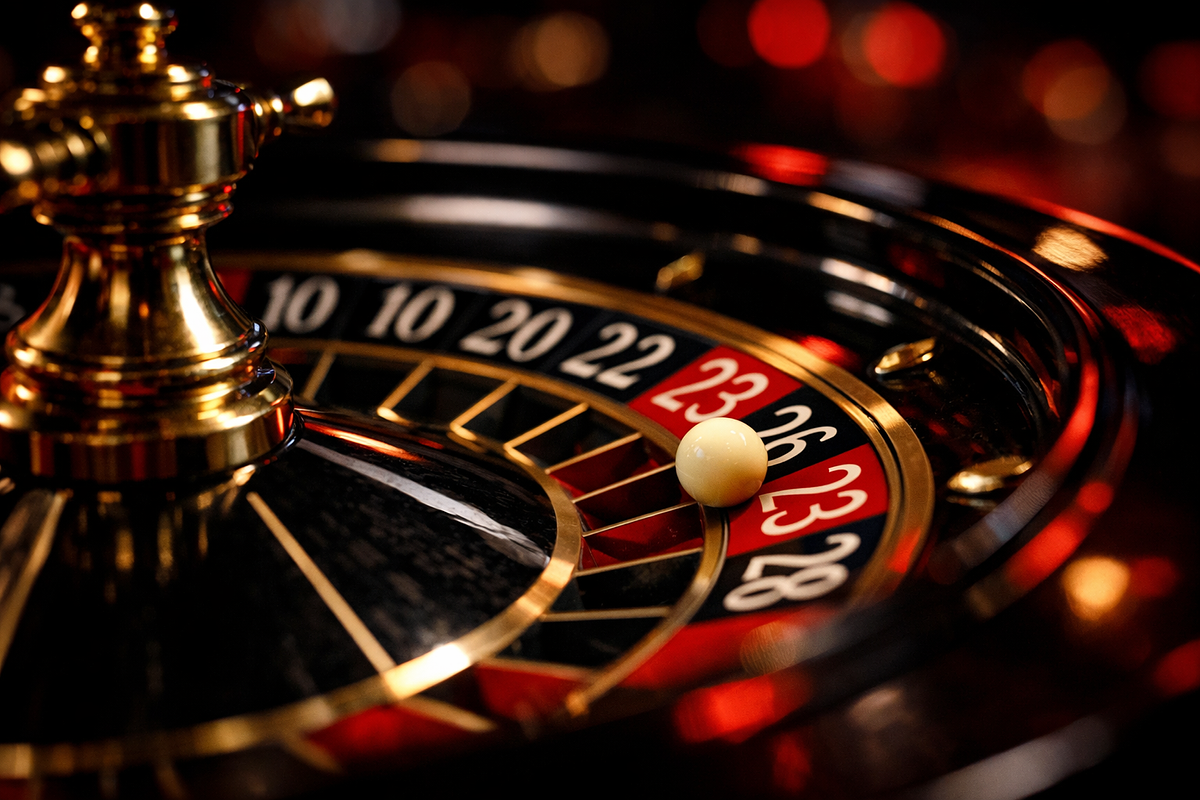
Each roulette spin is a statistically independent event. The ball is released onto a spinning wheel with no mechanical connection to any prior spin, so the wheel’s physical layout, not its recent history, determines the probability of every outcome. No sequence of past results, however long or striking, changes the probability of what the next spin will produce.
The gambler’s fallacy produces recognizable, recurring patterns at the roulette table. After a run of one color, players frequently shift their bets to the opposite color, reasoning that the streak has created an imbalance the wheel must correct. Others increase their wagers on a specific number they judge to be overdue, or stop betting on a color that has appeared several times in a row, treating its repeated appearance as evidence it’s now less likely to appear again.
None of these adjustments can improve expected outcomes. Each spin’s probabilities are set by the wheel’s fixed layout, the number of red, black, and green pockets, and that layout is identical on every spin regardless of what came before it. A run of ten reds does not reduce the probability of red on the eleventh spin. The wheel carries no record of its own history. Recognizing streak-based reasoning at the table lets a player read a run of outcomes for what it is: a sequence of independent results that tells you nothing about the next spin.
The Fallacy in Slot Machine Play
In legally regulated jurisdictions, each slot machine spin is independently and randomly determined by the machine’s random number generator, with no reference to any prior spin. Spin 500 carries exactly the same probability distribution as spin 1, regardless of what happened in between. Despite this, the gambler’s fallacy consistently produces two mirror-image beliefs among players, each pointing in opposite directions but rooted in the same underlying error.
The fallacy on slot machines takes two directional forms, and both are mechanically wrong. One leads a player to believe a machine is overdue for a payout after a long cold streak. The other leads a player to believe a machine can’t pay again soon after delivering a large prize. Both beliefs treat the machine as though it holds a running memory of its own history, when in fact each spin is resolved independently of every spin before it. Recognizing these two forms as expressions of the same error lets a player correctly read any recent pattern of machine outcomes, whether a cold run or a fresh jackpot, as carrying no predictive weight for the next spin.
The two directional expressions of the fallacy break down like this:
- Cold-streak expectation: the belief that a machine that hasn’t paid in some time is more likely to pay on the next spin. Because each spin is independently determined, the length of a losing run does not alter the probability of the next outcome in any direction.
- Post-payout expectation: the belief that a machine that recently paid a large prize is now unlikely to pay again soon. A recent large payout changes nothing about the probability of the next spin, because the machine’s random number generator operates without reference to prior results.
The Fallacy in Sports Betting
Sports betting sits in a different position than roulette or slots because not all outcomes bettors wager on are statistically independent. Some sports markets are built on genuinely random events, where the gambler’s fallacy applies in full. Others are built on performance-based events, where prior results carry real causal weight. That distinction, between independent and dependent outcomes, determines whether streak-based reasoning is a cognitive error or a legitimate analytical input.
Some sports-wagering markets are settled on outcomes that are genuinely random, such as which team wins a pre-match coin toss. Each such event is statistically independent: its probability is fixed and unaffected by the results of any prior event of the same type. Betting that a coin toss will “correct itself” after a run of the same result is a direct expression of the gambler’s fallacy, for the same reason it fails at the roulette wheel. The outcome carries no probabilistic memory of what preceded it.
The same error applies to any sports-wagering market whose underlying outcome is chance-based rather than performance-based. Expecting a genuinely random result to reverse after a streak does not change the probability of the next outcome. The streak itself is probabilistically inert. Recognizing which sports markets are genuinely random lets a bettor identify where streak logic has no valid application, and avoid treating a run of identical outcomes as evidence that a reversal is coming.
Individual athlete performance is a dependent variable, not an independent random event. An athlete’s recent form, physical condition, head-to-head matchup history, and record at a specific venue all causally connect to the probability of a future performance outcome. Because these factors are not independent of prior results, referencing them is not the gambler’s fallacy.
The mechanical distinction is straightforward: a dependent variable is one whose probability is shifted by prior outcomes or conditions. An athlete who has won consistently on a particular surface, or who enters a match carrying a physical limitation, presents a genuinely altered probability profile compared to baseline. That causal connection is what gives performance-based analysis predictive weight. The prior results aren’t just a streak to be read as a pattern; they’re evidence of an underlying condition that carries into the next event.
This distinction gives you a practical tool for evaluating betting commentary. When an analyst cites an athlete’s injury record, recent competitive results, or venue-specific history, that’s performance analysis grounded in dependent variables. When commentary treats a run of wins or losses as self-correcting, implying the next result must reverse because the streak has gone on long enough, that’s the gambler’s fallacy applied to sports, regardless of the sport involved.
Independent Versus Dependent Events
An independent event is one whose probability is completely unaffected by prior outcomes. A dependent event is one where prior outcomes causally shift the probability of what follows. The gambler’s fallacy applies specifically to independent events: because no causal link connects one outcome to the next, treating a streak as evidence that a correction is due is a reasoning error, not a probabilistic inference.
The same surface category of game can involve either independent or dependent event structures depending on its underlying mechanic. Classifying the mechanic, not the game’s name, is the necessary first step before deciding whether streak-based reasoning has any legitimate basis. The table below applies that classification to the formats most relevant to roulette, slot machine play, and sports wagering.
| Format or Scenario | Event Type | Why |
|---|---|---|
| Roulette spins | Independent | Each spin is mechanically isolated; the wheel’s layout fixes outcome probabilities regardless of any prior result. |
| Regulated slot machine spins | Independent | Each spin is determined by a random number generator with no reference to prior spins. |
| Coin-flip-style outcomes | Independent | Each toss is physically unconnected to prior tosses; the probability is fixed per toss and carries no memory of the sequence. |
| Single-deck card games (e.g., blackjack) | Dependent | Cards already dealt are removed from the deck, which directly alters the probability of every subsequent draw. |
| Individual athlete performance in sports wagering | Dependent | Form, physical condition, matchup history, and venue record causally connect to outcome probability, so prior results carry genuine predictive weight. |
The Psychology Behind the Fallacy
The gambler’s fallacy isn’t a simple reasoning slip. It’s the output of specific cognitive mechanisms identified in the psychological literature, most notably by Amos Tversky and Daniel Kahneman. These mechanisms operate below the level of conscious deliberation, which is why the fallacy persists even among people who understand probability. Research indicates that awareness of the fallacy is generally not enough to counter it. A more effective fix is actively treating each event as independent rather than simply labeling the error.
Tversky and Kahneman identified the gambler’s fallacy as a product of the representativeness heuristic, the tendency to expect short sequences of random outcomes to mirror the statistical properties of long sequences. When a roulette wheel produces five consecutive reds, the representativeness heuristic flags that sequence as looking “wrong” relative to the expected long-run distribution of roughly equal reds and blacks, and the mind treats the imbalance as something that must soon correct itself.
The related law of small numbers describes the mistaken assumption that small samples must be representative of the larger population from which they’re drawn. In practice, short runs of any outcome are entirely normal and carry no obligation to resemble the long-run average. Together, these two mechanisms produce the same fallacious expectation: a streak is read as statistically unrepresentative, and an imminent reversal is treated as more probable than the fixed underlying odds support.
Recognizing these mechanisms reframes the fallacy as a predictable cognitive output rather than a personal lapse in reasoning. When a commentator describes a team as “due for a win” or a slot player insists a machine “has to pay soon,” both are expressing the representativeness heuristic and the law of small numbers in action, not an idiosyncratic error but a predictable product of how human cognition processes sequences.
The belief that chance is self-correcting, that a run of one outcome creates a debt that future outcomes must repay, is a misapplication of the law of large numbers. That law describes the behavior of very large samples over time: as the number of trials grows, observed frequencies converge on theoretical probabilities. It makes no prediction about short sequences, and it does not require any individual run to be offset by its opposite.
Research cited in the psychological literature, including work by Roney and Trick, finds that simply naming the gambler’s fallacy or making a person aware of it is generally not enough to reduce its influence on behavior. Emphasizing the independence of each individual event, treating every spin, toss, or draw as starting from scratch, is the more effective corrective. This is reinforced by empirical results in which a majority of participants said they would bet against a repeated outcome after a short run, even while simultaneously acknowledging that both outcomes remained equally likely. The gap between stated belief and actual betting choice shows that labeling the fallacy does not dissolve the cognitive pull behind it. What changes behavior is the active, event-by-event application of independence, not the abstract knowledge that the fallacy exists.
Keren and Lewis (1994) identified two distinct forms of the gambler’s fallacy, both attributed to misperceptions of randomness. The classic form, Type 1, is the expectation that a particular outcome is “due” after a streak. It’s the version most commonly discussed in gambling contexts and covered in detail elsewhere in this article.
The Type 2 variant, as defined by Keren and Lewis, involves a different error: a gambler underestimates how many observations are required to reliably detect a favorable or biased outcome. For example, a player trying to identify a biased roulette wheel would need a far larger sample of spins than intuition suggests before any conclusion about bias could be statistically justified. Knowing that the fallacy takes more than one form lets you recognize it in less obvious presentations, not only in the “it’s due” reasoning of Type 1, but also in the premature confidence of Type 2, where too few data points are treated as sufficient evidence of a meaningful pattern.
Where the Fallacy Appears Beyond Gambling
The gambler’s fallacy isn’t confined to casino floors or sportsbooks. Researchers have documented the same reasoning error across a range of decision-making domains that have no structural connection to gambling. Its presence in these unrelated contexts confirms that the bias is a general feature of human cognition rather than a product of gambling environments specifically. That’s exactly what classifies it as a systematic cognitive bias.
The following domains show how broadly the same streak-based reasoning error operates:
- Lottery play: players select numbers they believe are overdue or avoid recently drawn numbers, applying streak logic to draws that are statistically independent of one another.
- Financial markets: traders apply streak-based reasoning to asset price movements, expecting a reversal after a run of gains or losses in a security.
- Racetrack wagering: bettors apply the same fallacious expectation of correction to horse racing outcomes, treating prior race results as predictive of the next.
- Loan officer decisions: sequential loan approval decisions by officers show a documented pattern consistent with the gambler’s fallacy, where a run of approvals increases the likelihood of a subsequent denial.
- Judicial rulings: sequential decisions by judges show a documented bias in which a run of grants or denials shifts the probability of the next ruling in the opposite direction.
- Sports refereeing: sequential officiating calls show a documented tendency for referees to avoid repeating the same call type, consistent with fallacy-driven expectation of alternation.
Reading Any Streak Accurately Starts With One Question
The practical value of understanding the gambler’s fallacy is being able to ask, before interpreting any streak, whether the underlying event is independent or dependent. That single classification determines whether a run of outcomes carries genuine predictive weight or none at all. Where independence holds, as it does in roulette and regulated slots, no observed pattern changes what comes next, and treating one as though it does is the fallacy in operation. That’s the same independence question behind the common belief that a slot or table is ‘due’ for a win.
We check operator terms, licences and payment details against the casino's own pages and update this content when they change. Read our editorial policy, our transparency statement, or report an error. If gambling stops being fun, see our responsible gambling resources.