
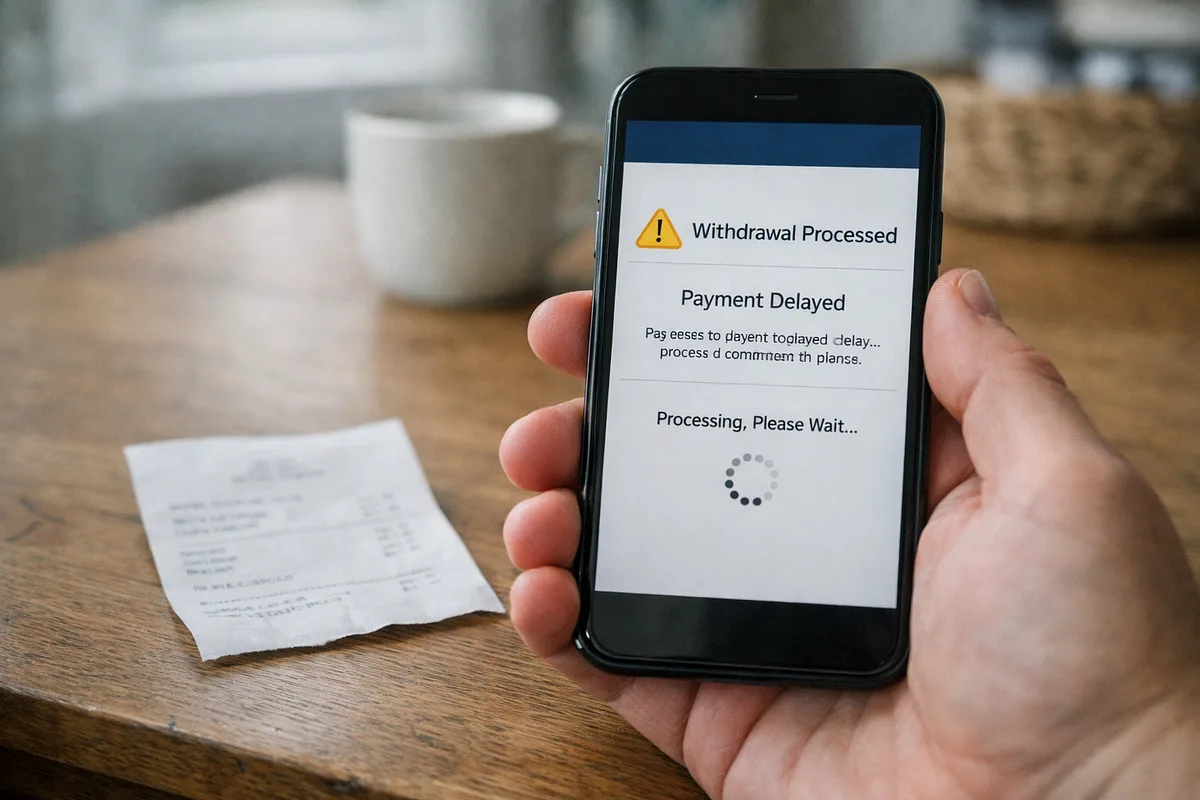
If your casino withdrawal is marked processed but hasn’t arrived, the delay is sitting in one of two places: the casino’s compliance layer or the payment network handling delivery. A processed status means the casino has finished its internal steps and released the funds. Getting those funds to your bank account, card, or wallet is a separate stage that runs on its own schedule. This page explains what each stage involves, what commonly causes a gap between the two, and how to figure out where your withdrawal currently stands.
When a casino marks a withdrawal as processed, it has finished its internal handling and handed the funds off to a payment network. Delivery to your bank, wallet, or card is a separate downstream step that runs on its own timeline. That gap between a processed status and actually receiving the money usually has a clear cause in one of those two places. Knowing which stage the delay belongs to is what tells you which check to run next.
What “Processed” Actually Means in the Withdrawal Pipeline
A withdrawal moves through two separate stages before money reaches your bank account, wallet, or card. The “processed” label only refers to the first one. Understanding where that boundary sits is the starting point for figuring out why funds haven’t arrived.
Stage one is entirely internal to the casino. It covers the approval workflow, compliance checks, and the release of funds to the relevant payment network. When the cashier shows “processed,” it means stage one is done. The casino has finished its part and handed the transaction off.
Stage two starts the moment the payment network receives that handoff. The bank, e-wallet provider, or card network then runs its own delivery process to move the funds into your account. That process runs on the payment provider’s timeline, not the casino’s. Once the handoff is made, the casino has no control over it.
When operators market withdrawals as “instant” or “fast,” they’re usually talking about stage-one speed: how quickly the casino approves and releases the request. That’s not the same as end-to-end delivery time. Delays of up to 48 hours can happen even at operators that advertise fast withdrawals, because the two stages run independently.
Once you understand the two-stage structure, a “processed” label without received funds makes more sense. It doesn’t automatically mean something went wrong, as long as you’re still within the payment provider’s normal delivery window for your chosen method.
The better question to ask isn’t “why hasn’t this arrived?” It’s “which stage is the delay in?” If stage one is confirmed complete and the payment provider’s stated window hasn’t passed yet, the delay is in stage two and outside the casino’s control. If that window has passed, both stages are worth looking at more closely. The “processed” status alone can’t answer that question for you.
Verification and Compliance Holds That Can Delay a Processed Withdrawal
A “processed” label in the cashier reflects the status of the casino’s internal workflow, not the status of every compliance check attached to your account. Identity, source-of-funds, and anti-money-laundering reviews run in a separate layer that can pause or reverse fund delivery even after that label appears. Compliance holds are the most commonly cited cause of the gap between a processed status and funds actually arriving.
Incomplete identity verification or an open source-of-funds review can hold or reverse a withdrawal even after the operator has marked it processed. Compliance workflows and cashier status labels don’t update in sync. The compliance system can flag an account for additional review at any point, and the cashier display won’t automatically reflect that. Operators can restrict or pause withdrawals, deposits, or all account activity while a source-of-funds check is still open. In one documented case, an operator allowed part of a withdrawal but withheld most of the account balance until source-of-funds checks were completed.
Under Licence Condition 17 of the UK Gambling Commission’s LCCP, an operator can’t require a customer to supply additional identity information as a condition of withdrawal if that information could reasonably have been requested earlier. Where an operator delays a withdrawal because of insufficient identity verification, it may be in breach of that condition and subject to regulatory action. Operators also can’t confiscate deposited funds on the basis that identity documents haven’t been provided.
Run through the checklist below before contacting customer support, so you can identify exactly which step is incomplete.
- Check your verification status, locate the account or profile section showing whether identity documents are marked accepted, pending, or rejected.
- Review any document requests, look for messages or notifications asking for additional identity, address, or source-of-funds documentation.
- Confirm document validity, make sure submitted documents are current, unexpired, and legible.
- Look for a compliance-hold notice, check messages or account banners indicating that activity is paused pending review.
Anti-money-laundering checks can be triggered by transaction size, deposit patterns, or account activity, and these reviews can extend past the point where a withdrawal shows as processed. Enhanced due diligence checks are mandatory in certain circumstances, including where a customer is based in a high-risk third country, so some accounts face a more intensive review process by default. Where an operator suspects or has knowledge of money laundering or terrorist financing, it must submit a Suspicious Activity Report, which carries specific regulatory expectations around moving or returning customer funds. Operators are not permitted to tell the account holder the specific details of an ongoing AML review, so an unexplained hold at this stage is a defined regulatory process, not an arbitrary delay. The compliance layer sits above the cashier interface, which is why a withdrawal can show a processed status while an AML review is simultaneously active on the same account.
How Payment Method Category Shapes Delivery After Processing
The payment method you choose at withdrawal determines what happens after the casino releases the funds. “Processed” on the casino side means the operator has finished its internal steps and handed the transaction to a payment network. The delivery window that follows varies by payment method, and the two stages run independently of each other.
The timeframes below describe the downstream delivery window that starts once the casino has released funds, not the total time from your original withdrawal request. Even at operators that advertise fast or instant withdrawals, a delay of up to 48 hours can occur after the casino marks a request as processed, because casino-side approval and payment-network execution are separate steps on different timelines.
| Payment Method Category | Typical Delivery Window After Processing | Notes on Delivery Path |
|---|---|---|
| E-wallet | Commonly same-day | Delivery handled entirely within the wallet provider’s network. A “complete” status within the wallet doesn’t always mean funds are immediately spendable, as additional processing time may apply. |
| Card and bank transfer | Several business days, typically within a week | Delivery routed through banking rails with settlement cycles. The exact duration depends on the receiving institution’s clearing process. |
| Cryptocurrency | Variable, dependent on network conditions | Delivery depends on network confirmations. Congestion on the relevant blockchain can extend the time between casino release and wallet receipt. |
A closed-loop withdrawal routes funds back to the same payment method used for the original deposit. Because the operator can confirm ownership of that method without additional checks, closed-loop withdrawals move through the delivery stage faster than withdrawals going to a different payment method.
When a withdrawal goes to a payment method not used at deposit, the operator typically pauses the transaction to verify that the new method belongs to the same account holder. That verification step adds time before the payment network even receives the funds.
This explains why two withdrawals of the same amount, submitted by the same player, can behave differently. One may arrive within hours while the other sits pending for a day or more. That’s not the operator treating the same request differently. It reflects whether the destination method matches the deposit source. If you see one withdrawal move faster than another, check whether the slower one is going to a payment method that wasn’t used to fund the account.
Account Flags and Compliance Triggers That Can Freeze a Processed Withdrawal
Certain account-level conditions can cause a withdrawal to be paused, reversed, or voided after it’s been marked processed. These triggers are separate from identity verification holds and come from different rule categories: terms-and-conditions compliance, geolocation integrity, and bonus-play conditions.
The categories below are the most commonly cited operator-side triggers for post-processing delays. Each one is something the operator can detect and act on independently of the payment network. Before assuming the delay is external, check your own account activity against each item. The cause is often on the account side rather than in transit.
- VPN or geolocation mismatch: check whether any account activity occurred through a VPN or from a location inconsistent with your registered account jurisdiction.
- Payment method mismatch: confirm the withdrawal method matches a deposit method on the account.
- Account ownership mismatch: confirm that the name on the withdrawal destination matches the registered account holder.
- Unmet bonus wagering conditions: verify that any active bonus wagering requirements have been fully met on the balance being withdrawn.
- Pending deposit awaiting approval: check whether a recent deposit is still pending, since operators may hold a withdrawal until any outstanding deposit reaches final approval.
A “processed” status is set by the cashier system when the operator completes its internal handling. Compliance systems, which monitor account activity for rule breaches, run on a separate update cycle and can apply a flag after that cashier status has already been recorded.
When a compliance flag is applied after the processed label appears, the withdrawal can still be reversed. The cashier status and the compliance review aren’t locked together, so a visible “processed” label doesn’t prevent a subsequent hold or reversal.
“Processed” is not the same as “irreversible.” The label accurately describes what the cashier system has done. It doesn’t describe what the compliance system has concluded or what the payment network has executed. If you see “processed” and then hit a delay or reversal, that’s not necessarily an error. It may be a compliance review that opened after the cashier step closed.
Escalating a Processed Withdrawal That Has Not Arrived
Once you’ve worked through the earlier diagnostic checks and the standard delivery window for your payment method has passed without funds arriving, escalation follows a clear sequence: get the transaction reference from your account history, contact the operator with that reference, and if the operator doesn’t resolve it, submit the case to an external dispute channel independent of the operator.
Your transaction history in the cashier or account settings is the main source of evidence for any support inquiry. Every withdrawal request generates a transaction reference or ID, which is the unique identifier support agents use to trace the request through the payment network and find where it stalled.
This reference is typically in the cashier section under a label like “transaction history,” “payment history,” or “account statement.” Some operators also let you export a statement in PDF or CSV format, which will include the same reference. Having this ID before you contact support is the single most effective step you can take to speed up the inquiry. Without it, an agent can’t query the payment network on your behalf.
Once the delivery window for your payment method has clearly passed, contact the operator with the transaction reference. Withdrawal delays are the most common category of consumer complaint received by the Gambling Commission, at approximately 2,000 complaints per year, which shows this escalation path is well-established and regularly used. For context, most withdrawal requests at established operators complete within a few hours to a couple of days. A delay well beyond that range warrants formal escalation. If the operator’s response is unsatisfactory or takes longer than their stated resolution timeframe, you can submit the case to an alternative dispute resolution provider that operates independently of the operator, available through the operator’s licensing jurisdiction.
Follow the steps below in order. Each one builds the evidence and formal record needed for the next.
- Retrieve the transaction reference: pull the withdrawal ID from your account transaction history.
- Contact operator support with the reference: submit an inquiry that includes the transaction ID, the amount, the withdrawal date, and the payment method.
- Request a defined response timeframe: ask the operator to confirm the expected resolution window and any documentation required.
- Escalate to alternative dispute resolution: if the operator’s response is unsatisfactory or exceeds their stated timeframe, submit the case to an independent dispute resolution channel available for the operator’s licensing jurisdiction.
Reading Your Own Withdrawal Status Accurately
Understanding the two-stage withdrawal pipeline turns an ambiguous status label into a useful starting point. A “processed” label tells you the delay is in one of two places: the operator’s compliance layer or the payment network’s delivery path. That location tells you which check to run and whether escalation makes sense. Without that distinction, the label gives you nothing to act on.