

When you request a cashout at an online casino, the money doesn’t move immediately. There’s a gap between when you submit the request and when the funds leave the casino’s system. That gap exists because the operator runs compliance checks, identity verification, and fraud screening before releasing anything to a payment network. That process is separate from how fast your chosen payment method moves money once it receives it. This article explains what happens during that gap, how hold times vary depending on how you’re getting paid, and what options you have while a withdrawal is pending.
The Two Phases of a Casino Payout
A casino payout has two stages, not one. The first is a hold on the operator’s side, where the funds stay inside the casino’s system. The second is the actual transfer, handled entirely by the payment provider or financial network once the operator releases the money. A lot of players mix these two stages up and end up contacting their bank or e-wallet about a delay the operator hasn’t resolved yet.
What a Pending Status Actually Represents
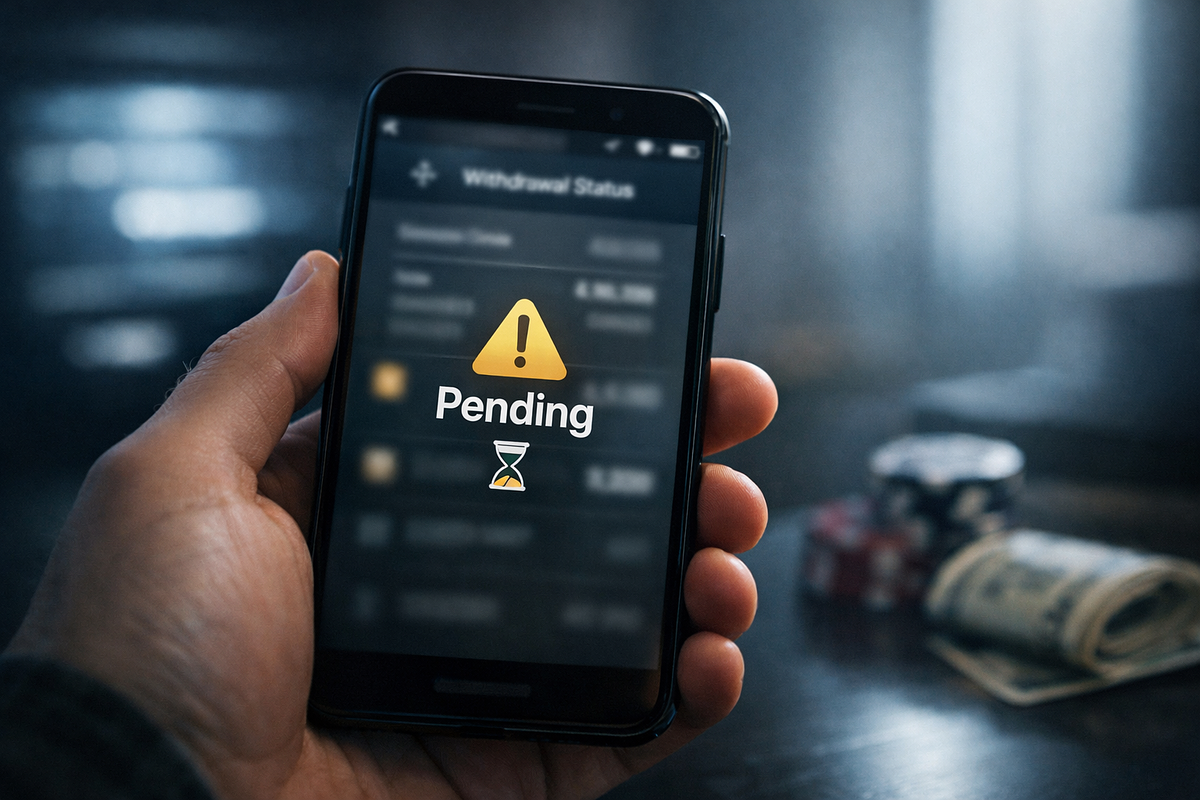
A pending withdrawal status means you’ve submitted a request and the operator has accepted it, but the money hasn’t left their system yet. The balance sits in a temporary hold rather than entering any external payment network. The operator hasn’t released the transaction to the payment provider, and all internal reviews, whether automated or manual, happen during this hold. When you check your payout status and see “pending,” that reflects your position in the operator’s queue. It’s not a delay caused by your bank, e-wallet, or a blockchain network.
Operator Approval Time Versus Payment Network Transfer Time
These two phases are controlled by different parties and run on separate timeframes. A payment method that can transfer money almost instantly doesn’t shorten the operator’s internal hold. A crypto withdrawal stuck in a long operator review won’t complete quickly, no matter how fast the blockchain settles transactions. The table below breaks down how the two phases compare across four dimensions.
| Phase | Controlling Party | Typical Purpose | Player Visibility |
|---|---|---|---|
| Operator-side hold (pending) | The casino operator | Internal compliance review, fraud screening, bonus condition checks, and identity verification before funds are released | Shown as “pending” or equivalent status on the player’s account page; cancellation of the request is generally available during this phase |
| Network transfer | The payment provider, bank, or blockchain network | Moving released funds from the operator’s payment processor to the player’s nominated account or wallet | Status typically updates to “processing,” “sent,” or equivalent; cancellation is no longer available once the payment processor confirms the transaction |
Why Operators Hold Payouts Before Processing
The pending window exists because operators are required, and in some cases choose, to complete a set of checks before releasing funds. These checks fall into three categories: compliance-driven review, fraud and risk screening, and bonus or account condition verification. Knowing which category applies to your situation helps you judge whether the delay is routine or whether it’s worth contacting the operator directly.
Compliance-Driven Manual Review
Regulated online gambling operators are treated like financial institutions, which means they have anti-money laundering obligations. Before releasing a payout, they may need to review documents, check the source of funds, and verify your identity. When a withdrawal triggers a compliance flag because account activity hits a reporting threshold or documentation is incomplete, the transaction gets moved out of the automated queue and into a manual review queue. That’s what extends the pending period beyond its normal length. A delay attributed to “verification” is a real procedural step with a legal basis behind it, not just an administrative stall.
Fraud Prevention and Unusual Activity Flags
Operators use both automated systems and human reviewers to spot account behavior that looks out of the ordinary. When something unusual is detected, the withdrawal moves into a secondary review window, which extends the pending period. The situations most likely to trigger this kind of extended review are:
- Large withdrawal amounts: a single request that’s much bigger than what the account typically processes
- First-time payout requests: accounts that have never completed a withdrawal before
- Activity inconsistent with deposit history: wagering patterns or funding sources that don’t match the account’s prior record
- Unusual account behavior: rapid or atypical sequences of deposits, wagers, or account changes just before the withdrawal request
Bonus and Account Condition Checks
Under UK Gambling Commission rules on withdrawing deposits, players must be allowed to withdraw their deposit balance at any time, including when a bonus is pending or active, subject only to general regulatory obligations. Operators also can’t ask for verification information at the point of withdrawal if they could reasonably have asked for it earlier. So a hold framed as a “bonus check” has defined limits: it applies to the bonus balance and its conditions, not to your deposit balance, and it can’t be used as a catch-all reason to withhold funds.
Typical Pending Durations by Payment Category
Once an operator releases a transaction, how long it takes to arrive follows a predictable pattern depending on the payment type. Knowing the normal range for each category gives you a useful benchmark. If your wait falls within the norm, it’s routine. If it clearly exceeds it, there’s probably a specific reason worth looking into. Keep in mind that the operator-side hold happens before any of this, and it runs independently of how fast the payment method itself moves money.
Standard Duration Ranges Across Payment Categories
Each payment type has its own transfer speed once the operator releases the funds, but that release is always preceded by the operator-side pending window. The table below shows transfer times that apply after release, with a note confirming that the operator pending window applies to all three categories before any transfer begins.
| Payment Category | Typical Transfer Time After Release | Operator Pending Window Applies |
|---|---|---|
| Cryptocurrency | Minutes to a few hours (commonly 10–60 minutes under normal network conditions) | Yes, applies before release regardless of blockchain speed |
| E-wallet | Within 24 hours | Yes, applies before release regardless of transfer speed |
| Bank transfer | 3–5 business days | Yes, applies before release regardless of transfer speed |
Extended Review Modifiers
Certain account conditions add extra review time on top of the standard operator-side hold. Large withdrawals and first-time payout requests are the two most common triggers, and the additional review typically runs 24–48 hours beyond the standard window. Across regulated markets, operators generally process withdrawal requests within a 24–72 hour baseline window, though this reflects observed practice rather than a universal rule. The New Jersey Division of Gaming Enforcement withdrawal bulletin, for example, states that funds can take up to two weeks to become available after a withdrawal request. If you can identify which modifier applies to your situation, a large amount, a first-time withdrawal, or a compliance flag, you can check whether the time elapsed still falls within that range or has gone past it.
Player-Side Mechanics During the Pending Window
While your withdrawal sits in the operator’s queue, you can still cancel it. That option disappears the moment the payment processor confirms the transaction. Knowing this helps you understand both what you can do during the pending period and why the pending status is designed the way it is.
Reverse Withdrawals and the Cancellation Window
A reverse withdrawal is when you cancel a pending payout yourself, which sends the funds back to your casino account balance. This is only possible while the transaction is still in the operator’s internal pending queue. Once the payment processor confirms the transaction has been released, the money is outside the operator’s system and can’t be cancelled. The cancellation option is a feature of the pending state, not something that exists throughout the whole payout process. If you can still see a cancellation button, your withdrawal hasn’t left the operator’s system yet.
How the Pending Window Shapes Player Experience
There are two ways people tend to frame the pending window. Informational sources describe it as a legitimate compliance and risk-management function: the operator uses the time to run identity checks, AML reviews, and fraud screening before releasing funds. Forum-based commentary, including discussion on Casinomeister, frames it differently: as a design feature that keeps funds accessible long enough to encourage players to cancel their withdrawal and keep playing, with sources such as The Walrus identifying the temptation to re-bet and cancel as a direct consequence of the pending period. Both framings can be true at the same time. The compliance function and the reversal window operate concurrently within the same pending period, and it’s worth keeping both purposes in mind when reading operator communications about processing times.
Reading a Pending Status With Confidence
Keeping the operator-side hold separate from the network transfer matters because it puts accountability in the right place. A delay during the pending window is something the operator controls, not a payment network failure. If you understand that distinction, you can check any pending withdrawal against known review triggers and the processing norms for your operator’s jurisdiction, and decide whether the time elapsed is normal or whether it’s worth reaching out to the operator directly.