

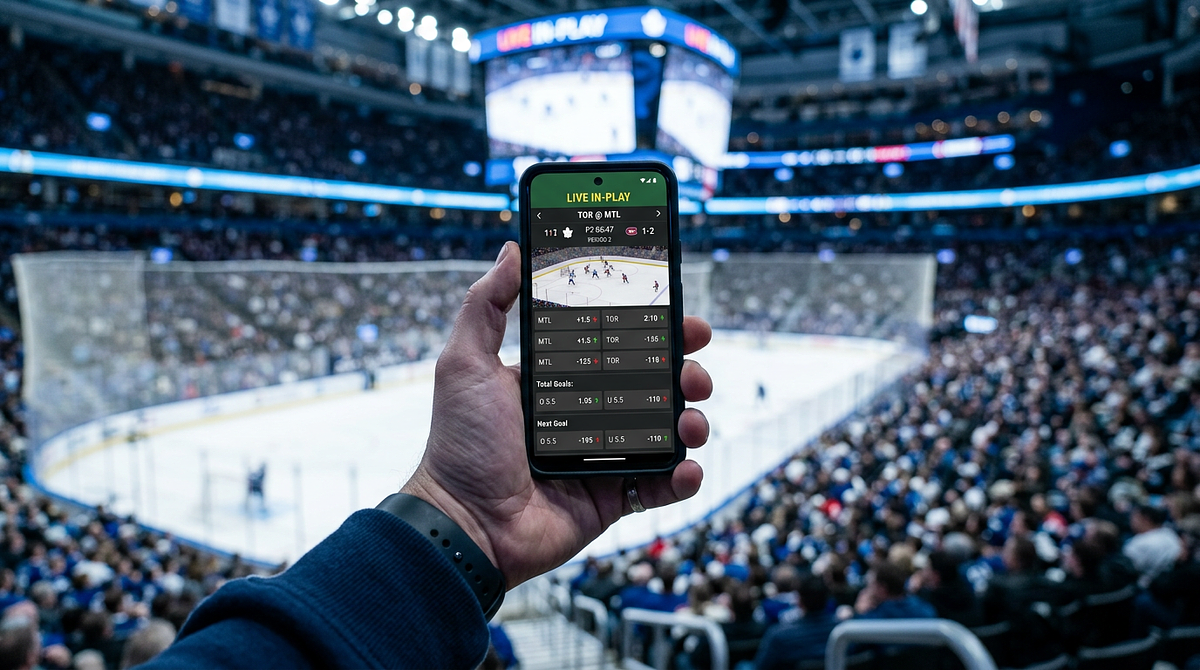
Live in-play betting in Canada lets you place wagers after an event starts, with odds shifting in real time as play unfolds. This article covers how in-play markets work, while looking at what regulated Canadian sportsbooks offer in this space. We’ll assess the risks and rewards of live betting in Canada so you can make safe and responsible decisions.
How Live In-Play Betting Works Mechanically
In live in-play betting, you place wagers after an event has started and while it’s still in progress. The sportsbook’s odds engine recalculates prices continuously, drawing on game state variables like current score, time remaining, momentum shifts, and key events to produce new odds at each moment. These prices aren’t fixed. They’re algorithmic outputs that change as the event unfolds. Knowing this separates someone who can read a sudden line movement correctly from someone who mistakes a routine recalculation for an error or an arbitrage opportunity.
How Data Feeds Drive Real-Time Odds Updates
It all starts with a data feed. A third-party data provider sends event data to the sportsbook’s pricing model in near real time: score changes, possession shifts, player events, and elapsed time. The model takes that data, recalculates implied probabilities for each available outcome, and publishes revised odds to the platform’s live interface.
This cycle repeats continuously throughout the event, so the odds you see at any given second reflect the model’s current read of the game state at that moment.
Why Markets Suspend, and Bets Get Repriced
After a significant event, such as a goal in soccer, an injury, a red card, or a key possession change in Canadian football, the pricing model needs a recalibration window. During that window, the sportsbook suspends the affected markets. You can’t place wagers on those markets until the suspension lifts and new odds are published. The suspension exists because the model needs to re-anchor its probability estimates before it can offer prices it’s willing to accept.
A “bet acceptance delay” happens when you submit a wager during or right after one of these suspension windows. The odds on your screen when you clicked may no longer be the odds the platform is willing to honour by the time your submission is processed. Depending on the platform’s settings, the bet may be rejected outright, or it may be repriced and reoffered to you for confirmation.
This is why a wager that appeared to be placed at one price sometimes gets confirmed at a different price. It’s a function of the recalibration cycle, not a platform error.
How a Live Bet Is Placed While a Game Is in Progress
Placing a live wager follows a sequence that’s different from pre-match placement in one important way: the odds displayed when you make your selection may change before the bet is confirmed.
You navigate to the live event, pick a market from those currently available, and add a selection to the bet slip. The bet slip shows the current odds and asks you to enter a stake. At this point, most Canadian sportsbooks offer a price-change acceptance setting. You can choose to accept any price change automatically, accept only changes in your favour, or reject all price changes and confirm manually.
When you submit the wager, the platform checks the current odds against those on the bet slip. If the odds have moved within your accepted tolerance, the bet is confirmed, and a receipt is issued. If the odds have moved outside that tolerance, the platform either rejects the bet or shows you revised odds for reconfirmation.
The practical result is that the confirmed price on your receipt may be different from the price you saw when you made your selection. If you understand this sequence, you can tell whether a repriced confirmation is a normal recalibration or something worth noting about how a particular operator handles live wagers.
The Role of Live Statistics and Data Feeds
Live in-play prices are only as accurate and current as the data feed supplying the pricing model. Canadian sportsbooks source these feeds from third-party providers, and those providers vary in how fast they transmit data and how much statistical detail they carry.
A feed with lower latency gets event data to the pricing model faster, producing odds that more closely reflect what’s happening in the game. A feed with greater statistical depth, carrying possession percentages, expected goals, shot maps, or drive charts, gives the pricing model more to work with when calculating probabilities.
Operators also vary in how much of this data they show through their live interface. Some display only a score and a match clock. Others show shot maps, possession trackers, and graphical match simulations.
The practical result of feed variation is that the same event, at the same moment, can show materially different odds across two sportsbooks. That’s not an anomaly. It reflects the difference in feed latency and model inputs between the two operators.
The Canadian Regulatory Context for Live Betting
Live in-play betting is legal in Canada. The federal government’s passage of Bill C-218 amended paragraph 207(4)(b) of the Criminal Code, receiving Royal Assent on June 30, 2021, and coming into force on August 27, 2021. That amendment authorised provinces and territories to conduct and manage single-event wagering, which includes in-play markets. Before this change, only parlay-style bets were permitted under provincial lottery schemes.
Ontario moved first and most extensively, launching an open iGaming market on April 4, 2022. Private operators registered with the Alcohol and Gaming Commission of Ontario (AGCO) and contracted through iGaming Ontario gained the right to offer sports betting, including in-game wagering, to Ontario residents.
The AGCO’s Registrar’s Standards for Internet Gaming explicitly cover in-game bet types within their scope, applying to single-event, in-game, pool, parlay, and exchange bets. The Ontario open market expanded to more than 40 operators across 70 gaming websites.
Outside Ontario, the federal framework hands regulatory authority to each province and territory individually. No province has replicated Ontario‘s open private-operator model in identical form, so platform availability varies across the country. “Canadian sportsbook” doesn’t describe a single nationally licensed category. It describes operators whose access and licensing status vary by province.
Live Betting Market Types Available During Canadian Sporting Events
Live betting markets fall into two categories: markets that exist both before and during a game, and markets that can only be offered once play has begun. Moneyline, point spread, and over/under totals belong to the first category. They carry over from pre-match but run under recalibrated prices.
Next-event markets, drive-outcome markets, and race-to-points markets belong exclusively to the second. An operator advertising a high total market count may be padding that figure with duplicated pre-match formats rather than genuinely live-only products. Telling the two categories apart is the right way to evaluate an operator’s live depth.
Standard Markets Adapted to Live Play
Moneyline, point spread, and over/under totals stay available throughout a game, but their prices are recalibrated continuously against the current score and time remaining. A moneyline on a team trailing by two goals in the third period reflects that deficit in the odds. It’s not the same wager as the pre-match moneyline on the same team. The same goes for the point spread: a live spread already incorporates the current scoreline, so a spread of -3.5 during play doesn’t mean the same thing as a pre-match -3.5 on the same side.
Over/under totals shift the same way. A total that opened at 6.5 goals pre-match may sit at 2.5 remaining goals once three goals have been scored. Treating a live total as equivalent to its pre-match counterpart is a misreading of the market. All three standard market types are repriced against live game state, not reset to pre-match conditions. That’s the baseline you need to understand before betting live with any Canadian operator. If you want a deeper grounding in how these formats work, this guide to reading sports betting odds in Canada covers moneyline, point spread, and totals in full detail.
Markets That Exist Only During Live Play
In-play-only markets are bets tied to the next unfolding event whose outcome is unknown at the moment of wagering. Because these markets have no pre-match equivalent, they’re the real differentiator between operators with genuine live depth and those that simply extend their pre-match menu into a live interface. The list below covers the categories of in-play-only markets you should expect to find on Canadian sportsbooks with strong live offerings.
- Next scorer / next goalscorer: Wager on which player scores the next goal or point.
- Next team to score: Which team records the next scoring event.
- Race to points: Which team reaches a specified point threshold first.
- Team to win the current period, quarter, or half: Segment-specific outcome.
- Next scoring method: The mechanism of the next score (e.g., touchdown, field goal, penalty kick).
- Next touchdown scorer (Canadian football): Player-specific in-play prop tied to the next score.
- Result of the current drive (Canadian football): Outcome of the possession in progress.
What Micro-Betting Is and How It Works
Micro-betting is a separate product category within live wagering. These are bets whose horizon is a single discrete event within a game: the outcome of the next pitch in baseball, the result of the next play from scrimmage, or the outcome of the next possession in basketball. These markets open, accept wagers, and settle within seconds or a few minutes, then immediately reopen for the following event. The cycle repeats continuously throughout the game.
Mechanically, micro-betting requires a data feed with low enough latency to price each event before it resolves and settle the market before the next one opens. Not all operators in Canada have the infrastructure to support this at scale. Some Canadian sportsbooks have entered agreements with data providers specifically to deliver low-latency feeds for major leagues, which is exactly the kind of infrastructure micro-betting depends on.
Why Micro-Betting Inflates Market Count Figures
This matters when you’re evaluating operators. When a Canadian sportsbook markets “unlimited live markets” or a very high total market count, micro-betting’s rapid open/settle cycles can generate a large number of individually counted markets from a single game. An operator running micro-betting on one sport can report hundreds of settled markets from a single match.
That figure doesn’t tell you anything about the breadth of sport coverage or the variety of market types. It reflects settlement frequency. Separating micro-betting volume from genuine market-type variety is necessary for an accurate assessment of live offerings across Canadian operators.
Sports and Leagues With the Deepest Live Market Coverage in Canada
Live market depth varies considerably across sports on Canadian sportsbooks. Operators concentrate their most extensive in-play coverage on leagues that draw the largest domestic audiences, while international coverage follows the global popularity of specific competitions.
An operator advertising thousands of live events may still offer shallow in-play menus for the specific sport you follow. Evaluating an operator on aggregate market counts gives you a less accurate picture than examining depth within the leagues that matter to you.
Domestic League Coverage
Professional hockey and Canadian football receive the deepest live market treatment on Canadian sportsbooks, while smaller domestic leagues see inconsistent in-play coverage. The table below breaks down what you can expect across different tiers of Canadian league coverage.
|
League Category |
Live Market Depth |
Typical In-Play Markets |
Coverage Consistency |
|---|---|---|---|
|
NHL (Professional Hockey) |
Deepest available |
Next goalscorer, next team to score, period-level markets, expanded prop menus beyond standard moneyline and totals |
Consistent across all Canadian operators; reflects position as primary domestic viewership driver |
|
CFL (Canadian Football) |
Deep, Canadian-specific |
Next touchdown scorer, result of current drive, next scoring method—drive-level markets that don’t exist pre-match |
Full coverage across the preseason, regular season, and playoffs on most operators |
|
Smaller Canadian Leagues |
Shallow to non-existent |
Often limited to moneyline during play, rarely extending to live props or drive-level markets |
Inconsistent; operators claiming “Canadian coverage” should be evaluated on whether live props are actually available |
Major International League Coverage
Top-tier North American basketball, baseball, and American football leagues get deep live coverage across most regulated Canadian operators. Some sportsbooks operating in Canada have entered specific agreements with data providers to deliver low-latency feeds for major leagues, which directly affects the accuracy and speed of live odds for those competitions.
International soccer, covering major European leagues and continental competitions, is another area of concentrated live depth. Operators built on global sportsbook infrastructure typically offer more detailed soccer and basketball live markets, including possession-based and shot-level propositions, than operators whose primary focus is the Canadian domestic market. A sportsbook with strong Canadian positioning may weigh NHL and CFL coverage more heavily while offering comparatively standard international soccer menus.
The practical takeaway is this: if your primary interest is Premier League soccer or NBA basketball, you’ll find deeper live markets on operators with established global infrastructure. If you’re focused on CFL or NHL, check whether an operator’s Canadian-market positioning translates into live prop depth rather than just moneyline availability.
Key Features That Differentiate Live Betting Operators in Canada
Five dimensions determine whether a live betting operator delivers a materially different experience from pre-match wagering. These five dimensions let you evaluate any regulated Canadian operator on its own merits.
- Real-time odds refresh speed and stability: How quickly prices update and how reliably the operator accepts bets during rapid market movement.
- Live streaming coverage and stream quality: The availability and quality of integrated video streams.
- Cash-out functionality: Whether the operator offers full cash-out, partial cash-out, or both.
- In-play market depth: The proportion of markets that exist only during live play rather than duplicating pre-match lines.
- Mobile app usability: Interface responsiveness and features like push notifications for live events.
Why Live Streaming Is a Distinct Differentiator
Without an integrated live stream, you’re placing in-play wagers based on data feeds, graphical simulations, and whatever broadcast delay exists on a separate television source. That gap between the event as it unfolds and the information available to you is a structural disadvantage that no statistical overlay fully makes up for.
Stream quality is not uniform across operators. HD delivery and SD delivery represent a real difference in your ability to read game state: player positioning, pace of play, visible injuries, all in real time. Device restrictions add another layer: some operators limit streaming to desktop browsers, while others support full mobile streaming on both iOS and Android.
Funded-account requirements are a near-universal condition attached to streaming access. Most Canadian sportsbooks require a recent deposit or an active balance before the stream unlocks, so a dormant account won’t automatically give you viewing rights. Event-selection limits matter just as much: an operator may advertise live streaming while covering only a narrow subset of the events on which it accepts live wagers.
Any “live streaming available” claim should prompt you to ask which sports, which leagues, which quality tier, and under what account conditions the stream activates.
How Cash-Out Options Work and Why They Matter Live
Cash-out is a mechanism where the sportsbook offers you a settlement price before the event concludes. The operator calculates that price using current live odds, effectively treating your open bet as a position to be closed at market value at that moment. Three variants exist across Canadian operators.
Full cash-out closes the entire bet at the offered price. Partial cash-out lets you settle a defined portion of the stake while leaving the remainder active through to the event’s conclusion. Auto-cash-out sets a threshold price in advance. The operator executes the settlement automatically when the offered value reaches that level, without requiring you to act manually during play.
The important point here is that cash-out prices are always set in the sportsbook’s favour relative to the theoretical equivalent derived from current live odds. The operator builds a margin into the settlement offer the same way it builds a margin into its standard lines. That means the offered cash-out price will consistently be lower than what you’d receive by placing the inverse wager at the same moment.
Knowing this lets you evaluate a specific cash-out offer as a risk-management decision with a known cost, rather than treating it as a neutral or fair-value transaction.
Mobile Apps and In-Game Usability
Mobile is the primary access channel for live betting because in-play wagering is time-sensitive in a way that pre-match betting isn’t. If you’re responding to a goal, a penalty, or a momentum shift, you have seconds, not minutes, to navigate to the relevant market and submit a wager before odds reprice or the market suspends. Desktop navigation adds friction that mobile-optimised interfaces are specifically built to reduce.
Push notifications are a separate feature from general app quality. An operator may have a well-designed interface but deliver no proactive alerts, requiring you to monitor the app continuously. Notifications that trigger on score changes, significant odds movements, or the opening of new live markets let you engage selectively rather than keeping your eyes on the screen the whole time.
Single-tap re-bet functionality, the ability to resubmit a previous wager at current odds without rebuilding the bet slip, is a usability feature specific to live contexts, where repeated small-stake wagers on evolving markets are common. App store ratings reflect aggregate user experience across casino, pre-match, and live products and don’t isolate live-specific usability.
Evaluating a mobile app for live suitability means assessing navigation depth to live markets, notification granularity, and bet-slip responsiveness under active market conditions. None of those things is captured by store ratings.
Responsible Play Considerations Specific to Live Betting
Peer-reviewed research has associated in-play betting with elevated problem-gambling severity scores relative to non-in-play betting, with a 2020 study on in-play betting and gambling problems identifying this relationship directly. A 2023 research brief from GREO further indicates that in-play betting may be associated with greater gambling-related harms. These findings are not specific to Canada, but the structural conditions they describe, the speed of the decision loop, and the continuous availability of new markets throughout a game are built into the live betting format regardless of jurisdiction.
Is Live Betting Right for You?
Whether this format is right for you depends on how you respond to time pressure and continuous market availability. If you place wagers reactively during momentum swings without a pre-set plan, or chase losses by adding bets as a game unfolds, the format works against you.
The practical test is being able to watch a game without wagering, even when attractive prices appear on markets you’d normally bet? If not, that signals a structural mismatch with responsible play.
We check operator terms, licences and payment details against the casino's own pages and update this content when they change. Read our editorial policy, our transparency statement, or report an error. If gambling stops being fun, see our responsible gambling resources.