

Sports betting odds in Canada appear primarily in decimal format, though American notation is widely available on most regulated platforms. Both formats display the same information across moneyline, point spread, and totals markets, with only the presentation differing. This article explains how each format works, how to read the three core bet types, and how to calculate payouts. Learn to interpret any line on a licensed Canadian sportsbook and understand exactly what a winning wager returns.
The Odds Formats Displayed on Canadian Sportsbooks
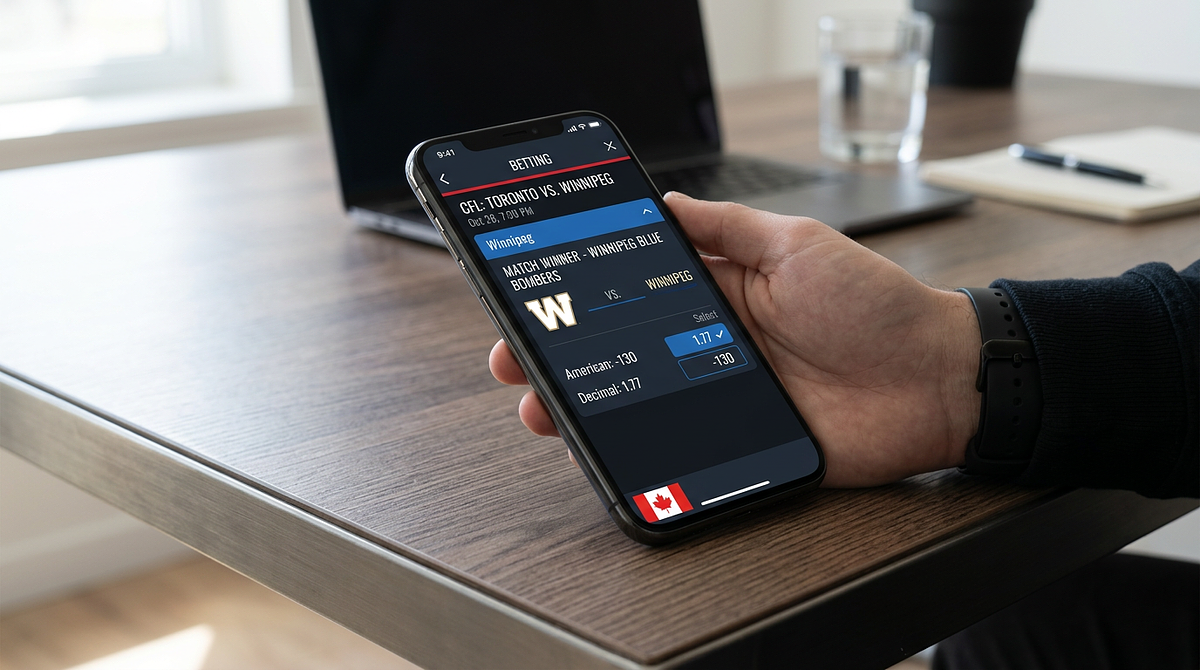
Regulated Canadian sportsbooks display odds mainly in decimal notation, which is the standard format across Canada, continental Europe, Australia, and New Zealand. Most platforms let you switch to the American format.
It’s worth knowing both, because betting content, analysis, and cross-border commentary often use American odds even when a sportsbook defaults to decimal. The format is just a display choice. The underlying wager and its return are identical no matter which notation you’re looking at.
How Decimal Odds Work
A decimal figure represents the total return per unit staked, including your original stake. The math is simple: stake × decimal odds = total return.
At odds of 2.50, a C$100 wager returns C$250 in total: C$150 in profit plus your C$100 stake back. At shorter odds of 1.50, the same C$100 wager returns C$150 total, so C$50 in profit.
Because the stake is built into the figure, decimal odds below 2.00 signal a favourite and odds above 2.00 signal an underdog. You can tell which side the market favours at a glance, without doing any conversion.
How American Odds Work
American odds are quoted relative to a C$100 reference wager. The sign tells you which side you’re looking at: negative odds mean the favourite, positive odds mean the underdog.
Negative odds show how much you need to stake to win C$100 in profit. At -150, a C$100 wager produces a profit of C$66.67, calculated as: profit = stake ÷ (odds ÷ 100), or C$100 ÷ 1.50 = C$66.67.
|
Negative Odds (Favourite) |
Positive Odds (Underdog) |
|---|---|
|
Show how much you need to stake to win C$100 in profit |
Show the profit you’d win on a C$100 stake |
|
At -150, a C$100 wager produces a profit of C$66.67 |
At +200, a C$100 wager produces a profit of C$200 |
|
Calculation: profit = stake ÷ (odds ÷ 100), or C$100 ÷ 1.50 = C$66.67 |
Calculation: profit = stake × (odds ÷ 100), or C$100 × 2.00 = C$200 |
|
A line of -200 reflects a much stronger favourite than a line of -110 |
How far the number sits from 100 tells you how confident the market is in that side |
Fractional Odds and Cross-Format Conversion
Fractional odds are common in the UK and Irish markets. They represent the profit-to-stake ratio and show up occasionally in Canadian content sourced from British outlets.
The practical reason to know them is so you can match a line you see in one format to the same line displayed in another. The table below lets you do that across all three formats and also shows the implied probability for each line.
|
American |
Decimal |
Fractional |
Implied Probability |
|---|---|---|---|
|
-200 |
1.50 |
1/2 |
66.67% |
|
-150 |
1.67 |
4/6 |
60.00% |
|
-110 |
1.91 |
10/11 |
52.38% |
|
+100 |
2.00 |
1/1 |
50.00% |
|
+150 |
2.50 |
3/2 |
40.00% |
|
+200 |
3.00 |
2/1 |
33.33% |
|
+300 |
4.00 |
3/1 |
25.00% |
Moneyline Wagers
A moneyline wager is a bet on which side wins the game outright. Margin of victory doesn’t matter. The selected side just needs to win. The price on each side reflects the sportsbook’s view of how likely each team is to win, which is why betting on the favourite pays less than betting on the underdog. The moneyline price is a probability signal built into a payout structure, not a random number.
Reading a Moneyline in Practice
Take a hockey matchup where the home side is priced at 1.67 in decimal and the visiting side at 2.30. In American notation, that same line reads home side -150, visiting side +130. The lower decimal figure and the negative American sign both point to the home side as the favourite.
|
Side |
Odds Format |
Profit on C$100 Stake |
Total Return |
|---|---|---|---|
|
Home (Favourite) |
1.67 decimal |
C$67 |
C$167 |
|
Home (Favourite) |
-150 American |
C$66.67 (C$100 ÷ 1.50) |
C$166.67 |
|
Visiting (Underdog) |
2.30 decimal |
C$130 |
C$230 |
|
Visiting (Underdog) |
+130 American |
C$130 (C$100 × 1.30) |
C$230 |
The tiny difference in the favourite’s return comes from rounding in the decimal display. The underdog calculation produces an exact match across both formats.
The odds format is just a display choice. Matching the same line across decimal and American notation confirms that the format never changes what you risk or win. That’s a useful check when you’re comparing lines across different sources or sportsbooks.
Converting Moneyline Odds Into Implied Probability
Every moneyline price encodes a probability estimate. Three formulas pull it out. For negative American odds: implied probability = |odds| ÷ (|odds| + 100). For positive American odds: implied probability = 100 ÷ (odds + 100). For decimal odds: implied probability = 1 ÷ decimal odds.
Using the examples above: -150 → 150 ÷ 250 = 60.00%; +200 → 100 ÷ 300 = 33.33%; decimal 1.91 → 1 ÷ 1.91 = 52.38%. Each result tells you the probability the sportsbook is assigning to that outcome.
In a two-way market, the implied probabilities on both sides add up to more than 100%. A line of -150 and +130 produces 60.00% and 43.48%, respectively, which is a combined 103.48%. That extra percentage above 100% is the sportsbook’s margin, commonly called the vigorish. Converting odds into implied probability lets you compare the sportsbook’s assigned probability against your own read on the game. That comparison is the starting point for any serious evaluation of betting value.
Point Spread Wagers
A point spread is a handicap the sportsbook applies to level out a mismatched game. The favourite is assigned a negative number of points that gets subtracted from its final score for settlement purposes. The underdog gets the equivalent positive number added to its final score. You need to read both pieces together: the line itself and the odds attached to it.
On most team sports, both sides of a spread market are priced near -110 in American notation, which is about 1.91 in decimal. That pricing reflects the sportsbook’s built-in margin, not any difference in probability between the two sides.
Covering the Spread
A spread of -5.5 on the favourite means that the team must win by 6 or more points for a bet on that side to win. The underdog at +5.5 covers by winning outright or by losing by 5 or fewer points. The half-point makes a tied result impossible.
A whole-number spread removes that protection. Take a favourite listed at -3: if that team wins by exactly 3 points, neither side wins the bet. The result is a push, and the stakes are returned to both bettors. The same push rule applies to any spread set at a whole number where the margin of victory lands exactly on the line.
That’s why you see so many half-point spreads like -5.5 or -7.5 in football and basketball markets. Sportsbooks use half-point lines to eliminate the push outcome entirely, so you’ll run into fractional spreads far more often than whole-number ones in major team sport markets.
Spread Equivalents in Hockey and Baseball
Low-scoring sports use a fixed-margin spread rather than one that shifts to reflect each matchup. In NHL betting, the spread equivalent is called the puck line and is set at 1.5 goals. The favourite is listed at -1.5 and must win by 2 or more goals to cover, while the underdog at +1.5 covers by losing by fewer than 2 goals. In MLB betting, the equivalent is called the run line, also fixed at 1.5 runs.
Because the handicap doesn’t move to reflect how strong the matchup is, the odds on each side carry that information instead. Those prices can move well beyond the standard -110 range. When a hockey or baseball spread is priced at, say, -220 on the favourite side, the price tells you how heavily the market favours that team, not the fixed handicap.
The Meaning of -110 Pricing
Standard -110 pricing on both sides of a spread means you risk C$110 to win C$100 in profit. That extra C$10 on each side is the sportsbook’s built-in margin, commonly called the vigorish, vig, or juice. It’s not a separate fee. It’s built right into the price.
In decimal format, -110 American corresponds to 1.91. Applying the implied probability formula (1 ÷ 1.91) gives you 52.38% per side. Two sides each at 52.38% add up to 104.76%, and those 4.76 percentage points above 100% represent the sportsbook’s expected margin across a balanced book.
The practical takeaway: if you’re betting exclusively at -110, you need to win 52.4% of your wagers just to break even. Any claim of long-term profitability at standard spread pricing has to be measured against that 52.4% threshold. It’s the minimum win rate before you see a single dollar of net profit.
Totals (Over/Under) Wagers
A totals wager, also called an over/under, is a bet on the combined final score of both teams relative to a number the sportsbook posts before the game. It doesn’t matter who wins. The posted total is the sportsbook’s forecast of combined scoring, and both the over and under sides are typically priced near -110 in American notation or 1.91 in decimal, the same as standard spread pricing.
Totals markets ask a different question than moneyline and spread markets. Instead of asking who wins, they ask about the scoring environment: pace, weather, defensive matchups.
Reading and Settling a Totals Line
Take a football game with a posted total of 54.5. A combined final score of 55 or more settles the over as a winner. A combined score of 54 or fewer settles the under as a winner. The half-point removes any ambiguity; every game produces a clear result on this market.
When the sportsbook posts a whole-number total instead, say 54, a third outcome becomes possible. If the two teams combine for exactly 54 points, the bet is a push: neither side wins, and the stakes are returned to the bettor. Sportsbooks use half-point totals specifically to take this scenario off the table in most markets.
The settlement mechanic reflects the kind of thinking a total wager requires. Evaluating a total means looking at the game’s scoring environment as a whole: pace, defensive quality, and weather conditions. You’re not asking which team is stronger. That’s why the same analyst can reasonably back one team on the moneyline while also betting the under on the total for the same game. The two markets are asking separate questions.
The Regulatory Context for Single-Game Sports Wagering in Canada
Canadian bettors used to have access only to government-run sports lottery products that required parlaying multiple selections. Before Bill C-218 changed the rules, understanding how parlay bets in Canada worked under the old legal framework was essential for anyone placing legal sports wagers.
Federal and provincial legal changes altered that, and regulated single-game online sports betting is now available in Canada. Licensing and authorisation of online sports betting operators is handled at the provincial level, so the operators available to you depend on which province you’re in. Before placing any wager, check which operators hold a licence in your specific province, because that list varies by jurisdiction.
Applying These Odds Concepts to Your Next Wager
Converting any line into its implied probability is the single most useful habit you can build, because that’s what the sportsbook is actually telling you. A moneyline of -150 means a 60% win probability; -110 spread pricing means you need 52.4% accuracy just to break even. Once you’re comfortable with the formats and settlement rules, pull up a live market on a licensed sportsbook in your province and compare the implied probability against your own assessment, as that’s where informed betting decisions start.
We check operator terms, licences and payment details against the casino's own pages and update this content when they change. Read our editorial policy, our transparency statement, or report an error. If gambling stops being fun, see our responsible gambling resources.