


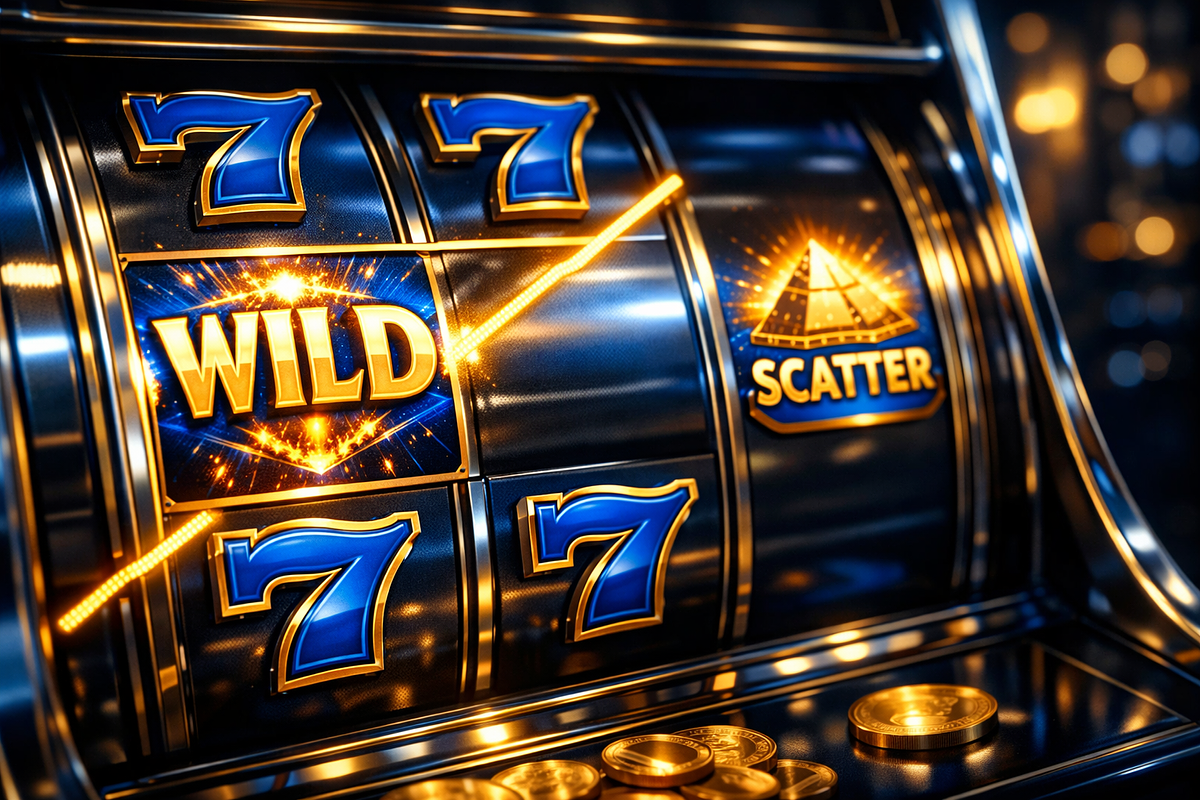
Wilds and scatters are the two most common special symbols in slot games, but they do different things. Wilds substitute for other symbols to help complete combinations on active paylines. Scatters trigger features based on how many appear anywhere on the reels, regardless of position. Those are two distinct jobs, and knowing the difference lets you read a paytable or a spin result accurately. By the end of this page, you’ll be able to tell the two apart by what they do and know what to expect when either one lands.
The Functional Divide Between Wilds and Scatters
“Wild” and “scatter” name two mechanically different jobs inside a slot’s logic, not two flavors of the same feature. Each symbol type answers a different question when the game evaluates a spin. The clearest line separating them is the payline requirement: wilds operate along active paylines, while scatters ignore payline geometry entirely. Every other difference between the two follows from that fact.
What a Wild Symbol Does on the Reels
A wild is a substitution symbol. It stands in for regular symbols to complete a winning combination on an active payline. At least one wild must be present on that payline for it to contribute to a win.
In most slots, wilds don’t carry their own standalone payout. Instead, they take on the value of the highest-paying symbol in the combination they complete. A wild landing alongside two mid-value symbols doesn’t pay at a wild-specific rate. It pays at the rate of the regular symbol it’s standing in for, based on the completed line.
Wilds can’t substitute for scatter symbols, bonus symbols, or jackpot symbols in most games. Some titles also exclude wilds from the first reel, which makes a payline made up entirely of wilds impossible in those games. The right way to think about a wild is as a completion mechanic, not a high-value symbol in its own right. Its contribution depends entirely on what it completes.
What a Scatter Symbol Does on the Reels
A scatter is a feature-trigger symbol. It activates free spins, bonus rounds, or instant payouts when the required number appear anywhere on the reels, regardless of position relative to any active payline. Position on the grid has nothing to do with whether a scatter counts.
The minimum number of scatters needed to trigger a feature is typically three, though some games activate features with two or more. NetEnt’s Wild Water, for example, awards up to 60 free spins when three, four, or five scatter symbols appear anywhere on the reels in the main game. Scatter payouts are typically added on top of any standard payline wins rather than replacing them, so a spin can produce both a line win and a scatter-triggered award at the same time. In some games, scatters also carry a multiplier that increases the value of wins when they appear.
Because scatters aren’t tied to payline geometry, a spin can produce a scatter-triggered bonus even when no payline wins register. That’s why a bonus trigger can appear on-screen even when nothing lined up on a payline: the scatter landed in the right quantity, not the right position.
The Single Distinction That Separates the Two
Even though a paytable lists both symbols, they answer different questions inside the game’s math. Wilds answer whether a payline completed. Scatters answer whether enough symbols landed anywhere on the reels to trigger a feature. Keeping that distinction in mind is enough to make sense of any slot’s rules screen, because every other mechanical difference between the two follows directly from it.
The table below maps the key dimensions across which the two symbols differ.
| Dimension | Wild Symbol | Scatter Symbol |
|---|---|---|
| Primary function | Substitution for regular symbols on active paylines | Feature trigger when required count appears anywhere on the reels |
| Payline requirement | Must land on an active payline | Any position on the reels |
| Minimum count to contribute | At least 1 | Typically 3, sometimes 2 or more |
| Standalone payout | Typically none, assumes value of highest-paying completed combination | Typically paid on top of any payline win |
| Triggers bonus features? | Not in standard mechanics | Primary trigger for free spins and bonus rounds |
| Can be substituted for by a wild? | Not applicable | No, wilds cannot replace scatters in most games |
The Common Variants of Wild Symbols
Substitution is the foundation of what a wild does, but game designers build on that foundation by changing how the wild behaves: how long it stays on the grid, how much of the reel it covers, whether it moves between spins, and whether it changes the size of a payout. These modifications produce a set of named variants that show up consistently across slot titles. The breakdown below covers those variants in two groups: ones that change where a wild sits or how long it stays, and ones that change the payout attached to the substitution.
Positional and Persistence Variants
This group of variants changes where a wild sits on the grid and how long it stays there. A single-cell wild that lands and disappears affects only the spin it appears on. A persistent or expanded wild carries consequences into nearby positions or future spins. Here’s what each variant in this group does.
- Stacked wild: Multiple wild symbols appear vertically on the same reel within a single spin, which increases the chance that the reel contributes to a winning combination on multiple paylines at once.
- Expanding wild: A wild that grows to cover an entire vertical reel. In some games the expansion stretches horizontally across a row instead.
- Sticky wild: A wild that stays locked in its position across multiple spins. This variant is commonly used during free spin features to make the bonus round feel different from base gameplay.
- Walking or shifting wild: A wild that moves one position across the reels per spin, typically disappearing once it reaches the edge of the grid.
- Random wild: A wild placed at random positions on the reels by the game engine itself, rather than arriving through the standard spin outcome.
Payout-Modifying and Hybrid Variants
This group changes the payout attached to the substitution, or combines the wild’s substitution function with the scatter’s feature-triggering function. In these variants, the wild isn’t a neutral stand-in for a missing symbol. It directly affects the size or type of win produced. Here’s what each payout-modifying and hybrid variant does.
- Multiplier wild: Substitutes for symbols and applies a multiplier (commonly 2x, 3x, 5x, or 10x) to any winning combination it contributes to. When two multiplier wilds both contribute to the same combination, their multiplier values compound.
- Wild scatter hybrid: Works as both a wild and a scatter at the same time. It substitutes for regular symbols on paylines and counts toward the threshold needed to trigger a bonus feature. The Book symbol in Book of Corsairs works this way, triggering free spins when three or more land anywhere on the reels.
How Wilds and Scatters Interact Inside the Same Game
In most slots, scatters and wilds aren’t independent features running in parallel. They’re two parts of a single design. The scatter determines whether a bonus round starts. The wild determines what that round does. The enhanced wild behavior you see in a bonus round isn’t random. It’s the designed payoff for the scatter trigger. Noticing that the wild rules change when the bonus begins is what separates a player who watches the reels from one who understands them.
Scatter-Triggered Rounds and Enhanced Wild Behaviour
When scatter symbols trigger a free spin round, the wild mechanic is commonly upgraded compared to the base game. Sticky wilds that appear only during the bonus, expanding wilds that arrive more often, and multipliers that stack across spins are the standard ways this upgrade shows up. The different feel of free spins, where wins seem to form more easily, comes from the wild doing more work, not from the reels running on different probability rules.
The scatter count at trigger determines how many free spins are awarded, and the scaling is consistent across titles. In Book of Corsairs, landing 3 scatter symbols anywhere on the reels awards 10 free spins, 4 scatters award 15, and 5 scatters award 25. NetEnt’s Wild Water follows the same logic: 3, 4, or 5 scatter symbols anywhere on the reels can award up to 60 free spins across those tiers. In both cases, the free spin count is the number of rounds during which the upgraded wild rules apply.
The bonus round isn’t a separate game with its own symbol set and independent math. It’s a defined period during which the wild substitution rules change. In Wild Water, wilds appear as single symbols in the base game but expand to cover an entire reel when they contribute to a winning combination during free spins. That shift is the point of the scatter trigger: it gives you access to the version of the game where the wild is operating at full capacity.
How These Symbols Shape RTP and Volatility
RTP and volatility are the two numbers that describe how a slot behaves over time. RTP is the percentage of wagered money returned to players over a large number of spins. Volatility describes how that return is spread across individual sessions. Wild mechanics are factored directly into the developer’s RTP calculation, so they’re not a bonus layer on top of the stated figure. They’re part of what produces it. Scatter-triggered bonus rounds, by contrast, concentrate payouts into less frequent, larger events, which pushes the game’s volatility in a different direction than wilds tend to.
The Directional Effect of Each Symbol on Slot Math
These aren’t claims about any single game. They’re about how each mechanic tends to shift a game’s math profile. Wilds smooth win frequency by creating more completed combinations across regular spins. Scatter-triggered bonuses pull value away from the base game and put it into rarer, larger events. When a game’s info screen carries a “high volatility” label, that label usually reflects the presence of a scatter-triggered bonus structure more than the wild mechanic alone. Here’s how each symbol type tends to affect the two math parameters.
- Frequent wilds and win frequency: Slots with frequently occurring wilds tend toward lower volatility, producing more regular wins of modest size.
- Scatter-triggered bonuses and payout concentration: Scatter-triggered bonus rounds are associated with higher-volatility payout structures, concentrating value into rarer, larger events.
- Wilds and RTP: Wild mechanics are factored into the developer’s overall slot math when RTP is calculated, meaning the wild is not extra value on top of the stated RTP but part of what produces it.
Reading a Slot’s Rules Screen With the Vocabulary Now in Place
Once you understand that wilds and scatters have separate structural roles, one governing payline completion and the other governing feature access, a slot’s rules screen becomes a readable document rather than a list of disconnected claims. A player who can identify which symbol type is doing which job at any point in a spin is reading the game’s design, not just reacting to what’s on the screen.
We check operator terms, licences and payment details against the casino's own pages and update this content when they change. Read our editorial policy, our transparency statement, or report an error. If gambling stops being fun, see our responsible gambling resources.