


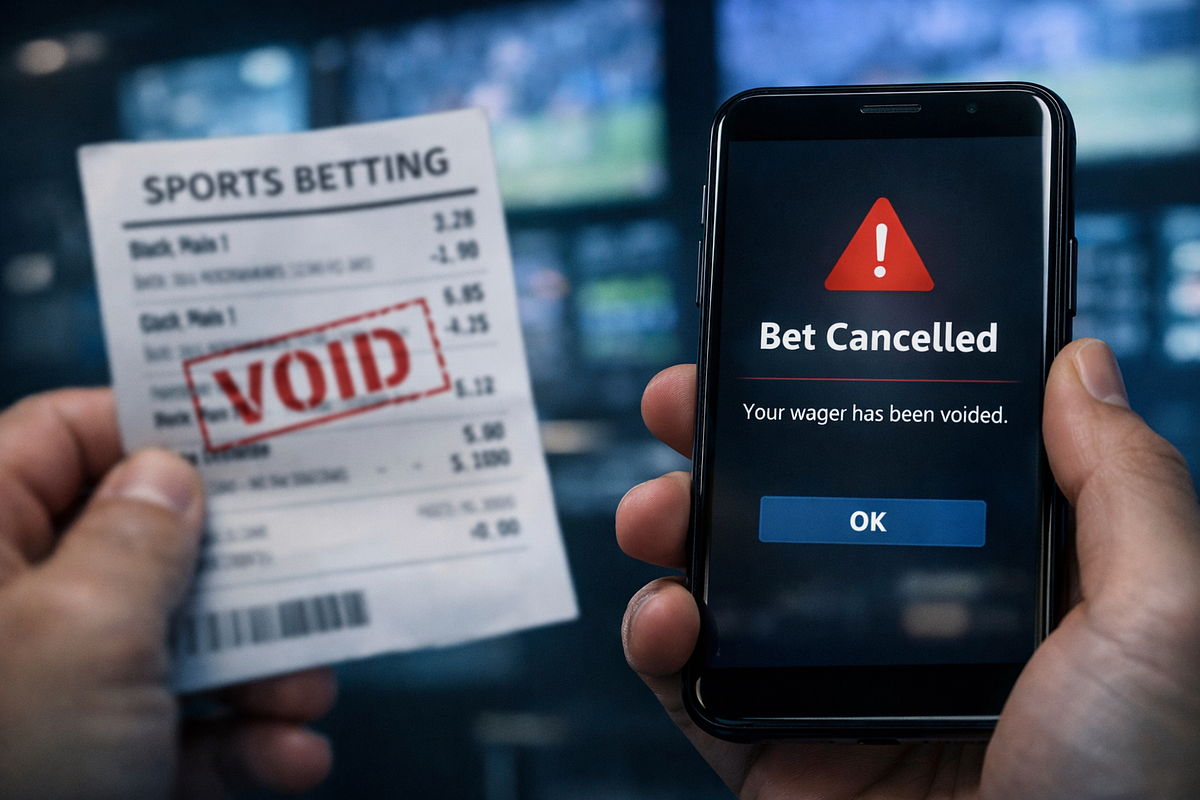
When a sportsbook voids a bet, it cancels the wager and returns your stake. This article walks through the specific conditions that cause that to happen, explains how a voided selection affects parlays and accumulators, and covers what happens to the remaining legs of a multi-bet. By the end, you’ll know what to expect if one of your bets gets cancelled and how to account for that when placing wagers.
What a Void Bet Is and How It Differs From a Loss
A void bet is a specific settlement outcome where the sportsbook cancels your wager and returns your stake in full. Mechanically, a voided bet is settled at odds of 1.00, so neither side gains or loses anything. The bet is treated as if it never happened.
That makes a void very different from a win or a loss. A losing bet removes your stake from your bankroll for good. A winning bet adds profit on top of your stake. A voided bet leaves your bankroll exactly where it was. If you record a void as a loss, your betting records will be wrong, and your performance numbers won’t reflect reality.
Event-Level Cancellation Triggers
The most common reason a bet gets voided is that the sporting event didn’t happen, didn’t finish, or was rescheduled outside the window the operator allows. Without a completed event or a resolved market condition, the sportsbook has no basis to settle the bet as a win or a loss.
Postponed, Abandoned, and Cancelled Events
Three event-level situations produce voids. First, a postponed event that isn’t rescheduled and completed within the operator’s window is voided because the outcome you bet on never happened. Second, an event abandoned mid-play before the relevant market conditions are met is voided for those affected markets, because there’s no final score, completed match, or full innings to settle against. Third, an event cancelled outright before it starts is voided in full.
The difference between “abandoned” and “cancelled” actually matters here. An abandoned event started but didn’t finish, which means markets whose conditions were already met before play stopped, like a first-scorer bet resolved in the opening minutes, may still settle normally. A cancelled event never began, so every wager on it is voided. Knowing which situation applies tells you which of your markets are affected and which, if any, will pay out.
Time Window Rules for Rescheduled Events
Operators don’t void a postponed event’s bets right away. Most apply a defined completion window, and only bets on events not completed within that window get voided. These windows exist because scheduling delays from weather, venue issues, or broadcast conflicts are common, while total non-completion is not. Operators want to keep bets active where possible.
When a match is postponed, your bet isn’t immediately void or live. You need to check the operator’s specific window rule, because it varies by book. Some use a 24-hour window, others 48 hours, and at least one documented rule extends to 72 hours from the originally scheduled completion date. The table below maps each event status to the typical operator treatment and what it means for your bet.
| Event Status | Typical Operator Treatment | Effect on Bet |
|---|---|---|
| Completed within scheduled time | Standard settlement | Wins or losses paid as normal |
| Postponed, completed within 24–48 hours | Bet generally stands | Settled on the rescheduled result |
| Postponed, completed within up to 72 hours | Varies by operator rule | Bet may stand or be voided |
| Not completed within the operator’s window | Void | Stake refunded |
| Abandoned mid-play before market conditions met | Void for affected markets | Stake refunded for those markets |
Player Participation Triggers
Many betting markets are built around a specific player, competitor, or animal actually taking part in the event. When that participant doesn’t compete, there’s no outcome to settle the wager against, so the bet is voided rather than graded as a loss.
Withdrawals, Non-Runners, and Inactive or Injured Participants
The void is triggered by the named participant being absent before the conditions needed to settle the market have been met. A player prop, like a points total or a first-scorer pick, depends entirely on that player being involved. If the player is ruled out before the game starts, the market can’t settle and your stake is returned. The same applies to a to-win market on a competitor who withdraws, or to a non-runner in a horse racing market where you bet on that specific animal.
The timing of the withdrawal is what determines how the void gets applied. A withdrawal confirmed before the market’s cutoff, typically before the event starts, produces a void as standard practice. Once the action has begun, the treatment changes. Fanatics Sportsbook specifies that if a game has already started and a player is subsequently removed, the wager stays active and is settled normally if it wins, rather than being voided.
Participation-based voids fall into three categories:
- Pre-event withdrawal: A player or competitor formally withdrawn before the event begins voids any market whose settlement depends on that participant’s involvement.
- Non-runner declaration: In racing markets, a competitor declared a non-runner before the race voids bets placed on that animal.
- Pre-market injury ruling: A participant ruled out due to injury before the relevant market conditions are met voids the affected wager, because the settlement condition (the participant competing) no longer exists.
Palpable or Obvious Pricing Errors
Palpable error voids, sometimes called obvious error voids, are a separate category from event-level or participant-level cancellations. Instead of responding to something that happened in the real world, operators use this clause when the odds displayed at the time of placement were clearly wrong compared to the wider market. The trigger is a pricing failure, not an external event, and the two categories are covered by separate provisions in operator house rules.
How Palpable Errors Are Distinguished From Normal Odds Movement
A palpable error is a price that’s out of line with the surrounding market because of a data-entry mistake or a pricing-model malfunction, not because of a genuine shift in market sentiment. Normal odds movement, including sharp, rapid movement driven by sharp money or breaking news, doesn’t qualify, even when the resulting price is unusually favorable to bettors.
Operators typically justify the void by comparing the accepted price to what the wider market was offering at the moment of placement. If the gap reflects a system failure rather than a market view, the operator treats the price as never having been valid. Ohio’s administrative code permits these voids provided the operator follows its published house rules and clearly communicates the reason for cancellation to the bettor.
The standard is clear and obvious misalignment, not just a price that favors the bettor. A generous price that results from a genuine market move, however surprising, doesn’t meet the threshold. The question is whether the price reflected any real market information at all.
Scale and Scrutiny of Obvious Error Voids
Ohio sportsbooks voided more than $77 million in wagers over the 13 months ending January 30, 2024, which was 0.91% of the $8.5 billion wagered in that window. That figure shows obvious-error voids are a recurring category with real financial scale, not a rare edge case.
Individual incidents can involve significant sums. In one documented case, DraftKings sought permission from Massachusetts regulators to cancel $4,182 in bets placed by 138 people. Those bets would have paid out $575,437 if the voids had been approved without condition. Massachusetts ultimately required DraftKings to pay bettors three times their original stake rather than the full payout.
Compliance specialists have criticized the obvious-errors clause as too broad, with one characterization describing it as a “get out of jail free” card used by too many sportsbooks. Technical problems attributed to third-party data and pricing vendors are cited as void justifications with increasing frequency. In the DraftKings case, a third-party vendor uploaded betting lines that the operator’s system misread, and a similar vendor-related error had occurred at the same operator in a prior year. The standard applied to obvious-error voids is contested and not uniformly settled across states, with some regulators requiring operator approval before voids take effect and others deferring entirely to the sportsbook’s house rules.
Late In-Play Bets Placed After a Key Event Has Occurred
This void category is separate from event cancellations, participant withdrawals, and pricing errors. It applies specifically to live betting: a wager placed during an active event in the gap between a decisive on-field development and the platform updating its price to reflect it. The event itself continues and isn’t cancelled. The void comes purely from the timing of the placement relative to when the material information changed.
Why Late In-Play Bets Are Voided
In-play markets update prices in near-real time, but there’s always a small delay between a key event occurring (a goal, a red card, a knockout, a decisive score) and the platform’s odds adjusting to reflect it. A bet placed in that window is accepted at a price that no longer matches the actual state of the event.
Caesars Sportsbook’s house rules state that a wager accepted after a market, match, or event has finished is void even if a valid receipt was issued to the bettor. Rollbit’s sports policy goes further, specifying that if a key event or significant event has already occurred in the game, bets on all affected markets are void. Both positions reflect the same principle: the outcome influencing the market had already occurred at the moment the wager was accepted, making the price a misrepresentation of the true probability.
This void category doesn’t require the bettor to have known about the underlying event at the time of placement. What matters is whether material information had already changed the true probability of the market, not whether the individual bettor knew about it. A bettor who placed a wager in good faith, with no idea a goal had just been scored, is subject to the same void treatment as one who placed the bet with full awareness of it.
Stake Treatment and Parlay or Accumulator Handling
Once a void is triggered, the operator applies a defined settlement procedure to the stake. The procedure depends on whether the wager is a single selection or part of a multi-leg structure, and within multi-leg wagers, the product type determines whether the remaining legs continue or the entire bet collapses.
What Happens to the Stake on a Single Voided Bet
On a single-selection wager, the operator settles the bet at odds of 1.00, which is why the full stake comes back rather than a partial amount. Your original stake is credited back to your account, and the wager is recorded as neither a win nor a loss. A returned stake is not a profit. If you track your results, record a voided single as a neutral event. Counting it as a winning return distorts your bankroll records and overstates your performance.
How Voided Legs Are Absorbed in Parlays and Accumulators
In a standard parlay or accumulator, a voided leg is removed from the wager rather than treated as a loss. The bet continues with the remaining selections, and the combined odds are recalculated to reflect only those legs. A five-leg parlay that loses one leg to a void becomes a four-leg parlay, and any payout is based on the recomputed odds of the four surviving selections, not the original five-leg odds.
If every leg in a parlay is voided, no recalculation is possible and the full stake is returned to the bettor.
Same-game multis and same-race multis follow a different rule. Because the legs within those products come from a single event and their odds are correlated, a void on any one leg causes the entire multi to be voided and the full stake is returned. The wager does not continue in reduced form.
The practical point for bettors is that a void within a multi-leg wager doesn’t automatically end the bet, but the product type determines the outcome. A standard parlay contracts around the void and continues, while a same-game or same-race multi collapses entirely. The table below summarizes how each wager type is handled.
| Wager Type | Effect of a Single Voided Leg | Stake Treatment |
|---|---|---|
| Single wager | Wager voided | Full stake returned |
| Standard parlay or accumulator | Voided leg removed, remaining legs continue | Payout recalculated on remaining legs |
| Standard parlay with all legs voided | Entire wager voided | Full stake returned |
| Same-game or same-race multi | Entire multi voided | Full stake returned |
We check operator terms, licences and payment details against the casino's own pages and update this content when they change. Read our editorial policy, our transparency statement, or report an error. If gambling stops being fun, see our responsible gambling resources.