


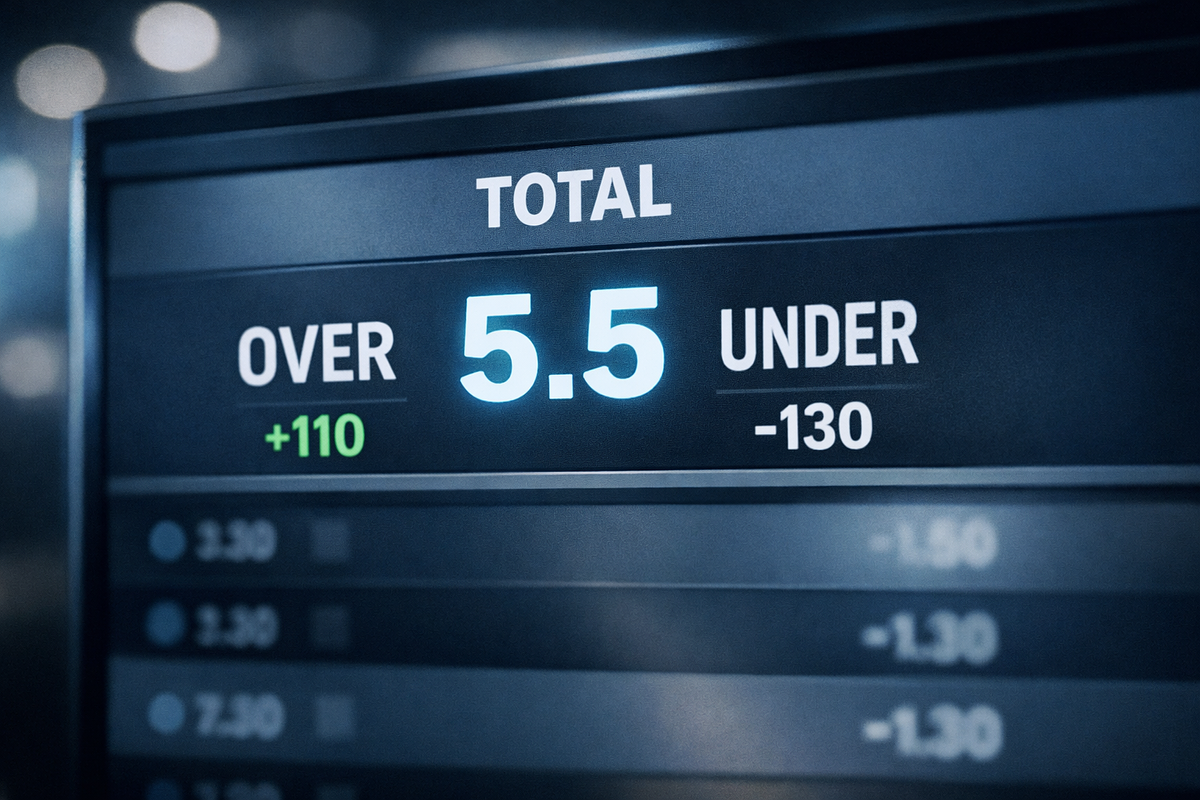
A totals bet comes down to a single number posted alongside two options: Over and Under. That number is the sportsbook’s projection of combined scoring, built from measurable inputs, and the pricing around it reflects how confident the book is in that projection. This article covers how totals lines are set and priced, how they resolve, and how sport-specific ranges and market variants shape what you see on a Canadian sportsbook. By the end, you’ll have enough context to read a totals market clearly and decide whether a given line is worth betting.
What a Totals Bet Actually Represents
A totals bet is a wager on the combined final score of both teams relative to a number posted by the sportsbook. You’re not betting on who wins. You’re betting on how much scoring the game produces, which changes how you read the market entirely. Across Canadian sportsbook interfaces and betting content, “totals” and “over/under” refer to the same market and are used interchangeably.
The sportsbook posts a single number (the total), and you pick either Over or Under. The result is determined by the combined final score of both teams, not either team’s individual score. That’s what separates totals from moneyline or spread markets: the posted number reflects expected scoring volume, not an expected winner. Because the total is about scoring rather than outcome, it can move independently of the moneyline. A key injury to an offensive player, for example, might push the total down while leaving the favourite unchanged.
Canadian sportsbooks and betting content use “totals” and “over/under” interchangeably. Both labels describe the same structure: a posted number with an Over side and an Under side. They are not two different markets. Knowing they mean the same thing lets you navigate any platform, whether provincial lottery-run or private, without getting confused when the label changes between sections or products.
How the Line Gets Set and What Goes Into It
A posted total is a constructed number. Oddsmakers build it from a defined set of measurable inputs that reflect how much scoring a specific matchup is expected to produce. A total of 5.5 in an NHL game and a total of 228 in an NBA game each say something specific about that matchup. The inputs below are what make those numbers readable.
A posted total is a projection of combined scoring built from factors that are measurable before the game begins. When those factors point toward slow play and strong defence on both sides, the number will sit low. That’s a statement about expected pace and efficiency, not an arbitrary figure. These inputs form the core of that projection:
- Pace of play, how quickly possessions or plays turn over, which directly controls how many scoring opportunities each side gets
- Offensive efficiency, how well each side converts its opportunities into points, runs, or goals
- Defensive efficiency, how well each side limits the opposing offence’s output
- Recent scoring form, how each team has performed offensively across its most recent games
- Key injuries, absences that materially shift a team’s offensive or defensive output relative to its baseline
- Weather conditions, relevant for outdoor sports, where wind, precipitation, or temperature can reduce scoring volume
The total posted the morning of a game isn’t necessarily the total available at kickoff. The line responds to new information and to the money coming in after posting. Injury news that surfaces in the hours before a game can shift the number in either direction, depending on whether the absent player affects scoring or defence. Weather updates for outdoor games work the same way. Sharp betting action (wagers placed by bettors whose patterns sportsbooks track closely) moves the line as the book adjusts to limit its exposure. Heavy public money on the Over near game time tends to push the total upward as the book responds to that imbalance. A total that has moved since it was first posted is a record of what information or money has entered the market in that window. Reading the movement tells you what the market has absorbed, not what decision to make.
Standard Odds, the Juice, and How Payouts Work
Totals at private Canadian sportsbooks are typically priced at -110 on both the Over and the Under. That symmetry is not a coincidence. It’s where the sportsbook’s margin is built. Because both sides carry the same price, a totals bet is not a coin flip that pays even money on a correct call. The gap between what a winning bet returns and what an even-money proposition would return is the book’s edge, embedded directly in the -110 figure.
American odds of -110 mean you risk $110 to win $100. Scaled to a common stake, a $50 CAD bet at -110 returns $45.45 in profit plus your original $50 stake if it wins, for a total payout of $95.45. That relationship holds at any stake size under -110 pricing: you risk more than you stand to gain. Once you know this, you can read any American-odds totals line at a glance and know the profit returned will be slightly less than the amount risked, without recalculating every time.
At -110 on both sides, the implied probability of each side is 52.38%, and the two sides together sum to 104.76%. That 4.76% excess above 100% is the sportsbook’s margin, the vig, built directly into the pricing. The two prices are not a neutral representation of a 50/50 outcome. They’re a market with a structural edge for the book on every bet placed. This isn’t specific to any one platform. It’s a standard feature of how sportsbooks price two-sided markets.
Provincial lottery-run betting products, such as OLG’s PROLINE+ in Ontario and BCLC’s PROLINE app in British Columbia, display odds in decimal format. The standard -110 American odds used at private books works out to approximately 1.91 decimal. Decimal odds represent the total payout per $1 wagered, including both profit and the original stake returned, so 1.91 on a $50 bet means a total return of $95.50. Private sportsbooks operating in Canada default to American odds rather than decimal. Provincial lottery products also price totals at fixed odds rather than the standard -110 convention typical at private books, so the same underlying market can carry a different displayed number depending on which platform you’re on. Knowing which format applies stops you from reading 1.91 and -110 as two different offers when both express the same approximate price.
Typical Total Ranges by Major Sport
Each major sport has a characteristic scoring band determined by its rules, pace, and scoring unit. A posted total only makes sense when you read it against that sport’s normal range. A number that looks low in one sport may sit at the high end of the scale in another. Knowing where a given line falls within the typical band for that sport is what tells you whether oddsmakers are projecting an unusually high-scoring or low-scoring contest.
Before reading any specific line, knowing the normal scoring band for that sport gives the posted number its context. A total sitting above the typical range means oddsmakers are projecting elevated scoring for that matchup. One below it means the opposite. The table below lists the characteristic ranges for the major sports covered at Canadian sportsbooks.
| Sport | Typical Total Range | Scoring Unit |
|---|---|---|
| NHL | 5.5 – 6.5 | Goals |
| NBA | 215 – 235 | Points |
| NFL | Low 40s – High 40s | Points |
| CFL | 48 – 53 | Points |
| MLB | 7 – 9 | Runs |
| Soccer | 2.5 | Goals |
Pushes, Half-Point Lines, and Parlay Behaviour
Whether a totals line is posted as a whole number or a decimal ending in .5 directly determines whether a push is possible. A whole-number total has three possible outcomes. A .5 total has two. That’s the most common thing people misread about totals markets.
A push happens when the combined final score lands exactly on a whole-number total. When that happens, the sportsbook returns your stake in full and grades the bet as no action. It’s neither a win nor a loss. Any whole-number total on a Canadian sportsbook offers three possible outcomes, not two, and one of those outcomes costs you nothing.
A combined score is always a whole number, so a total ending in .5 can never be landed on exactly. This removes the push as a possible outcome and forces every bet to resolve as a win or a loss. When a book posts a .5 total, it has priced the market to produce a binary result. There is no neutral outcome.
When a totals leg inside a parlay pushes, that leg is removed from the ticket and the parlay recalculates across the remaining legs. A two-leg parlay with one push becomes a single straight bet. A three-leg parlay with one push becomes a two-leg parlay, with the odds adjusted accordingly. The ticket stays live on the legs that haven’t settled yet, and the potential payout reflects the reduced number of active selections.
At most sportsbooks, overtime scoring counts toward the posted total unless the specific market rules say otherwise. The default is full-game scoring, including any extra periods, but individual books and individual markets can carry exceptions. Check the market rules on the specific game rather than assuming the total covers regulation time only.
Variants of the Totals Market Canadian Bettors Will Encounter
The standard game total isn’t the only totals-style market on Canadian sportsbooks. Related variants apply the same over/under principle to a narrower scope, one team’s output rather than both, or the remainder of a game rather than the full contest. They work the same way as a standard game total, just applied to a smaller piece of the game.
A team total covers only one team’s score rather than the combined score of both teams, so you can isolate a single offence. The mechanics are identical to a game total: the sportsbook posts a number, and you pick Over or Under. The only structural difference is scope, one side of the scoreboard instead of both. Think of it as a scoped-down version of the standard market rather than a separate product.
Live over/under betting reprices the total continuously as the game progresses, with both the line and the odds updating in real time based on the current score and pace of play. A live total reflects the scoring expected in the remaining portion of the game, not the full contest from the opening whistle. This means a live total will generally be lower than the original pregame number once scoring has already occurred. The two figures are not directly comparable, so don’t read a live total as though it represents the same thing as the pregame total.
The Canadian Regulatory Context for Totals Markets
Totals betting in Canada operates within a specific legal framework that determines which platforms can offer these markets, under what licensing conditions, and to whom. That framework is defined by federal criminal law amendments, provincial regulatory authority, and age-of-majority rules that vary by province. These three layers determine which platforms are available to you and why those platforms present odds and pricing differently.
Before August 2021, paragraph 207(4)(b) of the Criminal Code prohibited provincial lottery products from offering bets on a single sporting event, which meant standalone totals on one game were not a legal product. Bill C-218, formally titled An Act to amend the Criminal Code (single event sport betting) and also known as the Safe and Regulated Sports Betting Act, amended that paragraph to permit provinces and territories to conduct and manage single-event sports betting. Royal Assent was given on June 29, 2021, and the amendments came into force on August 27, 2021. That legislative change is the direct reason you can now place a totals wager on a single NHL or CFL game through a provincial lottery product, rather than being required to combine it with at least one other game in a parlay.
The legal betting age is 19 or older in most Canadian provinces and 18 or older in Alberta, Manitoba, and Quebec. You need to apply the threshold for the province where you’re located. There is no single national minimum that applies across all provinces.
Canadian bettors access totals markets through two categories of regulated platform: provincial lottery-run betting products and private sportsbooks operating within provincial regulatory frameworks. These two categories use different odds formats and pricing structures, which is why the same totals market can look and price differently depending on which platform you open.
| Platform Category | Operating Region | Odds Format Convention | Totals Pricing Structure |
|---|---|---|---|
| Provincial lottery-run products (PROLINE+/OLG, Sport Select/WCLC, PlayNow/BCLC, Mise-o-jeu/Loto-Québec) | Ontario, Western Canada, British Columbia, Quebec | Decimal odds | Fixed odds set by the lottery operator |
| Private sportsbooks (registered within provincial frameworks, including AGCO/iGaming Ontario in Ontario) | Canada-wide, with Ontario having the most defined private-operator licensing structure | American odds | Standard -110 on both Over and Under |
Reading a Totals Line on a Canadian Sportsbook With the Full Picture
A posted total is a structured argument about expected scoring, not an arbitrary number to bet against instinctively. When you can identify what the line measures, what the pricing embeds, and whether the fractional format removes the possibility of a push, the market becomes readable rather than opaque. That’s the difference between understanding what a line is actually saying and just guessing at it.
We check operator terms, licences and payment details against the casino's own pages and update this content when they change. Read our editorial policy, our transparency statement, or report an error. If gambling stops being fun, see our responsible gambling resources.