

Every table game posts two numbers: the minimum bet and the maximum bet. The minimum determines how many hands a fixed bankroll can survive, while the maximum controls how aggressively you can scale your bets during a recovery or winning run. This page explains how those two figures interact with bankroll size, session length, and the probability of losing your stake before the session ends. By the end, you’ll have a clearer basis for choosing tables that match your bankroll and your tolerance for risk.
The Mechanics of Table Limits and Why They Govern Session Outcomes
The minimum and maximum at any table set the floor and ceiling within which your bankroll has to survive each session. This section covers how those two numbers translate into session length, betting-system viability, and risk exposure before getting into specific probabilities or numeric benchmarks.
The minimum bet is the smallest wager a table accepts per round. The maximum is the largest. Together, they tell you which players the table is built for and at what stake level the casino expects to make money from that spot on the floor.
In brick-and-mortar casinos, minimums commonly run from $5 to $25, though what you actually find depends on the property, the day of the week, and the time of day. Resorts AC, for example, posts $10 minimums on weekdays and moves to $15–$25 on weekends based on demand. Online tables work differently, with some accepting bets as low as $1 per round. Maximums scale with property size: smaller locals casinos may cap bets at a few hundred dollars, while major casino properties offer tables with maximums reaching $10,000, and dedicated high-limit rooms go higher still.
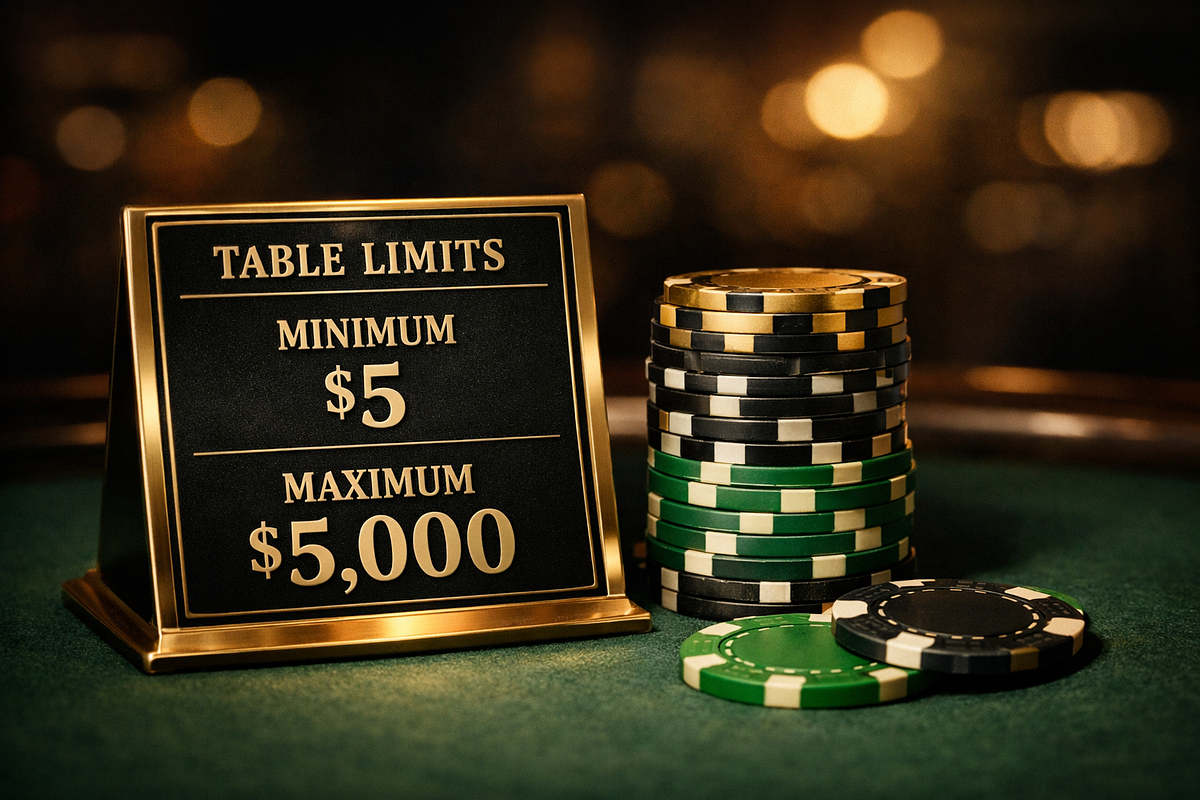
When you read a posted table sign this way, the two numbers tell you something specific. The minimum shows the smallest bankroll the table is designed to accommodate. The maximum shows the scale of player the property is prepared to host at that position. Together, they define the table’s intended clientele as clearly as any other posted rule.
The minimum sets the smallest amount your bankroll loses per round. Every hand played at the minimum costs that amount on a loss, making it the base rate at which your bankroll drains over a session.
The maximum sets the ceiling on how aggressively you can scale bets during a winning run or a recovery sequence. The ratio of maximum to minimum (the spread) defines how much room exists between those two poles. A table with a $5 minimum and a $500 maximum offers a spread of 100 to 1. A table with a $25 minimum and a $500 maximum offers a spread of only 20 to 1.
The same bankroll behaves very differently at two tables with different limit pairings, even when the game, the rules, and the house edge are otherwise identical. Table selection isn’t just a matter of preference. It’s a choice between structurally different constraint systems that will produce different session outcomes for the same starting funds.
How Table Minimums Determine Playable Hands and Session Length
Divide your bankroll by the table minimum and you get a rough estimate of how many rounds that bankroll can sustain. That calculation is the starting point for every risk decision you make before or during a session. The number on the placard isn’t a price tag for one hand. It’s a denominator that determines the structural length of your entire session. Every other variable, including variance, side bets, and deviations from the minimum, builds on top of this baseline.
The raw playable-rounds figure is bankroll divided by minimum bet. It represents the maximum number of hands you can lose in a row before the bankroll hits zero, and it’s the baseline before any variance is introduced. A $10 minimum and a $25 minimum aren’t marginally different stakes. They represent a real structural difference in how long a fixed bankroll can hold up. A player who treats those two figures as roughly equivalent is working from a materially incorrect picture of session survival. The table below shows how that difference plays out across two common bankroll sizes.
| Bankroll | Minimum Bet | Raw Playable Rounds |
|---|---|---|
| $200 | $10 | 20 |
| $200 | $25 | 8 |
| $100 | $10 | 10 |
| $100 | $25 | 4 |
The bankroll-divided-by-minimum calculation assumes every bet is placed at exactly the minimum and every loss is absorbed one unit at a time. That assumption breaks in practice. Doubling down, splitting pairs, and any voluntary bet increase all require extra capital beyond the base bet, which accelerates your drawdown faster than the math predicts. A run of losses at the minimum can deplete a short stack before the theoretical hand count is reached. Players who buy into higher-minimum tables with modest bankrolls frequently bust out in a compressed timeframe, reflecting the gap between the arithmetic estimate and what actually happens. The honest answer to “how many hands can I play?” is materially fewer than the division produces.
How Table Maximums Constrain Progressive Betting Systems
The table maximum isn’t a distant ceiling that only affects high rollers. For any player using a bet-scaling system, it becomes a hard mechanical barrier reached in a small number of hands. Doubling progressions burn through the available spread quickly, and the maximum cuts off the sequence at a fixed point regardless of how many losses still need to be recovered. Once the required next bet exceeds the maximum, the system can’t function as designed.
The ratio of maximum to minimum determines how many doubling steps exist before the table itself stops the progression. On a $5 minimum / $500 maximum table, the sequence runs as follows:
- Step 1: $5
- Step 2: $10
- Step 3: $20
- Step 4: $40
- Step 5: $80
- Step 6: $160
- Step 7: $320
The eighth required bet would be $640, which exceeds the $500 maximum. The spread is exhausted in seven steps. Any progressive system marketed as a reliable recovery method assumes unlimited spread. No real table provides that. The guarantee falls apart exactly when a losing streak is long enough to need it most.
When the spread runs out and a sequence fails at step seven, the player absorbs a combined loss across all seven bets. To offset that single terminal loss, a player has to complete many successful sequences, each returning only the base unit of $5, before one failure wipes out the accumulated gains. [VERIFY THIS] The research notes that this ratio is substantial: many successful sequences are required to recover from a single exhausted-spread loss on a $5/$500 table. What looks like a modest losing streak in isolation erases a long run of winning sequences. A streak that feels manageable while it’s happening carries a deferred cost that only becomes visible when the progression hits the ceiling and fails.
Risk of Ruin: The Quantitative Link Between Bankroll Size and Survival
Risk of ruin is the probability that your bankroll is fully depleted before the session ends. The research consensus treats this not as a fixed dollar threshold but as a function of how many betting units your bankroll contains. Expressing the bankroll in units rather than dollars makes the framework portable: a player betting $5 per hand and a player betting $25 per hand face identical risk profiles if both hold the same number of units. The dollar figure only becomes meaningful once the unit size is fixed, because the two numbers together define the ratio that drives survival probability.
Measuring your bankroll as a multiple of your base betting unit removes stake level from the equation. A player asking “how much should I bring?” is really asking two questions: how large is each bet, and how many of those bets can the bankroll absorb? The dollar amount answers neither question on its own. A $500 session bankroll is a deep reserve at a $5 table and a dangerously thin one at a $25 table, yet the dollar figure looks identical in both cases.
The benchmarks below, drawn from card-counting research on risk of ruin probabilities using a 1–12 bet spread, show how steeply risk of ruin falls as the unit count rises. The relationship is non-linear: doubling units from 200 to 400 halves the risk, but moving from 500 to 1,000 units reduces it by a factor of ten.
| Bankroll in Betting Units | Approximate Risk of Ruin |
|---|---|
| 200 units | ~40% |
| 400 units | ~20% |
| 500 units | ~10% |
| 1,000 units | ~1% |
Several published rules of thumb translate the unit framework into session-planning guidance, and each one embeds a different assumption about session length or variance tolerance.
One commonly cited rule targets a four-hour session and sets the minimum buy-in at 100 betting units. One operator source recommends holding 30 to 50 times the table minimum to absorb short-term variance, a more conservative floor that anchors the unit count to the posted minimum rather than to the player’s chosen bet size. One strategy source places the weekend-trip bankroll requirement at a substantially higher multiple, reflecting the longer exposure window of a multi-session visit rather than a single sitting.
These three rules aren’t interchangeable. The 100-unit session rule is calibrated to a defined time window. The 30-to-50-times-minimum rule is calibrated to variance tolerance at a specific table. The weekend-trip multiple is calibrated to cumulative session count. Applying the most aggressive rule to the longest trip, or the most conservative rule to a single short session, produces a bankroll that’s either undersized or unnecessarily large for the actual exposure.
Keeping the bet spread constant while scaling the bankroll produces a disproportionate reduction in risk of ruin. At a given card-counting spread, a $1,000 bankroll carries approximately 45% risk of ruin while generating roughly $10 per hour in expected value. A $5,000 bankroll at the identical spread produces the same $10 per hour but reduces risk of ruin to approximately 2%.
The expected value doesn’t change because it’s determined by the spread and the edge, not by the bankroll size. What changes is the probability of surviving long enough to realize that edge. Bet size and bankroll size are two halves of a single ratio. Advice framed purely around bet size, without specifying the bankroll behind it, is incomplete. Neither number means much without the other.
Why Casinos Set Maximum Limits
The maximum bet posted at a table is not a consumer-protection measure. It’s a variance-control mechanism designed to protect the casino’s own financial position. Players who interpret the ceiling as a safeguard for themselves are misreading its purpose, and that misreading leads to incorrect conclusions about how the limit actually works.
A casino’s mathematical edge only smooths into a reliable revenue stream when it’s applied across a large volume of bets. When a small number of players place very large bets, the outcome distribution for that session can’t be averaged out by volume, and a short run of wins by those players can eliminate a table’s daily revenue or, at a smaller property, consume a meaningful portion of the casino’s available cash.
That’s why the maximum bet is calibrated to what a specific property can absorb rather than set at a uniform industry figure. A small locals casino may cap bets at $100 to $500, while major high-traffic properties offer some tables with a $10,000 maximum. The ceiling scales with the property’s financial capacity to absorb a bad outcome on a single large bet, not with any standardized rule about player behavior. High-limit rooms carry higher ceilings precisely because those properties have the cash reserves and revenue volume to absorb the corresponding variance.
The player type commonly imagined to threaten a casino (the progressive-system bettor running a Martingale or similar escalation) doesn’t actually represent the real source of operator variance risk. Progressive systems are self-limiting against the maximum: the escalating sequence hits the ceiling after a small number of steps and can’t continue, which caps the operator’s exposure from that player at a predictable level.
The actual source of operator variance is the player making proportionately large flat bets and winning. That player doesn’t run into the ceiling during a winning sequence. The ceiling only constrains them from placing a bet the property can’t cover. This is why the maximum can feel loose to a small-stakes player (the ceiling is set far above anything that player would wager) while a high roller finds the same ceiling tight. The limit is calibrated against the lucky large-bet player, not against the system player.
How Rising Minimums Compress Effective Session Length
Table minimums on major casino floors have moved upward over time, while the budgets casual players bring to a session haven’t kept pace. The practical result is that a fixed dollar amount buys fewer rounds than it once did, even when the player’s nominal spending is unchanged. A posted minimum isn’t a stable entry price. It’s a variable that determines how much of a session a given bankroll can actually purchase.
Minimums at a single property aren’t fixed across the week. Resorts Atlantic City, for example, states that its minimums are generally $10 on weekdays and rise to $15–$25 on weekends depending on activity and demand. On the Las Vegas Strip, player reports indicate that tables running at $10–$15 during weekday mornings routinely move to $25 minimums by evening, with some properties reaching $25–$100 on Friday and Saturday nights.
The advertised minimum a property publishes is a floor figure that applies under the least-congested conditions. A player arriving on a Saturday evening at a property that advertises a $10 minimum may find no table available at that level. The same bankroll that covers 20 hands at the advertised rate covers only 8 hands at the peak-hour rate. That’s a fundamentally different bankroll proposition, at the same property, on the same visit.
When minimums rise faster than player budgets, the number of playable rounds shrinks even though the dollar amount brought to the table stays the same. A $200 bankroll yields 20 rounds at a $10 minimum and 8 rounds at a $25 minimum. A $100 bankroll yields 10 rounds at a $10 minimum and only 4 rounds at a $25 minimum. Those raw figures already overstate real session length, because they assume every bet is placed at the minimum and no splits, doubles, or variance-driven deviations occur. Players buying into $25 minimum tables with $300–$400 frequently deplete their stake within 15 minutes.
The difference between a $10 table and a $25 table isn’t a matter of preference or comfort level. It’s a structural change in what the bankroll is purchasing. At $25, the same dollar amount buys less than half the rounds, less time at the table, and a materially higher probability of ruin before variance has room to move in the player’s favor.
Games with lower house edges tend to carry higher minimum bets. A player can’t simultaneously get the lowest house edge and the lowest minimum, because the two variables move in opposite directions across the game menu. Baccarat, for instance, carries a low house edge but is typically found at higher minimums than the entry-level blackjack tables on the same floor.
This means the question “which game is best for my bankroll?” can’t be answered by house edge alone. A game with a lower edge but a higher minimum can accelerate ruin faster than a game with a slightly higher edge at a lower minimum, because the minimum determines how quickly the bankroll drains per round. For a small bankroll, the minimum bet level is a more immediate constraint on session survival than the house edge percentage. Research on monetary limits tools for gamblers confirms that bet sizing relative to bankroll is a primary driver of session outcomes.
Reading a Table’s Limits Before You Sit Down
A posted table sign tells you more than the entry price. The minimum and maximum together encode the bankroll assumptions the table is built around: the unit size it expects players to hold, the spread it permits for bet scaling, and the session length it’s designed to accommodate. A player who can read that pairing accurately before buying in knows the table’s actual terms, not just its entry price.
We check operator terms, licences and payment details against the casino's own pages and update this content when they change. Read our editorial policy, our transparency statement, or report an error. If gambling stops being fun, see our responsible gambling resources.