

Reading a roulette table’s rules before you bet is mostly a matter of looking at what the table already shows you. The placard, betting layout, and any posted signs tell you which variant you’re playing, what the limits are, which bets are available, and what each one pays. This page walks through each of those elements so you can check them quickly and confidently at any table you sit down at.
Reading the Table Placard Before You Sit Down
Every roulette table has a placard that shows the minimum and maximum bets for that specific table. Those are the terms that apply from the moment you place your first chip. Check those numbers before you buy in, so you don’t commit money to a table whose limits don’t match what you planned to wager. And don’t assume the limits at one table carry over to the one next to it, even if they’re side by side on the same floor.
Casinos set betting limits per table, not per room or game type, so two roulette tables standing next to each other can have different minimums. Those limits also shift depending on the day and time, as the casino adjusts to how busy the floor is. A table with a low minimum on a weekday afternoon might post a higher one on a weekend evening. That difference reflects scheduling, not any change in game quality or odds. The placard at the table you’re actually sitting at is the only reliable source for its current limits.
Here’s what a standard roulette table placard shows. Confirm each of these before placing any wager:
- Minimum bet: the smallest chip amount accepted per wager at that table.
- Maximum bet: the largest chip amount accepted per wager, often listed separately for inside and outside bets.
- Inside vs. outside minimums: whether the posted minimum applies to each individual inside wager or to the combined total of all inside wagers for a single spin, and whether each outside wager must individually meet the posted minimum.
- Time-of-day variation: whether the placard notes different limits for certain hours or days.
Identifying the Roulette Variant at the Table
Not every roulette table offers the same game. The variant at a specific table determines which bets are available and what the house edge is on every wager you place. That edge is built into the game’s structure, not into how you bet. You can identify the variant before you touch a single chip: the wheel and the betting layout together give you everything you need to figure it out.
Three variants are most common on casino floors, and you can tell them apart by looking at two things: how many zero pockets are on the wheel, and whether any special rules are noted on the layout or nearby signage. What that tells you, in practical terms, is how much the house takes from each wager on average.
| Variant | Zero configuration | Approximate house edge | Distinguishing feature |
|---|---|---|---|
| American | Single zero plus double zero | ~5.26% on most bets; ~7.89% on the five-number bet | Double-zero pocket on the wheel; five-number basket bet (0, 00, 1, 2, 3) available on the layout |
| European | Single zero only | ~2.7% | Single-zero wheel with no double-zero pocket; no five-number bet on the layout |
| French | Single zero only | ~1.35% on even-money outside bets | En prison and la partage rules in effect; usually noted on the layout or table signage |
Recognizing the Bet Types on the Betting Layout
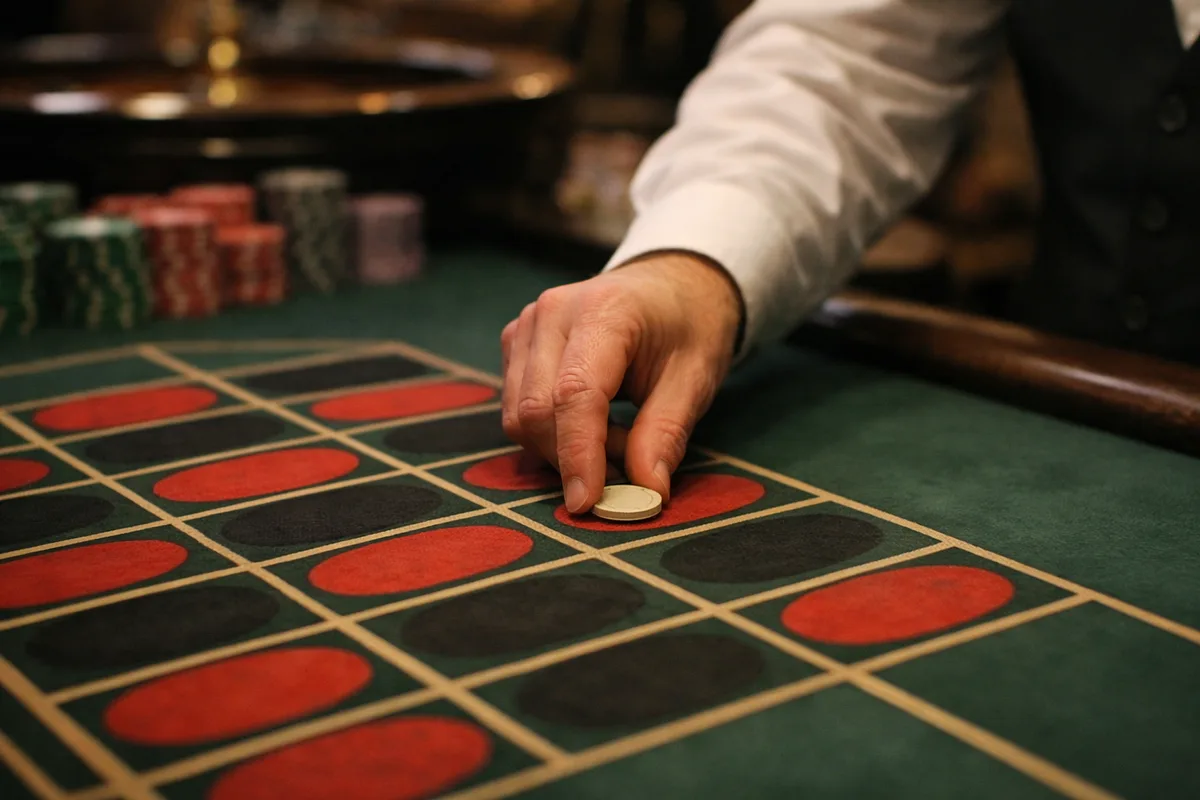
The betting layout is split into two zones: an inside area with the numbered grid, and an outside area with labeled boxes surrounding it. The bet you make is determined entirely by where your chip lands on the felt, not by anything you say to the dealer. Knowing the layout is what turns your intent into an actual wager, because the chip’s physical position is what the dealer reads when settling the spin.
Inside bets are wagers on specific numbers or small groups of adjacent numbers within the numbered grid. The exact bet is defined by where your chip sits on or between the number squares, so placement accuracy matters. A chip on the line between two numbers is a different bet than a chip on either of those numbers individually. If you misplace it, the recorded wager changes, regardless of what you intended.
Here are the inside bet types, identified by chip position on the numbered grid:
- Straight up: chip placed on a single number; covers 1 number.
- Split: chip placed on the line between two adjacent numbers; covers 2 numbers.
- Street: chip placed on the outer edge of a row of three numbers; covers 3 numbers.
- Corner: chip placed at the intersection of four numbers; covers 4 numbers.
- Double street (line): chip placed at the outer intersection of two adjacent rows; covers 6 numbers.
- Five-number bet: chip placed at the specific intersection covering 0, 00, 1, 2, and 3; available only on double-zero layouts.
Outside bets cover large categories of numbers, grouped by color, parity, range, dozen, or column. Each one has its own labeled box on the perimeter of the layout. Every outside bet excludes the zero pockets, which means if the ball lands on zero, all outside bets lose, unless a special rule like en prison or la partage is in effect at that table.
Here are the outside bet types, each identified by the labeled box the chip occupies:
- Red / Black: chip placed in the red or black box; covers 18 numbers of that color.
- Odd / Even: chip placed in the odd or even box; covers the 18 odd or 18 even numbers, excluding zero.
- High / Low: chip placed in the 1-18 or 19-36 box; covers those 18 numbers.
- Dozens: chip placed in the 1st 12, 2nd 12, or 3rd 12 box; covers 12 numbers.
- Columns: chip placed at the bottom of one of the three number columns; covers 12 numbers.
Confirming Payout Ratios for Every Bet Category
Each bet type pays at a fixed ratio based on how many numbers it covers. Those ratios are the same across American, European, and French roulette for standard bets. What changes between variants is the house edge, not the payout on a winning wager. Knowing the payout structure lets you figure out what any chip placement is actually worth before the spin. If a table advertises payouts that don’t match the standard ratios, that’s worth looking into before you put any chips down.
Payouts scale inversely with number coverage: the fewer numbers a bet covers, the higher the payout on a win, and the more numbers it covers, the lower the payout. That relationship produces every entry in the table below, and knowing it lets you quickly check whether a table’s advertised payouts are standard or have been changed.
| Bet category | Numbers covered | Payout |
|---|---|---|
| Straight up | 1 | 35 to 1 |
| Split | 2 | 17 to 1 |
| Street | 3 | 11 to 1 |
| Corner | 4 | 8 to 1 |
| Double street | 6 | 5 to 1 |
| Dozens / Columns | 12 | 2 to 1 |
| Red/Black, Odd/Even, High/Low | 18 | 1 to 1 |
Confirming Special Rules on Even-Money Outside Bets
Some roulette tables apply a rule to even-money outside bets when the ball lands on zero, either holding the wager for the next spin or returning half of it right away. Both outcomes lower the effective house edge on those bets below what a standard single-zero table carries. These rules aren’t offered at every single-zero table, so you can’t assume they’re in play. Check for a posted sign on or near the table, or just ask the dealer before you start.
Both rules only affect what happens to an even-money outside bet when zero wins. They don’t change payouts on winning spins, and they have no effect on inside bets or outside bets that pay 2 to 1. These rules are always in effect in French roulette, but may or may not be offered at European roulette tables. Table signage or a quick question to the dealer is the only way to know for sure at any specific table.
- En prison: the even-money wager is held (“imprisoned”) for the next spin when zero lands. If the next spin wins, the wager is returned without any payout.
- La partage: half the even-money wager is returned immediately when zero lands. The other half is lost.
- Effective house edge on even-money bets when either rule applies: approximately 1.35%.
- Scope of application: only even-money outside bets. Other bets are unaffected.
Procedural Rules the Table Enforces Around Your Bet
A roulette table runs on procedural rules that control when bets can be placed and how chips are handled. These rules determine whether a wager is valid and whether a winning bet gets paid to the right player. A bet placed outside the allowed window is voided. Chips on the wrong position pay the wrong amount, or nothing at all. Knowing how this works before you approach the table is what makes sure your bet counts and your payout goes to you.
Betting opens when the dealer signals that wagers are accepted and closes when the dealer calls “no more bets.” After that call, no chip can be placed, moved, or removed from the layout. It’s enforced: a chip placed or shifted after the announcement is not a valid wager and the dealer will void it. If you watch one full spin cycle before sitting down, you’ll see exactly when the window opens, how long it stays open, and when the call comes, giving you a reliable reference before your own chips are at risk.
Each player at a roulette table gets a unique color of non-value chips that are used only at that table. These chips have no cash value away from the table and can’t be redeemed at the casino cashier. You have to exchange them back for standard value chips at the same table before you leave. You’re responsible for placing your chips on the intended bet position, whether or not the dealer helps with placement. The unique-color-per-player system lets the dealer identify which winning bet belongs to which player, even on an outside box where several players have chips at once. That would be impossible if everyone used identical chips.
Approaching Any Roulette Table With a Clear Read on What It Offers
A roulette table shows you its full terms through things you can see before you place a single chip: the wheel configuration, the layout, the placard, and any posted signs. The same physical act of placing a chip produces very different expected outcomes depending on which variant, limits, payouts, and special rules govern that specific table. Reading those elements correctly means you know exactly what the game is offering before you commit any money to it.
We check operator terms, licences and payment details against the casino's own pages and update this content when they change. Read our editorial policy, our transparency statement, or report an error. If gambling stops being fun, see our responsible gambling resources.