


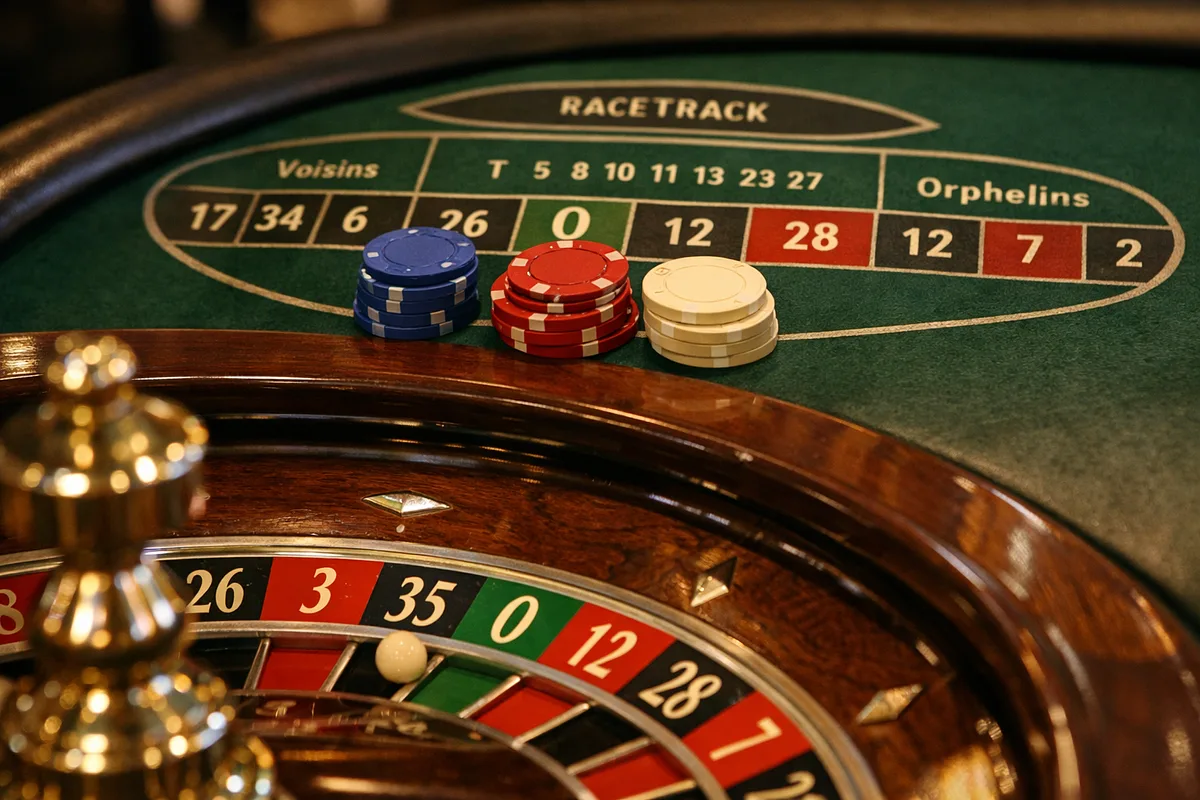
Neighbour bets are built around one simple principle: the bet follows the physical order of numbers on the wheel, not the layout of the table felt. Because each pocket in the sequence gets its own straight-up chip, the total stake goes up with every pocket you add. This page covers how many pockets a given neighbour configuration includes, how chips are spread across those pockets, and what the full stake looks like for both standard and extended setups. By the end, you’ll have what you need to pick a neighbour bet size that fits your coverage and budget.
What a Neighbour Bet Covers on the Wheel
A neighbour bet is built around a centre number you choose, plus a symmetrical band of pockets on either side of it in the physical wheel sequence. The pockets included have nothing to do with the numerical order on the table felt. They’re determined entirely by where numbers sit on the wheel relative to each other. That wheel-order basis controls everything about the bet: which pockets are covered, where chips go, and what the total stake adds up to before the spin.
Wheel-Order Adjacency Versus Table-Grid Adjacency
On a European single-zero wheel, the 37 pockets are arranged in a sequence that has no relationship to ascending numerical order. The number 1 on the table felt sits next to 2 and 4, but on the wheel it sits between 20 and 33. The racetrack-style oval betting area, found on single-zero tables and their online versions, reproduces this physical wheel sequence around its perimeter. That means you can spot and act on wheel-order adjacency without memorising the pocket arrangement. The racetrack is a map of wheel geometry, not an alternative version of the main grid. Each position on the oval corresponds to a physical pocket location, not a numerical relationship.
Standard Five-Pocket Coverage
The standard neighbour bet covers five pockets: your chosen centre number plus the two pockets immediately on either side of it in wheel order. Each of the five pockets gets its own straight-up bet, so a neighbour bet is really a bundle of five single-number wagers, not one grouped wager on a sector. Because each component is an independent straight-up bet, only the chip on the winning pocket pays out at 35 to 1. The other four chips are lost, regardless of which covered pocket wins.
- Centre number – the pocket you select as the anchor of the bet.
- First neighbour clockwise – the pocket immediately to one side of the centre number in wheel order.
- Second neighbour clockwise – the pocket two positions from the centre in the same direction.
- First neighbour anti-clockwise – the pocket immediately to the other side of the centre number in wheel order.
- Second neighbour anti-clockwise – the pocket two positions from the centre in that direction.
Extended Neighbour Variants
Many tables and online interfaces let you extend the number of neighbours included on each side, which scales the total pockets covered symmetrically around the same centre number. Extending to three neighbours on each side gives you a seven-pocket variant, with each of the seven pockets getting its own straight-up bet. The structure doesn’t change: adding more neighbours just increases how many straight-up bets are bundled together. If you’re using an interface with a “neighbours” selector (usually a numerical control next to the racetrack), you’re adjusting the bundle size, not switching to a different type of wager.
Chip Placement Procedure
Neighbour bets are placed through the racetrack betting area, the oval diagram that reproduces the wheel’s pocket sequence, rather than through the numbered grid on the main table felt. This applies in both live and online play, though the mechanics of placing the bet are different in each setting. Either way, the end result is the same: one chip of your chosen unit value sits on each covered pocket as a straight-up bet.
Placement at a Live Table
At a live single-zero table, you place a neighbour bet by announcing it to the croupier, typically with a phrase that names the centre number and the desired neighbours, such as “23 and the neighbours,” and placing the full stake within the croupier’s reach. The croupier then puts individual chips on each of the covered pockets on the racetrack layout. There’s a distinction between call bets, where you verbally commit to a bet before any chips are on the table, and announced bets, where chips are physically handed over before the spin. In both cases, the croupier is executing multiple straight-up placements, not a single grouped wager. Because each covered pocket gets exactly one unit chip, the total stake you hand over must be an exact multiple of the unit value by the number of pockets selected.
Placement in an Online Interface
Online roulette interfaces show the racetrack directly on screen as a clickable betting area. When you select a centre number on the racetrack with a chosen neighbour count, the interface automatically places the unit stake on every covered pocket as individual straight-up bets. At a £2 unit stake on a standard five-pocket neighbour bet, the interface commits £10 in total, placing £2 on each of the five pockets. The on-screen chip stack and stake display reflects five separate straight-up bets, not a single grouped wager. One click is executing multiple placements at once.
Availability on Single-Zero Versus Double-Zero Tables
The racetrack betting area is a standard feature of European and French single-zero roulette tables and is generally absent from American double-zero tables. Because neighbour bets are placed through the racetrack, they’re only available when that area is present. When you open any roulette interface, the presence or absence of the racetrack tells you straight away whether neighbour bets are an option in that game.
Total Stake Calculation
The total stake for any neighbour bet comes down to one simple calculation: the unit chip value multiplied by the number of pockets covered. Each covered pocket gets exactly one chip of the chosen unit value, no more and no less. That’s what determines your full financial commitment on any given spin.
The Unit-Times-Pockets Identity
Because each pocket in a neighbour bet gets exactly one unit chip, the total stake is always the unit chip value multiplied by the pocket count. Online interfaces can obscure this by automating the distribution across pockets in a single click, making it feel like one action rather than several simultaneous straight-up bets. The table below shows how unit value and pocket count combine into total stake across the two standard neighbour configurations.
| Neighbour Configuration | Pockets Covered | Unit Chip Value | Total Stake |
|---|---|---|---|
| Standard (2 neighbours per side) | 5 | £1 | £5 |
| Standard (2 neighbours per side) | 5 | £2 | £10 |
| Extended (3 neighbours per side) | 7 | £1 | £7 |
| Extended (3 neighbours per side) | 7 | £2 | £14 |
Table Minimums and the Stake Floor
Because each covered pocket must receive at least one unit chip, the table’s minimum chip value sets the per-pocket floor and therefore the floor for the total stake. The minimum total stake for a neighbour bet equals the table minimum multiplied by the number of pockets you’ve selected. A table’s posted minimum is a per-chip figure, not a per-bet figure. When you’re placing neighbour bets, that means your effective minimum commitment scales directly with however many pockets you’ve chosen to cover.
Odds, Payout, and House Edge
A neighbour bet is a bundle of straight-up bets, and that structure determines everything about its odds and payout. Because each component is a straight-up bet on a single-zero wheel, the probability of winning scales directly with the number of pockets covered, and the payout on the winning pocket is always 35 to 1 on one unit. The net return on the total stake is a separate figure: you subtract the losing units from the winning pocket’s return. The house edge doesn’t change no matter how many neighbours you select, because every component bet faces the same underlying odds.
Probability and Net Payout for the Standard Configuration
On a single-zero wheel with 37 pockets, a standard five-pocket neighbour bet wins with a probability of 5/37, roughly 13.51%. When a covered pocket lands, the winning straight-up bet returns 35 to 1 on that one unit, but the four remaining units placed on the other covered pockets are lost. The net return on the total five-unit stake is 35 minus 4, which equals 31 units of profit on a five-unit outlay, or roughly 6.2 to 1 on total stake. This distinction between the 35-to-1 straight-up payout and the roughly 6.2-to-1 net-on-total-stake figure matters when you’re reading any published payout claim for this bet. A source quoting “35 to 1” is describing the winning pocket in isolation, not the return relative to the full amount you put in.
Scaling to Extended Configurations
Extending the neighbour count to three on each side gives you a seven-pocket variant with a win probability of 7/37, roughly 18.92%, and a net win of 29 units on a total stake of 7 units. The higher win probability reflects the larger wheel coverage, but the total stake rises in proportion and the net payout on that stake falls relative to the five-pocket version. The two effects cancel each other out exactly, leaving expected value unchanged. Selecting more neighbours through an interface’s neighbour-count control doesn’t improve your expected outcome. You’re trading a lower-probability, higher-net-payout result for a higher-probability, lower-net-payout one at identical expected value.
House Edge Invariance
The house edge on any neighbour bet on a single-zero wheel is 2.7027%, regardless of how many neighbours you include. That’s because each component is a straight-up bet carrying the same underlying odds. No configuration, whether three, five, or seven pockets, produces a different expected return per unit staked. The table below summarises the two configurations, showing how probability and net payout shift while the house edge stays fixed.
| Configuration | Pockets Covered | Win Probability | Straight-Up Payout on Winning Pocket | Net Payout on Total Stake | House Edge |
|---|---|---|---|---|---|
| Standard (5 pockets) | 5 | 5/37 (≈13.51%) | 35 to 1 | ≈6.2 to 1 | 2.7027% |
| Extended (7 pockets) | 7 | 7/37 (≈18.92%) | 35 to 1 | 29 to 7 | 2.7027% |
Flexible Neighbour Bets Versus Fixed Section Bets
The racetrack area on a single-zero table supports two structurally different bet families. The first is the flexible neighbour bet, where you choose both the centre number and the number of neighbours to include on each side. The second is the fixed section bet, a named, standardised wager that covers a predefined wheel arc with a set chip count and a fixed mix of bet types: splits, straight-ups, trios, and corners in fixed combinations. Which family a wager belongs to determines everything about it, including how many chips are required, which pockets are covered, and what component bets those chips represent.
The Structural Distinction
A flexible neighbour bet is player-configured: you supply the centre number and the neighbour count, and the result is always a bundle of straight-up bets, one per covered pocket. A fixed section bet is fully specified before you act. The name of the bet determines the arc, the chip count, and the composition of component bets, none of which you can adjust. The racetrack area typically shows both families through separate regions, with the oval number sequence used for neighbour selection and distinct labelled zones for the named section bets. A named zone represents a fixed, predetermined structure, not something you can configure, so the chip count and component types are set in stone.
Fixed Section Bets on the Single-Zero Wheel
Each fixed section bet on a single-zero wheel is fully defined by three things: the number of pockets it covers, the number of chips it requires, and the composition of the component bets those chips represent. Placing one of these bets means identifying the named wager, not setting any parameters. The four standard French section bets are different across all three attributes, as the table below shows.
| Fixed Section Bet | Pockets Covered | Chip Count | Component Bet Composition |
|---|---|---|---|
| Voisins du Zéro | 17 | 9 | Splits, a trio, and a corner |
| Jeu Zéro | 7 | 4 | 3 splits and 1 straight-up |
| Le Tiers du Cylindre | 12 | 6 | 6 splits |
| Orphelins | 8 | 5 | Mixed straight-ups and splits across 2 non-contiguous arcs |
We check operator terms, licences and payment details against the casino's own pages and update this content when they change. Read our editorial policy, our transparency statement, or report an error. If gambling stops being fun, see our responsible gambling resources.