


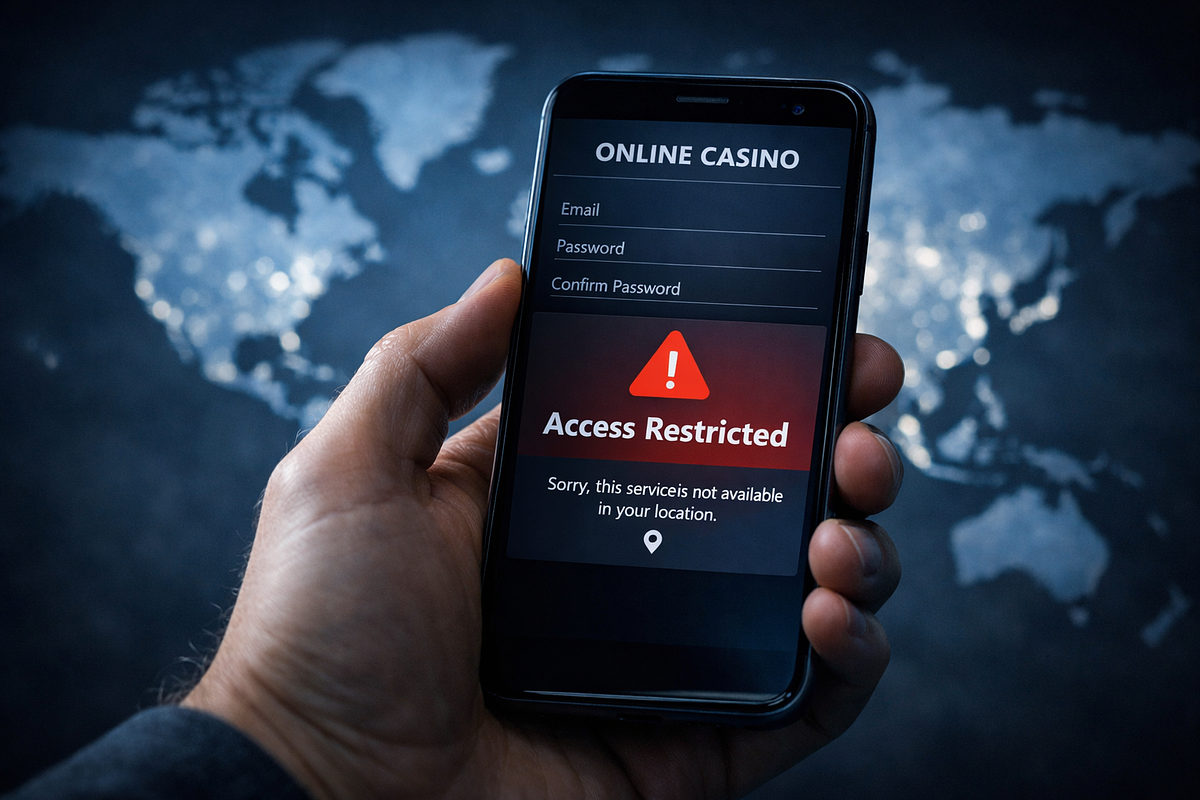
A “restricted jurisdictions” clause is a section in an online casino’s terms and conditions that lists the countries, regions, or smaller areas where the operator won’t accept players or won’t offer some or all of its services. It exists because of the licences an operator holds, the laws of each market it operates in, and the systems it uses to detect where a player is physically located. This page explains what the clause covers, why operators draw the line differently, and what a player in a restricted location can expect to happen. By the end, you’ll have enough information to know whether a given casino is available to you and what happens if it isn’t.
The Meaning of Restricted Jurisdictions in Casino Terms and Conditions
In online casino terms and conditions, “restricted jurisdictions” identifies the countries, regions, or subnational areas where an operator won’t accept players or won’t provide some or all of its services. The clause exists because operators need to translate their licensing obligations and legal exposure in each market into concrete access limits. Where a licence doesn’t cover a territory, or where local law prohibits the service, the restricted jurisdictions clause is the contractual mechanism that puts those limits into effect. It’s a legal instrument embedded in the agreement a player accepts at signup, not a discretionary policy applied after the fact.
How the Clause Is Written and Where It Appears
The clause typically appears as a dedicated section within the T&Cs, labelled with headings such as “Restricted Territories,” “Prohibited Jurisdictions,” or similar variants. It doesn’t always stay in one place: cross-references to the same restriction commonly appear inside eligibility clauses, bonus terms, and payment-method sections, so a player may encounter the restriction at multiple points in the document.
The clause takes two common forms. The first is an explicit list of named countries or regions the operator won’t serve. The second is a general reservation clause stating that the operator retains the right to restrict access wherever local law requires, without naming every affected territory. The UK Gambling Commission, for example, does not publish a list of jurisdictions that licensed operators can or cannot serve. Instead, it expects operators to conduct their own due diligence and put controls in place to meet legal requirements in other jurisdictions. Because of this, the written list in any given T&Cs document is often narrower than the operator’s actual enforcement scope.
Knowing this changes how a player should read a signup denial or a locked bonus. Neither is a technical error. Both are the direct application of a contractual boundary the player agreed to, whether or not they read the relevant clause.
Restrictions on Access Versus Restrictions on Features
Restriction isn’t always all-or-nothing. An operator may block a jurisdiction entirely, or it may allow account registration while restricting specific services for players in that location. Regional restrictions can affect games, bonus promotions, and payment methods independently of full platform access, so a player may hold a valid account and still find parts of the service unavailable based solely on their location.
The four levels a player may encounter are:
- Full platform block: the operator refuses accounts or wagers from the location entirely.
- Game-level restriction: the account is permitted but certain games are hidden or unplayable.
- Bonus-level restriction: the account and games are available but promotional offers are excluded.
- Payment-method restriction: the account is available but specific deposit or withdrawal methods are blocked.
The Licensing Framework That Determines Which Jurisdictions Are Restricted
An operator’s restricted-jurisdictions clause is a direct result of the licences it holds. A licence grants permission to offer gambling services under defined conditions, and those conditions don’t automatically extend to every country in the world. The laws of each market the operator wants to enter impose additional requirements, and where those requirements aren’t met, or where local law prohibits the service entirely, the operator must exclude that market. The restricted list is the practical output of mapping licence scope against the legal situation in every potential player location.
How Licensing Authorities Shape the Restricted List
Licensing authorities generally don’t hand operators a definitive list of permitted or forbidden markets. The UK Gambling Commission has confirmed, in response to a Freedom of Information request, that it does not publish a list of jurisdictions outside Great Britain that licensed operators can or cannot serve, and that no such recorded information is held. Instead, the Commission expects operators to conduct their own due diligence and put controls in place to meet legal requirements in other jurisdictions. The Commission also recognises that different operators may reasonably reach different conclusions about the risks of serving a given market, provided those conclusions rest on reasonable assumptions and a coherent rationale.
The practical result is that two operators holding licences from the same authority can produce different restricted lists. One operator may assess a grey-zone market as an acceptable commercial risk and choose to serve it; another may assess the same market as too legally uncertain and exclude it. The restricted list on any given site reflects that operator’s specific legal risk profile and commercial decisions, not a universal rulebook derived from the licence itself.
Common Licensing Jurisdictions and Their Reach
Operators serving international audiences typically hold licences from a small set of jurisdictions recognised in the industry. The scope of each licence, which game types it covers and which markets it permits the operator to target, directly shapes the boundaries within which the operator can legally accept players. The table below summarises the licensing jurisdictions identified in the research and the characteristics confirmed for each.
| Licensing Jurisdiction | Scope of Licence | Notable Characteristic |
|---|---|---|
| Malta (Malta Gaming Authority) | A single licence can cover multiple game types; the MGA categorises all games into four game types and an operator may hold one licence to offer one or multiple of them | The MGA retains full discretion to categorise a game into the type it believes most closely reflects the game’s nature; Type 1 covers casino games (including live casino, roulette, blackjack, baccarat, and virtual sports), poker played against the house, lotteries, and secondary lotteries |
| United Kingdom (UK Gambling Commission) | Covers provision of gambling services to players in Great Britain; operators must conduct their own due diligence for any markets outside Great Britain | The Commission does not publish a list of permitted or forbidden overseas markets; operators are individually responsible for assessing the legality of each market they serve |
| Curaçao | Widely used by operators serving international audiences across multiple markets | Commonly cited as a licensing base for operators targeting markets not covered by stricter regional licences |
| Isle of Man | Covers remote gambling services for operators targeting international player bases | Recognised in the industry as a jurisdiction offering remote gambling licences to internationally operating online casino operators |
| Gibraltar | Covers remote gambling services for operators targeting international player bases | Recognised in the industry as a jurisdiction offering remote gambling licences to internationally operating online casino operators |
The Spectrum of Jurisdiction Statuses Worldwide
Jurisdictions don’t fall into a simple legal-or-illegal binary when it comes to online gambling. The standard way to think about it is to classify them across a spectrum of regulatory models, each producing different consequences for operators and players. Three primary models account for most of the variation seen globally: the ban model, the licensing model, and the grey-zone model.
The Three Global Regulatory Models
Under the ban model, all online gambling is fully prohibited by national law. An operator that conducts proper legal due diligence will list every ban-model country as a restricted jurisdiction and refuse accounts from players located there. Countries in this category include outright prohibitions on online casino activity, sometimes extended from earlier bans on land-based gambling.
Under the licensing model, a domestic regulatory framework exists and operators must hold a local licence to serve players in that market lawfully. An offshore operator without the required local licence cannot legally accept players from a licensing-model country, even if it holds a valid licence from another authority such as Malta or Curaçao. Only operators that have obtained the specific national licence may serve those players.
Under the grey-zone model, no clear domestic framework exists or enforcement is ambiguous, and operators commonly serve players through offshore licences. Because no definitive legal prohibition applies, the operator’s own risk assessment determines whether the market appears on its restricted list. Two operators holding licences from the same authority can therefore reach different conclusions about the same grey-zone market.
A Classification Table of Jurisdiction Statuses
The standard convention for this topic sorts jurisdictions into four status categories: legal and regulated, partially regulated, unregulated or grey zone, and banned. Each category carries a distinct definition and produces a different default outcome in an operator’s restricted-jurisdictions clause. The table below assigns example jurisdictions to each category based on the regulatory characteristics identified in the research.
| Status Category | Definition | Example Jurisdictions |
|---|---|---|
| Legal and regulated | An active domestic licensing framework exists; operators hold local licences to serve local players lawfully. | United Kingdom, Malta |
| Partially regulated | Some forms of online gambling are licensed (e.g., sports betting) but online casino is prohibited or restricted to a state monopoly. | France (online casino prohibited; sports betting and poker licensed), Poland (online casino restricted to state monopoly; sports betting licensed separately), Turkey (only state-run sports betting operator IDDAA permitted online) |
| Unregulated or grey zone | Enforcement is ambiguous; operators commonly serve players through offshore licences with no definitive domestic prohibition in force. | Markets where no clear domestic framework exists and offshore-licensed operators assess risk individually |
| Banned | All online gambling (or online casino specifically) is fully illegal under national law. | Australia (online casino banned under the Interactive Gambling Act 2001; sports wagering remains available), Japan, China, Albania, Russia, Vietnam, Singapore, Syria, Yemen, Indonesia, Cuba |
Subnational Variation Within a Single Country
A country’s national-level status is often an incomplete guide for a player, because regulation can happen at the state, provincial, or regional level rather than uniformly across the country.
The United States is a clear example. The 2006 Unlawful Internet Gambling Enforcement Act did not prohibit online gambling outright; it restricted financial transactions connected to illegal gambling activities, which had the practical effect of pushing regulatory authority down to individual states. The result is a patchwork: as of 2025, only seven US states have legalised online casino gaming, Connecticut, Delaware, Michigan, New Jersey, Pennsylvania, Rhode Island, and West Virginia.
A player in any of the remaining states lives inside a country that appears “partially regulated” at the national level but is effectively in a restricted jurisdiction for online casino purposes. An operator’s restricted-jurisdictions clause may name the United States as a whole, name specific states, or use a general clause reserving the right to block access wherever local law requires. A player’s physical location within the country, not just their nationality, determines whether access is permitted.
How Operators Enforce Restricted Jurisdictions in Real Time
The restricted-jurisdictions clause in a casino’s terms and conditions doesn’t enforce itself. Operators must actively detect where a player is located at each point of interaction and block access when that location falls outside permitted territory. Enforcement combines technical geolocation detection with financial-transaction controls, so a player can encounter a block at the platform level, the payment level, or both.
Geolocation as the Primary Enforcement Layer
Geolocation technology is how operators verify a player’s physical location. That check doesn’t happen only once at account creation; it runs at registration, at each login, and at the moment a wager is placed.
All US states that have legalised online casino gaming require real-time geolocation verification confirming that a player is physically inside state borders when placing a wager. This reflects the subnational structure of US gambling law, where a licence issued in one state carries no authority in another.
A location check can fail mid-session, not just at signup. A player who created an account while physically inside a permitted area and then travels outside it will find individual wagers refused even though the account itself remains open. The block is triggered by the location signal at the moment of the bet, not by the location recorded at registration.
Payment and Banking Restrictions as a Second Layer
Enforcement also operates through the financial system, independently of the platform. Some jurisdictions restrict gambling-related payments at the banking level, which means a player may be able to reach a casino’s website while still being unable to complete a deposit or withdrawal.
The US federal Unlawful Internet Gambling Enforcement Act targeted financial transactions for illegal gambling activities rather than prohibiting gambling activity directly. That legislative structure placed the enforcement burden on banks and payment processors, not solely on casino operators.
Norway blocks foreign online gambling platforms through a combination of banking restrictions and DNS-level controls, with enhanced enforcement measures in effect from January 2025. Under that regime, a transaction a player initiates can be declined by the bank before it ever reaches the casino’s payment system.
For a player experiencing a failed deposit or withdrawal on an otherwise accessible platform, the block may originate in the payment network rather than with the casino itself. Knowing which layer is responsible, the platform or the payment system, determines what remedy, if any, is available to the player.
What Happens to a Player Located in a Restricted Jurisdiction
When a player is in a jurisdiction an operator has designated as restricted, the consequences are contractual obligations set out in the terms and conditions the player accepted at registration. Those consequences range from being refused an account before any play begins to having winnings voided after a wager has already settled. The specific outcome depends on when and how the operator detects the location, and which clause in the T&Cs applies at that point. Because the terms are agreed to at signup, the operator is entitled to enforce them whether or not the player was aware of the restriction at the time.
The Practical Consequences a Player May Encounter
The consequences a player faces depend on when the operator identifies the restricted location. Detection at registration is the least disruptive outcome: the account simply isn’t created, and no funds change hands. Detection after an account is open, whether at login, during a session, or at the payment stage, carries progressively greater disruption, because the player may have deposited funds, accepted a bonus, or placed wagers before the restriction is enforced. Detection after wagering carries the most serious contractual consequence, as T&Cs commonly include forfeiture clauses that apply where a player was in a restricted jurisdiction at the moment a bet was placed. The following outcomes represent the concrete results a player in a restricted jurisdiction may encounter at each stage of the account lifecycle.
- Registration refused: the account cannot be created from the restricted location.
- Login or session blocked: an existing account cannot be accessed from the restricted location.
- Wager refused mid-session: geolocation detects a location change and blocks the bet before it is accepted.
- Bonus withheld: the account is permitted but promotional offers are excluded for players in that location.
- Payment method rejected: a deposit or withdrawal is refused at the banking layer, independent of platform access.
- Winnings voided: T&Cs clauses allow forfeiture where the player was in a restricted jurisdiction at the time of wagering.
We check operator terms, licences and payment details against the casino's own pages and update this content when they change. Read our editorial policy, our transparency statement, or report an error. If gambling stops being fun, see our responsible gambling resources.