

Responsible gambling means setting your own limits on time, money, and how often you play so gambling doesn’t cause financial, emotional, or social harm. This guide explains lower-risk play, what tools regulated platforms in Canada are required to offer, and where to find provincial support if you need it. By the end, you’ll have a clear picture of where your current habits stand and what options are available to you.
Defining Responsible Gambling in the Canadian Context
Responsible gambling is a player-directed practice built on self-imposed rules about how much money to spend, how often to play, and which games to engage with. In Canada’s regulated environment, these limits aren’t abstract ideals. They’re configurable controls built into licensed platforms, grounded in evidence-based guidelines developed by Canadian public health bodies. This section explains what responsible gambling means in practice and draws a clear line between it and problem gambling, a clinically distinct pattern of behaviour.
Responsible gambling means playing within self-imposed rules on time, money, and frequency, so play doesn’t produce financial, emotional, or social harm. This framing matters because it repositions gambling from something that happens passively into something the player actively controls through decisions made before a session starts. The mechanism behind this is pre-commitment: setting limits in advance reduces the chance of impulsive decisions during a live session, when the pull of a near-miss or a losing streak is strongest. Any legitimate Canadian regulated platform presents responsible gambling as a set of player-configurable controls, including deposit limits, session timers, and self-exclusion options, not merely as a warning label attached to marketing material.
Responsible gambling describes behaviour within a healthy range, where the player stays in control of decisions about time and money. Problem gambling is a clinically distinct pattern marked by loss of that control, and the two aren’t simply opposite ends of a binary. Problem gambling exists on a continuum. Validated screening tools, most notably the Problem Gambling Severity Index (PGSI), measure where on that continuum a person’s behaviour falls, with scores ranging from no-risk through moderate-risk to problem gambling severity. Understanding this continuum helps you avoid two mistakes: dismissing early warning signs as ordinary variance, and over-pathologising occasional loss chasing that doesn’t meet clinical thresholds. Among people who score in the higher severity range on the PGSI (a score of eight or above), 41% have a diagnosed mental health condition. That figure points to a meaningful overlap between gambling addiction and broader mental health concerns. Responsible gambling messaging on regulated Canadian platforms is prevention-oriented: it’s designed to keep players within the lower-risk range, not to diagnose a condition.
The Lower-Risk Gambling Guidelines
The Lower-Risk Gambling Guidelines are an evidence-informed framework developed by the Canadian Centre on Substance Use and Addiction. They give players a research-derived reference point for measuring their own gambling behaviour. Rather than relying on a gut sense of moderation, Canadian players can use the guidelines to check their habits against specific, tested thresholds. The guidelines define lower-risk gambling through three limits covering how much you spend, how often you play, and how many game types you engage with. All three thresholds have to hold at the same time. Meeting two out of three doesn’t put you in the lower-risk range.
The three thresholds work as a single combined benchmark, not three independent limits you can apply selectively. Exceeding any one threshold moves you out of the lower-risk range, regardless of how well you do against the other two. This gives you a three-dimensional picture of your gambling behaviour against a research-derived standard, rather than a single spending figure you can use to justify other excesses. The thresholds are:
- Spending threshold: no more than 1% of monthly household income before tax.
- Frequency threshold: no more than 4 gambling sessions per month.
- Variety threshold: no more than 2 distinct game types on a regular basis.
A player who stays well within the spending threshold but gambles more than four times a month, or regularly plays more than two game types, is not in the lower-risk range. Each threshold captures a different type of risk: the spending threshold addresses financial exposure, the frequency threshold addresses time exposure, and the variety threshold addresses how broadly you’re exposed across game types. Because these risks are independent, a low score on one doesn’t cancel out a high score on another. An accurate self-assessment means checking all three dimensions together, not treating a modest weekly spend as enough evidence that you’re playing responsibly.
Recognizing Warning Signs of Problem Gambling
Warning signs are observable behaviours and emotional responses that indicate a player has moved outside the lower-risk range, whether or not they’re aware of it. They can be noticed by the player directly or by someone close to them. Catching these signs early matters because the protective tools available on regulated platforms and the support services offered provincially are most useful before patterns become entrenched.
Warning signs fall into two reinforcing categories: behavioural patterns, which are visible in how a person gambles, and emotional or psychological responses, which reflect how gambling affects their internal state. The two categories reinforce each other because distressing emotional states drive escalating behaviour, and escalating behaviour deepens emotional distress. The following indicators are recognized by the Responsible Gambling Council as signs that gambling may have moved beyond the player’s control.
- Chasing losses: continuing to gamble in an attempt to recover money already lost.
- Borrowing to gamble: using borrowed money, credit, or funds meant for other obligations to continue gambling.
- Concealment: hiding the extent, frequency, or losses of gambling from family, partners, or friends.
- Withdrawal-type emotional responses: feeling anxious, restless, or irritable when unable to gamble.
Some groups have a meaningfully higher baseline risk of experiencing gambling harm. Among people who score in the higher severity range on the PGSI (a score of eight or above), 41% have a diagnosed mental health condition, according to GambleAware’s secondary data analysis of the Health Survey for England (2020). That overlap means existing mental health conditions and problem gambling aren’t independent. They interact and compound each other. The Lower-Risk Gambling Guidelines explicitly note that people with problems related to anxiety, depression, alcohol, cannabis, or other drug use, as well as those with a personal or family history of gambling problems, should consider gambling less than the standard thresholds recommend, or not at all. Responsible gambling frameworks are public-health tools calibrated to variable population risk, not uniform rules that apply identically to every player.
Responsible Gambling Tools on Canadian Regulated Platforms
Canadian regulated platforms, particularly those operating within the provincially regulated online market, are required under standards such as the AGCO Registrar’s Standards for Internet Gaming to provide a standardised set of player-configurable controls. These controls are consumer protection measures built into the platform architecture, not optional add-ons. Their value depends on a player activating them before a session begins, because the conditions that make limits meaningful exist before play starts, not during it. A tool set in advance works as a pre-commitment device. The same tool left unconfigured provides no protection at all.
The four standard controls form a coordinated system rather than a collection of isolated features. Each one addresses a different failure point: over-depositing before play begins, losing track of time during a session, acting on impulse in the moment, and managing an extended period of problematic behaviour. Together, they cover the full arc from pre-session planning to crisis-level intervention. The table below maps each tool category across the dimensions that determine how and when it works.
| Tool Category | What It Controls | When It Activates | Duration |
|---|---|---|---|
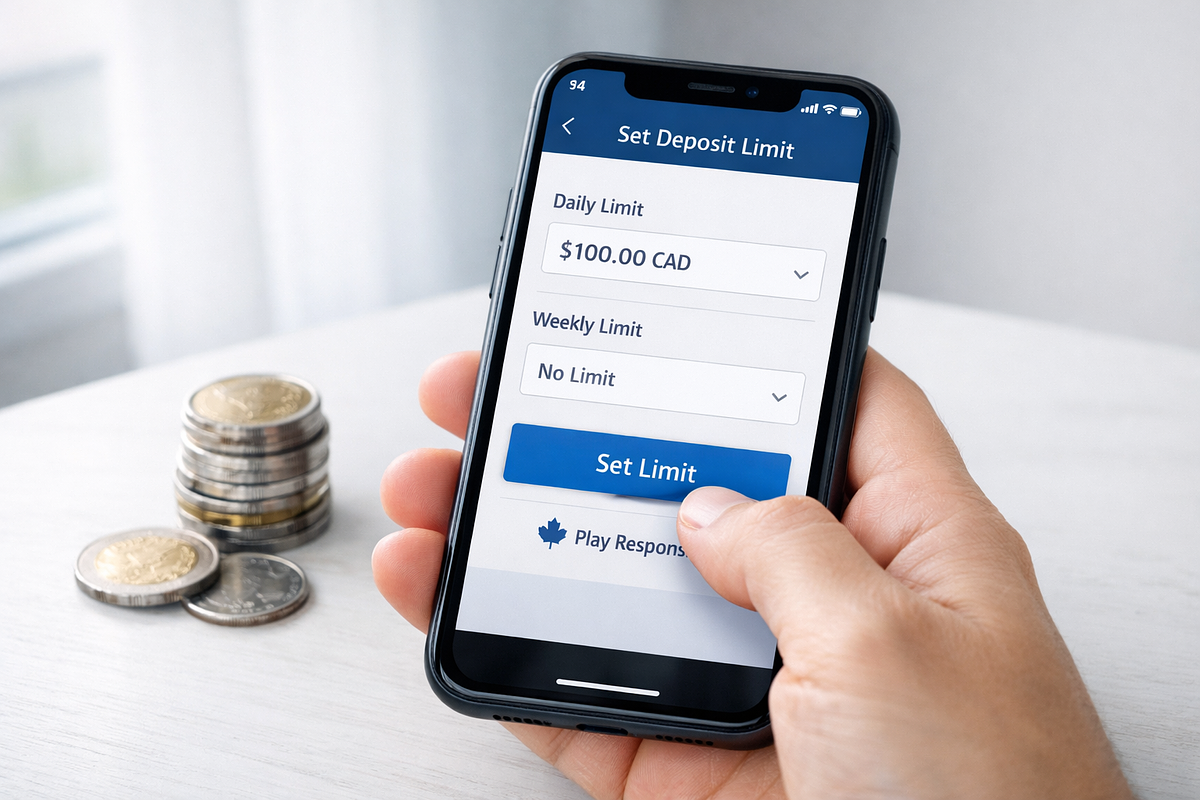
| Deposit limits | The maximum amount a player can deposit into their account within a defined period | Before funds are added; the cap is enforced at the point of deposit | Player-configured (daily, weekly, or monthly intervals) |
| Reality checks | On-screen notifications that interrupt play to display elapsed session time and net spend | At player-configured intervals during an active session | Player-configured interval; repeats throughout the session |
| Cooling-off periods | Temporary suspension of the player’s ability to access gambling on the platform | Immediately upon player request | Player-configured short-term period; operator-defined minimum applies |
| Self-exclusion | Full removal of access to the platform and, where applicable, to a network of regulated sites | Immediately upon enrolment | Operator-defined minimum; typically a longer-term or permanent option |
The research base on how players perceive the effectiveness of responsible gambling tools is still developing. Two figures cited in some sources, including a survey finding on the proportion of gamblers who view these tools as effective and a specific break interval shown to reduce impulsive decisions after losing bets, could not be confirmed from available verified sources. What the verified evidence does establish is that these tools are designed as pre-commitment mechanisms. Their harm-reduction function works through a player’s deliberate, advance decision rather than through in-session willpower. In-session prompts like reality checks aren’t friction added to the experience. They’re evidence-informed interruptions designed to restore the deliberate decision-making state that existed before play began. A player who understands this can treat any in-session notification as a harm-reduction prompt rather than a nuisance.
Some Canadian jurisdictions require independent third-party accreditation to verify that an operator’s responsible gambling program meets a defined standard, rather than relying on self-reported compliance. The accreditation framework developed by the Responsible Gambling Council, introduced in 2014, is structured around 9 standards and 48 criteria, supported by hundreds of measurable metrics that assess program depth across the full range of player-protection obligations. Alberta’s iGaming Corporation made this accreditation a mandatory requirement for all internet gaming sites entering Alberta’s regulated market. An accreditation seal displayed on a regulated platform means an independent body has audited the operator’s responsible gambling program against that defined framework, not that the operator has self-certified its own practices.
The Canadian Regulatory Backdrop for Player Protection
Canada’s gambling framework divides authority between the federal government and the provinces. That division is the direct reason why the consumer protection tools and support resources you encounter depend on where in the country you’re playing. Federal law sets the outer boundary of what’s permitted, while each province sets the specific rules operators must follow within that boundary. Because those provincial rules vary, the protections built into a regulated platform in one jurisdiction don’t automatically apply in another.
Canada’s federal gambling law is set out in Part VII of the Criminal Code of Canada (RSC 1985, c C-46), which broadly prohibits gambling as a default position. Section 207(1)(a) creates the operative exception: it grants provincial governments the authority to conduct and manage lottery and gaming schemes, carving out a space within which legal gambling can exist. Because that authority is provincial rather than national, an operator licensed in one province has no automatic standing in another, and operators based offshore fall entirely outside the Canadian regulatory structure. Players using offshore platforms have no access to the consumer protections that provincial regulators require of licensed operators. The scale of that unregulated market is significant: Canadians are estimated to spend upwards of $14 billion every year on illegal or offshore single-event sports wagering outside of Canadian regulations.
Provincial regulators set the specific standards that licensed operators must meet, and those standards vary across jurisdictions. Ontario is one of two Canadian provinces operating a regulated iGaming regime that allows third-party business-to-consumer operators to transact directly with players, a market it launched in 2021 under the Alcohol and Gaming Commission of Ontario (AGCO). The quarterly gaming revenue generated by that market reflects its scale, though the precise quarterly figure has not been confirmed in official published reports. The AGCO’s approach to player protection extends beyond platform tools into advertising rules: its Registrar’s Standards prohibit Ontario internet gaming operators from using active or retired athletes in advertising and marketing, except for the exclusive purpose of advocating for responsible gambling practices, with implementation guidance for that restriction published on 8 February 2024. That restriction exists because recognized athletes are considered to appeal to minors, making it a direct consumer protection measure rather than a general marketing preference. Players in other provinces encounter different regulatory frameworks, which is why the tools, advertising, and support pathways they see vary across Canadian jurisdictions.
Canadian Support Organizations and Provincial Helplines
A Canadian player seeking help has access to two overlapping resource layers. The first is a national-level organization focused on prevention and research. The second is a network of provincially operated or provincially funded helplines that serve as the primary entry point for immediate gambling and addiction support. The national body sets standards and provides information, while provincial helplines connect players directly to counselling and treatment services.
The Responsible Gambling Council (RGC) is an independent non-profit headquartered in Toronto, Ontario, that has operated for over 35 years with a focus on problem gambling prevention. Its work centres on research, public education, and the development of responsible gambling standards, including the RG Check iGaming Accreditation program used by regulated operators across Canada. The RGC is not a crisis counselling service. It functions as a prevention and research body, and its resources are oriented toward informing players, operators, and policymakers rather than providing direct clinical support. Players or family members looking for general information about problem gambling prevention can reach the RGC by phone at +1 (416) 499-9800.
Every Canadian province operates or funds a helpline covering gambling and related addiction concerns. The specific entry point, including the name of the service, the phone number, and the scope of support offered, varies by province, so players outside Ontario should check with their provincial health authority to find the correct local pathway.
| Province or Territory | Primary Helpline Category | Contact Pathway |
|---|---|---|
| Ontario | ConnexOntario | ConnexOntario gambling and addiction support line |
| Other Canadian provinces and territories | Provincial addiction helpline | Provincial health authority |
Putting Responsible Gambling Into Practice in Canada
The practical value of understanding responsible gambling isn’t in knowing the terminology. It’s in recognising that gambling risk is measurable and manageable before harm occurs. A player who understands the difference between a self-directed practice and a clinical pattern can read their own behaviour against evidence-based benchmarks, activate protective tools on regulated platforms before a session begins, and find the right provincial pathway if their behaviour, or someone else’s, moves beyond the lower-risk range.
We check operator terms, licences and payment details against the casino's own pages and update this content when they change. Read our editorial policy, our transparency statement, or report an error. If gambling stops being fun, see our responsible gambling resources.