

Player props and proposition bets work differently from most bet types you’ll find on a Canadian sportsbook. While moneylines, spreads, and totals all depend on the final outcome of a game, proposition bets resolve on isolated events or individual statistics, regardless of who wins. This article explains what prop markets are, how they’re structured, how the odds work, and how player props compare to game props. By the end, you’ll know how to read a prop market on a Canadian sportsbook and understand what you’re actually betting on.
What a Proposition Bet Is and How It Differs from Standard Bet Types
Proposition bets (props) are wagers on outcomes within a game that have nothing to do with the final result or the margin of victory. That puts them in a separate category from moneylines, point spreads, and totals. On a licensed Canadian sportsbook, props appear alongside those standard bet types but settle on completely different criteria.
A proposition bet is a wager on a specific event or statistical outcome within a game, independent of which team wins or what the final score is. A player can put up a big statistical game on the losing side. A specific in-game event can happen regardless of how the contest ends. That independence is what separates props from standard bet types structurally, not just in subject matter.
Props are not a subset of the moneyline. They’re a parallel class of wagers, priced on their own logic, with lines and odds that reflect the probability of a specific occurrence rather than a team-level result. Keeping that distinction in mind is what lets you read and evaluate any prop market correctly on a regulated Canadian platform.
Moneyline, point spread, and totals bets all settle on the game’s final outcome or aggregate score. The game has to finish before any of them can be graded. Proposition bets settle on isolated events or individual statistical lines, which can be determined independently of the final result. The table below shows how these four bet types compare.
| Bet Type | What It Resolves On | Scope of Outcome |
|---|---|---|
| Moneyline | Final game winner | Team-level |
| Point Spread | Margin of victory | Team-level |
| Totals (Over/Under) | Combined final score versus a set line | Game-level aggregate |
| Proposition Bet | Isolated event or individual statistic | Event- or player-level |
The Two Primary Prop Bet Formats
Proposition bets come in two main formats: over/under on a statistical line, and yes/no on a specific event. Each format has its own pricing convention, which affects how the odds are expressed and what they mean. Knowing which format a market uses lets you correctly read both the line and the odds before placing a bet.
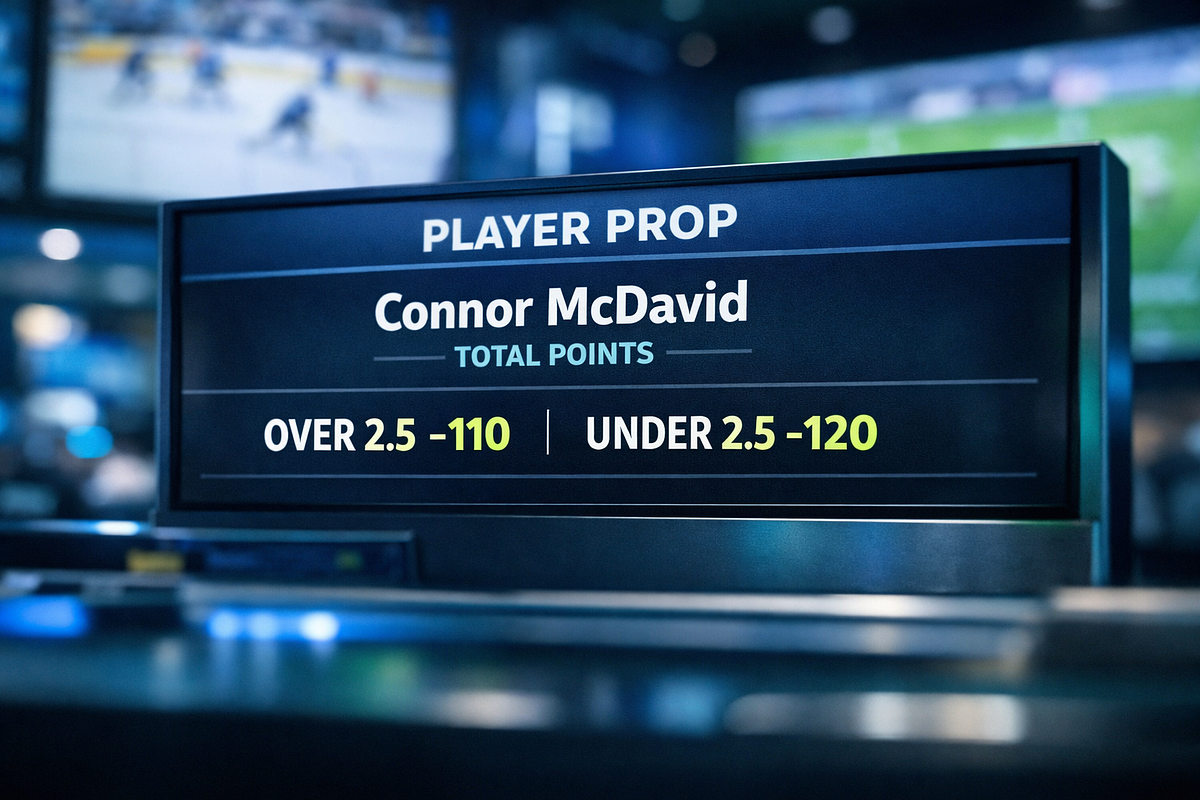
In the over/under format, the sportsbook sets a number for a specific statistic (passing yards, points scored, rebounds, strikeouts, goals) and you bet on whether the player’s actual result will finish above or below that number. Half-point lines, like 27.5 or 28.5 points, are common in player props because they eliminate the possibility of a push, where the result lands exactly on the line and neither side wins. Both the over and the under are typically priced at around -110, meaning both sides cost roughly the same to bet. When both sides sit at or near -110, the market is balanced. When one side is priced shorter and the other longer, the book has shifted the implied probability toward one outcome, and the pricing signals that shift.
In the yes/no format, the sportsbook poses a discrete question (will a player score a touchdown, or will a specific event happen in the first period) and prices each outcome using moneyline-style odds. Unlike over/under props, yes/no props usually carry asymmetric pricing that reflects the probability of the event occurring. The more likely outcome is priced as a favourite with negative odds, and the less likely outcome is priced as an underdog with positive odds. That asymmetry lets you read implied probability directly from the odds without needing a statistical line, because the odds themselves show how often the book expects the event to happen.
Player Props as a Distinct Category
Within the broader prop family, player props are defined by their subject: the measurable statistical output of a single player, rather than any team-level result or game-level aggregate. A player prop settles entirely on what one individual does during a game, regardless of which team wins or what the final score is. At least one provincially regulated Canadian operator defines this market type explicitly as bets relating to a single player’s performance [VERIFY THIS QUOTE], which confirms that this framing reflects how the regulated domestic market categorises these wagers. Because the outcome is tied to one individual rather than a collective result, player props sit structurally apart from moneyline, spread, and totals markets, even when they share the same over/under format.
The statistics offered as player props are not the same across sports. Each sport’s prop markets reflect the performance metrics that define how that sport is scored and evaluated. A sport built around discrete scoring events generates different prop categories than one built around cumulative yardage or counting statistics. The table below maps the major sports available on Canadian regulated sportsbooks to the individual statistics typically offered as player-prop markets.
| Sport | Categories of Individual Statistics Offered |
|---|---|
| American Football | Passing yards, rushing yards, receiving yards, touchdowns |
| Basketball | Points scored, rebounds, assists |
| Baseball | Strikeouts, hits, runs batted in |
| Hockey / Soccer | Goals, shots on goal |
Sportsbooks set player-prop lines using statistical models, historical performance data, injury reports, and incoming betting activity. The line at open reflects a modelled probability, but it’s not fixed. It moves as bets come in and as new information, like a late injury update, enters the market.
Player-prop markets tend to be thinner than spread and totals markets, meaning less money is wagered on them overall. Because of that lower volume, a concentrated flow of action on one side can move a prop line more noticeably than the same amount of action would move a main-market line.
One documented pattern shows how public behaviour gets built into prop pricing: unders on NFL player props have historically settled as winners on close to 60% of wagers across multiple seasons, a figure that reflects a consistent public tendency to bet overs. That number doesn’t tell you which side of a prop to take. It tells you that sportsbooks shade lines to account for predictable public behaviour, so the price you see on any given prop reflects both the modelled probability and the anticipated direction of public money.
Player Props Versus Game Props
Within the broader proposition-bet family, the main structural split is between player props and game props. The two categories settle on different things and are typically formatted differently, so knowing the distinction helps you read a sportsbook’s prop menu more accurately.
Player props settle on individual player statistics. The outcome depends entirely on what one athlete does during the game, regardless of which team wins or loses. Game props settle on specific game events that aren’t tied to the final score, such as which team scores first, whether a particular event occurs within a set period, or aggregate team statistics that don’t represent the final result. Because these two categories draw on different data and use different question structures, sportsbooks tend to format them differently too. Player props lean toward over/under lines, and game props lean toward discrete yes/no questions.
| Dimension | Player Props | Game Props |
|---|---|---|
| What it resolves on | Individual player statistics | Specific game events not tied to the final score |
| Typical format | Over/under on statistical lines | Yes/no on discrete events |
| Common examples | Passing yards, points, rebounds, strikeouts, goals | First team to score, event in a given period, team-level aggregates |
How Prop Bets Are Offered on Licensed Canadian Sportsbooks
Proposition markets are a standard feature across Canada’s licensed sports betting operators, available on major professional leagues including the NFL, NHL, NBA, and MLB. The breadth of those markets, the formats they use, and the combinations they support vary by operator and by time of year.
Every licensed Canadian operator that carries major professional sports offers prop markets on those sports. What varies between operators is the depth of those markets: how many individual player and game props are listed for a given contest, whether alternate lines around the primary statistical threshold are available, and whether more exotic prop types beyond standard over/under offerings are included. If you compare the same game across two licensed books, you may find materially different prop menus. That reflects product decisions made at the operator level (which markets to source, price, and display) rather than any difference in what the regulated framework allows. The regulated framework itself doesn’t restrict prop market depth. Operators build their own catalogues independently.
Player props can be combined into same-game parlays (SGPs), a bet type that links multiple prop legs from a single contest into one wager. Every leg in an SGP has to win for the parlay to pay. If any single leg loses, the entire wager loses. Because outcomes within one game are correlated (a quarterback throwing for more yards tends to coincide with more receiving yards for his targets), sportsbooks adjust SGP odds to account for that correlation rather than simply multiplying the individual leg prices together. That’s why the odds on a multi-leg prop parlay diverge sharply from what a straightforward multiplication of the individual legs would produce.
Prop betting gained significant popularity in Canada around Super Bowl season, a period when licensed operators expand their prop offerings to sustain bettor engagement late in the NFL calendar. The breadth of prop menus on a licensed Canadian book is not static across the year. If you browse prop markets during a major seasonal event, you’ll find a wider selection than the same operator carries during a quieter stretch of the schedule.
We check operator terms, licences and payment details against the casino's own pages and update this content when they change. Read our editorial policy, our transparency statement, or report an error. If gambling stops being fun, see our responsible gambling resources.