

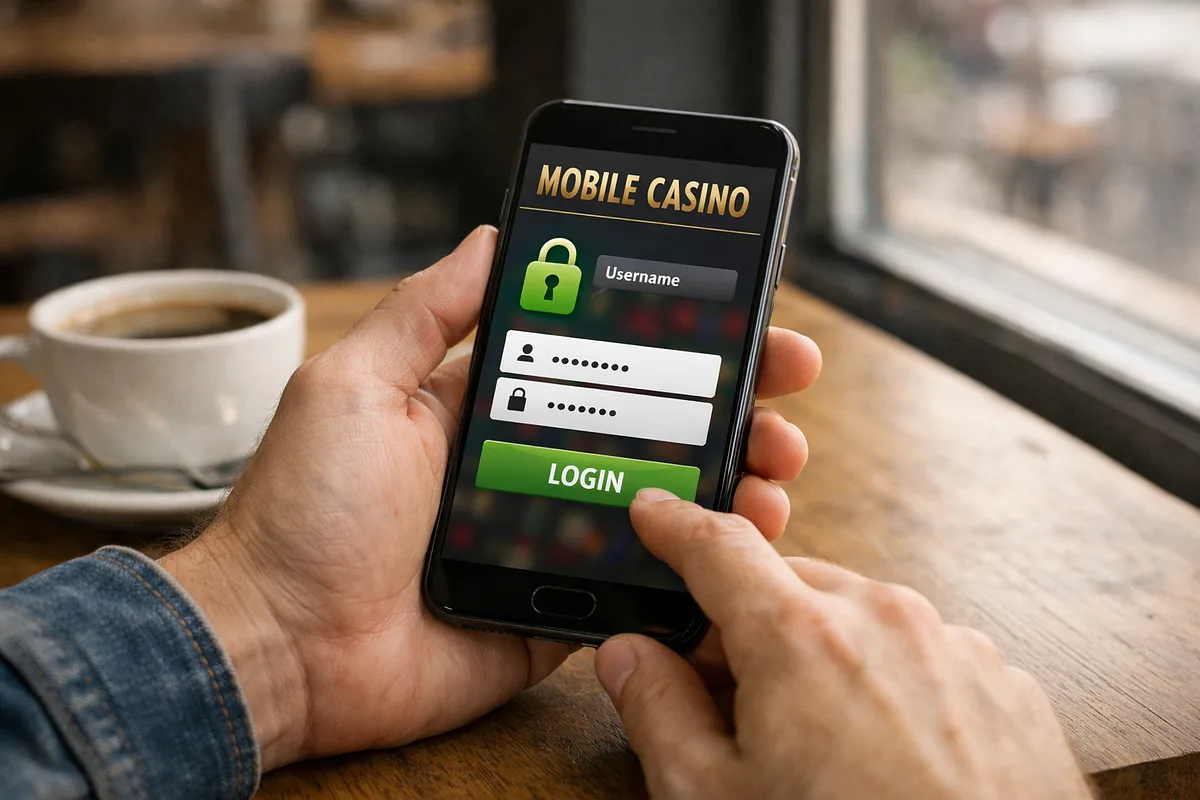
When you play at a mobile casino on public Wi-Fi, the network you’re sitting on determines whether your login details, session tokens, and payment information are exposed or protected. Public networks in coffee shops, hotels, airports, and transit hubs give you no reliable way to know what’s happening to your data. This page walks through the specific attacks that target that network layer, explains which precautions stop each one, and gives you what you need to accurately assess your own risk before or during a session.
Why Public Wi-Fi Changes the Threat Model for Mobile Casino Sessions
A mobile casino session combines two categories of high-value data in one connection: account credentials that control access to a funded account, and payment information that moves real money. Whether a third party can read that data isn’t determined by the casino app itself. It’s determined by the network the app runs on. According to research published by Kaspersky’s Securelist, 24.7% of public Wi-Fi hotspots worldwide use no encryption at all, meaning data leaving your device travels in plain text across radio frequencies that anyone nearby can receive. The scale of exposure is real: approximately 60% of internet users worldwide have logged into personal accounts over public Wi-Fi, putting a large share of the global user base in exactly this situation.
The Data at Stake During a Mobile Casino Session
Knowing what actually travels over the network during a casino session helps you understand how much risk a given connection creates. At login, the app sends your username and password across the network to the server. Once you’re authenticated, the server issues a session token or cookie that travels with every request you make after that, acting as proof that you’re logged in. Any deposit or withdrawal sends payment details, including card numbers or banking information. Account registration and verification send personal identity data like your full name, date of birth, and identity document information. On a network without encryption, all of that travels as readable text, not as scrambled ciphertext.
- Authentication credentials: username and password transmitted at login
- Session tokens and cookies: issued post-login and sent with every subsequent app request
- Payment details: card numbers and banking information transmitted during deposits and withdrawals
- Personal identity information: name, date of birth, and identity document data transmitted during registration and verification
The Encryption Baseline of Public Networks
On a network with no encryption, data leaving your device doesn’t need to be “intercepted” in any sophisticated sense. It’s broadcast in a form that cheap radio hardware and freely available software can read directly, without requiring any special position on the network. Nearly one in four public hotspots worldwide operates this way, so connecting to an unfamiliar access point carries a real chance of landing on a network where everything you transmit is immediately readable. A password-protected network isn’t automatically a secure one, either. Legacy protocols like WEP, and WPA2 networks secured with weak or publicly shared passwords, offer encryption that’s either trivially broken or shared with every other user on the same access point. That wipes out the protection encryption is supposed to provide. A password prompt at connection time tells you something about who can join the network. It tells you nothing about whether your traffic is actually secure.
Named Attack Vectors Targeting Mobile Casino Sessions on Public Wi-Fi
The threats that come with running a mobile casino session over a public network fall into a small set of named attack categories. Each one works differently and can be stopped at a different point. The sections below explain each attack type concretely: where the attacker sits, what data they can get, and what you do or don’t see on your device. That’s what lets you correctly read the signals your device gives you when something is wrong.
Man-in-the-Middle Attacks and SSL Stripping
A man-in-the-middle attack puts the attacker between your device and the destination server, so your traffic passes through the attacker before it reaches where it’s going. SSL stripping is a technique used from that position: it downgrades an HTTPS connection to HTTP, so traffic you assume is encrypted travels in plain text. DNS spoofing is a related method that redirects your device to an attacker-controlled server instead of the real casino platform, so your session never reaches the legitimate site at all. The padlock icon in a mobile browser tells you the encryption state of your current connection. If it disappears during what should be an encrypted session, that’s a sign the connection has been downgraded, not a cosmetic detail to ignore.
Evil Twin and Rogue Hotspot Attacks
An evil twin attack involves an attacker setting up a wireless access point that impersonates a legitimate network by broadcasting a familiar-sounding network name (SSID). Once your device connects, all your traffic routes through the attacker’s hardware before reaching the internet, giving the attacker the same interception position as a man-in-the-middle attack. The Australian Cyber Security Centre documented a case where an individual created fake Wi-Fi networks at airports and on flights across multiple cities, including Perth and Melbourne, to steal personal information from travellers. This shows the attack happens in exactly the kinds of transit environments where people commonly use mobile casinos. A familiar network name is a claim, not a verification. Your device has no technical way to tell a legitimate access point from an evil twin by name alone, so a known-sounding SSID in your network list confirms nothing about whether that access point is real.
Packet Sniffing on Unencrypted Networks
Packet sniffing is the passive interception of data travelling over a network the attacker is already connected to or within radio range of. On an unencrypted access point, no special network position is needed. Standard software is enough to capture traffic in plain text, meaning any nearby device running that software can read your data. Packet capture leaves no visible trace on your device, so a session can look completely normal (no errors, no slowdowns, no warnings) while every credential, session token, or payment detail you transmit is being recorded.
Session Hijacking After Successful Interception
Session hijacking is when an attacker takes over an already-authenticated session by capturing your session token or cookie, typically as a result of a successful man-in-the-middle position or packet capture. The attacker doesn’t need your password. Having the active session token is enough to act as you until the session expires or you manually end it. Logging out explicitly terminates the session token on the server side. Closing the app without logging out typically leaves the token active, meaning an attacker who captured it still has usable access to your account after you’ve put your phone away.
Malware Injection Through Network Position
An attacker who controls the network path can modify downloaded content or deliver malicious payloads by injecting scripts into unencrypted traffic, or by showing fake update prompts that appear during a browsing or app session. Outdated device software with unpatched vulnerabilities gives a network-positioned attacker more to work with, because many injection techniques rely on known vulnerabilities that vendors have already fixed in patches. An unexpected prompt, redirect, or software update request that appears during a session on an unfamiliar network is a warning sign consistent with this attack type, not a routine system event.
Comparative View of the Attack Vectors
The five attack categories above share some overlapping mechanics but differ in where the attacker sits relative to the network and what data they can reach. The table below maps each one across those dimensions and shows whether the attack produces any signal you’d actually see during the session.
| Attack Vector | Attacker Position | Primary Data Exposed | Visible to User |
|---|---|---|---|
| Man-in-the-Middle / SSL Stripping | Between device and destination server, intercepting and modifying traffic in transit | Credentials, session tokens, payment details, personal identity data | Sometimes: an absent padlock or certificate error may appear if stripping is incomplete |
| Evil Twin / Rogue Hotspot | Controlling the access point the device connects to, routing all traffic through attacker hardware | All unencrypted traffic transmitted during the session | No: the network name appears legitimate and the connection functions normally |
| Packet Sniffing | Connected to or within radio range of the same unencrypted access point as the target | Any plain-text traffic on the network, including credentials and session tokens | No: passive capture produces no device-side indication |
| Session Hijacking | Downstream of a successful interception, operating with a captured session token | Active session access, enabling account actions without the password | No: the hijacked session uses a valid token and generates no authentication error |
| Malware Injection | Controlling the network path, modifying content or injecting payloads into unencrypted traffic | Device integrity; persistent access beyond the current session | Sometimes: spoofed update prompts or unexpected redirects may appear |
Where and When These Attacks Actually Occur
The venue where you run a mobile casino session is a real variable in your risk calculation. Certain network environments attract more attacker activity because they combine high user density, transient populations who can’t vet network legitimacy, and infrastructure that gets little or no security oversight. The sections below give you a framework for judging whether a given location raises your risk above the baseline.
Venue Categories With Elevated Incident Rates
Public Wi-Fi security incidents aren’t spread evenly across venue types. Travel-related environments account for the highest documented incident shares. Users in these environments connect quickly, rarely verify network identity, and share infrastructure with large numbers of strangers. High traveller density means more targets per access point. Transient user pools mean fewer people notice anything unusual. And the networks themselves rarely get the kind of vetting applied to corporate or home infrastructure. The figures below show the share of reported incidents attributed to each venue type.
- Planes: 67% of reported public Wi-Fi security incidents, the highest share of any venue. This reflects a captive user pool with no alternative connectivity and limited ability to verify network legitimacy mid-flight.
- Airports: 59% of reported incidents, consistent with documented real-world evil twin operations targeting travellers at departure and arrival points. Statista survey data also identifies airports among the most common locations where personal information was compromised on public Wi-Fi in the US as of October 2024.
- Cafés and public transport: 52% of reported incidents, reflecting high-turnover environments where networks are shared across a continuously rotating user base and where an attacker can operate without drawing attention.
Corporate and Traveler Exposure Patterns
The concentration of incidents in travel environments connects to a broader pattern documented in large-scale breach analysis. Verizon’s 2025 Data Breach Investigations Report, which examined more than 22,000 security incidents and 12,195 confirmed data breaches across 139 countries, found that network threats including rogue base stations and insecure Wi-Fi were involved in over 52% of mobile breaches analyzed. A mobile casino session run over airport or in-flight Wi-Fi operates in a network environment that shares structural characteristics with the conditions present in a material share of real-world mobile breaches. That’s a meaningfully different risk profile from the same session run over a known home network.
Technical Precautions That Materially Reduce Exposure
Each precaution below maps to specific attack mechanisms: packet sniffing, man-in-the-middle interception, SSL stripping, session hijacking, and malware injection through network position. These measures aren’t interchangeable. Each one stops specific threats and leaves others untouched. The sections below spell out that mapping so you can judge your own coverage rather than assume any single measure is enough.
VPN Use for Encrypting Traffic
A VPN wraps your outbound traffic in an encrypted tunnel from your device to a remote endpoint, so the local access point sees only ciphertext regardless of whether the underlying network is itself unencrypted. This stops packet sniffing entirely, because the data crossing the local network carries no readable payload. It also defeats most man-in-the-middle observation at the network layer, because an attacker positioned between your device and the access point intercepts only the encrypted tunnel, not the session content inside it. The NSA explicitly advises using a personal or corporate-provided VPN whenever connecting to any public Wi-Fi network, a recommendation that reflects the agency’s assessment of network-layer interception as a realistic threat. A VPN stops network-layer attacks specifically. It does not protect against endpoint compromise, malware already on your device, or vulnerabilities in the casino app itself.
HTTPS Enforcement and App-Level Transport Security
HTTPS encrypts the payload between the app and the destination server end-to-end, so even a network-positioned attacker who intercepts the traffic sees only ciphertext at the application layer. A mobile casino app that doesn’t enforce HTTPS on every request stays vulnerable to SSL stripping, the man-in-the-middle technique that downgrades an HTTPS connection to HTTP and causes traffic you assume is encrypted to travel in plain text. OWASP identifies misconfigured HSTS headers and SSL/TLS certificate problems as conditions that directly enable this class of attack. A certificate error or connection warning is not a cosmetic interruption. It’s the app or browser reporting exactly the condition that SSL stripping or DNS spoofing produces. Dismissing it removes the only visible signal that your session has been compromised.
Two-Factor Authentication as a Session-Compromise Backstop
Two-factor authentication (2FA) requires a second credential that ties account access to something the attacker doesn’t have, even when login credentials have been captured over the network. This limits the usefulness of stolen credentials because completing a login from an unrecognised session still requires the second factor, which the attacker typically can’t supply. 2FA also partially reduces session hijacking risk, depending on how aggressively the platform enforces re-authentication on new or suspicious sessions. A 2FA prompt appearing at an unexpected moment during a session means the platform has detected something worth challenging. It’s not a system error to bypass.
Device and Software Currency
Outdated operating systems, browsers, and casino apps carry unpatched vulnerabilities that give a network-positioned attacker more to exploit than current software would. Malware injection and certain man-in-the-middle variants depend specifically on known vulnerabilities that vendors have already fixed in patches, meaning a fully updated device is protected against those particular attack paths. An update prompt on your device is a security event that closes a documented vulnerability window, not just a version number change.
Mapping Precautions to the Attacks They Actually Address
Each precaution works at a specific layer: network, application, authentication, or behavior. It closes only the attack mechanisms that operate at that same layer. A VPN doesn’t protect against a stolen session token left active after you close the app. Logging out doesn’t protect against packet sniffing on an unencrypted connection. Treating precautions as interchangeable creates gaps where an attack vector stays open even though you think you’re covered. The table below shows actual coverage across the five attack categories covered in earlier sections.
Attack-to-Precaution Correspondence
The table maps each named attack vector to its primary technical control, a secondary technical control, and the behavioral precaution that addresses it at the connection or session level. Coverage is partial where a precaution reduces exposure without eliminating the mechanism entirely.
| Attack Vector | Primary Precaution | Secondary Precaution | Behavioural Precaution |
|---|---|---|---|
| Man-in-the-Middle / SSL Stripping | VPN (encrypts the tunnel before SSL stripping can downgrade it) | HTTPS enforcement and certificate-warning awareness | Abort the session immediately on any certificate error or unexpected HTTP connection |
| Evil Twin / Rogue Hotspot | Disable auto-connect on the device | VPN (limits damage if connection to a rogue access point occurs) | Verify the network name with venue staff before connecting |
| Packet Sniffing | VPN (wraps traffic in an encrypted tunnel the local access point cannot read) | HTTPS enforcement (encrypts payload at the application layer) | Avoid financial transactions on any network where VPN is unavailable |
| Session Hijacking | Explicit logout (terminates the active session token) | Two-factor authentication (limits re-use of a captured token at re-authentication) | Do not close the app without logging out; treat session-end as a deliberate step |
| Malware Injection via Network Position | Device and software patching (closes the known vulnerabilities the injection path requires) | VPN (reduces the attacker’s ability to inject content at the network layer) | Decline any software update or install prompt that appears during a public Wi-Fi session |
Reading Risk Accurately When the Network Is Not Under Your Control
Security on a public network isn’t a simple yes-or-no condition. Each attack mechanism operates at a distinct point and is stopped only by the precaution that addresses that specific layer. Once you understand that correspondence, you can assess any unfamiliar connection accurately: you’ll know which threats are still open given the controls you actually have in place, rather than assuming that any single measure covers everything.
We check operator terms, licences and payment details against the casino's own pages and update this content when they change. Read our editorial policy, our transparency statement, or report an error. If gambling stops being fun, see our responsible gambling resources.