

Every odds format, American, decimal, or fractional, is really just a percentage in disguise. That percentage tells you how likely the bookmaker thinks an outcome is, with their profit margin already baked in. This guide walks through how to convert each format into that percentage, and how to spot the margin the bookmaker has built into the numbers. By the end, you’ll be able to take any posted odds and turn them into a probability you can actually work with.
Implied probability is the percentage form of any price a bookmaker sets. When you see a number on a sportsbook, the real question is: what probability does that number actually represent, and does it reflect the outcome’s true likelihood or the bookmaker’s adjusted estimate? This article covers how to convert American, decimal, and fractional odds into implied percentages, and how to read the margin the bookmaker has built into those figures.
What Implied Probability Represents
Implied probability is the percentage form of any betting price. Every odds format is a different way of writing the same underlying percentage, and that percentage has the bookmaker’s margin built into it. Every conversion formula in this article, every market comparison, and every judgment about whether a price offers value starts from the implied probability you get from the posted odds.
Implied probability is a percentage you calculate from betting odds. It represents the likelihood the bookmaker’s price assigns to an outcome. It’s not a neutral estimate of what will actually happen, because the bookmaker’s profit margin is already built into the price before it’s published. The implied percentage is your reference point for interpreting any price you see. It answers the question: what are these odds actually claiming about this outcome’s likelihood, in a form you can compare to any other probability estimate?
Any odds format is just a different notation for the same underlying percentage. Converting between formats doesn’t change the probability being expressed, it only changes the arithmetic you use to get there. Once you understand that, the way you read a posted price changes. The number isn’t a neutral forecast. It’s a price that already contains the bookmaker’s built-in edge.
When you add up the implied probabilities for every possible outcome in a market, the total comes out above 100%. This excess is called the overround, and it’s how the bookmaker’s margin shows up in the numbers. In a two-outcome market where both sides are priced at -110, each side carries an implied probability of 52.4%, and the two figures add up to 104.8%. That extra 4.8% above 100% is the bookmaker’s margin.
Spotting the overround is how you tell a bookmaker-adjusted percentage apart from one that reflects only the actual likelihood of an outcome. A market where the implied probabilities add up to more than 100% isn’t broken. It’s working exactly as designed, with the excess representing the theoretical margin the bookmaker keeps across the market.
Converting American Odds Into a Percentage
American odds (also called moneyline odds) are written with either a plus or a minus sign, and that sign determines which formula you use. Positive and negative values are two separate cases, each with its own calculation. The two formulas are covered separately below, each with worked examples.
For positive American odds, the implied probability formula is: 100 ÷ (odds + 100), multiplied by 100 to get a percentage. Applied to +150, the calculation is 100 ÷ (150 + 100) = 100 ÷ 250 = 0.40, which equals 40%. Applied to +500, the same formula gives 100 ÷ (500 + 100) = 100 ÷ 600 = 16.667%.
A positive American odds value means the outcome is priced as less than a 50% chance. The bigger the positive number, the smaller the implied percentage. So any positive price immediately tells you you’re looking at an underdog, without needing to run the full calculation. Once you’ve internalized the formula, any positive American price gives you a rough sense of the implied likelihood at a glance, making it easy to check whether the bookmaker’s number matches your own estimate.
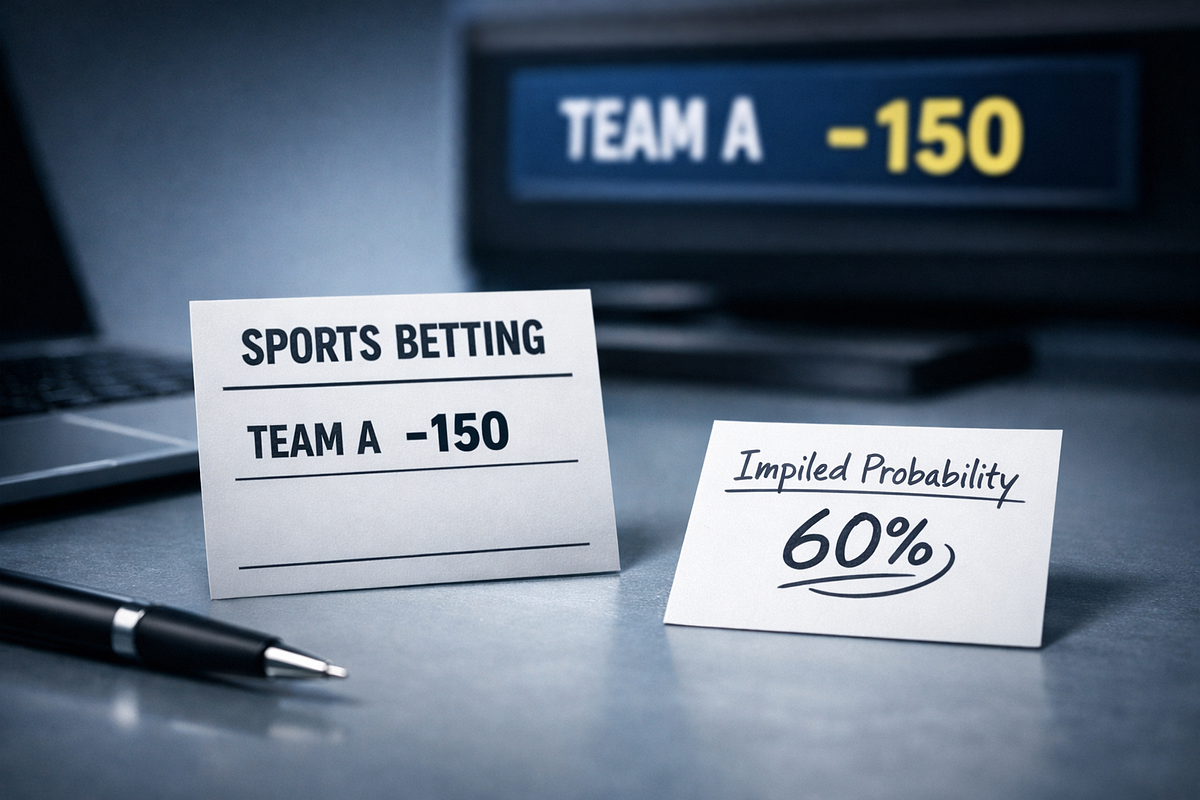
For negative American odds, the implied probability formula is: |odds| ÷ (|odds| + 100), multiplied by 100 to get a percentage. The vertical bars mean you drop the minus sign before doing the math. Applied to -150, the calculation is 150 ÷ (150 + 100) = 150 ÷ 250 = 0.60, which equals 60%.
A negative American odds value means the outcome is priced as more than a 50% chance. The bigger the absolute value, the higher the implied percentage. So -300 carries a much higher implied probability than -150. Any negative price tells you immediately that you’re looking at a favourite, and the formula tells you how strongly the bookmaker is pricing it that way, which gives you a direct basis for comparing that figure to your own probability estimate.
Converting Decimal Odds Into a Percentage
Decimal odds use a single formula that works for every value in the format, with no sign-based split needed. The structure of the number encodes the implied probability directly, which makes the math more transparent than the two-case approach American odds require. Because the relationship between the decimal figure and the underlying percentage is a straightforward inverse, decimal odds are the easiest format to convert without a calculator. The formula and a worked example below show both the mechanics and the shortcuts that follow from them.
The formula is: implied probability = (1 ÷ decimal odds) × 100. Applied to decimal odds of 2.0, the calculation is (1 ÷ 2.0) × 100, which gives 50%.
The formula works this way because a decimal odds figure is the reciprocal of the implied probability expressed as a fraction. A 50% probability is 0.5 as a fraction, and the reciprocal of 0.5 is 2.0, which is exactly the decimal odds figure. Dividing 1 by the decimal odds reverses that relationship and recovers the fractional probability. Multiplying by 100 then converts it into a percentage.
This inverse relationship produces some reliable reference points. Decimal odds of 2.0 always represent an even-money proposition, where the bookmaker’s price implies a 50% chance. Any decimal odds figure below 2.0 means an implied probability above 50%, marking the outcome as a priced favourite. Any figure above 2.0 means an implied probability below 50%, marking the outcome as a priced underdog. The further the decimal value moves from 2.0 in either direction, the more extreme the implied probability becomes.
Converting Fractional Odds Into a Percentage
Fractional odds are written as two numbers separated by a slash, where the left number is the numerator and the right number is the denominator. The formula uses both values, placing the denominator in the numerator of the calculation and the sum of both parts in the denominator. This structure reflects the way fractional odds encode a ratio of outcomes, which makes the format well-suited to a frequency-based reading. Neither American nor decimal odds produce that frequency interpretation as directly from their raw notation.
The formula is: implied probability = denominator ÷ (denominator + numerator) × 100.
Applied to 9/2, the calculation runs: 2 ÷ (2 + 9) × 100 = 2 ÷ 11 × 100 = 18.1%. The denominator, 2, sits in the numerator of the division because it represents the count of successful outcomes in the implied ratio, while the total of 11 represents every attempt, wins and losses combined.
The second example, 3/1, gives: 1 ÷ (1 + 3) × 100 = 1 ÷ 4 × 100 = 25%. The intuitive reading follows directly from the math: a 3/1 outcome is expected to win once in every four attempts, and 25% is exactly that frequency expressed as a percentage. The denominator, 1, counts the wins; the total, 4, counts all attempts.
This makes fractional odds practical for shorter-priced selections. A bettor reading 3/1 can get to 25% without doing the full division, because the ratio of wins to total attempts is already visible in the notation. For longer prices like 9/2, the mental math is less immediate, but the same logic applies: denominator over the combined total, scaled to 100.
Reference Conversion Table Across All Three Formats
Placing equivalent values side by side across formats is the clearest way to see that American, decimal, and fractional notation are three ways of expressing the same underlying percentage. The table below is a reference point, not an exhaustive list of every possible price.
The following table shows how the same implied probability appears across American, decimal, and fractional notation.
| Fractional Odds | Decimal Odds | American Odds | Implied Probability |
|---|---|---|---|
| 3/1 | 4.0 | +300 | 25% |
| 1/2 | 1.5 | -200 | 66.7% |
Implied Probability Versus True Probability
Implied probability and true probability are two different things, and treating them as the same is the most consequential mistake a bettor can make when reading odds. Implied probability is the percentage you get directly from the odds a bookmaker publishes, and it has the bookmaker’s margin built in. True probability (also called fair probability) is what’s left once that margin is removed. Every formula in this article produces an implied probability, not a true one, and understanding the gap between the two is what makes those formulas useful in practice.
True probability is the fair likelihood of an outcome calculated from no-vig odds, meaning the bookmaker’s margin has been stripped out. The clearest way to see the difference is at the market level: implied probabilities across all outcomes in a market add up to more than 100%, while fair probabilities add up to exactly 100%. The excess above 100% is the overround, the bookmaker’s built-in margin. Removing the vig proportionally scales each implied probability down so the full set of outcomes sums to exactly 100%.
Here’s a concrete example: when both sides of a two-outcome market are priced at -110, each side carries an implied probability of 52.4%, producing a combined total of 104.8%. The fair probability for each side is 50%, because the 4.8% overround is distributed across both figures. This means the percentage you calculate from raw published odds is the bookmaker’s price in probability form, not a neutral forecast of the outcome. Any time you compare that figure to an independent probability estimate, you need to account for the margin first.
A value bet is one where your own assessed probability of an outcome is higher than the implied probability from the odds. At +150, the implied probability is 40%. If your independent assessment of the same outcome is 45%, that’s a 5% edge in your favour. Value assessment sits directly on top of the conversion work that produces implied probability. Without converting the odds into a percentage, your own probability estimate and the bookmaker’s price exist in different units and can’t be compared. Odds expressed as +150 or 2.50 or 3/2 have no obvious relationship to a percentage estimate of 45%. Only after conversion does the comparison become possible. Odds alone aren’t enough to spot value. Value only becomes visible once the odds are expressed as a percentage and placed alongside your own probability estimate for the same outcome.
We check operator terms, licences and payment details against the casino's own pages and update this content when they change. Read our editorial policy, our transparency statement, or report an error. If gambling stops being fun, see our responsible gambling resources.