


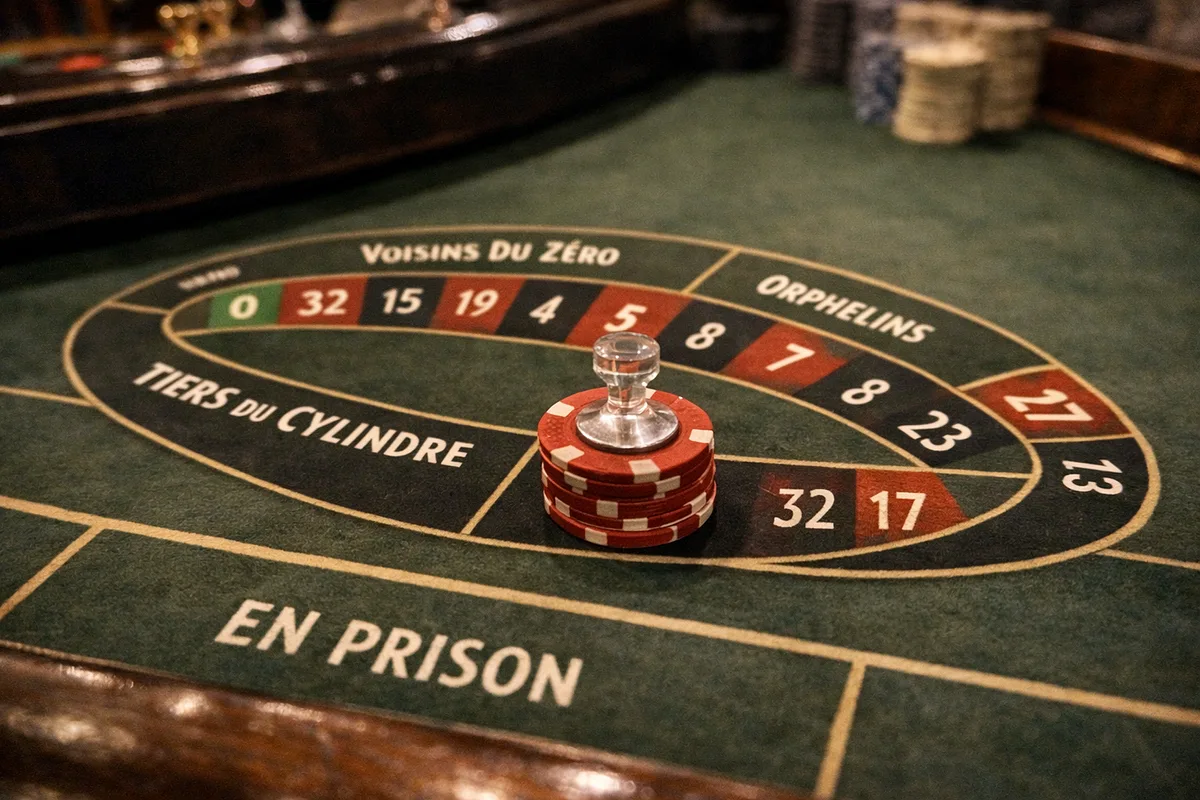
This page covers three mechanics that separate French roulette from standard European roulette: La Partage, En Prison, and announced bets. La Partage and En Prison govern what happens to even-money bets when the ball lands on zero, giving you a partial or conditional recovery instead of an automatic full loss. Announced bets, placed using the racetrack oval on the table layout, are a set of sector-based wagers that don’t appear on the standard betting grid. By the end, you’ll know how each mechanic works well enough to follow the rules at a French table and decide which bet types suit you.
What Sets the French Variant Apart from Other Roulette Formats
French roulette has two categories of rules that standard European roulette doesn’t include: a zero-spin recovery mechanic for even-money outside bets, and a set of sector-based wagers placed through a racetrack layout on the table. These two categories are structurally separate. The recovery mechanics determine what happens to an existing bet when zero lands. The sector-based wagers are a different betting system built around the physical positions of numbers on the wheel. The sections below cover each category on its own, starting with the recovery mechanics and then moving to the sector-based wagers.
The La Partage Rule: Immediate Half-Stake Recovery on Zero
La Partage kicks in when the ball lands on zero and you have an even-money outside bet on the table. The result is neither a full win nor a full loss on that bet. On a standard table, zero means you lose the whole stake on those bets, so this changes the picture considerably. It’s worth understanding that distinction before comparing French roulette to European or American formats, because a zero spin carries a different financial consequence depending on which variant you’re playing and which bet type you have down.
Activation Conditions and Eligible Bet Types
La Partage activates on one trigger: the ball landing on zero. Only even-money outside bets are covered. Inside bets, dozens, and columns are not affected by the rule and settle as a total loss on a zero spin, just as they do on any standard single-zero table. The three eligible bet categories are listed below, each covering two opposing outcomes.
- Red / Black, a wager on the colour of the winning number
- Odd / Even, a wager on the parity of the winning number
- High / Low, a wager covering the upper half (19–36) or lower half (1–18) of the number range
The Half-Stake Outcome and Why It Halves the House Edge
When zero lands and La Partage applies, half your stake is returned immediately and the other half goes to the house. The round closes for that bet with no further spin. This is what cuts the house edge on eligible bets from the standard single-zero rate of 2.70% down to 1.35%, exactly half, because you’re getting something back on every zero instead of losing the full amount. That 1.35% figure only applies to the three even-money outside bet types covered by the rule. All other bets at the same table still carry the 2.70% edge. So a zero spin under La Partage is a partial loss on even-money outside bets, while the same spin is a total loss on inside bets, dozens, and columns.
The En Prison Rule: Imprisoned Stakes and the Follow-Up Spin
En Prison is the second zero-spin recovery rule in French roulette, and like La Partage, it only applies to even-money outside bets when zero lands. The difference is in how it resolves. La Partage closes the bet immediately. En Prison holds the stake over to the next spin, so the outcome is deferred rather than settled. After a zero spin, your position under En Prison is genuinely open, not determined.
The Imprisonment Procedure and the Croupier Marker
When zero lands at a table using En Prison, the croupier doesn’t return or take any part of your even-money stake. The full amount stays on the table, and the croupier places a marker on it to show it’s imprisoned and waiting on the next spin.
That follow-up spin has three possible outcomes:
- Winning spin: The imprisoned stake is released and returned to you in full, with no extra winnings paid.
- Losing spin: The full stake is forfeited to the house.
- Second zero: At tables that offer this variant, a second consecutive zero leaves the stake imprisoned for another spin rather than triggering a forfeit or a split return.
House Edge Impact and Statistical Equivalence to the Immediate-Recovery Rule
En Prison produces a house edge of 1.35% on the even-money bets it covers, exactly half the standard single-zero edge of 2.70% that applies to those same bets on a European roulette table without a recovery rule. En Prison and La Partage work through different mechanics, one deferring resolution to a later spin, the other settling immediately at half the stake, but they’re statistically equivalent over the long run. Both arrive at the same long-run cost per unit wagered. In practice, the choice between the two rules affects the timing and volatility of a zero outcome, but not the underlying rate at which even-money bets are eroded over time.
Why Only One Recovery Rule Applies at Any Given Table
La Partage and En Prison are mutually exclusive. A table runs under one or the other, never both, and the table rules will tell you which is active. Because the two rules handle a zero spin differently (one returns half the stake immediately, the other holds the full stake for another spin), the zero-spin experience varies depending on which rule the table uses, even though both produce the same long-run house edge of 1.35% on even-money outside bets. In online environments, La Partage is by far the more common option, including on major live dealer platforms. En Prison is rarely offered online. You’re more likely to encounter it at land-based European casino tables, where the imprisoned-stake mechanic has a long tradition in the physical game.
Announced Bets and the Racetrack Layout
Announced bets, also called called bets, are sector-based wagers that group numbers by where they sit on the physical wheel, not by their position on the standard inside or outside betting grid. When you place one of these bets, you’re covering a defined arc or pattern of the wheel in a single action, which gives you a coverage map that has no equivalent on the flat rectangular layout. Because the groupings follow wheel geography rather than grid position, misreading a sector wager as a standard bet means you’ll cover a different set of numbers than you intended. These bets must be declared verbally before chips are placed, and they’re placed using a racetrack oval (an elliptical representation of the wheel printed on or displayed alongside the main table layout), not on the standard betting grid.
Standard Announced Bet Categories and Their Wheel Coverage
Each standard announced bet category covers a defined arc or grouping on the wheel, with a fixed position relative to zero and a specific set of numbers. The categories divide the wheel into distinct, non-overlapping segments, with one exception that covers the numbers left unclaimed by the two largest segments. The table below lists each category with its wheel-position description and number count or coverage range.
| Category Name | Wheel Coverage Description | Number Count / Range |
|---|---|---|
| Voisins du Zéro | Numbers between 22 and 25 on the wheel, covering the zero neighbourhood | 17 numbers |
| Le Tiers du Cylindre | Numbers on the arc opposite zero on the wheel, from 27 to 33 | Defined arc from 27 to 33 |
| Orphelins | Numbers not covered by Voisins du Zéro or Le Tiers du Cylindre | 8 numbers |
| Jeu Zéro (Zero Game) | Numbers immediately adjacent to zero on the wheel | 6 numbers |
| Finales | All numbers on the wheel sharing the same final digit | Variable by digit called |
House Edge Across Roulette Variants
The three main roulette formats (American, European, and French) carry different house edges on even-money wagers, and those differences don’t apply uniformly across all bet types within a given format. The lower edge available at a French table comes with two conditions: a recovery rule (La Partage or En Prison) must be running at that table, and the bet you place must be an even-money outside bet. All other bet types at a French table, including inside bets, dozens, and columns, settle at the standard single-zero edge. That’s an important distinction, because the lower figure doesn’t apply to every bet on a French layout.
Comparative Edge by Variant
All three variants can be compared on the same measure: house edge on even-money wagers, since that bet category exists across all of them. The figures below reflect the edge under each variant’s standard conditions. The scope condition for the French variant is stated explicitly because it’s conditional, not universal.
| Roulette Variant | House Edge on Even-Money Wagers | Applies Under |
|---|---|---|
| American roulette (double-zero) | 5.26% | All spins, all even-money wagers |
| European roulette (single-zero, no special rules) | 2.70% | All spins, all even-money wagers |
| French roulette (single-zero with La Partage or En Prison) | 1.35% | Even-money outside bets only, with recovery rule active |
Reading a French Roulette Table Before the First Bet
French roulette’s defining mechanics work on two separate levels: what happens to an even-money stake when zero lands, and how sector-based wagers map onto the wheel. Neither can be assumed from the table layout alone. Checking the table rules before you bet tells you which recovery mechanic is active and lets you correctly interpret any sector wager announced at the racetrack. That way, every decision you make is based on how that specific table actually works, not on assumptions.
We check operator terms, licences and payment details against the casino's own pages and update this content when they change. Read our editorial policy, our transparency statement, or report an error. If gambling stops being fun, see our responsible gambling resources.