


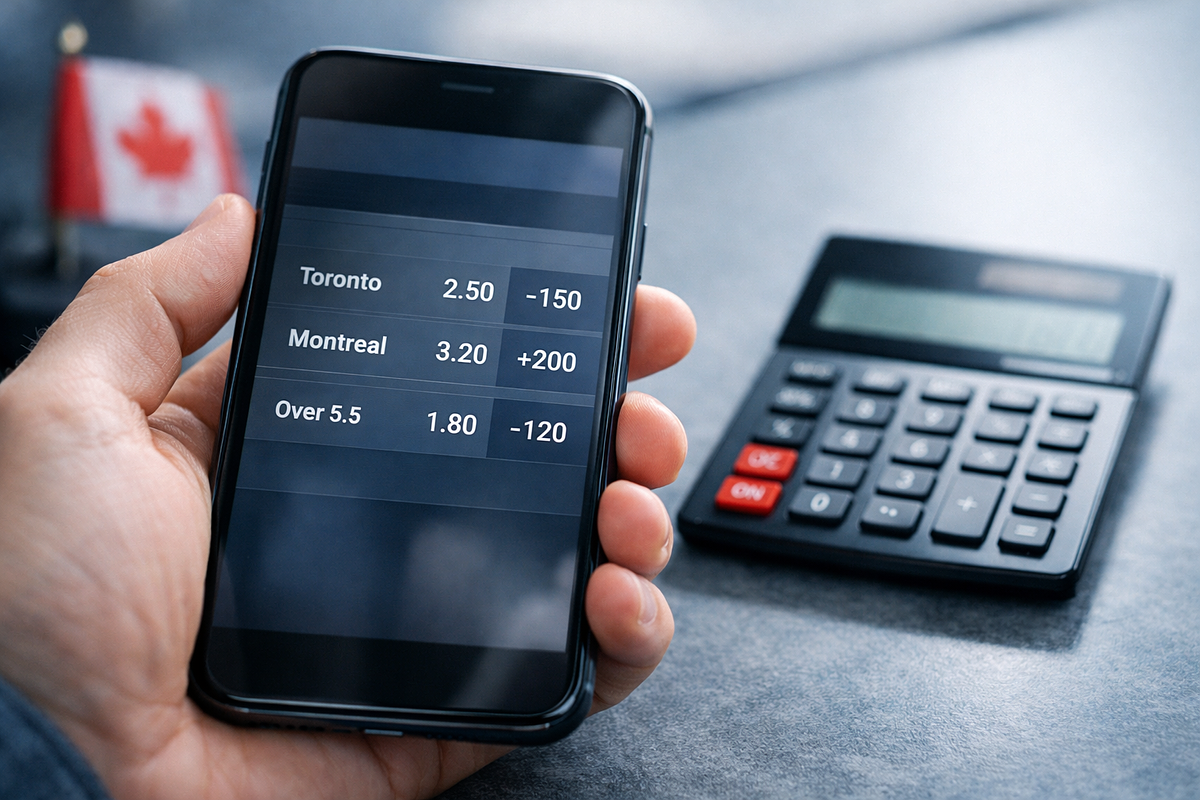
If you’ve opened a Canadian sportsbook and seen two different odds formats sitting side by side on the same market, you’re not alone in wondering which one to use. Canadian sites default to decimal odds, but American odds show up too, largely because of the influence of US sportsbooks across the border. This page breaks down how each format works, what it looks like in practice, and where the two part ways in terms of readability. By the end, you’ll have what you need to pick a default format that fits the way you read a line and calculate a return.
How Decimal Odds Express Total Return
Decimal odds are the format most Canadian bettors see first when they open a sportsbook. The number shown is the total return per dollar wagered, and that includes your stake. That one detail sets decimal odds apart from other formats and changes how you should read the number. If you know the stake is already built into the figure, you won’t underestimate your payout by treating it as profit only.
The decimal figure is a multiplier you apply directly to your stake. The result is your total payout, not just the profit on top of what you put in. At decimal odds of 2.0, a $100 wager returns $200 in total: $100 stake back plus $100 in profit. Read that figure as “what my ticket will pay out,” not “what I win on top of my stake.” The second reading causes you to undercount the stake when you’re estimating your return.
A decimal figure below 2.00 means you’re looking at a favourite. The sportsbook considers that outcome more likely than not. A figure above 2.00 means you’re looking at an underdog. The 2.00 mark is the dividing line because it represents an even-money outcome, where the implied stake return and profit are equal. This makes comparing lines straightforward: the lower the decimal number, the shorter the price and the more heavily favoured the outcome.
To get the implied probability from a decimal figure, use this formula: (1 ÷ decimal odds) × 100. At decimal odds of 2.0, that gives you 50%, meaning the sportsbook is pricing that outcome as a coin flip. Implied probability lets you read a line as a likelihood rather than just a number, so you can see exactly what chance the sportsbook is assigning to that outcome.
How American Odds Express Profit on a $100 Reference Wager
American odds use a two-part system built around a $100 reference wager. Positive figures identify underdogs, and negative figures identify favourites. Canadian bettors run into this format because of cross-border influence from the US market, not because it’s native to Canadian sportsbooks, which default to decimal. If you don’t know what the plus and minus signs mean, you can’t quickly tell which side is favoured or figure out what a winning ticket pays. The breakdown of each sign, and how to calculate implied probability, is covered below.
A negative American figure identifies the favourite and tells you how much you need to risk to profit $100. At -110, you wager $110 to win $100 in profit. The negative sign tells you this side is priced short, and the size of the number tells you how heavily favoured it is. A figure of -300 reflects a much bigger favourite than -110.
A positive American figure identifies the underdog and tells you the profit you’d collect on a $100 wager. At +110, a $100 bet returns $110 in profit if the outcome lands. The larger the positive number, the longer the price and the less likely the sportsbook thinks that outcome is.
For positive American odds, the implied probability formula is: 100 ÷ (American odds + 100) × 100. Applied to +110, that’s 100 ÷ (110 + 100) × 100, which gives you an implied probability of about 47.6%. Positive and negative American figures each require their own formula to convert to implied probability. That’s one reason this format is generally considered harder to read at a glance than decimal odds, where a single formula works regardless of whether you’re looking at a favourite or an underdog.
Format Prevalence Across Canadian Sportsbooks
Decimal odds are the default format on Canadian betting sites. Tools like the casinosranknow.com odds converter [VERIFY THIS QUOTE] label decimal explicitly as “the Canadian standard.” Most Canadian sportsbooks show lines in decimal by default, and you’d need to go into your settings to switch to something else.
American odds appear on Canadian platforms as a secondary option. They’re there because of cross-border influence from the US market, not because of any Canadian convention. If you see American odds on a Canadian sportsbook, that doesn’t mean you’re on a US-facing product. The format is simply available because many Canadian bettors follow US leagues and are used to seeing lines displayed that way.
Fractional odds occupy a smaller space in the Canadian market. You’ll mostly see them at racetracks and on some internationally oriented books. They’re outside the scope of a decimal-versus-American comparison, but they’re worth mentioning because three formats do coexist in this market, with decimal having the broadest reach.
Converting Between Decimal and American Formats
If a sportsbook shows odds in a format you don’t read quickly, you can convert them without switching platforms or guessing at the value. Converting to decimal first is the most practical approach when comparing odds across formats, since decimal figures show total return per dollar staked at a glance. The formula you use depends on where the odds fall: whether the decimal figure is above or below 2.00, and whether the American figure is positive or negative.
The right conversion formula depends on the value and sign of the number you’re starting with. For decimal odds, the threshold is 2.00: figures above and below that level use different formulas. For American odds, the sign (positive or negative) determines which formula applies. The table below maps each conversion direction to its applicable range and formula.
| Conversion Direction | Applicable Range | Formula |
|---|---|---|
| Decimal → American | Decimal odds above 2.00 | (Decimal Odds − 1) × 100 |
| American → Decimal | Positive American odds | 1 + (American odds ÷ 100) |
| American → Decimal | Negative American odds | 1 − (100 ÷ American odds) |
Readability and Payout Calculation Compared
Most betting education sources describe decimal odds as the simpler format for reading payouts quickly, and the reason is straightforward. Decimal odds show total return per dollar wagered without asking you to interpret a sign or mentally supply a reference wager first. With American odds, you have to do two things before you can estimate a return: figure out whether the figure is positive or negative, then apply the right logic for that sign. For Canadian bettors whose sportsbooks already show decimal odds by default, that directness is a real practical advantage when you’re scanning lines fast. The implied probability calculation is also simpler with decimal odds, since positive and negative American figures each require their own formula.
Decimal and American odds part ways across several dimensions that affect how quickly you can read a line and estimate a payout. The table below applies the same dimensions to both formats so you can compare them directly.
| Dimension | Decimal Odds | American Odds |
|---|---|---|
| What the figure represents | Total return per $1 wagered, stake included | Profit relative to a $100 reference wager |
| Favourite / underdog signal | Figure below 2.00 = favourite; above 2.00 = underdog | Negative figure = favourite; positive figure = underdog |
| Payout calculation | Multiply stake by the decimal figure | Depends on sign of the figure; two different mental steps |
| Implied probability formula | (1 ÷ decimal odds) × 100 | 100 ÷ (American odds + 100) × 100 for positive figures |
| Prevalence in Canadian sportsbooks | Dominant / default format | Present due to cross-border US market influence |
Choosing a Default Odds Format as a Canadian Bettor
The format you default to affects how quickly and accurately you can read a line, both as a payout figure and as a probability. Now that you understand both decimal and American odds, you can identify which format a sportsbook is showing, convert to your preferred format when needed, and read favourites and underdogs without pausing to interpret a sign or work out a reference wager.
We check operator terms, licences and payment details against the casino's own pages and update this content when they change. Read our editorial policy, our transparency statement, or report an error. If gambling stops being fun, see our responsible gambling resources.