


This page covers the pass line, come bets, and odds bets in craps so you can follow the action at the table. It explains how each bet is placed, what makes it win or lose, and how the odds bet affects the math. By the end, you’ll be able to read the layout clearly and make informed decisions about which bets to place.
The Come-Out Roll and Why It Anchors Every Bet That Follows
A craps round moves through two distinct phases, and what any number means depends on which phase is active when the dice land. Every bet covered here, the pass line, the come, and the odds, resolves differently depending on where the round stands. The puck, a double-sided disc managed by the dealer, is your fastest way to track that phase without asking anyone at the table.
The come-out roll is the first roll of a new round, and it starts with no point established. If the shooter rolls a 4, 5, 6, 8, 9, or 10 on that roll, that number becomes the point and the round moves into the point phase. From there, the round continues until either the point is rolled again (which ends the round in a pass) or a 7 appears first (which ends the round and resets everything). Knowing which phase is active is what lets you correctly interpret whether a given number just helped or hurt any bet on the layout.
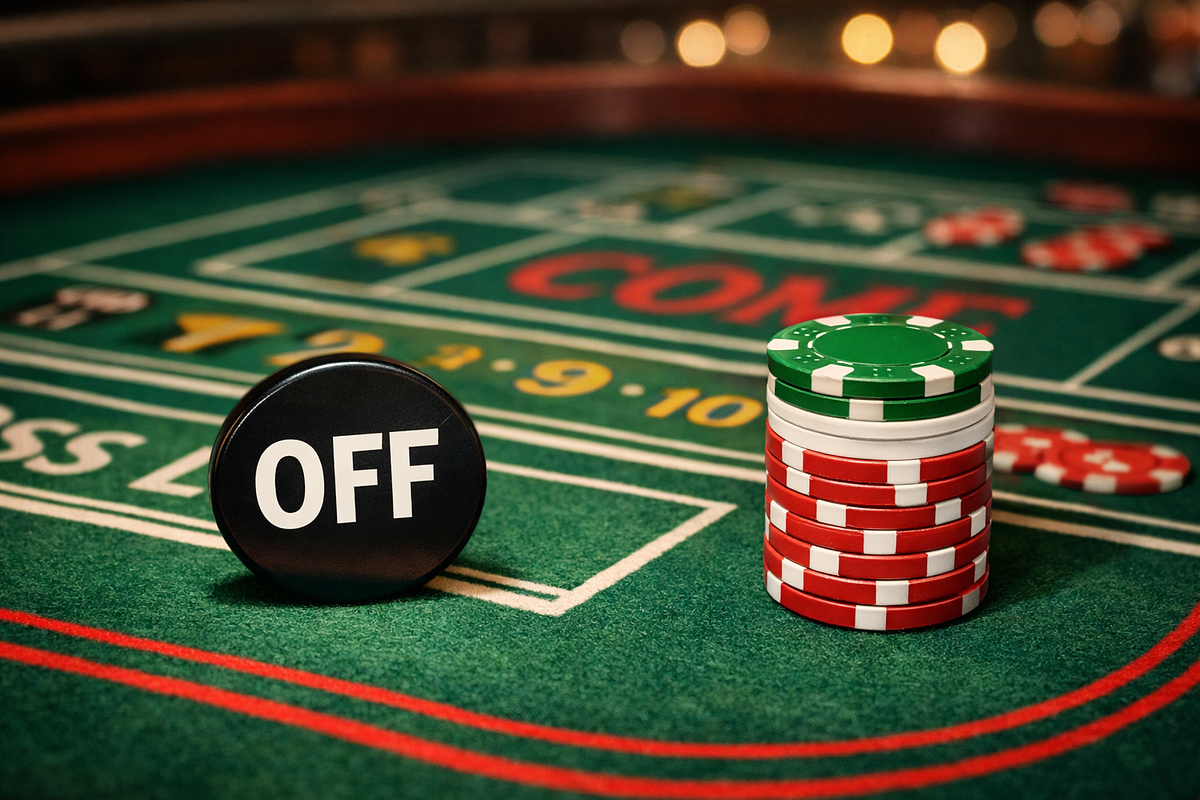
Dealers use a physical marker called the puck to show the current phase. The black side faces up and reads “OFF” when no point is established. The white side faces up and reads “ON” once the puck is moved onto the point number on the layout. Find the puck before any roll and you’ll immediately know the phase and what any outcome will do to every active bet, without waiting for a dealer to announce it.
The Pass Line Bet, The Foundation of the Game
The pass line bet organises a shooter’s entire round, and it’s the bet most players place first when they sit down. It doesn’t resolve in a single moment. The bet moves through two phases, each with its own outcomes. The phase the game is in, shown by the puck, determines which rules apply on any given roll. Understanding this two-phase structure is what makes everything else at the table readable.
The pass line bet must be placed before the come-out roll, when the puck is showing its OFF side. This timing is why the pass line is called a contract bet: once a point is established on the come-out roll, you can’t take the bet down or reduce it. That locked-in status gives the bet its consistent house edge, because you can’t exit the wager once the probability balance shifts in the point phase.
The pass line resolves differently depending on which phase is active, and each phase has its own win and loss triggers. The five outcomes below cover every pass line result you’ll see at the table.
- Come-out roll, instant win: The bet wins if the shooter rolls a 7 or 11.
- Come-out roll, instant loss (“craps”): The bet loses if the shooter rolls a 2, 3, or 12.
- Come-out roll, point established: If the shooter rolls a 4, 5, 6, 8, 9, or 10, that number becomes the point and the bet stays active into the point phase.
- Point phase, win: The bet wins if the shooter rolls the point number again before rolling a 7.
- Point phase, loss (“seven-out”): The bet loses if the shooter rolls a 7 before rolling the point again.
The pass line carries a house edge of 1.41%, which puts it among the lowest-edge bets on the craps layout. On the come-out roll alone, the win probability is 22.22%, because 8 of the 36 possible dice combinations produce a 7 or 11. Across a full round, accounting for both come-out outcomes and all point-phase resolutions, the overall win probability is about 49.3%. The outcome is close to an even proposition, but that small persistent edge in the house’s favour defines its long-run math.
The Come Bet, Extending the Pass Line Logic Mid-Round
The come bet lets you open a new pass line-style wager at any point during the point phase, without waiting for the current round to end and a fresh come-out roll to begin. You place it in the COME area of the layout, and from that moment it follows the same win, loss, and point-establishment logic as the pass line, just on its own timeline. If you want more numbers working at once rather than sitting out until the next round, come bets let you layer additional action on top of an existing pass line bet.
Once a come bet sits in the COME area, the very next roll of the dice acts as a personal come-out roll for that bet alone. A 7 or 11 on that roll wins the come bet immediately. A 2, 3, or 12 loses it immediately. If any other number (4, 5, 6, 8, 9, or 10) appears, that number becomes the come point for that specific bet, and the dealer moves the chips to the corresponding numbered box on the layout. From there, the come bet wins if its come point repeats before a 7 is rolled, making it essentially a portable pass line timed to your decision rather than the table’s phase.
You can hold several come bets at once, each anchored to a different come point, all running alongside the pass line’s own point. The outcomes below describe what happens on subsequent rolls once multiple come points are active.
- Come point repeats before a 7: That specific come bet wins and pays even money.
- 7 rolled during the point phase: A 7 that ends the round by seven-out also wipes out every come bet still waiting on its come point, along with any odds attached to those bets.
- Come-out roll for a new round: Come bets stay on their come points. Their odds are off by default but can be requested “working” by the player.
- Any other number: No effect on a come bet unless that number matches its specific come point.
The come bet carries the same 1.41% house edge as the pass line, so switching between the two doesn’t change the mathematical cost per dollar wagered. The don’t come bet mirrors don’t pass at 1.36%: it wins on a 2 or 3 when placed, loses on a 7 or 11, pushes on a 12, and once a come point is established, wins if a 7 appears before that number repeats. Every pass-side bet has a don’t-side counterpart with slightly better math but an opposite relationship to the outcomes the rest of the table is cheering for.
Odds Bets, The Layer That Changes the Math
An odds bet is a supplemental wager that can only be placed after a point or come point has been established, never before. You place it physically behind the original pass line or come bet on the layout, which is why it’s commonly called “taking odds” or “backing” the original bet. The odds bet carries a 0% house edge and pays at the exact mathematical probability of the outcome occurring. It’s the only bet in the game where the payout precisely reflects the true likelihood of winning.
The payout on an odds bet varies depending on which point number the bet is attached to, because each point number has a different probability of appearing before a 7 is rolled. The payouts in the table below come directly from the number of ways each point can be made versus the six ways a 7 can be rolled on two dice. They reflect actual dice probability, not a casino-set rate.
| Point Number | Ways to Roll (out of 36) | True Odds Payout |
|---|---|---|
| 4 or 10 | 3 ways each | 2:1 |
| 5 or 9 | 4 ways each | 3:2 |
| 6 or 8 | 5 ways each | 6:5 |
Most casinos cap the size of an odds bet at a stated multiple of the original pass line or come bet. The most common structure is the 3-4-5x odds system, which sets a different cap for each point group: 3x on 4 and 10, 4x on 5 and 9, and 5x on 6 and 8. These multipliers aren’t arbitrary. When a maximum odds bet under this system is paid at true odds, the combined return is always 6x the original pass line or come bet regardless of which point is active, which simplifies dealer payouts. A posted odds rule of 10x or 100x follows the same logic but allows a larger true-odds layer on top of the base wager. The higher the posted multiple, the more of the total money in action carries a 0% edge.
Come bets accept odds the same way pass line bets do. Once a come point is assigned and your chips are moved to the corresponding numbered box, you can place an odds bet behind them. By default, though, come odds are off (not working) on the shooter’s next come-out roll. That means a 7 on that roll won’t collect the odds portion, and hitting the come point number won’t pay the odds portion either, unless you specifically ask to keep them working. This default protection kicks in right when a new round begins, which is when a 7 is most likely to appear as a natural outcome. Knowing this prevents the common beginner mistake of assuming every active bet resolves the same way on every roll.
Combining the Three Bets, How the House Edge Actually Behaves
The pass line and come bets each carry a fixed house edge that applies to the base wager regardless of what else is placed alongside it. Adding odds on top of either bet mathematically dilutes the combined effective edge, because the odds portion contributes zero edge of its own. The higher the permitted odds multiple, the closer the blended edge across the total stake gets to zero, though it never reaches zero because the base wager keeps its 1.41% or 1.36% throughout. A player staking $5 on the pass line with 10x odds is putting $55 in total at risk, and only $5 of that carries any house advantage at all.
Each of the four foundational bets resolves through a different combination of placement timing, triggering numbers, and house edge. The table below puts those details side by side so you can see how the bets relate to each other at a glance.
| Bet Type | When Placed | Primary Win Trigger | Primary Loss Trigger | House Edge |
|---|---|---|---|---|
| Pass Line | Before come-out roll | 7 or 11 on come-out; point repeats before 7 | 2, 3, or 12 on come-out; 7 before point | 1.41% |
| Don’t Pass | Before come-out roll | 2 or 3 on come-out; 7 before point | 7 or 11 on come-out; point repeats before 7 | 1.36% |
| Come | Any roll during point phase | 7 or 11 on next roll; come point repeats before 7 | 2, 3, or 12 on next roll; 7 before come point | 1.41% |
| Don’t Come | Any roll during point phase | 2 or 3 on next roll; 7 before come point | 7 or 11 on next roll; come point repeats before 7 | 1.36% |
| Odds (behind any of above) | After point / come point set | True odds win with underlying bet | Underlying bet loses | 0% |
You can also add odds behind don’t pass or don’t come bets, but the payout structure reverses. On the don’t side, you lay odds, putting up more to win less, because a 7 (the most frequently rolled total) is what wins. The lay ratios reflect that: against a point of 4 or 10, you lay 2 to win 1; against 5 or 9, you lay 3 to win 2; against 6 or 8, you lay 6 to win 5. A don’t-side player staking a larger amount on odds isn’t taking an aggressive position. The larger stake is simply the arithmetic result of the same 0% edge expressed from the opposite side of the probability.
Reading the Craps Table Once the Mechanics Are Clear
Craps becomes readable once you understand how these three bets connect as a single interlocking system rather than three separate wagers. If you can locate the puck, identify the active phase, and trace what any given roll does to each bet on the layout (including why an odds bet behind a pass line changes the blended math without touching the base wager), you have the structural knowledge you need to follow the game accurately.
We check operator terms, licences and payment details against the casino's own pages and update this content when they change. Read our editorial policy, our transparency statement, or report an error. If gambling stops being fun, see our responsible gambling resources.