


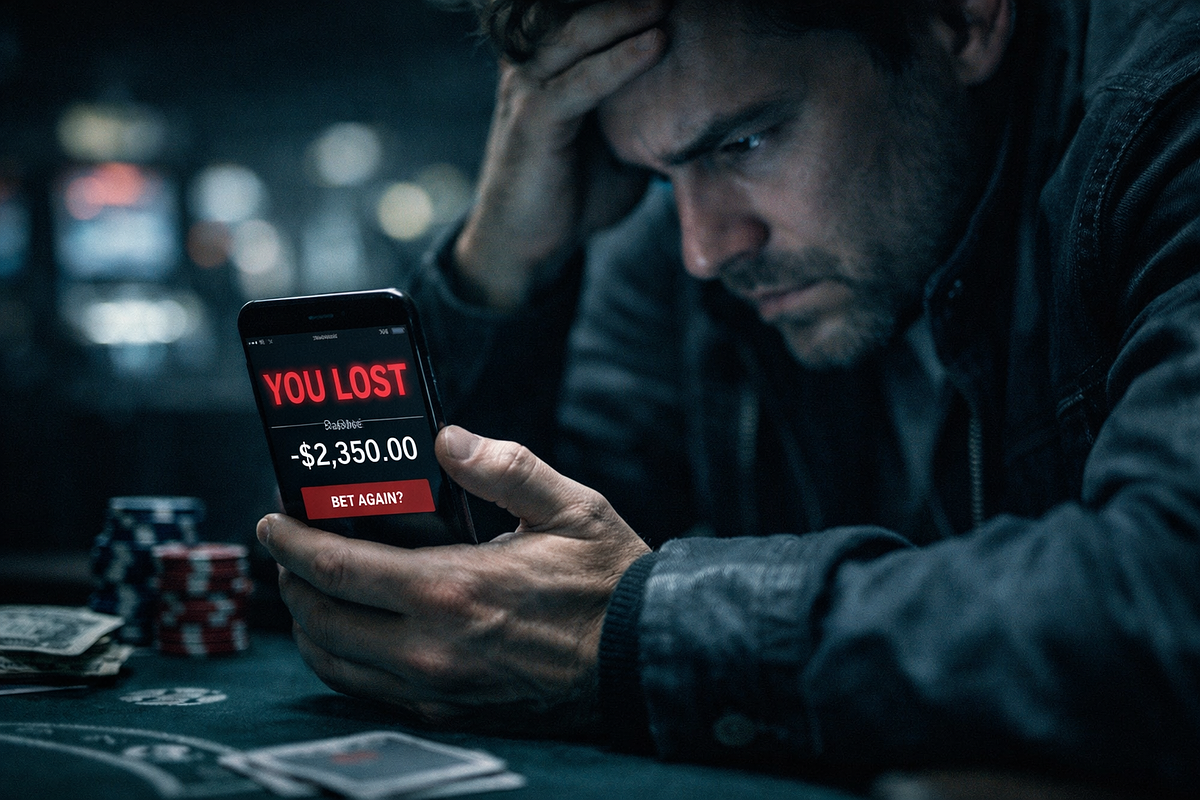
Chasing losses means continuing to bet after losing money, often with bigger stakes, in an attempt to win it back. It’s a recognized clinical warning sign of gambling disorder, not just a lack of willpower. Specific cognitive biases and disrupted emotional processing drive the behavior, whether you want them to or not. This page explains what those mechanisms are and what you can do to interrupt them.
Chasing losses is driven by identifiable psychological and neurological patterns, including cognitive biases and disrupted emotional processing, that work independently of a person’s intentions. Understanding those patterns makes the behavior interruptible: if you can recognize which driver is active in a given moment, you have a concrete place to step in.
What Chasing Losses Actually Means
Chasing losses means increasing your bet size or continuing to gamble after a loss in order to recover money you’ve already spent. The behavior is defined by its goal, getting back a prior loss, not by any change in the odds. Each new bet resets the probability of winning to exactly the same level as the first bet of the session, so the math doesn’t support the recovery you’re hoping for.
The Psychology Behind Chasing Losses
Chasing losses isn’t a random lapse in judgment. It comes from specific cognitive and neurological mechanisms that exist across the general population and become more pronounced as gambling frequency and severity increase. The drivers fall into three overlapping categories: cognitive biases that distort how you interpret a loss, neurochemical processes that reinforce continued gambling at the level of brain circuitry, and emotional regulation difficulties that make gambling a default response to distress.
Cognitive Biases That Fuel the Behaviour
Loss aversion is the well-established finding that a loss feels psychologically heavier than an equivalent gain. In gambling, this makes recovering a loss feel more urgent than winning something new, which pushes you to place another bet rather than accept the deficit and stop.
The illusion of control is the belief that skill, strategy, or persistence can influence outcomes that are actually determined by chance. When you believe your next decision can correct a random result, each loss starts to feel like a problem to solve rather than an outcome to accept, which keeps the impulse to keep playing alive.
The gambler’s fallacy is the belief that a win becomes statistically more likely after a run of losses. Because each bet resets to the same fixed probability, this belief has no mathematical basis. But it gives people a justification for continuing to wager after repeated failures.
Recognizing these three biases doesn’t make them disappear, but it does let you identify the specific thought pattern driving a post-loss urge to bet. That’s the first step toward interrupting it.
The Role of Dopamine and Brain Response
Gambling triggers the release of mesolimbic dopamine, the brain’s primary driver of incentive motivation. Research has found that dopamine synthesis capacity is greater in pathological gamblers than in non-pathological gamblers, and that the degree of release is linked to symptom severity. Dopamine has been identified as a prime candidate in studying neurochemical abnormalities in pathological gambling because of its role in drug addiction and reward-driven behavior.
In studies of healthy individuals, activity in the ventromedial prefrontal cortex and dorsal anterior cingulate cortex, brain areas associated with conflict between cognitive and emotional systems, was linked to choosing to chase losses. This means loss-chasing has a specific neurological signature, not just a motivational one.
Because gambling alters brain function in a way comparable to substance addiction, the reinforcement cycle becomes harder to interrupt as losses accumulate, not easier. That reframes chasing losses as a neurological pattern rather than a personal failing.
Impulsivity and Difficulty Managing Emotions
Impulsivity is consistently associated with problem gambling, and avoidance-based coping strategies, including impulsivity, rumination, and emotional non-acceptance, are linked to gambling severity. Research on the relationship between emotion regulation and gambling disorder has found that difficulties in processing and managing emotions are a reliable correlate of problem gambling across more than two decades of literature.
One specific emotional processing difficulty, alexithymia, characterized by trouble identifying and describing your own emotional states, appears at much higher rates among problem gamblers. A study using the South Oaks Gambling Screen and the Toronto Alexithymia Scale found that 34% of problem gamblers met criteria for high alexithymia, compared with 11.1% of non-problem gamblers. The same research links alexithymia specifically to loss-chasing behavior, with alexithymic individuals showing a greater tendency to increase bets following a loss, and that tendency scaling with the size of the loss.
The practical takeaway is that post-loss betting often functions as emotional escape rather than a strategic recovery attempt. When you can’t clearly identify or process the distress a loss produces, continued gambling becomes a way of avoiding that distress rather than dealing with it.
Chasing Losses as a Warning Sign of Gambling Addiction
Chasing losses isn’t just a bad decision made in the heat of the moment. It’s a recognized warning sign in the clinical progression of gambling disorder and a defining criterion for diagnosis. The sections below look at where this behavior fits in that progression and what consequences follow when the pattern takes hold.
Where Chasing Losses Fits in the Progression of Gambling Disorder
Loss chasing is described in the research literature as a central feature of gambling disorder and has featured prominently in clinical accounts of excessive gambling. It’s also an established diagnostic criterion for gambling disorder as a formally recognized condition. Research indicates that more than 75% of problem gamblers report chasing losses, and chasing was observed even when other commonly cited indicators of problem gambling were absent.
The behavior compounds through escalation. Each unsuccessful attempt to recover losses increases both the financial deficit and the emotional pressure to continue, which raises the stakes of the next attempt. The cycle reinforces itself because the motivation to recover grows alongside the amount lost.
Recognizing where a pattern of behavior sits in this progression lets you assess more accurately whether your gambling has moved from recreational into compulsive territory. When loss chasing is present alongside escalating bet sizes and repeated failed attempts to stop, the pattern looks more like the clinical picture of gambling disorder than ordinary recreational play.
Emotional, Financial, and Relationship Consequences
The consequences of sustained loss chasing go well beyond the gambling session itself. They build up across three areas of a person’s life, and the damage in each area tends to reinforce the conditions that drive further gambling.
- Financial impact: Each recovery attempt adds to the existing deficit rather than reducing it, because the mathematical structure of gambling doesn’t change with prior losses. Over time this produces escalating debt and, in severe cases, financial ruin.
- Mental health impact: Pathological gambling is associated with mood and anxiety disorders. Using gambling as an escape from distress is identified as a defining characteristic that separates problem gamblers from recreational players, meaning the behavior both reflects and deepens psychological difficulty.
- Relationship impact: The financial strain, secrecy, and emotional withdrawal associated with problem gambling place sustained pressure on family members, partners, and close social ties, often eroding trust before the gambling behavior itself is acknowledged.
How to Stop Chasing Losses
Stopping the pattern of chasing losses requires two parallel efforts: external structural limits that reduce exposure before emotions take over, and internal work on the cognitive biases and emotional responses that drive the behavior. Knowing when those self-directed efforts aren’t enough is itself a necessary part of the strategy.
Practical Strategies to Interrupt the Pattern
Because chasing losses is sustained by loss aversion, the gambler’s fallacy, dopamine-driven motivation, and avoidance-based coping, effective interruption works against those mechanisms directly. That means pre-committed limits that remove in-session decision-making and emotional regulation practices that address the distress driving the impulse to continue.
- Set a fixed gambling budget: Treat the amount as an entertainment cost, not an investment, and don’t exceed it regardless of outcomes.
- Accept losses as part of gambling: Recognize that recovering a specific loss isn’t a realistic goal because odds reset with each bet.
- Use time and deposit limit tools: Apply the built-in limit tools available on betting platforms and apps to pre-commit to boundaries before a session begins.
- Journal emotional triggers: Track the emotions and situations that come before the impulse to bet after a loss, so patterns become visible.
- Develop healthy coping mechanisms: Replace avoidance-based coping, such as rumination and impulsive action, with active coping practices for stress and negative emotions.
- Seek social support: Talk with trusted people about the behavior. Isolation reinforces the pattern.
- Consider professional help: Reach out to licensed mental health professionals or gambling-specific treatment services when self-directed strategies aren’t working.
Recognising When to Seek Outside Support
Several signals indicate that self-directed strategies are no longer adequate. Repeated failure to stay within a set budget, progressively larger bets, borrowing money to fund gambling, and hiding gambling activity from family or friends all point to a pattern that has moved beyond recreational behavior. The most clinically significant signal is gambling used as a primary response to emotional distress. Research identifies this as a defining feature that separates problem gamblers from recreational players, because it means the behavior is functioning as emotional escape rather than entertainment.
When one or more of these signals is present, three categories of outside support are available. National gambling helplines provide immediate, confidential access to trained advisers at no cost. Peer support communities connect people with others who have direct experience of the same pattern, which reduces the isolation that reinforces continued gambling. Licensed mental health professionals with experience in behavioral addictions offer structured, evidence-based treatment that addresses both the gambling behavior and any underlying emotional regulation difficulties that sustain it.
The threshold for seeking support isn’t defined by the size of losses alone. It’s defined by how much the behavior persists despite negative consequences and resists self-imposed limits.
Moving Past the Impulse to Chase
What makes chasing losses interruptible isn’t willpower. It’s identification. The behavior is driven by distinct, nameable mechanisms, cognitive, neurochemical, and emotional, and recognizing which one is active at a given moment is what creates a point of intervention. A person who can tell the difference between a gambler’s fallacy thought and an avoidance-driven urge is in a much better position to respond in a way that addresses the actual driver, not just the surface impulse.
We check operator terms, licences and payment details against the casino's own pages and update this content when they change. Read our editorial policy, our transparency statement, or report an error. If gambling stops being fun, see our responsible gambling resources.