

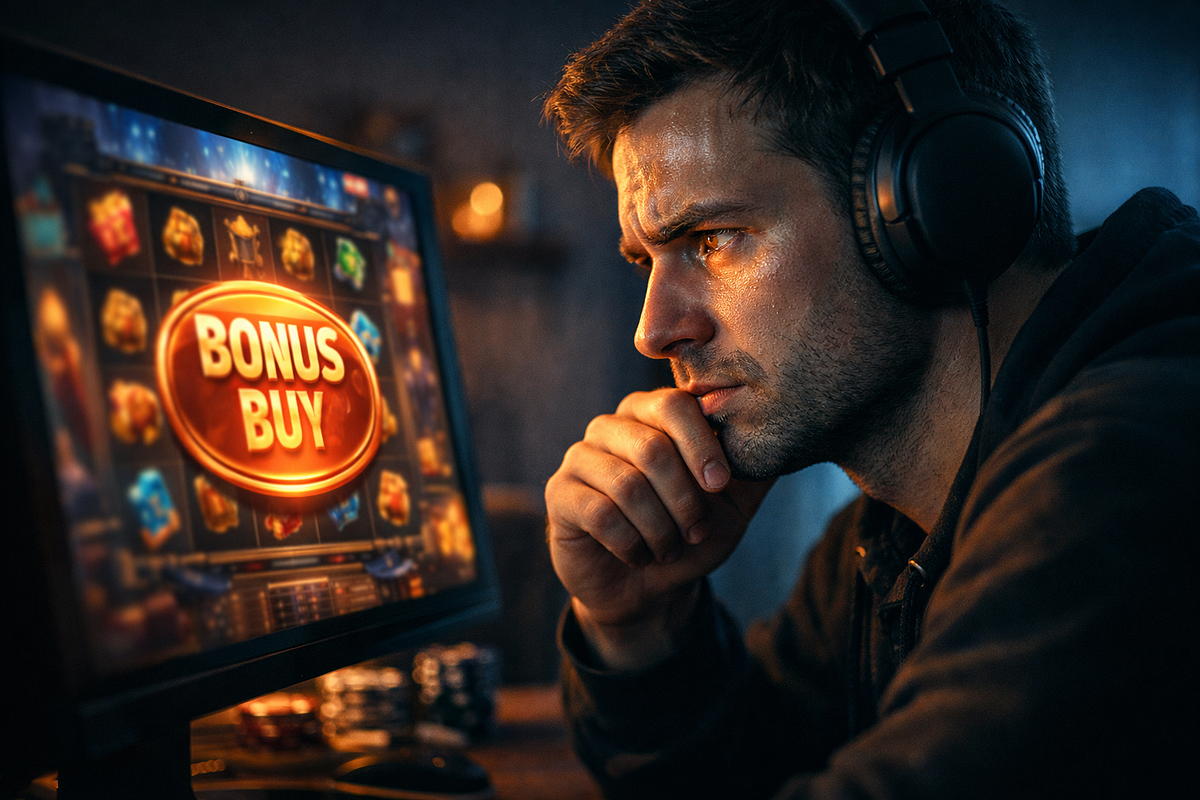
Many of the bonus buy sessions you watch on casino streams are funded by casino operators, not the streamer’s own money. That matters because it changes what you’re seeing. When a streamer places repeated high-cost bonus buys without flinching, it looks very different once you know who’s paying for them. This article covers how streamer sponsorships work, what Canadian advertising and licensing rules say about bonus buy promotions, and what the feature actually costs a player spending their own money. By the end, you’ll have a clearer picture of how much weight to give streamer content when thinking about bonus buys yourself.
The Sponsorship Model Behind Streamed Bonus Buys
A large share of high-stakes casino streaming is funded by casino operators, not the streamer’s personal bankroll. That changes the meaning of what you see on screen. The stakes, the decisions, the emotional reactions, all of it happens under conditions that have nothing to do with what a regular player faces. Gambling communities have broadly agreed on this point, and awareness-focused video channels have called the practice out directly as misleading to viewers.
How Casino-Funded Bankrolls Work in Practice
Sponsored streamers place high-value bonus buys using money supplied or reimbursed by the casino operator, so an on-screen loss costs the streamer nothing personally. Forum communities like Casinomeister have noted that streamers routinely place bonus buys in the range of CAD $10,000–$20,000 without hesitation, which makes more sense when you realize they have no personal downside. A YouTube video titled “Gambling Streamers: An Industry Of Secrets And Scams” states directly that streamers send a false message by wagering casino-supplied money rather than their own. An Instagram reel reportedly exposed three streamers playing with casino-funded money while framing the sessions in a way that encouraged viewers to deposit real funds based on fabricated gameplay.
These arrangements come in a few recognizable forms:
- Direct bankroll provision: The operator funds the session outright. The streamer starts playing with money that was never theirs to lose.
- Loss reimbursement arrangements: The streamer uses their own money during the session but gets their losses covered by the operator afterward, removing the financial sting after the fact.
- Flat promotional fees: The streamer gets a fixed payment from the operator regardless of whether the session ends in a win or a loss, so their income has nothing to do with what happens on screen.
- Revenue-share affiliate structures: The streamer earns a cut of deposits made by viewers who sign up or deposit through the streamer’s referral link. This gives them a financial reason to encourage viewer participation rather than show realistic play.
Why the On-Screen Illusion Distorts Viewer Perception
Because the streamer has no personal money at risk, placing several high-cost bonus buys in a row isn’t a playing style anyone can replicate. It’s only possible because the financial risk has been removed. A self-funded Canadian player making the same sequence of buys would face real, compounding losses with each purchase.
When you watch a streamer chase a bonus round with a third or fourth consecutive buy, it reads as excitement or bold decision-making. In practice, it reflects the absence of consequences, not some calculation about expected value or bankroll management. The same goes for the emotional reactions on stream. The tension and elation you see are produced in a context where the financial stakes for the person on screen are different from those facing anyone watching at home.
Legal Status of Bonus Buys in the Canadian Market
Bonus buy features are legal and available at licensed Canadian online casinos, including those operating under Ontario’s regulated private market. That means the mechanic you see on stream is accessible to a self-funded Canadian player at home. It’s not restricted to offshore or unlicensed platforms. And because it’s available, Canadian players can replicate what they see on stream, which makes it worth knowing how other regulators have treated the same feature.
Cross-Jurisdictional Contrast
The UK Gambling Commission’s bonus buy removal required operators to remove the feature entirely, deciding it was problematic enough to ban outright. That’s a useful reference point for Canadian viewers: the feature shown on stream isn’t universally accepted as low-risk. At least one major regulator looked at the same mechanic and pulled it from its market.
| Jurisdiction | Bonus Buy Availability | Regulatory Position |
|---|---|---|
| Canada (including Ontario’s licensed private market) | Permitted and available at licensed online casinos | The Alcohol and Gaming Commission of Ontario (AGCO) regulates online gambling in Ontario and has not prohibited the feature. Private operators registered with the AGCO and iGaming Ontario may offer bonus buy slots. |
| United Kingdom | Prohibited; removed from all licensed operator sites by 17 May 2021 | The UK Gambling Commission required all operators it contacted to remove the feature, citing that it increases “the intensity of play and the corresponding risks to players” (UK Gambling Commission, May 2021) |
Provincial Variation Within Canada
Gambling regulation in Canada is handled at the provincial level, so what’s available to you depends on where you live. British Columbia, Alberta, and Quebec run government monopoly platforms with a more limited range of products. Ontario opened its market to private licensed operators on 4 April 2022, a change made possible at the federal level when Bill C-218 received royal assent on 29 June 2021. That bill amended paragraph 207(4)(b) of the Criminal Code to allow provinces and territories to conduct and manage single-event sports betting and to support broader provincial market expansion. Bonus buy features are available wherever regulated online slots are offered. Players in Ontario’s private licensed market can access the same feature type that streamers show on screen, while players on government monopoly platforms in other provinces may find a narrower selection of titles and features.
Advertising Rules That Shape What You See, and Don’t See
Ontario’s gambling regulator prohibits operators from advertising bonuses, inducements, and credits to the general public. That rule got sharper teeth after amendments took effect on 28 February 2024. Streamer content featuring bonus buys, free spins, or promotional credits works like advertising, which puts it in tension with that framework. The gap between what a licensed operator can advertise and what shows up in streamed content isn’t accidental. It’s a structural feature of how the current rules are written.
The Inducement Advertising Prohibition
Section 2.05 of the AGCO’s Registrar’s Standards for Internet Gaming says advertising and marketing materials that communicate gambling inducements, bonuses, and credits are prohibited. There’s a narrow exception for an operator’s own gaming site and for advertising directed at players who have actively consented. The prohibition explicitly covers free spins, and ads must not contain misleading claims, whether direct or indirect. When a streamer showcases a bonus buy feature or talks about free-spin credits to a general audience, that content does the same job as the advertising the standard restricts. The sources confirm this tension exists. They don’t assert that any specific streamer has faced regulatory action.
How This Reshapes the Viewer’s Reading of Streamed Promotions
Once you understand Ontario’s advertising rules, streamer content about bonuses and buy features looks different. A licensed operator can’t broadcast those inducements to an unconsenting general audience, but a streamer can present the same content as entertainment without being held to the same standards. So the promotional framing you see on stream, the enthusiasm around a bonus buy, the display of free-spin outcomes, may be reaching you through a channel outside the rules applied to operators. The content isn’t neutral. It carries the same informational effect as an ad for the feature, regardless of how it’s labeled.
The Real Financial Mechanics of a Bonus Buy for a Self-Funded Player
A bonus buy has a fixed cost expressed as a multiple of your base bet, and that cost comes out of your balance the moment you make the purchase, regardless of what the feature pays out. Because each transaction is large relative to a single spin, your balance moves much faster under bonus buy play than it does during a regular base-game session.
The Standard Cost Structure
The standard cost of purchasing a bonus feature is 100 times your chosen base bet stake. So if you’re betting CAD $1 per spin, you pay CAD $100 to trigger the feature directly. That single transaction compresses what would otherwise be many individual spins’ worth of expected wagering into one immediate deduction from your balance. The purchase price is locked in at the point of transaction. What the feature actually pays out, which can range from well below the purchase cost to a large multiple of it, is only determined after the money is gone.
Balance Depletion Dynamics
Because each buy costs a fixed multiple of your base bet and gets deducted regardless of outcome, sequential purchases can drain a bankroll quickly. Ten consecutive buys at a CAD $1 base stake costs CAD $1,000 in purchase costs alone, before accounting for any returns those features produce.
A forum account on Casinomeister describes a streamer losing approximately CAD $250,000 across roughly 100 consecutive bonus buys on a high-volatility title, Dog House Megaways. That’s a single unverified forum statement with no independent corroboration, and it’s presented here as reported community sentiment rather than a confirmed event. But what it illustrates is real: high-volatility titles can return well below the purchase cost across extended sequences, and each subsequent buy made to try to recover a prior loss adds a full fixed cost to a balance that’s already smaller. The cost structure of the next purchase doesn’t change because the previous one went badly. It just applies the same fixed multiple to less money.
The Gap Between Streamed Outcomes and Realistic Player Results
Streamed bonus buy content is a curated selection of high-variance outcomes. It’s not a representative sample of what a self-funded player experiences across sessions. Big wins get clipped, shared, and recirculated. Extended loss runs don’t. This selection process sits inside a broader industry environment where, according to a 2026 audit covering 2025 US market spending, gambling operators directed roughly 8.7 times more money toward celebrity and athlete endorsement partnerships than toward responsible gambling programs. What you watch is shaped by editorial choices at the streamer level and commercial priorities at the industry level.
Selective Presentation and Session Curation
High-variance bonus buy content gets distributed selectively. Clips showing large wins circulate widely across short-form video platforms and social feeds. Sessions dominated by consecutive losses rarely get the same treatment. This isn’t incidental. It’s the natural output of a content format that rewards engagement, and big wins generate more of it. Community forum threads and user-generated criticism on gambling discussion platforms have documented this pattern, with awareness-focused video channels framing it as systematically misleading rather than aspirational. The result is that audiences form a picture of typical outcomes from an unrepresentative sample, one weighted heavily toward the upper end of the variance range.
Marketing Spend vs. Responsible Gambling Investment
A 2026 audit by 5W Research Division, covering 2025 spending in the US gambling market, found that operators allocated approximately $520 million USD to celebrity and athlete endorsement partnerships and approximately $60 million USD to responsible gambling programs and communications, a ratio of roughly 8.7 to one. The figures cover the US market specifically and don’t extend directly to Canada, but they show the scale of the gap between promotional investment and harm-reduction investment at an industry level. The audit doesn’t establish a causal link between this spending ratio and any individual streamer’s editorial choices, but it describes the commercial environment in which streamed bonus buy content is produced and distributed.
Reading Streamed Bonus Buy Content as a Critically Informed Canadian Viewer
When the financial conditions behind a streamed session are completely different from those facing the person watching, the session can’t tell you what the mechanic actually costs in practice. A Canadian viewer who understands that gap, between sponsored play and self-funded play, isn’t watching streamed bonus buy content as a demonstration of realistic outcomes. They’re reading it accurately as commercially produced material shaped by interests that don’t match their own. Knowing which creators disclose sponsorships clearly is part of that judgment.
We check operator terms, licences and payment details against the casino's own pages and update this content when they change. Read our editorial policy, our transparency statement, or report an error. If gambling stops being fun, see our responsible gambling resources.