

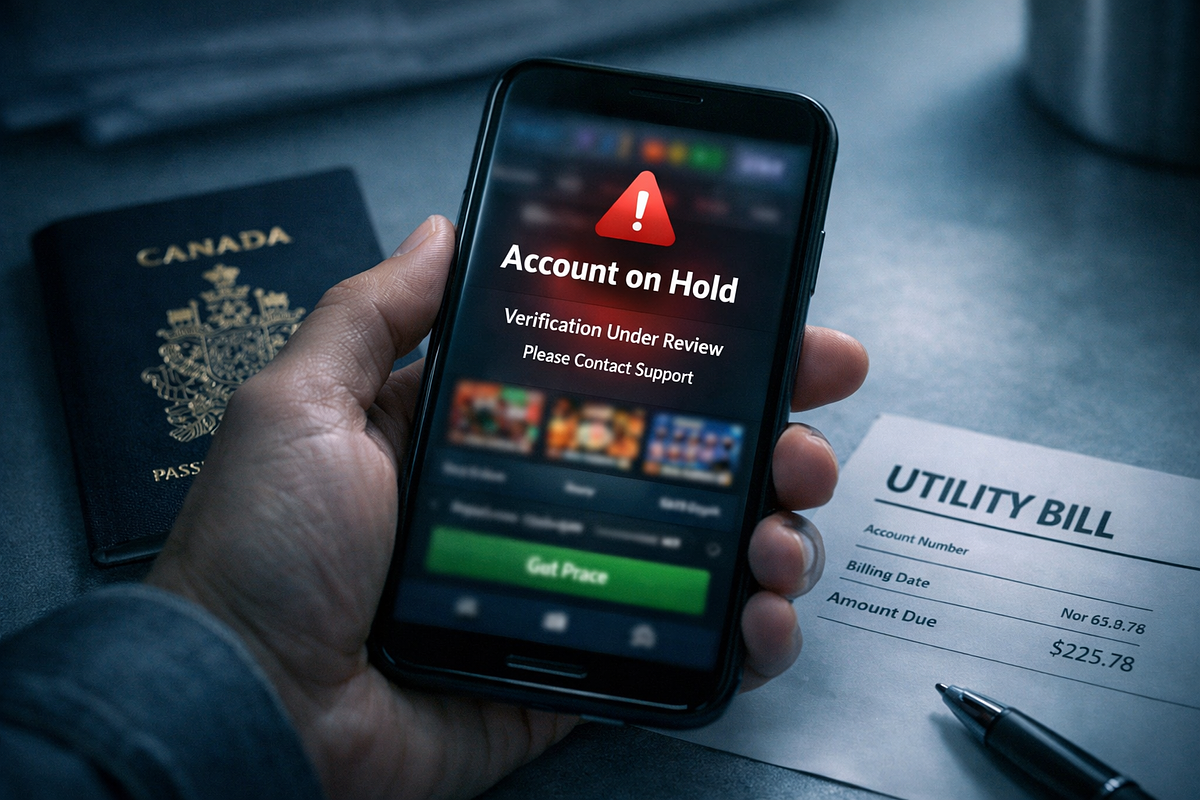
Yes, Canadian online casinos can close or suspend your account, and they have both contractual and legal authority to do so. When you register, you agree to a terms of service contract that gives the operator grounds to act if you break the rules. Canadian operators also have mandatory obligations under federal anti-money laundering law, which means some account actions aren’t a judgment call. Knowing what triggered an account action tells you how to respond.
The Legal Basis for Account Action at Canadian Online Casinos
Canadian online casinos can suspend or close accounts under two related frameworks: the contract you agree to at registration, and the federal law that governs financial crime reporting. Both give operators defined grounds for action, so a suspension isn’t random. Knowing which framework is driving the action tells you what evidence matters and what options you have.
Contractual Authority Under Terms and Conditions
Every online casino’s terms of service reserve the right to block or refuse service to any player who breaks those terms. This is standard across the industry, not unique to Canadian operators. The account agreement is the main tool an operator uses when it takes action, and its scope is wide. Terms typically cover identity verification, permitted payment methods, bonus use, and betting behaviour. When an operator suspends or closes an account, it’s enforcing a contract the player agreed to at sign-up. The relevant questions are: which term was breached, what evidence does the operator have, and what do the terms say about remedies or appeals?
Regulatory Obligations That Shape Mandatory Action
Canadian casinos are designated reporting entities under the Proceeds of Crime (Money Laundering) and Terrorist Financing Act (PCMLTFA), a federal law aimed at detecting and deterring money laundering and terrorist financing. The agency that administers and enforces compliance is FINTRAC, the Financial Transactions and Reports Analysis Centre of Canada. Under the PCMLTFA and its Regulations, casinos must verify client identity and file reports for certain transactions, including a Large Cash Transaction Report whenever a casino pays out CAD $10,000 or more in a single transaction or in multiple transactions within a 24-hour period. Because these are legal requirements, not discretionary policies, some account holds and identity checks aren’t the operator choosing to act. They’re the operator complying with a legal duty it cannot waive. If your account gets reviewed because of a large transaction or a suspicious-activity flag, that’s a federal compliance process, not a business decision.
The Most Common Reasons a Canadian Casino Suspends or Closes an Account
The triggers seen across the Canadian online casino market fall into a defined set of recurring categories, each grounded in the operator’s terms of service and, in several cases, in federal law. They divide into two broad types: operator-initiated action taken in response to player behaviour, and player-initiated action like voluntary self-exclusion. Knowing which type applies tells you how to interpret the action and what to do next.
Failed Identity Verification (KYC)
Identity verification, commonly called KYC, is the process by which an operator confirms your identity, age, and address before processing a withdrawal. Operators typically ask for a government-issued photo ID, proof of address, and, where relevant, proof that you own the payment method you’re using.
Failed verification is one of the most common causes of account holds because identity verification is a legal requirement under the Proceeds of Crime (Money Laundering) and Terrorist Financing Act, not an optional step the operator can skip.
If your submitted documents don’t match your registration data, are expired, illegible, or can’t be authenticated, the operator holds the account until the issue is resolved. FINTRAC guidance specifies that an identification document must not have been expired at the time it was verified. If the problem isn’t fixed, the operator closes the account.
A verification hold is a solvable procedural problem, not a punishment. Treating it as a document-matching issue rather than a penalty tells you what to submit next. The verification process itself follows its own separate rules about what triggers it and what happens when it fails.
Creating Multiple Accounts
A duplicate account means more than one active registration per player at the same operator or across affiliated operator networks. Creating multiple accounts breaks the terms of service at every Canadian online casino operator.
Operators detect duplicates through IP tracking, identity document matching, payment instrument overlap, and other detection methods. When duplicates are confirmed, every linked account gets suspended. The player also risks being blacklisted from re-registering, and all associated funds may be forfeited.
A sudden multi-account closure is the result of pattern detection across linked data points, not random enforcement. That’s the right framing when you’re deciding how to engage the operator’s dispute process.
Bonus Abuse and Promotion Exploitation
Bonus abuse means exploiting promotional offers in ways the terms of service prohibit, such as betting patterns designed purely to clear a wagering requirement, or coordinating promotions across multiple accounts.
Operators track wagering-requirement progress, bet sizes relative to bonus balance, and game selection during bonus play. Patterns that fall outside normal recreational play get flagged. Confirmed violations lead to bonus forfeiture, winnings clawback, and account limitation or closure.
Promotional terms are active, tracked contracts. A bonus-related restriction is the result of a specific tracked deviation, not an unexplained penalty.
Terms and Conditions Violations (Payment, Geography, Betting Patterns)
This category covers contract breaches that don’t fall under identity, duplicate accounts, or bonus abuse. It includes three distinct triggers: using a payment method not held in your own name, accessing the platform from a jurisdiction the operator’s licence doesn’t cover, and generating suspicious or irregular betting patterns.
These are among the least obvious triggers because they can come from behaviour that unknowingly crosses a term. A player using a shared payment account, travelling outside Canada, or placing bets in an unusual pattern may trigger a review without realising they’ve broken any rule.
Operators detect payment violations through payment instrument verification, geographic violations through geolocation and IP checks, and irregular wagering through automated systems. Ontario’s AGCO defines suspicious betting activity as unusual betting activity that cannot be explained, and characterises it as indicative of match fixing, manipulation of an event, misuse of inside information, or other dishonest activity. That definition shows how broadly irregular patterns can be interpreted under licence conditions.
A sudden restriction in this category often comes down to an operational detail: a payment account holder name, a travel location, a bet size. Fraudulent activity flags follow the same logic. The system identifies a deviation, not necessarily intent.
Player-Initiated Self-Exclusion
Self-exclusion is a player-requested closure, not an operator-initiated suspension. The Responsible Gambling Council defines it as a commitment a player makes voluntarily by entering into an agreement with operators not to gamble for a chosen period.
In Ontario, BetGuard is a centralised self-exclusion programme run under AGCO oversight. It lets a player register once and be excluded from all legal Ontario online gambling platforms at the same time. All legal Ontario operators are required to maintain a self-exclusion programme that is well-promoted and easily accessible.
Self-exclusion is binding on the operator for the period selected and typically can’t be lifted early on request. If you try to open a new account or access a platform during an active self-exclusion period, you’re in breach of the agreement, and that attempt itself is grounds for further account action.
Self-exclusion is a protective closure, not a penalty. The options available after a self-exclusion closure are materially different from those available after an operator-initiated suspension.
Suspicion of Fraudulent Activity or Unusually Large Winnings
This category covers account freezes or closures based on suspicion of cheating, collusion, or activity that triggers fraud-review or responsible-gambling thresholds, including cases where unusually large winnings prompted a review.
This is the trigger most likely to feel arbitrary because it isn’t tied to an obvious rule breach. A player who hasn’t done anything deliberately irregular can still generate a pattern that deviates from expected behaviour in ways the monitoring system flags.
Machine-learning and rules-based systems flag deviations from expected play patterns. Separately, FINTRAC requires casinos to detect and report suspicious transactions, and publishes guidance to help operators identify money laundering and terrorist financing risks. That means some account freezes in this category are driven by federal reporting obligations, not just operator discretion. Flagged accounts enter a review process during which withdrawals are held.
An unexpected hold on a winning account is a defined review process, not an accusation. The right response is to engage the operator’s review process with documentation, not to treat the hold as a final decision.
What a Player Can Do After an Account Is Suspended or Closed
The right next step depends on what triggered the account action. A verification hold calls for a different response than a bonus-abuse finding or a self-exclusion activation. Most account actions can be resolved when you engage the operator’s process with documented evidence. Escalating to a licensing authority is the right path only after the operator has failed to act on a direct complaint.
Immediate Steps and Escalation Path
The recourse process moves from operator-level communication to licensing-authority escalation. Documented evidence is the most important thing you control throughout that process. Ontario players, for example, can submit internet gaming complaints directly to the AGCO once they’ve exhausted operator-level resolution. Where the account issue involves self-exclusion or responsible-gambling limits, the right contact is a national resource, not the operator’s support line.
These are the actions available to a player whose account has been suspended or closed.
- Request the specific reason in writing. Contact operator support and ask for the exact clause or category cited for the action, in writing, so you have a record in your own inbox.
- Assemble supporting documentation. Gather identity documents, payment records, session or bet history, and any promotional terms that were in effect, matched to the cited reason.
- Complete outstanding verification requests. If the trigger is verification-related, submit the specific documents the operator asks for in the exact format required.
- Preserve all communications. Keep every email, chat transcript, and reference number in a single file to support any later escalation.
- Escalate to the operator’s licensing authority. If the operator doesn’t act on your complaint, submit your documented evidence to the regulator that issued the operator’s licence. You can find that information on the operator’s own site.
- Contact a national responsible-gambling resource where relevant. If the account issue involves self-exclusion or responsible-gambling limits, the Responsible Gambling Council provides Canadian-facing help resources, including access to gambling counsellors and GamTalk. That’s the right contact, not the operator’s support line.
Reading the Category Correctly Is What Determines the Outcome
Account actions at Canadian online casinos aren’t all the same. They come from different systems, each with its own logic and recourse path. If you can identify whether an action comes from a contract breach, a statutory compliance obligation, or a voluntary self-exclusion agreement, you know what response makes sense. Without that, you’re guessing. With it, a resolvable situation stays resolvable instead of turning into an abandoned account.
We check operator terms, licences and payment details against the casino's own pages and update this content when they change. Read our editorial policy, our transparency statement, or report an error. If gambling stops being fun, see our responsible gambling resources.