

The difference between soft hands and hard hands in blackjack comes down to one fact: an Ace can count as either 1 or 11, and whether that flexibility is still available determines which rules apply to your hand. A soft 17 and a hard 17 have the same total but call for different actions, and knowing why is what separates guesswork from sound play. This page explains how to classify any hand as soft or hard, what happens when a soft hand converts to a hard one during play, and which basic strategy decision is correct for each hand type against every dealer upcard. By the end, you’ll be able to look at any two-card combination, identify it correctly, and know the right move to make.
What Makes a Hand Soft or Hard in Blackjack
Every strategic difference between a soft hand and a hard hand traces back to one property of the Ace: it counts as either 1 or 11, whichever produces the better result. That dual value is the basis of the soft-versus-hard distinction. Until you understand how the Ace’s value shifts, the strategy rules for each hand type seem arbitrary. Once that concept clicks, the rules follow directly from the math. The three sections below build from that foundation.
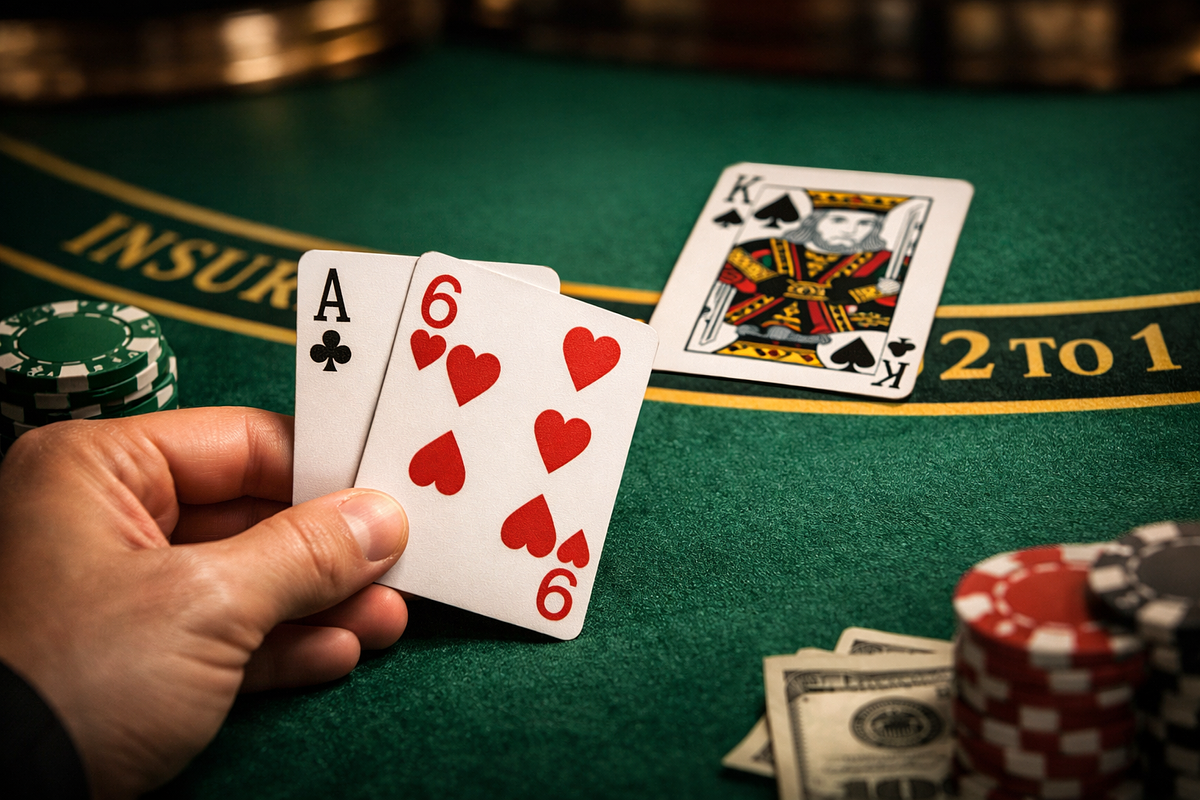
A soft hand is any hand that contains an Ace currently counting as 11, where that count doesn’t push the total above 21. The hand holds two valid totals at once: the Ace counted as 11 and the Ace counted as 1. The higher of the two is the working total until an additional card forces a change. An Ace combined with a 6 is soft 17, carrying totals of either 7 or 17. An Ace combined with a 2 is soft 13, carrying totals of either 3 or 13. There are nine valid soft scores in blackjack, with soft 13 being the lowest. An Ace paired with any ten-value card on the initial deal is a natural blackjack rather than a soft 21, which is a separate outcome with its own payout rules. A soft hand isn’t a single fixed total. It’s a hand with a safety net that stays active until a drawn card removes it.
A hard hand is any hand that either contains no Ace, or contains an Ace that must count as 1 to keep the total at 21 or below. The transition from soft to hard is mechanical. Take a player holding an Ace and a 6, a soft 17. If that player draws a 10, counting the Ace as 11 produces 27, which busts the hand. The Ace reverts to 1, and the hand becomes hard 17. From that point, the hand has a single fixed total. Because no reversion is possible, any additional card that pushes the total past 21 results in a bust. A hard hand means you’re working without the Ace’s safety net, and every decision to hit carries real bust risk.
The Ace’s reversion property creates a direct difference in bust risk between the two hand types. A soft hand can’t bust on a single additional card. If a drawn card would push the total past 21 when the Ace counts as 11, the Ace automatically reverts to 1 and absorbs the excess. A hard hand has no such mechanism. Its total is fixed, and any card that pushes it past 21 ends the hand as a loss.
This is why the same numeric total plays differently depending on hand type. A hard 17 and a soft 17 share the same number, but the hard version carries immediate bust risk on any hit while the soft version doesn’t. When you hit a soft hand, you’re deciding whether to improve a total that can’t collapse on a single card. When you hit a hard hand, you’re accepting the possibility that the next card ends your hand as a bust.
Basic Strategy Rules for Hard Hands
Hard-hand strategy is more defensive than soft-hand strategy because every hit on a hard total risks an immediate bust, with no Ace reversion to absorb the damage. The dealer’s upcard is the main variable that drives most hard-hand decisions. Dealer upcards 2 through 6 are treated as weak, meaning the dealer has a meaningful chance of busting. Upcards 7 through Ace are treated as strong, meaning the dealer is more likely to reach a competitive standing total. This two-zone framework, weak upcards versus strong upcards, organizes nearly every hard-hand decision you’ll face.
Any hard total of 17 or higher always stands, regardless of what the dealer shows. The reason is straightforward: the chance of busting on a single additional card at these totals is high enough that the potential gain from improving the hand doesn’t justify the risk. A hard 17, for example, busts on any card valued 5 or above. Hard 17 or higher is one of the simplest reads at the table because the correct action never changes.
Hard totals from 12 through 16 are called stiff hands. They’re too high to hit safely against a strong dealer, yet too low to beat most dealer standing totals outright. The correct action splits cleanly along the weak-upcard and strong-upcard boundary: hard 13 through 16 stands against dealer 2 through 6 and hits against dealer 7 through Ace. Hard 12 is a narrower exception. It stands only against dealer 4 through 6 and hits against every other upcard, including dealer 2 and 3.
Standing against weak upcards makes sense because the dealer’s bust probability is high enough that letting the dealer bust is the higher-value play. Hitting against a strong dealer upcard is correct because standing on a stiff total against a dealer likely to reach 17 or above loses at a high rate.
Where surrender is available, it’s the correct play on hard 15 against a dealer 10, and on hard 16 against a dealer 9, 10, or Ace. Stiff hands are where beginners most often make the wrong call, because the urge to hit a weak-looking total overrides the logic of letting a vulnerable dealer bust.
Hard 9, 10, and 11 are the main doubling totals in hard-hand strategy. Hard 11 always doubles down. Hard 10 doubles against dealer 2 through 9 and hits against dealer 10 or Ace. Hard 9 doubles against dealer 3 through 6 and hits against all other upcards.
The case for doubling at these totals is that a single ten-value card, the most common card value in the deck, produces a strong finishing total. The dealer’s upcard determines whether the expected value of committing a second bet beats the expected value of simply taking a free card. Spotting a doubling opportunity is a mental shift: you’re not just looking up a rule, you’re identifying a spot where the math favors putting more money in.
Hard 8 and below always hits. The bust risk from a single additional card at these totals is effectively zero, and the total is too low to compete with any dealer standing hand. These hands need no analysis. The decision is the same regardless of the dealer’s upcard.
Hard-Total Strategy Summary Table
The table below consolidates the correct basic strategy action for every hard total against every dealer upcard.
| Player Hard Total | Dealer 2 | Dealer 3 | Dealer 4 | Dealer 5 | Dealer 6 | Dealer 7 | Dealer 8 | Dealer 9 | Dealer 10 | Dealer A |
|---|---|---|---|---|---|---|---|---|---|---|
| 17+ | Stand | Stand | Stand | Stand | Stand | Stand | Stand | Stand | Stand | Stand |
| 13–16 | Stand | Stand | Stand | Stand | Stand | Hit | Hit | Hit | Hit | Hit |
| 12 | Hit | Hit | Stand | Stand | Stand | Hit | Hit | Hit | Hit | Hit |
| 11 | Double | Double | Double | Double | Double | Double | Double | Double | Double | Double |
| 10 | Double | Double | Double | Double | Double | Double | Double | Double | Hit | Hit |
| 9 | Hit | Double | Double | Double | Double | Hit | Hit | Hit | Hit | Hit |
| 8 or less | Hit | Hit | Hit | Hit | Hit | Hit | Hit | Hit | Hit | Hit |
Basic Strategy Rules for Soft Hands
Soft-hand strategy is more aggressive than hard-hand strategy because the Ace can revert from 11 to 1, which means you can’t bust on a single additional card. That safety net expands the range of totals where doubling is the right play, since drawing a large card gets absorbed by the Ace rather than busting the hand. It also explains why surrender is never correct on any soft hand. The flexibility that makes surrender unnecessary on hard stiff hands is always present in a soft hand by definition. Across the full range of soft totals, the correct decisions shift between doubling, hitting, and standing based on how the Ace’s flexibility interacts with the dealer’s upcard.
Soft 20 (A,9) always stands against every dealer upcard. Soft 21 made on the initial two cards is a natural blackjack, which is a separate outcome from a soft total and is paid at a premium rather than played as a hand. Soft 19 (A,8) stands in most situations, but doubles against a dealer 6 when the H17 rule is in effect. That specific play doesn’t apply under the S17 rule, where standing is correct across all upcards. These totals stand because they’re strong enough to win against most dealer outcomes, and drawing a card risks converting a strong soft total into a weaker hard total for little gain. Soft 19 and soft 20 are the soft totals you can recognize immediately as complete hands under standard conditions.
Soft 18 (A,7) produces the most nuanced decision in soft-hand basic strategy. Against a dealer 2 through 6, the correct play is to double. Against a dealer 7 or 8, the correct play is to stand. Against a dealer 9, 10, or Ace, the correct play is to hit. The reason you hit against strong dealer upcards is that standing on 18 against a dealer showing 9, 10, or Ace loses more often than it wins or pushes. The dealer’s probable final total exceeds 18 often enough that using the Ace’s flexibility to draw for improvement is the higher-expectation choice. Beginners most often misplay soft 18 by standing on any 18, treating it as a strong total no matter what the dealer shows.
Soft totals from soft 13 through soft 17 follow a consistent pattern: the doubling range widens as the soft total increases, and hitting is correct whenever doubling isn’t. Soft 17 (A,6) doubles against dealer 3 through 6 and hits against all other upcards. Soft 15 and soft 16 (A,4 and A,5) double against dealer 4 through 6 and hit otherwise. Soft 13 and soft 14 (A,2 and A,3) double against dealer 5 or 6 and hit otherwise. A useful memory pattern: every soft hand through soft 18 doubles against a dealer 5 or 6.
Lower soft totals never stand because the total is too weak to hold against any dealer outcome. And since the Ace’s reversion means hitting carries no single-card bust risk, the strategy is aggressive across this range. Any card you draw either improves the total or triggers Ace reversion to produce a playable hard total.
Soft-Total Strategy Summary Table
The table below consolidates the correct basic strategy action for every soft total against every dealer upcard.
| Player Soft Total | Dealer 2 | Dealer 3 | Dealer 4 | Dealer 5 | Dealer 6 | Dealer 7 | Dealer 8 | Dealer 9 | Dealer 10 | Dealer A |
|---|---|---|---|---|---|---|---|---|---|---|
| Soft 20 (A,9) | Stand | Stand | Stand | Stand | Stand | Stand | Stand | Stand | Stand | Stand |
| Soft 19 (A,8) | Stand | Stand | Stand | Stand | Double | Stand | Stand | Stand | Stand | Stand |
| Soft 18 (A,7) | Double | Double | Double | Double | Double | Stand | Stand | Hit | Hit | Hit |
| Soft 17 (A,6) | Hit | Double | Double | Double | Double | Hit | Hit | Hit | Hit | Hit |
| Soft 15–16 (A,4 / A,5) | Hit | Hit | Double | Double | Double | Hit | Hit | Hit | Hit | Hit |
| Soft 13–14 (A,2 / A,3) | Hit | Hit | Hit | Double | Double | Hit | Hit | Hit | Hit | Hit |
When a Soft Hand Becomes a Hard Hand
Soft hands aren’t a permanent classification. A hand that starts as soft can convert to a hard hand mid-round, and that conversion changes which strategy rules apply for every decision that follows.
The trigger is mechanical: when an additional card would push the total past 21 if the Ace counted as 11, the Ace automatically reverts to 1. At that point, the hand loses its soft status and becomes a hard hand.
Once the conversion happens, you apply hard-hand strategy rules from that point forward. The soft-hand rules that applied earlier in the same hand no longer apply.
Take a player holding soft 17, an Ace and a 6. Following soft-hand strategy, the player hits against most dealer upcards. The next card dealt is an 8. Counting the Ace as 11 would produce a total of 25, which busts the hand, so the Ace reverts to 1. The hand is now hard 15.
Hard 15 against a dealer 10 is a different situation. Under hard-hand strategy, the correct play is to hit, or to surrender if the table permits it. That’s the opposite of simply standing, and it applies even though the same physical cards that were soft 17 a moment ago are still on the table.
Your read of a hand has to update in real time as each card is added. The same physical cards can carry different strategic identities as the count evolves. What was a soft total requiring one set of rules can become a hard total requiring a different set within a single round.
Game Rule Variables That Modify Basic Strategy
Basic strategy isn’t a single fixed chart that applies identically at every blackjack table. Table rules change the correct play at the margins, which means the same hand can have a different optimal action depending on where you sit. The most common variable is whether the dealer hits or stands on soft 17. That single rule, usually printed on the table felt, is the first thing to confirm before applying any strategy decisions.
When the dealer hits on soft 17, the rule is labelled H17. When the dealer stands on soft 17, it’s labelled S17. The H17 rule adds approximately 0.22% to the house edge compared to S17, which matters given that basic strategy already reduces the house edge to approximately 0.5% under favorable game conditions. That edge difference also shifts a small number of optimal player decisions. The clearest example is soft 19 (Ace and 8): doubling against a dealer 6 is correct under H17, but standing is correct under S17. Knowing which rule is in effect before the first hand is dealt is part of reading a table correctly. The same two cards in your hand can call for a different action depending on this one variable alone.
Reading Your Hand Before You Read the Table
Correctly classifying a hand as soft or hard is the prerequisite to every strategy decision in blackjack, because the same numeric total calls for different actions depending on which type it is. A player who can identify hand type at a glance, track when a soft hand converts to hard mid-round, and apply the right strategy rule against the dealer’s upcard is working from the game’s actual mechanical logic rather than intuition.
We check operator terms, licences and payment details against the casino's own pages and update this content when they change. Read our editorial policy, our transparency statement, or report an error. If gambling stops being fun, see our responsible gambling resources.