


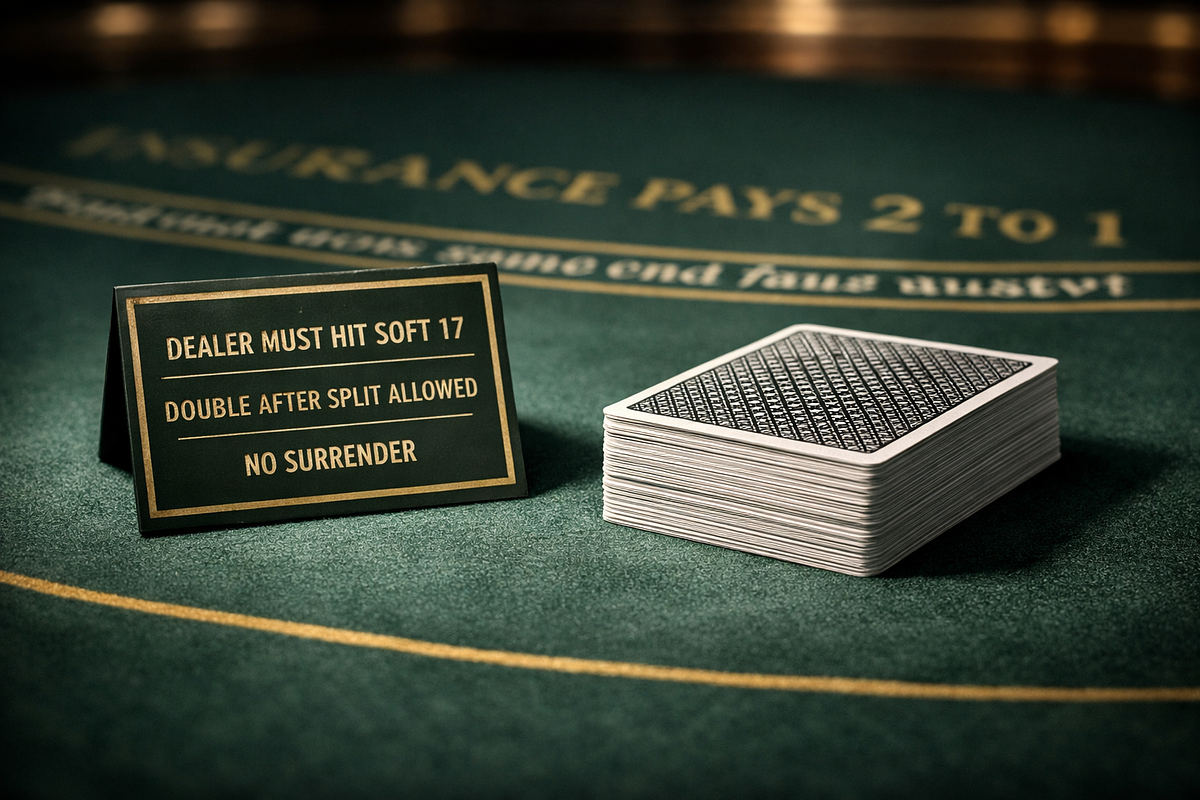
This page covers blackjack rule variations: dealer stands, double down, surrender, and splits. These printed conditions define how a specific game plays and what the house edge is. Each category of rule shifts that edge by a measurable amount, and the combination in effect at any table matters more than any single rule on its own. After reading, you’ll be able to look at any rule set, understand what each condition means for the math, and judge whether a given table works in your favor or against it.
Blackjack rule variations appear as printed conditions on a table felt or in an online game’s rules panel, and each one has a measurable effect on the mathematical expectation of the game. The combination of rules at any given table determines the house edge, not any single rule in isolation. This article covers how each category of variation shifts that edge, and by how much, so you can interpret any rule set and spot which combinations favor the house and which reduce its advantage.
The Standard Baseline Ruleset and Why It Matters
Every percentage figure attached to a blackjack rule variation only means something relative to a fixed starting point. Without a defined baseline, a claim that a rule “increases house edge by 0.20%” tells you nothing, because you have no reference game to measure from. This article uses a widely recognized baseline drawn from established blackjack analysis, and every figure cited below is measured against that same reference point.
All house-edge effects cited in this article are measured against a specific eight-deck game in which the dealer stands on soft 17, the player may double on any first two cards, doubling after splitting is permitted, and the player may split to four hands. When a later section states that a rule change increases house edge by a given percentage, that figure assumes this baseline holds in full and only the named rule differs. The following rules define the reference point for every percentage figure in this article.
- Number of decks: eight
- Dealer soft 17: dealer stands
- Doubling window: player may double on any first two cards
- Doubling after split: permitted
- Split limit: player may split to four hands
A positive percentage figure means the rule change increases the house edge, making the game worse for the player relative to the baseline. A negative figure means the rule change decreases the house edge, making the game better for the player. A rule listed as “+0.14%” costs the player roughly fourteen hundredths of a percentage point of expected return compared with the baseline game.
These figures are additive approximations. Adding several variations together gives a rough net effect on house edge, not a mathematically exact one, because individual rules interact in ways a simple sum doesn’t fully capture. Treat the combined figure as a directional estimate rather than a precise calculation.
Each figure represents one component of a table’s overall expectation. A single rule that shifts house edge by 0.10% may look small on its own, but it sits alongside every other rule in force at that table. Reading any one figure without accounting for the full rule set gives you an incomplete picture of the game’s actual expectation.
Dealer Soft 17 Rule Variants
The rule governing what the dealer does on a soft 17 is the most consequential dealer-side variable you’ll see on a table sign. It dictates whether the dealer is forced to draw another card or must stop when holding a soft 17, which is any hand totaling 17 that includes an ace counted as 11 (like ace-six). This isn’t a discretionary dealer decision; the table’s rules mandate the outcome. Because the rule applies to every qualifying dealer hand throughout a session, its effect on the game’s mathematical expectation is consistent and cumulative.
Under S17, the dealer stands on soft 17, meaning the hand is locked at that total and no further cards are drawn. Under H17, the dealer hits soft 17, drawing additional cards and giving the dealer a chance to improve to 18, 19, 20, or 21, or to bust. H17 gives the dealer extra draws on a hand that S17 would force to stand. Those additional draws benefit the dealer because they create opportunities to reach stronger totals from a position that would otherwise be fixed. Moving from the S17 baseline to H17 increases the house edge by approximately 0.2%.
When a table sign reads “Dealer stands on all 17s,” that’s S17. When it reads “Dealer hits soft 17,” that’s H17. These aren’t cosmetic phrasing differences. They identify the single most visible dealer-side rule shift printed on the felt, and they carry a direct, quantifiable difference in the table’s expectation. Reading this label correctly tells you what mathematical baseline you’re sitting down to before you consider any other rule on the sign.
Double Down Restrictions
Doubling down is one of the few player actions that carries a positive expected value in the right situations, because it lets you commit a second bet when the hand composition favors you. Any rule that narrows when doubling is permitted removes access to that positive expectation directly. Restrictions appear on table rule signs under labels that reference specific totals, typically hard 9, 10, or 11, or 10 and 11 only, and each label corresponds to a measurable shift in house edge.
Doubling restrictions fall on a spectrum from fully permissive, where you may double on any first two cards, to progressively narrower windows that exclude soft totals, then low hard totals, and in the most extreme case eliminate doubling entirely. A narrower window removes the double precisely on the hands where its expected value would otherwise be greatest: the soft totals and lower hard totals that basic strategy identifies as doubling opportunities. The table below maps each named variant to its effect on house edge, measured against the eight-deck, dealer-stands-on-soft-17 baseline in which doubling on any two cards is permitted.
| Doubling Rule Variant | Description | Effect on House Edge |
|---|---|---|
| Double on any first two cards (baseline) | Player may double on any initial two-card total, including soft hands | Reference point (0%) |
| Reno rule | Double permitted only on hard 9, 10, or 11 | Approximately +0.10% |
| European doubling restriction | Double permitted only on hard 10 or 11 | Approximately +0.20% |
| No doubling permitted | Player may not double on any hand | Approximately +1.48% |
Doubling after a split (DAS) is treated as a distinct rule from the general doubling window because it governs a different game state. By the time you’re considering doubling after a split, you’ve already committed additional chips to form a second hand. Permission to double again at that point is a separate layer of discretion that the general doubling rule doesn’t automatically cover.
The baseline ruleset permits DAS. Removing that permission, playing under a no-DAS rule, increases the house edge by approximately 0.14%.
This distinction changes how you should read a table’s rule sign. A sign that states only “Double on any two cards” describes the general doubling window and says nothing about the post-split state. That same table may still prohibit doubling after a split, and the house edge cost of that prohibition is separate from, and additive to, any restriction on the general doubling window.
When reviewing a game’s rules, read the DAS designation as its own line item rather than as a consequence of the general doubling rule. A table that offers unrestricted doubling but removes DAS carries a different mathematical profile than one that restricts the general window while retaining DAS. The two can’t be treated as equivalent just because both involve the word “double.”
Split and Resplit Rules
Splitting rules form a family of related permissions that govern whether pairs can be split at all, how many times a hand can be split, whether aces follow the same rules as other pairs, and whether a newly formed split hand can itself be split again. These permissions are often printed as separate lines on a table’s rule sign, and each line carries a distinct mathematical weight. Taken together, they represent the most fragmented rule cluster you’ll encounter at the felt, where minor print governs meaningful shifts in expected return.
When you hold two cards of the same rank, the standard rule lets you separate them into two independent hands, each backed by an additional bet equal to the original. Resplitting refers to the permission, or restriction, that applies when a third card of the same rank arrives on one of those new hands. You can either split again to form a third hand, or be forced to play on without splitting. The baseline permits splitting up to four hands in total.
The table below shows how each variant in this category shifts house edge relative to that baseline, where all other rules remain at their standard values.
| Split Rule Variant | Description | Effect on House Edge |
|---|---|---|
| Split to four hands permitted (baseline) | Player may resplit pairs up to a total of four hands | Reference point (0%) |
| No resplitting of pairs | Player may split once but cannot split again if a matching card appears on a split hand | Approximately +0.04% to +0.10% |
| No splitting at all | Player may not split any pair under any circumstances | Approximately +0.57% |
A pair of aces is the most powerful splittable hand in blackjack, and nearly every ruleset treats it differently from all other pairs. The standard restriction is that after splitting aces, you receive exactly one additional card per ace and may not hit further, regardless of what that card is.
Two specific permissions move the house edge in the player’s favor. Allowing the player to hit split aces, rather than locking each ace to a single draw, reduces house edge by approximately 0.13%. Allowing the player to resplit aces if a second ace appears on a split hand reduces house edge by approximately 0.03%. These two permissions are independent of each other and of the general resplit rules that apply to non-ace pairs.
Under standard rules, receiving a ten-value card on a split ace produces a hand worth 21, but it counts as a soft 21, not a blackjack. The 3:2 blackjack payout doesn’t apply; the hand is settled as an ordinary 21. That matters because it means the value of splitting aces is lower than it might appear if you assume a natural payout is still possible.
When a rule sign lists aces separately from other pairs, for example noting “resplit all pairs” alongside a separate line about aces, that’s not a redundant restatement of the same permission. It reflects a different rule governing a different game state, and both lines must be read independently to understand the full scope of what the table permits.
Surrender Rule Variants
Surrender is the least commonly offered player option in the rule cluster covering dealer soft-17, doubling, and splits. When a table does offer it, the specific variant, early or late, determines whether the concession from the house is substantial or marginal. Surrender is an all-or-nothing action: you forfeit half the original bet and the hand ends immediately, with no further cards dealt. That finality is what makes the variant form consequential.
Early surrender lets you forfeit half the bet before the dealer checks their hole card for blackjack. Late surrender is only available after the dealer has confirmed they don’t hold blackjack. The timing is the entire mechanical distinction between the two variants, but it determines whether you can exit a hand while the dealer still has a potential blackjack in front of them. Because early surrender lets you escape from those situations, it carries a substantially larger reduction in house edge than late surrender does.
The table below shows the house-edge effect of each surrender variant, measured against the standard eight-deck baseline with dealer standing on soft 17.
| Surrender Variant | Situation | Effect on House Edge |
|---|---|---|
| Early surrender | Against dealer ace | Approximately −0.39% |
| Early surrender | Against dealer ten | Approximately −0.24% |
| Late surrender | Against dealer ten | Approximately −0.07% |
| Late surrender | Overall estimate | Approximately −0.08% |
Surrender is generally not permitted after splitting. Once you commit to splitting a pair, the surrender option is no longer available for the resulting hands. A player who splits and then finds themselves in a difficult position against a strong dealer upcard can’t fall back on surrender to recover half the additional bet placed on the split.
Late surrender is only available in games where the dealer checks for a hole card. In no-hole-card games, the dealer doesn’t draw or examine a second card until after the player has completed all actions, so there’s no point at which the dealer can confirm the absence of blackjack before the player acts. That structural absence means late surrender in its standard form doesn’t exist in no-hole-card games.
A “Surrender” note printed on a table’s felt or listed in a game’s rules panel is not self-contained information. Whether the game uses a hole card determines whether any surrender offered is genuinely late surrender or a different arrangement. Whether the player has already split determines whether surrender remains available at all on the current hand.
Reading a surrender rule correctly means treating it as one element within the broader rule set rather than an isolated permission. The variant form, the hole-card structure, and the split state of the hand all interact to define what surrender actually means at a given table.
Related Rules That Shift House Edge
Two rules sit outside the dealer-soft-17, doubling, splitting, and surrender cluster but appear on the same rule sign as those four categories at virtually every table. Each can individually produce a house-edge shift larger than any single variation in the core cluster. Reading them in isolation from the rest of the rule sign gives you an incomplete picture of a game’s true mathematical expectation.
A natural blackjack, an ace paired with any ten-value card on the initial deal, has traditionally paid 3:2. Under that structure, a €10 bet returns €15 in winnings. A 6:5 payout, increasingly common at lower-limit tables, returns only €12 on the same €10 bet.
That €3 difference per natural compounds across every session because naturals occur with meaningful frequency. According to Wizard of Odds data, switching from 3:2 to 6:5 increases the house edge by approximately 1.39%. Blackjack Review places the same figure at approximately 1.36%. Both figures sit well above the effect of any single rule variation covered elsewhere in this article.
To put that in context: the largest single swing from the dealer, doubling, splitting, and surrender categories is approximately 0.57% for removing splits entirely. The 6:5 payout shift exceeds that figure and can outweigh the combined effect of several favorable rules appearing on the same sign.
Check the payout ratio first on any rule sign. A game offering generous doubling and surrender rules but paying 6:5 on naturals will, in most rule combinations, carry a higher house edge than a more restrictive game paying 3:2.
In a standard hole-card game, the dealer draws a face-down second card at the start of the round and checks it for blackjack before players act. In a no-hole-card game, the dealer receives only one face-up card at the start. The second card isn’t drawn until after every player has completed all actions, including any doubles or splits.
The practical risk in a no-hole-card game is that you may commit additional chips to a double or split, then watch the dealer complete a blackjack and lose all of those chips. The original bets only (OBO) rule addresses this directly: when the dealer subsequently reveals a blackjack, only the player’s original wager is forfeited, and any additional chips placed on doubles or splits are returned as a push rather than lost.
This structure also interacts with surrender availability. Late surrender in its standard form requires the dealer to have already checked for blackjack, which doesn’t occur in a no-hole-card game. A no-hole-card table therefore can’t offer standard late surrender, a connection that links this section directly to the surrender rules covered earlier.
A game labelled “no hole card” is not automatically worse for the player when OBO is also in effect. The two labels work as a pair: “no hole card” describes when the dealer’s second card is drawn, and “OBO” describes what happens to extra chips if that card completes a blackjack. Reading one without the other gives you an incomplete account of the game’s actual exposure.
Consolidated House Edge Impact Table
The table below is the single reference point for every rule variation and its quantified effect on house edge covered in this article. Rows are ordered from the most player-favorable (largest negative effect on house edge) to the most player-unfavorable (largest positive effect), with the baseline ruleset marked at zero. All figures assume the eight-deck, S17, double-any-two-cards, DAS, split-to-four-hands baseline; only the named rule changes in each row.
To interpret any rule sign, find each stated variation in the table and read its associated effect on house edge. Where the source data expresses a figure as a range, that range is preserved in the table cell rather than collapsed to a single point estimate.
| Rule Variation | Category | Effect on House Edge |
|---|---|---|
| Early surrender vs. dealer ace | Surrender | Approximately −0.39% |
| Early surrender vs. dealer ten | Surrender | Approximately −0.24% |
| S17 vs. H17 (moving toward player) | Dealer soft 17 | Approximately −0.20% |
| Hit split aces permitted | Splits | Approximately −0.13% |
| Late surrender (overall) | Surrender | Approximately −0.08% |
| Late surrender vs. dealer ten | Surrender | Approximately −0.07% |
| Resplit aces permitted | Splits | Approximately −0.03% |
| Baseline ruleset (reference) | Reference point | 0% |
| No resplitting of pairs | Splits | Approximately +0.04% to +0.10% |
| Reno rule (double on hard 9, 10, or 11 only) | Doubling | Approximately +0.10% |
| No double after split (no DAS) | Doubling / splits | Approximately +0.12% to +0.14% |
| H17 instead of S17 | Dealer soft 17 | Approximately +0.20% |
| European doubling restriction (double on 10 or 11 only) | Doubling | Approximately +0.20% |
| No splitting at all | Splits | Approximately +0.57% |
| 6:5 blackjack payout instead of 3:2 | Payout | Approximately +1.36% to +1.39% |
| No doubling at all | Doubling | Approximately +1.48% |
Reading a Blackjack Table’s Rules With a Clear Interpretive Framework
The house edge at any blackjack table is not a single posted number. It’s the combined result of every rule printed on the felt, all operating at once. A player who can identify each rule variant and its directional effect on expected value is reading the same sign as an uninformed player but extracting different information: not just a list of permissions, but a clear picture of what the game actually costs to play.
We check operator terms, licences and payment details against the casino's own pages and update this content when they change. Read our editorial policy, our transparency statement, or report an error. If gambling stops being fun, see our responsible gambling resources.