

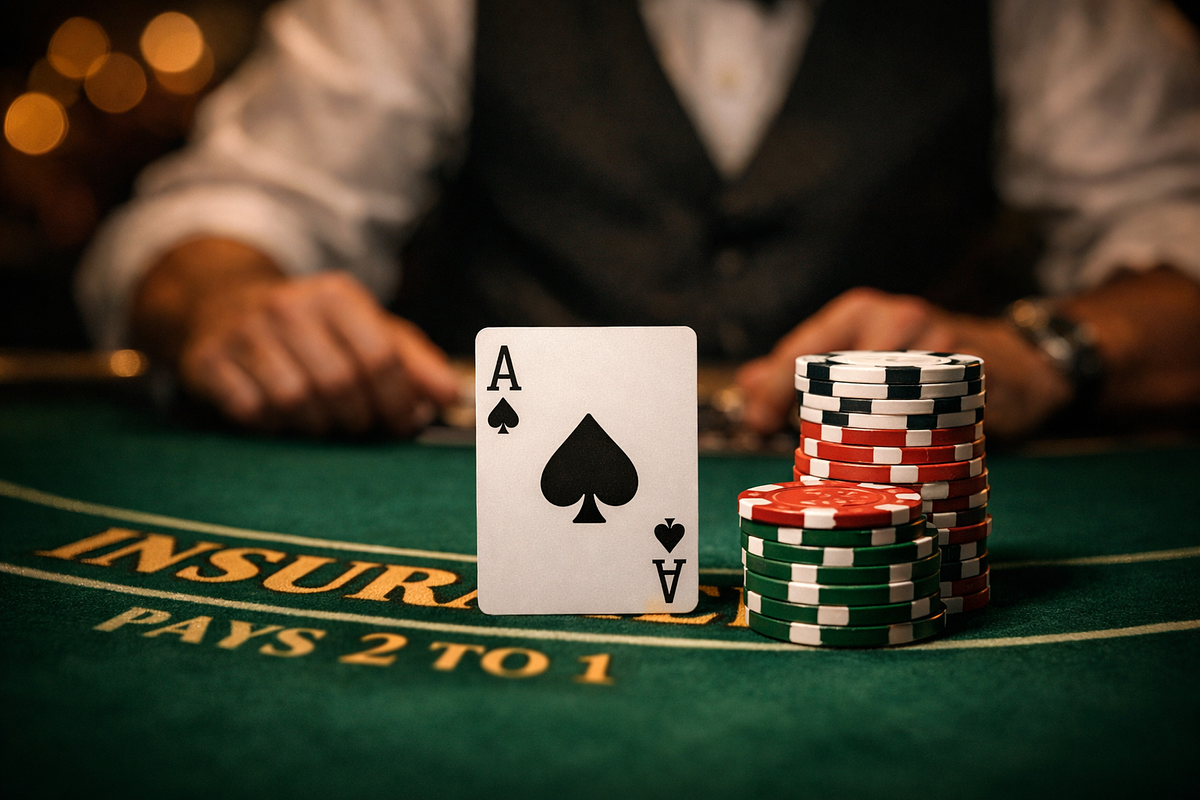
Insurance in blackjack is a side bet you can make when the dealer shows an Ace. You’re betting that the dealer’s hidden card is a ten-value card, which would give the dealer a blackjack. The bet is sold as protection for your hand, but the payout doesn’t reflect the actual odds of the dealer completing a blackjack. This page walks through the probability and payout math behind insurance, explains why that gap gives the house a bigger edge than the base game, and covers the one narrow situation where the math flips. By the end, you’ll have what you need to decide whether taking insurance ever makes sense for how you play.
How the Insurance Bet Is Structured and Paid
Insurance is a side bet with a fixed wager size and a fixed payout ratio. Those two numbers, measured against the true probability of the dealer’s hole card being a ten-value card, determine whether the bet wins or loses money over time. Getting the structure right is the starting point for every edge calculation that follows.
The Trigger Condition and Wager Sizing
Insurance is offered at one specific moment: after the dealer receives an Ace as the upcard and before the dealer checks the hole card. You can place a side bet equal to exactly 50% of your original wager, no more and no less. That side bet is then settled on its own, independently of what happens to your main hand. If the dealer’s hole card completes a blackjack, the insurance bet wins. If it doesn’t, the insurance bet loses, regardless of whether you win or lose the main hand.
The word “insurance” implies it protects your original wager against a dealer blackjack, but that’s just framing. The side bet is simply a wager on whether the dealer’s hole card is a ten-value card. Because the side bet is fixed at half the main wager, every edge calculation is anchored to that stake size.
The 2:1 Payout and the Break-Even Threshold It Implies
When the dealer does hold a ten-value hole card and the blackjack is confirmed, insurance pays 2:1 on the side bet. A 2:1 payout has a specific requirement built into it: the underlying event needs to happen at least once in every three attempts (a frequency of 33.33%) for the bet to break even over time.
That threshold comes directly from the payout structure. In any bet paying 2:1, a player who wins once and loses twice across three identical trials breaks even: one win returns two units, two losses cost two units, and the net result is zero. Any frequency below 33.33% produces a net loss over time at that payout ratio.
That 33.33% figure reframes the real question. The question isn’t whether insurance protects you from a bad outcome. It’s whether the deck contains enough ten-value cards for the dealer to complete a blackjack at a rate that justifies a 2:1 payout. The next section looks at whether the actual probability clears that bar.
The Probability Mechanics That Make Insurance a Losing Bet
The math case against insurance comes down to one comparison: how often the dealer actually holds a ten-value hole card versus how often a 2:1 payout would need that to happen to break even. A 2:1 payout breaks even only when the event happens exactly one time in three, or 33.33% of the time. The actual frequency of a dealer ten falls short of that threshold in every standard deck configuration. The gap is small in percentage terms, but it’s fixed by deck composition and can’t be closed through any decision you make in the base game.
Counting the Ten-Value Cards Behind the Ace
In a single-deck game, once the dealer’s Ace is face up, 51 cards remain unseen. Of those, 16 are ten-valued (four each of ten, jack, queen, and king) and 35 are not. The true odds against the dealer holding a ten are 35-to-16. The insurance bet pays only 2:1, which is equivalent to 32-to-16 on those same 16 winning cases. The payout treats the situation as though only 32 non-winning cards exist, when there are actually 35. That gap of 3 cards out of 51 is where the house edge comes from: 3 divided by 51 gives a single-deck insurance edge of about 5.88%, a figure confirmed directionally by Wizard of Odds at 5.9%. The house’s advantage here isn’t an arbitrary markup. It’s a direct result of the mismatch between how many ten-value cards the deck contains and how many the payout ratio assumes.
The Gap Between Actual Probability and the Break-Even Threshold
Across standard deck configurations, the dealer holds a ten-value hole card about 30.66% to 31.37% of the time. Both ends of that range fall below the 33.33% frequency a 2:1 payout needs to be neutral, leaving a structural gap of roughly 2 to 3 percentage points. That gap is the direct source of the house edge on the insurance side bet. As more decks are added to the shoe, the proportion of ten-value cards shifts slightly and the dealer’s probability of holding a ten drifts lower, which widens the gap further. The deck-count analysis in the next section covers that relationship in detail. No rule variation available to a player in the base game changes the underlying deck composition enough to close this gap.
House Edge on Insurance Across Deck Configurations
The insurance house edge isn’t a fixed number. It shifts upward as the number of decks increases, because each additional deck slightly dilutes the proportion of ten-value cards, pushing the dealer’s probability of holding a ten further below the 33.33% break-even threshold. Even the lowest point in that range sits well above the base-game house edge a player faces under basic strategy. So a bet that looks structurally identical across single-deck, double-deck, and multi-deck games carries a meaningfully different (and consistently worse) disadvantage depending on the format at the table.
Insurance Edge by Number of Decks
Each deck added to the shoe reduces the share of ten-value cards in the remaining pool by a small amount. The ratio of tens to non-tens is fixed per deck, but removing the dealer’s Ace upcard has a proportionally smaller effect on a larger pool. As a result, the dealer’s probability of completing a blackjack drifts slightly lower with every additional deck, widening the gap between that probability and the 33.33% break-even point. More decks consistently produce a higher insurance house edge. The table below shows confirmed insurance edge figures across standard deck configurations from verified sources.
| Deck Configuration | Insurance Bet House Edge |
|---|---|
| Single-deck | 5.9% |
| Double-deck | Higher than single-deck; exact figure not confirmed by a verified source |
| Six-deck | 7.395% |
Insurance Edge Versus the Base Game Edge Under Basic Strategy
The base-game house edge under basic strategy sits between 0.5% and 1%, with 0.5% cited for a standard 3:2 table where the player applies basic strategy correctly. The insurance bet’s edge, by contrast, runs roughly 7 to 15 times higher than that base-game figure depending on the number of decks in play.
That puts insurance in a different category entirely. It’s not a modest hedge layered onto the main hand. It’s a standalone wager with a house edge closer to many slot-adjacent side bets than to the main blackjack game.
One industry source puts a number on the cumulative effect: a player who takes insurance regularly raises their effective house edge from about 2% to 8.5%. That shift reflects how much weight a high-edge side bet carries when you accept it repeatedly across sessions. The main hand’s edge doesn’t change, but the blended cost across all money wagered climbs sharply once insurance bets are factored in.
The Even-Money Variant and Its Mathematical Equivalence
Even money is the offer you get when you’re holding a natural blackjack against a dealer’s Ace upcard. Accepting it trades the standard 3:2 payout on your blackjack for a guaranteed 1:1 payout, settled immediately regardless of what the dealer’s hole card turns out to be. This can feel different from placing an insurance bet, since you’re locking in a certain win rather than making a side wager. But the underlying bet is mathematically identical to taking insurance when you’re holding a blackjack.
What Even Money Actually Exchanges
When you hold a natural and the dealer shows an Ace, the two possible outcomes under insurance produce the same net result. If the dealer’s hole card is a ten-value card, the main hand pushes and the insurance bet pays 2:1, giving you a net gain equal to your original wager. If the dealer’s hole card is not a ten-value card, the insurance bet loses half your original wager and the natural pays 3:2, which also gives you a net gain equal to your original wager. Either way, you end up exactly one original bet ahead. That’s the same outcome even money delivers directly.
Even money just collapses those two paths into one guaranteed result, skipping the step of settling the insurance bet and the main hand separately. The probability structure underneath doesn’t change: the dealer holds a ten-value hole card roughly 30.66% to 31.37% of the time depending on deck count, which falls below the 33.33% frequency required for a 2:1 payout to be neutral. That shortfall is the source of the house edge on insurance, and accepting even money carries the same shortfall. The guaranteed-win framing doesn’t fix the probability mismatch. It just presents the same disadvantageous trade under a label that makes it harder to see what you’re doing.
We check operator terms, licences and payment details against the casino's own pages and update this content when they change. Read our editorial policy, our transparency statement, or report an error. If gambling stops being fun, see our responsible gambling resources.