


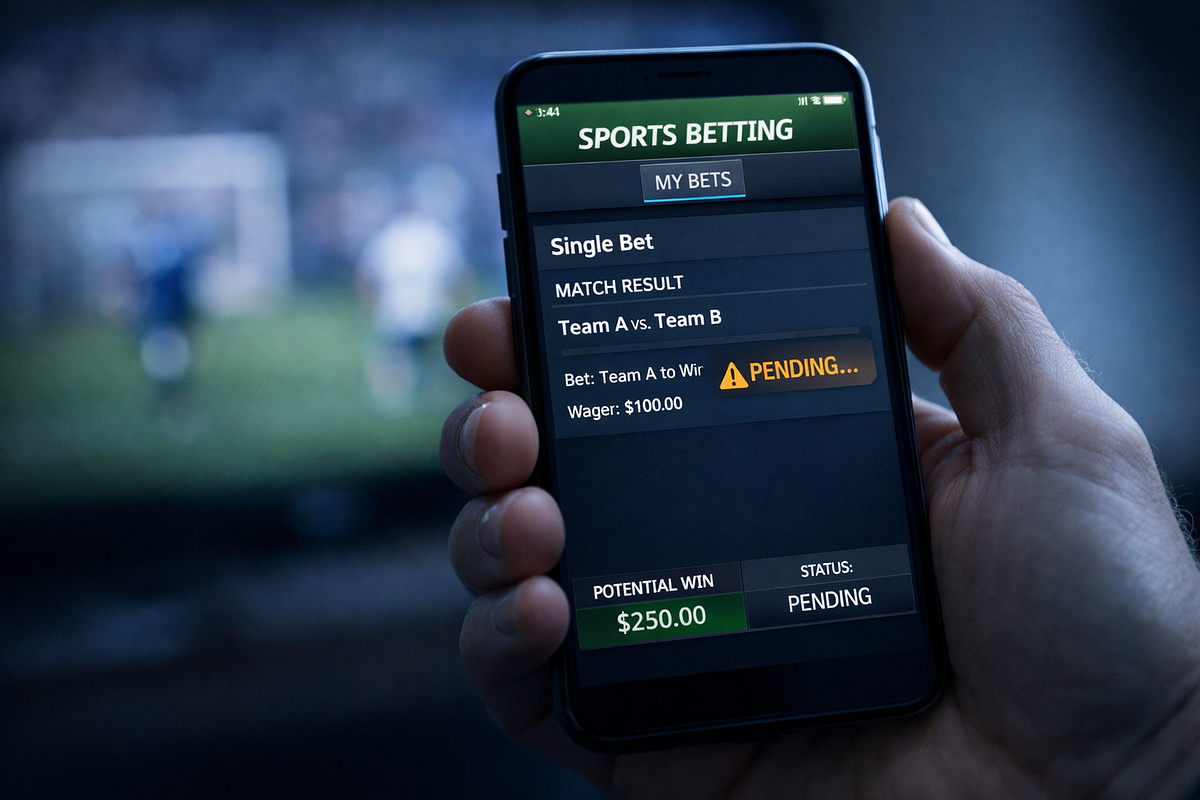
If a result looks clear on screen but your payout hasn’t arrived, you’re not alone in finding that frustrating. Sportsbooks settle bets based on official result confirmation from the sport’s governing body, not the moment the event visibly ends. That’s why a bet that looks like a winner can still show as pending. This page explains where that gap comes from and covers the situations where a pending bet might be voided rather than paid out. By the end, you’ll know what to expect and when it’s worth contacting your operator.
The Difference Between an Event Ending and a Bet Being Settled
An event ending on screen and a bet being settled are two separate things with two separate triggers. Operators settle bets when an official result is published under the relevant sport’s governing rules, not when the final whistle blows or the scoreboard updates. Until that official result is confirmed and sent to the operator’s settlement system, a bet stays pending, no matter what any broadcast or live tracker shows.
What “Pending” Actually Signals in the Account Interface
A “pending” status means the bet has been accepted, the event has ended or is still in progress, and the market outcome is waiting for official confirmation. It doesn’t mean the operator is holding anything back. A “settled” status appears only after the official result has been received and processed, at which point the bet moves out of the unsettled queue. Settled bets stay visible in the My Bets area for 90 days, then move to the account’s History section, as documented in bet365’s help documentation.
The Standard Window Between Official Result and Settlement
Most operators aim to settle bets within one hour of the official result being published. Betfair’s help documentation says customers should allow up to 30 minutes for a result to be confirmed and winnings to appear, while bet365 says it aims to settle within one hour of an event finishing. That window starts at official result publication, not when the event ends. If the official result is delayed, say due to a protest, a weather interruption, or a data feed gap, the settlement window shifts with it, and the bet stays pending until the result is formally confirmed.
Why Official Result Confirmation Is the Real Trigger
Operators don’t settle bets based on the score shown on a broadcast or stadium scoreboard. Settlement only happens when the official result, as defined by the sport’s governing rules, has been delivered to the operator’s settlement system by its data provider. Both things need to happen independently: the result has to be rule-defined as final, and the data feed has to transmit it without error. If either one is missing, the bet stays pending.
How the Governing Sport’s Rules Define the Result
Each sport has its own framework for deciding when a result is considered final for settlement purposes, and operators reference those frameworks directly in their published house rules. The visible outcome of a match has to match a rule-defined result before the settlement system can act. In cricket, a match shortened by rain doesn’t produce a raw score operators can settle against directly. Instead, the result is calculated using the Duckworth-Lewis-Stern method, and bets are settled on that adjusted official outcome. If no official result is produced under that framework, William Hill and Betfair both state that all bets are voided. In volleyball, if a match is interrupted and not resumed within 48 hours, all bets are voided except those whose outcomes were already determined before the interruption.
The Role of the Data Provider in Triggering Settlement
Operators rely on third-party data feeds to bring the official result into their settlement system, so any delay, gap, or error in that feed holds up settlement even when the result is publicly known. The types of data provider errors listed below are the conditions under which an operator may void and refund a bet rather than settle it. Understanding them explains why a bet that looks like a winner can still be reversed after the event has ended.
- Erroneous odds: pricing was published incorrectly on the affected market.
- Incorrect market status: the market was open or graded in a state it shouldn’t have been in.
- Inaccurate event start time: the scheduled time referenced by the market didn’t match the actual event.
- Incorrect team or tournament identification: the market was tied to the wrong participants or competition.
Conditions That Cause a Bet to Be Voided Instead of Settled
Some pending bets aren’t delayed toward a payout. They’re delayed toward a void. Void rules exist to protect market integrity when the conditions a bet was originally priced against no longer apply, such as when a match isn’t completed or its format changes after wagers are accepted. Most void rules include an important exception: if the specific market’s outcome was already clearly determined before the disruption occurred, the bet may still be settled rather than voided.
Abandonment, Postponement, and Match Interruption
When a match starts but isn’t completed, the general rule is that all bets on that event are voided unless the outcome of a specific market was clearly determined before the interruption. In volleyball, for example, if a match is interrupted and not resumed within 48 hours, all bets are voided except those where the result was already determined at the point of interruption. That 48-hour threshold appears across multiple operator house rules and the Azuro Settlement Policy. The “already determined” exception means different markets on the same disrupted event can resolve differently. A first-set winner market settled before play stopped may pay out, while a match-winner market on the same event is voided.
Format Changes and Restarts
When a scheduled match format changes after bets are placed, for example a contest shifts from a Best of 3 format to a Best of 1, the terms the bet was priced against no longer apply, and all unsettled bets are voided. In esports, technical restarts introduce a closely related rule: if a round or game is restarted due to a technical issue, markets that were already settled before the restart remain valid, while unsettled markets are void unless the relevant content is replayed in full. Betcris documents this directly, noting that if an esports match fails mid-event, earlier settled markets, such as completed quarter markets in an eBasketball match, stand, while markets covering the interrupted portion are cancelled. Bovada’s rules add that in-play bets on a “Current Round” market are void if that round is restarted, with the replayed round treated as a separate event for settlement purposes.
Integrity Investigations and Suspected Manipulation
When there’s evidence of match-fixing or manipulation, operators may hold settlement pending investigation or cancel all bets tied to the affected event. This doesn’t happen often for most bettors, but it has one defining characteristic: the resolution timeline isn’t tied to the standard post-event settlement window and has no fixed endpoint. Licensed sportsbooks operate under know-your-customer and anti-money-laundering obligations as part of broader sports integrity governance, which means an integrity-related hold can stay in place until an external investigation concludes.
How Live Betting Affects Settlement Timing
Bets placed during an active event go through extra stages before settlement is possible. While a contested moment is unresolved, such as a reviewed goal or a challenged call, the market suspends. Settlement only follows once the outcome is clear under the sport’s governing rules. A live bet has two dependencies that need to resolve in sequence: the market decision and the official result must both come through before the operator’s settlement system can act.
Why Prices Suspend and What That Means for a Pending Bet
Live markets suspend or reprice when the outcome of a specific moment is genuinely unclear, such as a goal under video review, a challenged point in tennis, or a disputed wicket in cricket. That suspension happens before settlement even becomes possible. It reflects the market’s inability to price the event accurately, not the operator processing a known result. A bet placed just before the suspension enters a pending state that can’t move forward until two separate conditions are met: the market must reopen or close with a determined outcome, and the official result must come through the operator’s data feed. Pre-match bets only have the second dependency, so a live bet placed at the moment of a contested incident will typically sit pending longer than a comparable bet placed before the event started.
Cash-Out Availability Around Pending Outcomes
When a market suspends, cash-out becomes unavailable for bets tied to that market. This is separate from settlement: the operator hasn’t graded the bet yet, and the missing cash-out option reflects the suspended market state, not a problem with the bet itself. If the cash-out button is gone while your bet shows as pending, the most likely cause is an active market suspension, not an error on the operator’s side.
Regulatory Obligations Around Settling Bets Within a Reasonable Timeframe
Settlement isn’t left entirely to operator discretion. Regulators require licensed operators to publish rules explaining how bets are resolved and to settle within a reasonable timeframe. Those published rules are your concrete reference point when a delay goes longer than the operator committed to in writing. If an operator’s conduct departs from its own published terms, regulatory frameworks give you a defined basis for a complaint.
What Licensed Operators Must Publish
Knowing where to find an operator’s settlement rules gives you a concrete reference point when a pending status drags on longer than expected. The UK Gambling Commission requires licensees to publish rules across the following categories, each of which directly governs a condition that can keep a bet unsettled or result in it being voided.
- Void circumstances: the conditions under which bets will not be settled.
- Treatment of errors: how pricing, market, and data errors are handled.
- Late bets: how wagers accepted after the market should have closed are treated.
- Maximum payout limits: the ceiling on what any single wager can return.
- Result determination: the means by which event outcomes are officially decided.
The “Reasonable Timeframe” Standard and Its Consequences
US state regulations require sportsbooks to pay winning bets within a reasonable amount of time, and operators that fail to meet this standard face potential fines. The UK Gambling Commission’s Remote Gambling and Software Technical Standards, specifically RTS 5, covering result determination, require that customers be notified as soon as practicable after any error affecting them, such as an incorrectly settled bet. Where settlement issues occur contrary to an operator’s published rules, operators are required to return money to affected customers. This means that if your winning bet stays pending beyond the window described in the operator’s own terms, you have a defined regulatory framework behind any complaint, not just a customer service request.
Reading Your Pending Bet Status With Clarity
Settlement follows rule-based verification, not the visible end of an event. That’s why a bet that looks like a winner can legitimately stay pending or be voided without any error on the operator’s part. Once you understand this, you can find the operator’s published house rules, measure an unsettled bet against the stated settlement window, and work out whether a delay is within normal bounds or has gone beyond what the operator is required to honour.
We check operator terms, licences and payment details against the casino's own pages and update this content when they change. Read our editorial policy, our transparency statement, or report an error. If gambling stops being fun, see our responsible gambling resources.