


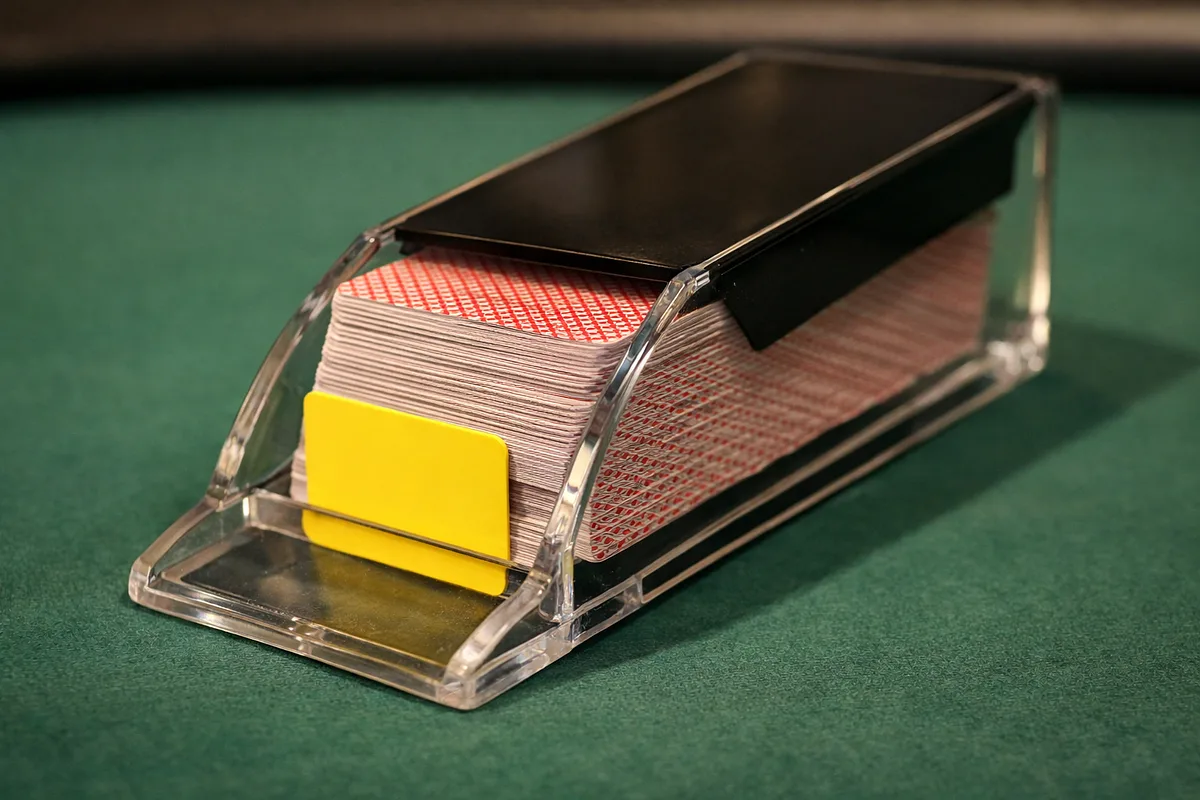
Shoe size, burn procedures, and cut card placement all shift the odds in baccarat, but only within tight limits set by the game’s fixed drawing rules. This page breaks down exactly how each variable works and what it actually changes, so you can decide whether any of these factors are worth thinking about when you play.
Baseline Outcome Probabilities Under Standard Shoe Conditions
Every baccarat hand produces one of three outcomes: banker win, player win, or tie. Each carries a distinct probability that stays stable under the standard eight-deck shoe. These numbers aren’t arbitrary. They follow directly from the fixed card composition of an eight-deck shoe and the game’s mandatory drawing rules. The eight-deck setup sits so close to the theoretical infinite-deck limit that its probabilities work as the practical reference point for everything else. Any discussion of how deck count, burn procedures, or cut card placement affects baccarat odds starts here.
The Three Baseline Probabilities and Why They Anchor Every Analysis
The three outcomes don’t split evenly because the drawing rules give the banker side a built-in structural advantage. That advantage comes from the mechanics of the game, not from any player decision. Ties happen much less often than either primary outcome, making them a separate category rather than a near-equal alternative. Because the card composition of an eight-deck shoe is fixed and the drawing rules are deterministic, these baseline figures show up consistently across independent mathematical analyses.
| Outcome | Baseline Probability (Standard 8-Deck Shoe) |
|---|---|
| Banker win | ~45.84–45.9% |
| Player win | ~44.6–44.62% |
| Tie | ~9.5–9.53% |
How These Baselines Shape What the Reader Should Expect to See
The banker’s edge over the player is about one percentage point. That gap is narrow enough to get misrepresented sometimes, but it’s wide enough to produce a real difference in house edge between the two primary bets. If you see a published probability that differs noticeably from these baselines, it points to a non-standard shoe configuration, a rule variant like a different commission structure or modified drawing rule, or an error in the source. Keeping these baselines in mind lets you quickly judge whether a claimed probability figure makes sense for standard eight-deck play.
How Deck Count Shifts Banker, Player, and Tie Probabilities
Deck count is the configuration variable that comes up most often in baccarat probability discussions, and its effect on outcomes is real and directional. As deck count drops from eight toward one, the probabilities for banker, player, and tie shift away from the values you get with a large, stable shoe. The shifts are bounded, though. The eight-deck game sits so close to the theoretical infinite-deck limit that the practical difference between them is negligible. Knowing this prevents a common mistake: assuming that switching shoe configurations meaningfully restructures the game’s fundamental asymmetry.
Comparative Probabilities Across Deck Configurations
The practical range for baccarat runs from single-deck through six-deck and eight-deck configurations up to the infinite-deck theoretical baseline. A six-deck shoe produces a marginally higher banker win probability than an eight-deck shoe, while the eight-deck figures converge so tightly on the infinite-deck values that the two are effectively indistinguishable at the table. Single-deck baccarat diverges the most from the infinite-deck baseline, producing the largest directional shift in all three outcome probabilities.
| Shoe Configuration | Banker Win | Player Win | Tie |
|---|---|---|---|
| Single-deck | Diverges most from baseline; directional shift toward banker | Correspondingly reduced | Slightly altered |
| Six-deck | Marginally higher than 8-deck baseline | Marginally lower than 8-deck baseline | Near baseline |
| Eight-deck | ~45.86% | ~44.62% | ~9.52% |
| Infinite-deck | ~45.84% | ~44.61% | ~9.54% |
Why the Eight-Deck Standard Approximates the Theoretical Ceiling
The eight-deck figures differ from the infinite-deck values by fractions of a percentage point across all three outcomes. That’s the mathematical reason the industry settled on this configuration as a practical standard. Adding more decks beyond eight produces only vanishing changes to outcome probabilities, so the eight-deck game represents the effective ceiling of banker-favored asymmetry you can get through shoe expansion alone. If you’re playing an eight-deck game, you can treat its published probabilities as essentially equal to the infinite-deck theoretical limit. A six-deck game won’t present a meaningfully different probability profile at the table.
The Role of Burn Cards and Cut Card Placement
Burn cards and the cut card determine which cards from a shoe actually reach the table. The burn procedure removes cards at the start of each shoe, and the cut card marks where dealing stops before the shoe runs out. Together, these two mechanisms mean the cards available during any session are a subset of the full shoe, not the complete contents. Because both variables reset differently each time, the “same” eight-deck shoe never plays out over an identical sequence of cards from one session to the next.
How Burn Procedures Reduce Cards in Play
At the start of a new shoe, the dealer exposes one card and removes additional cards based on its value. Because the exposed card is drawn at random, the number burned varies from shoe to shoe, and no two shoes begin with the same card composition available to players. The burn happens before any hand is dealt, so its effect on composition is invisible to anyone sitting at the table.
The burn quantity follows these rules:
- Ace exposed: No additional cards burned.
- Ten or face card exposed: Nine additional cards burned.
- Any other card exposed: Additional cards burned equal to pip value minus one.
Cut Card Placement and Effective Hands per Shoe
The cut card is inserted a fixed distance from the bottom of the shoe and marks the last hand to be played, leaving a block of cards that never enters play. Under standard procedure for an eight-deck shoe, the cut card is placed 16 cards from the bottom, and roughly 25% of the full card inventory typically goes undealt by the time the shoe ends. That’s why practical hand counts per shoe fall within a predictable range rather than varying freely.
The table below shows how cut card placement and burn procedures translate into approximate cards in play and hands per shoe across two standard configurations.
| Shoe Configuration | Approx. Cards in Play | Approx. Hands per Shoe |
|---|---|---|
| Eight-deck, cut card 16 from bottom | ~393–394 | ~80–81 |
| Six-deck, 15 burn cards | Not specified in source figures | ~60 |
Why Procedural Variability Sharpens the Reader’s Interpretation of Shoe Behavior
Because burn quantities vary by exposed card value and the cut card removes a substantial block of cards, each shoe represents a sampled subset of the full 416-card or 312-card inventory, not a complete deal of every card in the shoe. A meaningful fraction of the cards is never seen by anyone at the table. Claims about what a shoe “will do” based on its total card composition are structurally misleading, because the actual cards in play are determined by two procedural variables that reset differently with every shoe.
Card Removal Effects and the Limits of Card Memory in Baccarat
A baccarat shoe is a finite card supply, which means every hand dealt changes the composition of what remains. That change, no matter how small, alters the probabilities for the next hand. This property is called card memory, and it means consecutive hands within a shoe are technically not independent events. Card memory in baccarat is weak, though, and that weakness is exactly why the game behaves as effectively random from hand to hand under normal playing conditions.
Why Baccarat Is Not Strictly Independent Between Hands
Analysis of baccarat outcomes at scale has shown that results within a shoe don’t follow a strictly independent distribution. Removing cards from a finite deck creates measurable, if small, shifts in subsequent hand probabilities. The deviation from independence is negligible for practical purposes and doesn’t change how a player should approach any given hand. The finding matters conceptually because it confirms that card memory exists in baccarat, but it doesn’t translate into exploitable information under normal casino conditions.
Why the Effect Is Substantially Smaller Than in Blackjack
Card counting in baccarat is approximately nine times less effective than in blackjack, a ratio established in Edward Thorp’s The Mathematics of Gambling. The reason is that baccarat’s fixed drawing rules limit how much any single removed card can shift the probability of the next hand’s outcome. In blackjack, players can change their drawing decisions based on deck composition, which amplifies the value of card-removal information. So while card memory exists in baccarat, that doesn’t mean it can be exploited. The nine-times-less-effective ratio is the quantitative reason those two claims don’t follow from each other.
The Practical Limits of Card Counting Given Standard Shoe Configuration
The theoretical window where card composition shifts enough to matter in baccarat is roughly the last twenty cards of an eight-deck shoe. Standard cut card placement ends dealing well before play reaches that region. This isn’t incidental. It’s a structural feature built into the procedural design of the game, and it’s why almost all claims about baccarat card counting fall apart once you account for the cut card.
The Twenty-Card Threshold and Why Play Never Reaches It
Wizard of Odds documents that card-counting strategies in baccarat become meaningful only within approximately the last twenty cards of an eight-deck, 416-card shoe, with one specific counting method identified as exploitable only within the final sixteen cards. The cut card is placed sixteen cards from the bottom of the shoe as standard procedure. When it appears, the dealer completes the current hand, plays one additional hand, and stops, terminating the shoe before the final card block is accessible to players. This is a designed feature of the game. The cut card exists precisely to prevent dealing into the region where card composition could yield a counting edge.
How This Boundary Sharpens Interpretation of Card-Counting Claims
When someone claims baccarat can be beaten through card tracking under standard casino conditions, the cut card placement shows exactly where that claim breaks down. The region of the shoe where counting produces any measurable edge (the final cards) is structurally unreachable under normal dealing procedures. The exploitable window and the accessible window don’t overlap. That’s why the consensus among gambling mathematics experts, documented over more than forty years, holds that card counting doesn’t work at the baccarat table.
How Shoe Configuration Interacts With the House Edge
Shoe configuration sets the raw outcome probabilities, but it doesn’t determine the house edge on its own. Commission rate on the banker bet and payout structure on the tie bet are separate variables that act on those probabilities to produce the edge a player actually faces. The same underlying win probabilities can yield different effective edges depending on which table rules apply. That’s why two tables with identical shoe configurations can carry meaningfully different costs per dollar wagered.
Banker, Player, and Tie House Edge Under Standard Conditions
The banker bet carries the lowest house edge of the three standard wagers under a 5% commission structure. That’s a direct result of the banker’s asymmetric drawing advantage combined with the commission reducing the net payout on wins. When casinos cut that commission rate, the effective edge on the banker bet drops further, because the same win probability now returns more per winning wager. The tie bet’s edge is an order of magnitude larger than either primary bet, reflecting a payout structure that substantially undercompensates for how rarely a tie actually occurs.
| Bet Type | Approximate House Edge |
|---|---|
| Banker (5% commission) | ~1.06% |
| Banker (4% commission) | ~0.6% |
| Player | ~1.24% |
| Tie (standard 8-deck) | ~14.36%–14.4% |
Why the Tie Bet’s Edge Is Structurally Independent of Shoe Size
The tie bet’s house edge of roughly 14.4% comes from the gap between its 8-to-1 payout and its base probability of approximately 9.52%. That relationship is determined entirely by payout arithmetic, not by how many decks are in the shoe. Deck count shifts the tie probability only marginally across realistic shoe configurations, leaving the payout-to-probability gap essentially unchanged. No shoe configuration a casino uses in practice narrows that gap enough to bring the tie bet’s edge close to the ~1% range of the primary bets. Shoe-configuration effects matter when analyzing banker and player outcomes, but they’re irrelevant to the tie bet’s position as the highest-edge wager on the table.
We check operator terms, licences and payment details against the casino's own pages and update this content when they change. Read our editorial policy, our transparency statement, or report an error. If gambling stops being fun, see our responsible gambling resources.