

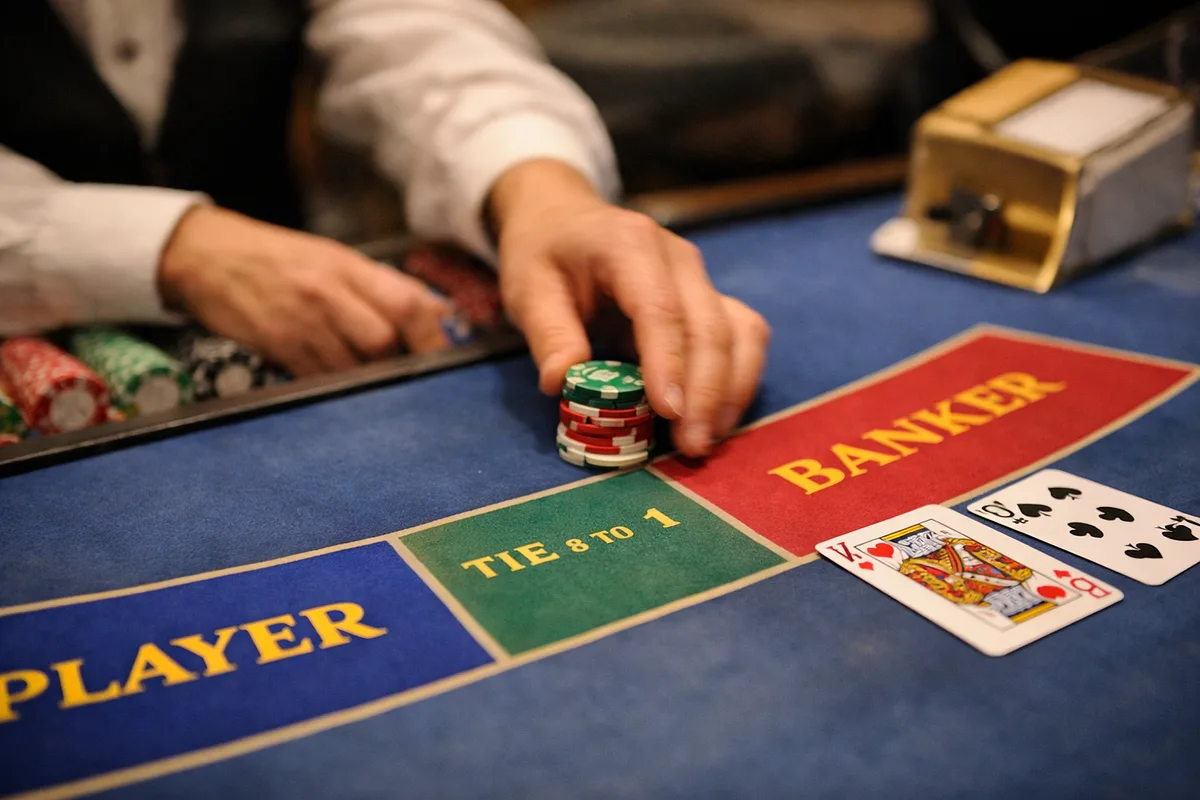
Most players think about bet size when they’re trying to figure out what a baccarat session will cost them. But the number of hands you play per hour carries the same mathematical weight. A faster table raises your expected hourly loss just as surely as raising your bet does. This page explains how table format and playing conditions affect pace, how pace feeds into a concrete hourly loss figure, and how to calculate that figure for your own situation. By the end, you’ll have enough to compare tables, adjust your session length, and make smarter decisions about where and how you play.
The Theoretical Loss Formula in Baccarat
Expected hourly loss in baccarat comes from multiplying three things together: average bet size, house edge, and hands per hour. The relationship is strictly linear. Double any one of those inputs and your expected hourly loss doubles, as long as the other two stay the same. What this formula makes clear is that hands per hour isn’t a fixed property of the game. It’s a separate variable that changes your expected cost without any change to your bet size or wager type.
The Three Multiplicative Inputs
Each input in the formula represents a distinct part of a baccarat session.
- Average bet size is the mean dollar amount you wager per hand across a session. You control this entirely. A $50 average bet produces twice the expected hourly cost of a $25 average bet at the same pace and edge.
- House edge is the casino’s built-in mathematical advantage on a given wager type, expressed as a percentage of each bet. For the banker bet in standard commission baccarat, the house edge is 1.06% in Las Vegas. No-commission variants like EZ Baccarat and Tiger No Commission Baccarat, both approved for use in Nevada, change the payout structure in ways that adjust this figure. The house edge is the one input you can’t change within a chosen wager type.
- Hands per hour is the number of complete rounds dealt in one hour. It’s shaped by table format, how many players are seated, and dealer speed, all of which shift during a session. Recognizing this as a separate input from bet size and house edge lets you read any session cost estimate more accurately.
Why the Relationship Is Strictly Linear
The linearity follows directly from how the game works. Each hand in baccarat is an independent trial with the same expected value. Because no hand’s outcome affects the next one, the total expected loss over any number of hands is just that per-hand expected value multiplied by the number of hands played.
Doubling hands per hour doubles the number of independent trials you complete in a fixed time window, which doubles your expected loss over that window. A bankroll that would sustain roughly 19 hours of play at one pace drains in under 9 hours when pace doubles, because the rate of expected loss per hour doubles while the bankroll stays the same.
When a pace figure comes up in a casino discussion, whether a dealer quotes it, a game guide lists it, or you estimate it from table conditions, it works as a direct multiplier on expected hourly cost. A shift from 40 hands per hour to 80 hands per hour is the cost equivalent of doubling your average bet size.
Hands Per Hour Benchmarks by Baccarat Format
Each baccarat format has a characteristic pace that feeds directly into any hourly loss calculation. Those baselines span a wide range, from the slowest ceremonial rooms to the fastest single-player electronic setups. Two players placing identical bets can face very different hourly costs based solely on which format they’re sitting at. Knowing where your chosen format falls on that spectrum is what turns the theoretical loss formula into a real dollar figure you can apply to your own session.
Format-Level Pace Comparison
The figures below are characteristic benchmarks for each format category, not fixed rates. Actual pace within any format shifts based on conditions covered in the next section, so treat these numbers as the central reference point around which real-world play clusters.
| Format Category | Typical Hands Per Hour | Playing Context |
|---|---|---|
| Traditional full-table baccarat | ~40 | Ceremonial dealing conventions; larger seating capacity slows hand resolution |
| Standard active-table baccarat | 60–80 | Pace varies with occupancy and dealer speed at a standard pit table |
| Mini baccarat | ~70 | Smaller table, faster dealer-controlled dealing; no ceremonial card handling |
| High-speed or single-player baccarat | Up to 150 | Electronic or near-solo play eliminates inter-player delays entirely |
| High-roller big baccarat room | As few as 15 | Deliberate pacing, extended rituals, and low table occupancy reduce round frequency |
Why the Same Format Varies Within Its Range
Table occupancy is the main driver of pace variation within a format. When fewer players are seated, the dealer resolves each round against fewer hands, which shortens the time between shuffles and wager settlements. A full table reverses that, since the dealer has to manage chips, side bets, and multiple hand outcomes before the next round can start.
Dealer speed adds a second layer of variation that has nothing to do with occupancy. Individual dealers differ in how quickly they handle cards, pay winners, and collect losing bets. A quieter pit doesn’t automatically mean a faster dealer.
Player betting behavior adds a third factor, and it’s more pronounced in baccarat than in many other table games. Players often delay placing their bets while reviewing prior outcomes on scorecards, which stretches the idle time between hands. That adds up across a full session. Cutting just a few seconds off that delay per hand is enough to add one more round per hour. So any quoted pace figure is the midpoint of a range shaped by all three of these factors at once, not a fixed rate. Treating it as fixed will either overstate or understate your actual hourly exposure at that table.
Worked Dollar Examples of Theoretical Hourly Loss
The formula (bet size x house edge x hands per hour) only clicks when it produces a dollar figure you can compare against your buy-in, your win target, or your comp expectation. The examples below take the inputs covered earlier and turn them into concrete numbers. This is where format choices stop being abstract and start carrying a visible price tag.
Two Baseline Calculations
The table below shows two worked examples, each as an explicit multiplication of the three formula inputs.
| Scenario | Bet Size | House Edge | Hands per Hour | Expected Hourly Loss |
|---|---|---|---|---|
| Mini baccarat, flat $10 wager | $10.00 | 1.00% | 70 | ~$7.00 |
| Las Vegas Strip, $25 banker bet | $25.00 | 1.06% | ~100 | ~$26.50 |
The 1.06% figure in the second scenario reflects the verified house edge for the banker bet under standard commission baccarat in Las Vegas. Each result is a statistical expectation across many hours of identical play, not a prediction for any single session.
If a session ends above or below these figures, that doesn’t mean the formula is wrong. Variance is real and operates hand by hand. The expected-loss figure only becomes an accurate description of outcomes when the number of trials is large. For a single session, its value is as a reference point. It shows which direction outcomes drift over time, not what any individual hour will produce.
How the Figure Shifts When Pace Changes
Because the relationship between hands per hour and expected loss is strictly linear, changing pace while holding bet size and house edge constant scales the hourly cost by exactly the same proportion. Double your hands per hour and you double your expected hourly loss. Nothing else needs to change.
The practical consequence shows up in bankroll duration. A bankroll that sustains roughly 19 hours of play at one pace drains in under 9 hours when pace doubles. That compression happens without any change to bet size or wager type.
This is what separates sitting at a full traditional baccarat table from sitting alone at a mini baccarat table with the same $25 wager. The house edge on the banker bet is the same in both settings. The bet size is the same. But the hands-per-hour input is materially different between a slower full table and a faster single-player setup, and that difference alone changes the hourly cost of an otherwise identical wager.
Pace as a Bankroll Management Variable
Most bankroll discussion treats bet size as the main lever, which leaves hands per hour unexamined even though it carries the same mathematical weight. Reduce hands per hour by a given proportion and you reduce expected hourly loss by that same proportion, without changing your bet size or wager type. Pace is a separate, controllable variable in the loss equation, not just a side effect of which format you chose.
How Pace Changes the Expected Session Cost
Your choice of format sets the baseline hands-per-hour input before a single card is dealt. Traditional full-table baccarat runs at roughly 40 hands per hour. Mini baccarat runs at roughly 70. For an identical bet on the same wager type, those two formats produce materially different expected hourly costs, not because the house edge is different, but because the number of trials completed in a fixed time window is different.
Within a given format, table occupancy and in-session behavior shift the hands-per-hour figure further. A fuller table spreads dealer time across more players, which reduces the number of hands any one player completes per hour. Sitting out individual hands removes those trials from your personal count entirely, lowering your effective pace without changing the bet size you place on hands you do play.
One hour of play is not a fixed unit of expected value across formats or table conditions. A session hour at a full traditional table and a session hour at a solo mini-baccarat seat represent different amounts of expected loss, even when the wager and wager type are identical. Treating session length as a uniform measure of exposure, without accounting for the hands-per-hour rate embedded in that session, gives you an inaccurate picture of how much theoretical loss has accumulated.
Pace, Comp Accrual, and Loyalty Point Calculations
Casino comp and loyalty point programs calculate reward accrual as a function of theoretical loss. That means the same pace figure that scales your expected cost also scales the expected comp value you earn in that session. Hands per hour sits on both sides of the ledger at once: it’s a revenue variable for the casino and a cost variable for you, and both framings describe the same underlying number.
The Simultaneous Scaling Effect
Because comps are calculated as a fraction of theoretical loss, any change in hands per hour moves expected loss and expected comp accrual in the same direction at the same rate. Double hands per hour and you double expected theoretical loss. You also double the comp credits generated from that session, since both figures come from the same base calculation.
One illustrative figure from the research places comp accrual at roughly $5 per hour for a player wagering $15–$25 per hand across about 40 hands of baccarat. [VERIFY THIS QUOTE] That figure is proportional to the theoretical loss produced at that pace and bet size. It’s not a separate benefit calculated independently of expected loss.
That proportional relationship changes how comp offers should be read. A higher comp return rate isn’t a discount applied against expected loss. It’s a larger fraction of the same theoretical loss figure. The expected loss itself is still determined by bet size, house edge, and hands per hour. Comp accrual scales with that loss rather than offsetting it.
Session Pace as a First-Order Input to Expected Hourly Cost
Expected cost in baccarat isn’t determined by wager size alone. Pace carries equal mathematical weight in the same formula. A player who reads a table’s format and conditions as a direct input to hands per hour gets a more accurate picture of their actual hourly exposure than one who tracks only bet size. That applies across every format, from ceremonial full-table rooms to high-speed single-player configurations.
We check operator terms, licences and payment details against the casino's own pages and update this content when they change. Read our editorial policy, our transparency statement, or report an error. If gambling stops being fun, see our responsible gambling resources.