

This page walks through how to calculate your expected loss in baccarat using a simple formula that combines your average bet, deal rate, time at the table, and the house edge. The hands-per-hour figure is the one that changes most between table formats, which means two players betting the same amount can face very different costs depending on where they sit. Below, you’ll find the formula, how deal rates vary by format, and a fully worked example with real numbers you can adapt to your own situation.
Expected loss in baccarat is the product of four variables: average bet, hands per hour, hours played, and house edge. Multiply them together and you turn an abstract percentage into a real dollar figure you can plan around before you sit down. The hands-per-hour rate shifts most dramatically between table formats, so two players betting the same amount can face very different hourly costs. This article covers the formula, how deal rates differ by format, and a worked dollar-amount example you can plug your own numbers into.
The Expected Loss Formula for Baccarat
The formula takes four inputs and multiplies them together to turn a house edge percentage into a dollar amount you can compare against your actual bankroll. It doesn’t predict what will happen in any single session. It tells you what the math expects to happen on average across all the action you generate.
The formula is: Expected Loss = Average Bet × Hands Per Hour × Hours Played × House Edge. Each variable captures one aspect of your session, and together they determine the total dollar amount the house edge gets applied to. Express the house edge as a decimal: 1.06% becomes 0.0106.
- Average Bet – the typical dollar amount you wager per hand across the session.
- Hands Per Hour – how fast hands are dealt and resolved, which varies by table format.
- Hours Played – how long you plan to play.
- House Edge – the casino’s mathematical advantage on the specific bet you’re placing, written as a decimal.
Use the house edge that matches the bet you’re actually placing. The two main bet types carry different figures, so using the wrong one will give you an inaccurate estimate.
| Bet Type | House Edge | Notes |
|---|---|---|
| Banker | 1.06% | Reflects the 5% commission applied to winning Banker bets |
| Player | 1.24% | No commission applied |
When a hand ends in a tie, your Banker or Player bet isn’t won or lost. It’s returned or left in place, so it doesn’t count as a resolved bet. The 1.06% and 1.24% figures are calculated only against resolved Banker and Player outcomes, with ties removed. If you mistakenly apply a tie-inclusive house edge figure, you’ll overstate your expected loss, because that figure spreads the casino’s advantage across fewer hands than the published figures assume.
Hands Per Hour by Baccarat Format
Hands per hour is the variable in the formula that changes most when you move from one table format to another. It multiplies against bet size, house edge, and hours played all at once, so even a modest increase in deal rate raises your hourly cost by the same proportion. Two players both betting on the Banker at 1.06% will end up with very different session totals if they’re sitting at tables with different deal rates.
Traditional full-table baccarat moves slower than mini-baccarat or other compressed formats, and that difference feeds directly into your expected loss. The table below shows the hands-per-hour benchmarks for each format, based on industry sources.
| Format | Hands Per Hour |
|---|---|
| Traditional full-table baccarat | Approximately 40 |
| Mini-baccarat | Approximately 70 |
| Faster-format industry input range | 70-90 |
Because hands per hour sits in a multiplicative position in the formula, doubling it doubles your expected loss for the same bet size, house edge, and session length. Moving from a traditional table at roughly 40 hands per hour to a mini-baccarat table at roughly 70 hands per hour doesn’t change the house edge. You’re facing the same edge applied nearly twice as often within the same clock hour. That cost difference adds up across every hour you play.
A Worked Dollar-Amount Example
Once you assign concrete numbers to all four inputs, the formula spits out a specific dollar figure. The example below uses a $100 average bet, a deal rate consistent with faster-format baccarat, a four-hour session, and the Banker house edge. The result gives you both a total session cost and an hourly figure you can scale up or down by changing any single input.
This scenario puts a player at a faster-format table, betting $100 per hand at 80 hands per hour across a four-hour session on the Banker bet, which carries a 1.06% house edge. Plug those four numbers into the formula: Average Bet × Hands Per Hour × Hours Played × House Edge.
$100 × 80 × 4 × 0.0106 = $339.20
That $339.20 is the expected loss across the full four-hour session. Divide by four and you get an hourly cost of $84.80, which is the long-run average to budget against. Change any one input and the output changes by the same proportion, so the formula works just as well with your own numbers.
Variance and Why Actual Results Diverge from Expected Loss
The expected loss figure is a statistical average across a large number of hands, not a fixed cost your session will match. In practice, actual results land above or below that figure all the time, sometimes by a wide margin, because each hand is its own independent event. The formula tells you what results converge toward over time, not what will happen in your next two or four hours at the table. Treating it as a guaranteed session cost is the most common mistake players make when using this formula.
Baccarat resolves hands quickly relative to most other table games, around 70 per hour at a mini-baccarat table. That means you rack up a large number of independent bet outcomes in a single session. Even with a house edge as low as 1.06% on the Banker bet, that volume of hands creates real short-term swings. A session can end well above or well below the expected-loss figure without anything changing in the underlying math. A losing session doesn’t mean the house edge went up. A winning session doesn’t mean the math stopped applying. Both are just short-term variance around a stable long-run average.
Connecting Expected Loss to Session Bankroll Sizing
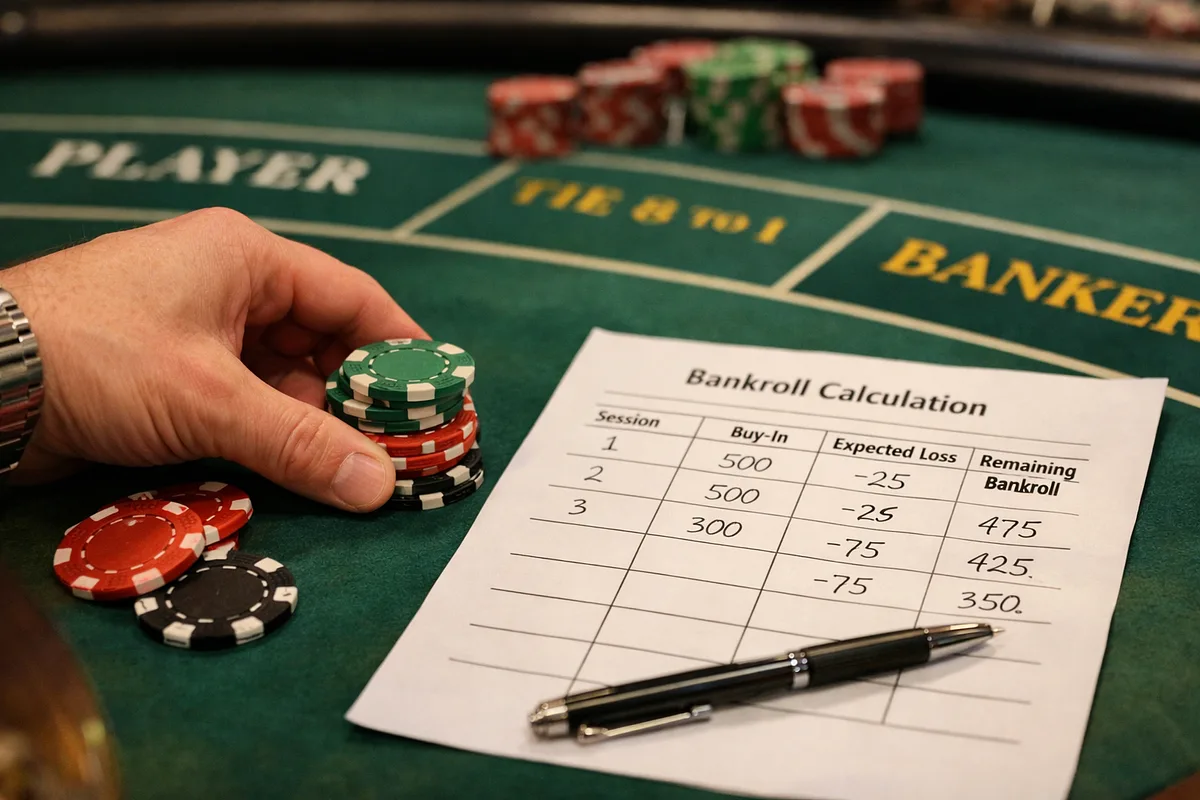
The expected-loss formula gives you a dollar figure, but that number only becomes useful when you put it next to the funds you’re actually bringing to the table. This section looks at how bet size relates to session bankroll, and how the ratio between your bankroll and your expected loss affects how long a session can realistically run.
A commonly cited guideline puts each per-hand wager at 1-5% of your total session bankroll, which ties your bet-size input directly to the funds you have available. A separate practical rule sizes the starting bankroll at 20 times the minimum bet: a $10 per-hand bet corresponds to a $200 session buy-in under this approach. The allocation you choose determines how quickly expected loss works through your available funds.
- 1% allocation – Conservative bet-to-bankroll ratio; expected loss eats through a smaller share of starting funds per hour.
- 5% allocation – Aggressive bet-to-bankroll ratio; expected loss eats through a larger share of starting funds per hour.
- 20x minimum bet rule – A practical starting-bankroll anchor that ties bet size to a defined session buy-in.
The ratio between your total session bankroll and your per-hand expected loss rate determines how many rounds you can realistically play before expected loss consumes a significant portion of your starting funds. One figure from punto banco analysis puts this in concrete terms: with a $1,000 starting bankroll and $10 flat bets, a player exhausts funds in an average of 936 rounds. That reflects the house edge applied repeatedly against a fixed bankroll. A larger starting bankroll relative to your per-hand expected loss extends how long a session can run; a smaller one compresses it. The relationship is proportional: double the starting bankroll while keeping bet size the same, and you roughly double the round count before depletion.
We check operator terms, licences and payment details against the casino's own pages and update this content when they change. Read our editorial policy, our transparency statement, or report an error. If gambling stops being fun, see our responsible gambling resources.