


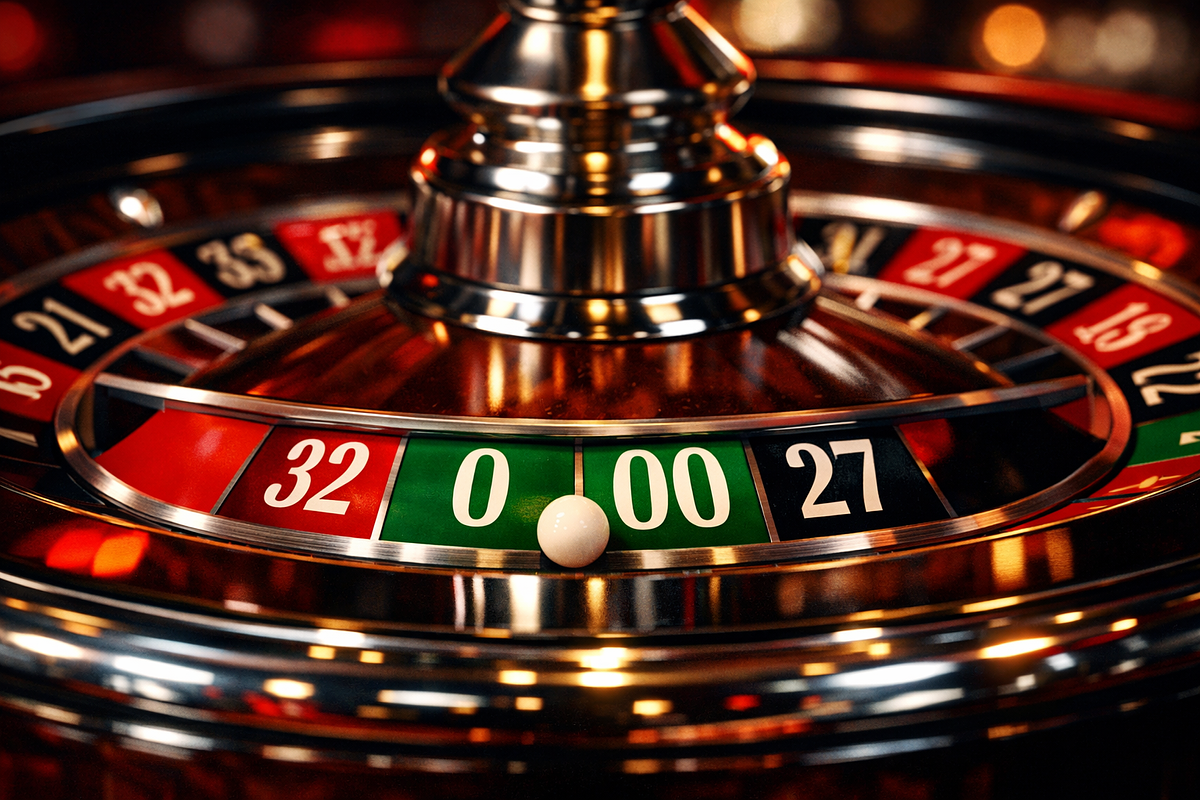
The American roulette wheel has 38 pockets: numbers 1 through 36, a single zero, and a double zero. The European wheel has 37. That one extra green pocket changes the math behind every bet on the table, which means identical payouts on the two wheels don’t produce identical odds. This article covers how the American wheel is structured, what the double zero does to the numbers behind each bet type, and where rule variations can shift those figures.
The Structure of the American Roulette Wheel
The American roulette wheel has one more pocket than the European version. That single addition, the double zero, drives every difference in probability and payout between the two games. Before getting into odds or bet types, it helps to understand the physical layout of the wheel.
The pocket count and the color of the green sections are the two things that tell you which version of the game you’re looking at.
The American wheel has 38 pockets: numbers 1 through 36, a single zero (0), and a double zero (00). Both zero pockets are green, and the numbered pockets alternate red and black. The European wheel has 37 pockets, the same numbers 1 through 36 plus one green zero, with no double zero. Since each pocket is one equally likely outcome per spin, adding a pocket changes the denominator of every probability on the layout. One green pocket means a 37-outcome denominator. Two green pockets mean a 38-outcome denominator. That’s the visual cue that tells you which math applies.
The number sequence around the American wheel is fixed and standardized across casinos. The pockets are arranged to spread high, low, red, and black numbers around the rim rather than grouping them. Because the sequence is uniform, the physical position of any number on the wheel has no bearing on where the ball will land next. The list below shows the fixed order of pockets as they appear around the wheel.
- 0 – 28 – 9 – 26 – 30 – 11 – 7 – 20 – 32 – 17 – 5 – 22 – 34 – 15 – 3 – 24 – 36 – 13 – 1 – 00 – 27 – 10 – 25 – 29 – 12 – 8 – 19 – 31 – 18 – 6 – 21 – 33 – 16 – 4 – 23 – 35 – 14 – 2
How the Double Zero Changes the Math
The double zero pocket produces a measurable, fixed shift in every probability on the layout. Adding one pocket changes the denominator of every calculation from 37 to 38, and that change affects the house edge and the win probability on every bet type. The sections below break down what that means in practice.
On nearly all standard bets on the American double-zero wheel, the house edge is 5.26%, or 1/19. That figure comes directly from having two green pockets instead of one. Payouts on both the American and European wheels are built around a 36-number layout, so the green pockets are outcomes the house wins without any corresponding payout to the player. The European single-zero wheel has a house edge of 2.70% (1/37), which makes the American figure roughly double. The house edge is a fixed mathematical property of the wheel. It represents the long-run expected loss per dollar wagered, not something that shifts with short-term results. Placing the same bet types at the same payout rates on both wheels is not the same value proposition because the number of possible outcomes is different.
Even-money bets (red/black, odd/even, and 1–18/19–36) pay 1 to 1, but they don’t win half the time on the American wheel. Only 18 of the 38 pockets satisfy any given even-money condition, so the win probability is 47.37% per spin. The gap between 47.37% and 50% comes from the two green pockets. Neither 0 nor 00 satisfies any even-money condition, so both outcomes are losses for the player on these bets. Treating “even money” as a coin flip is mathematically wrong on this version of the game.
One bet on the American layout carries a house edge worse than 5.26%: the five-number combination covering 0, 00, 1, 2, and 3. That bet carries a house edge of 7.89%. It only exists on double-zero layouts, since the European wheel has no double zero to include. The elevated edge comes from a payout structure that doesn’t fully account for the five covered outcomes on a 38-pocket wheel. The standard payout applied to this bet produces a return that falls short of the 5.26% baseline that applies to every other standard bet on the table. The five-number bet is not just another option on the American bet menu. It’s a structurally worse one.
The Standard Payout Structure
The American roulette wheel uses the same payout schedule as the European single-zero wheel, even though it has one extra pocket. That schedule was built around a 36-number layout, counting only the numbered pockets and ignoring the green ones. Because the actual wheel has one or two green pockets beyond those 36, every payout ratio falls short of the true odds of winning. That shortfall is where the house’s mathematical edge comes from.
The payout schedule doesn’t change between the two variants. What changes is the number of possible outcomes. Keeping payouts the same while adding a pocket is the mechanism that turns the extra green pocket into a built-in house advantage.
Each bet type on the American layout has a fixed payout ratio based on how many pockets it covers relative to a 36-number wheel. Because the two green pockets sit outside that reference count, they tilt every probability toward the house without any adjustment to the payout. The table below is the standard payout reference for the American double-zero layout.
| Bet Type | Numbers Covered | Payout |
|---|---|---|
| Straight-up (single number) | 1 | 35 to 1 |
| Split | 2 | 17 to 1 |
| Street | 3 | 11 to 1 |
| Corner | 4 | 8 to 1 |
| Five-number (0, 00, 1, 2, 3) | 5 | 6 to 1 (house edge diverges from the standard schedule) |
| Six-line | 6 | 5 to 1 |
Rule Variations That Change the House Edge
The 5.26% house edge is the default for American double-zero roulette, but it’s not the same at every table. Some casino jurisdictions apply rule variations that reduce the edge on specific bet categories, leaving the wheel structure and all other bets unchanged. A rule notice posted at the table is worth reading. It can signal a different probability structure even when the layout looks identical to any other American wheel.
The American double-zero wheel is part of a broader family of roulette variants that differ mainly in how many green pockets the wheel has. Across all variants, the number of green pockets is the main driver of the house edge. Each additional green pocket increases the gap between the payout schedule and the actual number of outcomes. The table below maps green-pocket count to house edge across the common variants.
| Variant | Green Pockets | House Edge |
|---|---|---|
| European (single-zero) | 1 | 2.70% |
| American (double-zero) | 2 | 5.26% |
| Triple-zero | 3 | 7.69% |
| Quadruple-zero | 4 | 10.00% |
Reading an American Roulette Layout on Sight
The double zero is what separates the American probability structure from every other roulette variant. A layout that looks familiar, with the same bet types and the same payout labels, runs on a different denominator the moment two green pockets appear instead of one. That pocket count tells you the variant, implies the house edge, and puts every payout ratio on the felt in its proper context.
We check operator terms, licences and payment details against the casino's own pages and update this content when they change. Read our editorial policy, our transparency statement, or report an error. If gambling stops being fun, see our responsible gambling resources.