


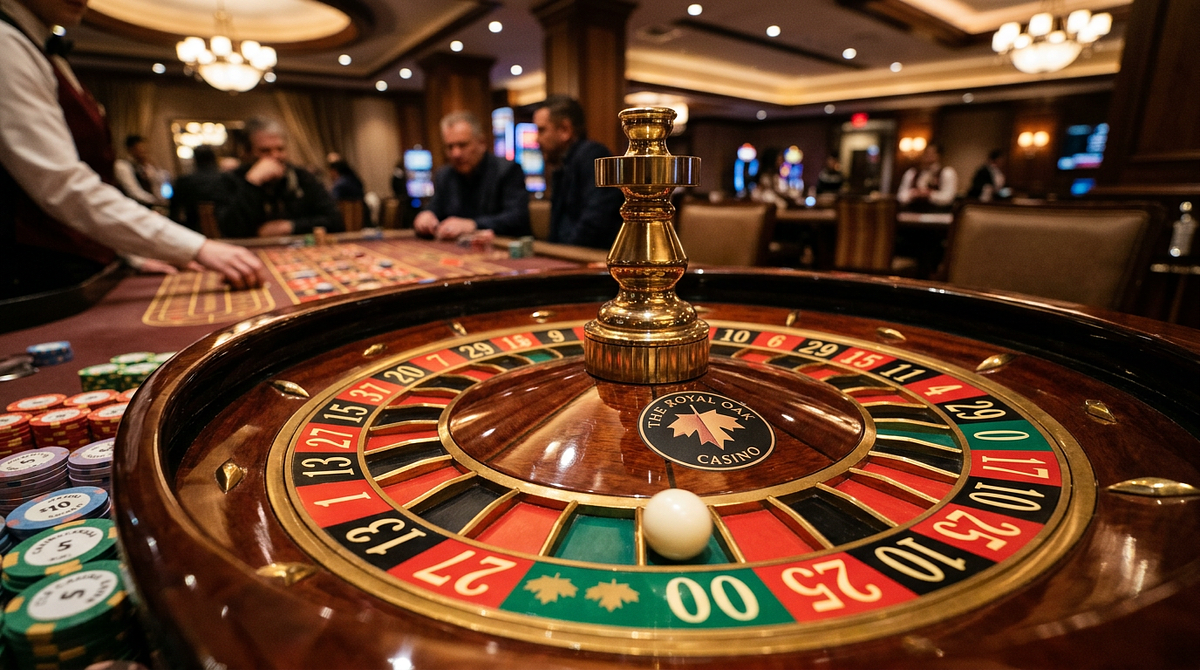
The difference between European and American roulette comes down to a single extra pocket. That double-zero on the American wheel nearly doubles the house edge from 2.70% to 5.26%. This article breaks down how each wheel is structured, what those percentages mean in real CAD terms per spin, and which variants Canadian players can actually find and play. By the end, you’ll have enough information to choose the wheel that gives you the better mathematical return.
How the Wheel Layout Determines the Math
The European roulette wheel has 37 pockets: numbers 1 through 36 plus a single zero. The American wheel has 38 pockets: numbers 1 through 36 plus both a single zero (0) and a double zero (00). That one extra pocket is the sole mechanical reason for every odds and payout difference between the two wheel types. Once you understand that pocket count drives the math, you can read any roulette odds figure and immediately tell which wheel type a source is describing.
The Extra Pocket and What It Costs the Player
On a European wheel, the true probability of any single number hitting on a given spin is 1 in 37. On an American wheel, that drops to 1 in 38. The payout for a straight-up single-number bet is 35:1 on both wheels. That figure doesn’t change between variants.
The issue is how that payout is calculated. Casinos price the 35:1 payout as though the wheel had exactly 36 pockets, one for each non-zero number. The actual wheel has either 37 or 38. The gap between “payout calibrated to 36 pockets” and “wheel that actually has 37 or 38 pockets” is where the house takes its advantage. On a 37-pocket wheel, the casino keeps one pocket’s worth of probability that it doesn’t pay the player for. On a 38-pocket wheel, it keeps two.
The practical takeaway for Canadian players: any roulette odds figure quoted without specifying the wheel variant is mathematically incomplete. A win probability, expected return, or house edge figure means something different on a 37-pocket wheel than on a 38-pocket wheel, even when the payout ratio is identical. Get in the habit of confirming the pocket count before treating any quoted odds figure as relevant to the game in front of you.
House Edge Figures Across the Three Wheel Variants
Three figures come up consistently across Canadian and international gambling publications when roulette house edge is discussed: European roulette at 2.70%, American roulette at 5.26%, and French roulette with La Partage or En Prison rules at 1.35% on even-money bets. These are the industry-standard benchmarks. Use them as a reference point to check any roulette content you come across. If a source quotes a figure that differs from these three, identify the wheel variant or rule set behind that number before treating it as meaningful.
What Each Percentage Means for a C$100 Wager
On a European single-zero wheel, the expected loss on a C$100 wager is C$2.70 per spin. On an American double-zero wheel, that rises to C$5.26 per spin. On a French wheel where La Partage or En Prison applies to an even-money bet, the expected loss on that same C$100 wager is C$1.35 per spin.
The gap between the American and European wheels is 2.56 percentage points. For a Canadian player wagering C$100 per spin, that works out to an average of C$2.56 more lost per spin at an American table than at a European one. Over a session of 50 spins, that difference adds up to C$128 in additional expected loss, without any change in bet size or strategy.
Expected value is a per-spin average calculated across a theoretically infinite number of spins, not a guaranteed loss on any individual spin. You can win on any given spin regardless of the house edge figure. A common mistake in Canadian gambling marketing is treating house edge as “how much you will lose.” It isn’t. The edge describes a long-run statistical rate of return to the house, not a predetermined outcome on each wager.
Wheel Variants to Avoid on the House Edge Scale
Two variants are worse than the standard American wheel. The triple-zero wheel, which adds a third zero pocket for 39 total pockets, carries a house edge of 7.69% on every bet. The American basket bet, a five-number combination covering the 0, 00, 1, 2, and 3 pockets, carries a house edge of 7.89% and only exists on American roulette.
Both work the same way: their payout structures are calculated as though the wheel has fewer pockets than it actually does. The triple-zero wheel pays as though it were a 36-pocket wheel; the basket bet pays 6:1 on a combination whose true probability on a 38-pocket wheel doesn’t support that payout. This makes the gap already present on the standard American wheel even larger.
The full house-edge ranking across roulette variants is: 1.35% (French, even-money bets only), 2.70% (European, all bets), 5.26% (American, all bets except basket), 7.69% (triple-zero, all bets), and 7.89% (American basket bet only). You can rank any roulette game at a Canadian venue or Ontario online casino against this scale using just the wheel type and applicable rules.
| Wheel or Bet Variant | Pocket Count | House Edge | Applies To |
|---|---|---|---|
| French roulette with La Partage or En Prison | 37 | 1.35% | Even-money bets only |
| European roulette | 37 | 2.70% | All bets |
| American roulette | 38 | 5.26% | All bets except basket |
| Triple-zero roulette | 39 | 7.69% | All bets |
| American basket bet | 38 | 7.89% | Basket bet only |
Payout Ratios and the Gap Between True Odds and Paid Odds
The payout ratios for equivalent bets are identical on European and American roulette wheels. A straight-up single-number bet pays 35:1 on either wheel; a split pays 17:1; a corner pays 8:1; even-money bets pay 1:1. The two wheels differ in their true winning probabilities, not in what the casino pays out. When a Canadian casino advertises “35:1 payouts on roulette,” that figure is mathematically incomplete without the pocket count. The payout is fixed; the winning probability is what changes between wheel types. The 35:1 figure alone tells you nothing about the house edge you’re actually accepting.
Bet-Type Odds Comparison Across Both Wheels
The table below shows exactly how much the extra zero pocket on the American wheel reduces your winning probability across every standard bet type. The payout stays the same on both wheels. What changes is the probability behind it. You can use this table to find, for any bet you’re planning to place, the exact probability you’re giving up by sitting at an American table instead of a European one.
| Bet Type | Payout | European Win Probability | American Win Probability |
|---|---|---|---|
| Straight (single number) | 35:1 | 2.70% | 2.63% |
| Split (two numbers) | 17:1 | 5.41% | 5.26% |
| Street (three numbers) | 11:1 | 8.11% | 7.89% |
| Corner (four numbers) | 8:1 | 10.81% | 10.53% |
| Line (six numbers) | 5:1 | 16.22% | 15.79% |
| Column or Dozen | 2:1 | 32.43% | 31.58% |
| Even-money (red/black, odd/even, high/low) | 1:1 | 48.65% | 47.37% |
Why the 35:1 Payout Is the Source of the House Advantage
The math behind the house edge is straightforward to work out from scratch. On a European wheel, a C$1 straight-up bet has a 1/37 chance of winning C$35 and a 36/37 chance of losing C$1. The expected value is: (1/37 × C$35) − (36/37 × C$1) = −C$0.027 per C$1 wagered. On an American wheel, the same bet has a 1/38 chance of winning C$35 and a 37/38 chance of losing C$1. The expected value is: (1/38 × C$35) − (37/38 × C$1) = −C$0.053 per C$1 wagered.
A 35:1 payout would only be mathematically fair on a hypothetical 36-pocket wheel with no zero. The zero pocket on the European wheel and the zero plus double-zero on the American wheel are the precise mechanism by which the house takes its edge. The payout schedule is calculated as though those pockets don’t exist, but the ball can land in them. The house edge doesn’t come from manipulated outcomes. It comes from a published, transparent payout schedule that is one or two pockets short of fair.
Rule Variants That Change the Math on Even-Money Bets
Two rules, La Partage and En Prison, reduce the effective house edge on single-zero wheels. A functionally similar rule called surrender appears on a small number of American tables. All three apply only to even-money bets (red/black, odd/even, high/low) and only when the ball lands on zero. No other bet type is affected. When a Canadian online casino advertises a “1.35% house edge,” that figure applies only to even-money bets on a wheel operating under one of these rules. It doesn’t describe the house edge across the game as a whole.
How La Partage, En Prison, and Surrender Work Mechanically
La Partage returns half of a losing even-money wager when the ball lands on zero. A C$10 bet on red that loses because the ball lands on zero returns C$5 to the player under this rule. The house keeps the other C$5, which is why the effective house edge on qualifying bets drops from 2.70% to 1.35%. The player only absorbs half the loss on zero outcomes.
En Prison works differently. When the ball lands on zero, the even-money bet is held on the layout for the next spin rather than collected. If that next spin wins, the original stake is returned without any additional winnings. The player neither gains nor loses on that sequence. If the next spin loses, the stake is collected in full. The long-run mathematical effect on house edge is identical to La Partage: 1.35% on qualifying bets.
The American surrender rule is structurally the same as La Partage. Half the even-money losing wager is returned when the ball lands on 0 or 00. But surrender doesn’t bring the American wheel’s house edge down to European levels. Two zero pockets still remain on the wheel, so the baseline probability structure is unchanged. Surrender on an American table reduces the effective house edge on even-money bets from 5.26% to approximately 2.63%, not to 1.35%.
A “1.35% house edge” claim is only accurate when it refers to even-money bets on a single-zero wheel operating under La Partage or En Prison. Applying that figure to straight-up bets, splits, corners, or any other bet type on the same table is wrong. Those bets carry the standard 2.70% house edge regardless of which zero rule is in effect.
Wheel Availability for Canadian Players
Double-zero American wheels are the dominant roulette format in Canadian land-based casinos, consistent with the broader North American, South American, and Caribbean market. A Canadian player walking onto a casino floor without prior research will most likely find the American wheel as the default, and with it, a house edge of 5.26%. Single-zero European wheels and French variants with La Partage or En Prison have a lower house edge, but these formats are far more accessible through online casinos serving Canadian players than through physical venues. The wheel that gives you the better mathematical value is not the one you’re most likely to find by default at a land-based table.
What This Means for Where to Play
At a Canadian land-based casino, assume the table in front of you runs a double-zero American wheel at 5.26% house edge. Before sitting down, check whether a single-zero table is available on the floor. Some venues offer both formats, but the European wheel is not guaranteed to be there. Treating the American wheel as the default and planning around that is the more reliable approach.
Online, Canadian-facing casinos frequently offer both American and European formats, often at identical stake levels. The wheel variant isn’t always clearly labelled in the game lobby, so verify it before you start playing. A game titled simply “roulette” can run on either a 37-pocket or 38-pocket wheel, and that difference is not cosmetic. Players in British Columbia online casinos and other provinces will often find both formats available through offshore platforms, making it easier to seek out the lower house edge option.
The bankroll implication is straightforward: the American wheel at 5.26% produces, on average, nearly double the expected hourly loss of the European wheel at 2.70% when stakes are held constant. A session budget built around European roulette will be depleted at roughly twice the rate on an American wheel. Your bankroll planning needs to reflect the specific wheel variant you’re actually playing, not a generic roulette assumption.
Choosing the Right Wheel for Your Next Session
Most Canadian players sitting down at a land-based roulette table are already playing the American wheel without realising it. That default choice costs roughly C$128 more in expected losses over 50 spins at C$100 per spin than the European alternative would. That gap doesn’t come from different payouts, which are identical across both wheels, but from a payout schedule calibrated to 36 pockets applied to a wheel that actually has 38. The fix is simple: confirm the pocket count before you play, not after. Online, where European and French variants are far more accessible to Canadian players than on any casino floor, that confirmation is especially worth making. A game labelled simply “roulette” can sit anywhere on a house-edge scale that runs from 1.35% to 7.89% depending on the wheel and rules in play. If you want to compare specific tables before committing, our Canadian casino guide breaks down which platforms offer single-zero and La Partage options by default. Lightning Roulette is a popular variant worth comparing against standard European roulette’s RTP and house edge.
We check operator terms, licences and payment details against the casino's own pages and update this content when they change. Read our editorial policy, our transparency statement, or report an error. If gambling stops being fun, see our responsible gambling resources.