

Online craps access in Canada runs on a two-tier system, not a single national framework. One province has a fully licensed commercial iGaming market open to private operators. Every other province looks different: provincially operated lottery platforms exist alongside offshore-licensed sites that Canadian residents can legally access as individual players.
This guide covers how platforms are regulated across the country, what changes between the two digital formats, and how the house edge compares to what you’d find at a land-based casino. By the end, you’ll have enough information to choose a format and a platform that suits how you want to play.
The Provincially Regulated Market Versus the Offshore Access Model
Ontario is one of two Canadian provinces with a fully regulated commercial iGaming market open to private operators. The market is overseen by the Alcohol and Gaming Commission of Ontario (AGCO), with iGaming Ontario managing the market through registered private operators. That market launched on April 4, 2022. Before that date, the Ontario Lottery and Gaming Corporation (OLG) was the only internet gaming site regulated by the AGCO in Ontario.
Players in every other province operate under a different model. Provincial lottery corporations run their own online platforms, and offshore-licensed casinos are accessible to Canadian residents at the same time. The Criminal Code of Canada targets unlicensed operators, not individual players. That’s why accessing an offshore-licensed site is a practical reality for Canadians outside Ontario, not a legal risk for the user.
The legal gambling age is 18 in three provinces (Alberta, Manitoba, and Quebec) and 19 in the rest. When you see a platform described as “available in Canada,” the more useful question is: which tier does it operate under? The answer tells you what consumer protections apply, what dispute-resolution options you have if something goes wrong, and which games you can actually access.
Why Exclusive Provider Contracts Restrict Where Certain Live Products Appear
The dominant live dealer craps product available to Canadian-facing platforms comes from a single studio that holds a commanding position in the global live casino market. That studio holds exclusive live casino contracts with certain provincial operators in Canada. The direct result is that a live dealer craps table may be available on one platform in a given province and missing from another platform in the same province, not because of anything the operators did differently, but because of licensing arrangements invisible to the player.
This is why forum discussions and Reddit threads about craps availability in Canada produce contradictory reports. Two players in the same province, on different platforms, can have completely different access to the same live product when a platform review says “no live craps available.” That reflects a distribution contract outcome, not a quality problem with the platform itself. The platform may be perfectly capable of offering the product. The contract above it determines whether it does.
RNG Craps Versus Live Dealer Craps — The Structural Format Split
Online craps comes in two mechanically distinct formats: RNG and live dealer. The difference between them affects pace, minimum stake, social experience, and which bets appear on the layout. Treating “online craps” as one thing leads to mismatched expectations.
You need to know which format a given platform offers and whether it fits your bankroll, your tolerance for pace, and your preference for a human-run table. Specific bet mechanics and house edges are covered in the next section.
The RNG Format — Self-Paced Digital Craps
In the RNG format, dice outcomes come from a certified random number generator. There’s no human dealer, no other players visible, and you control the pace completely. A new round starts only when you start it. The software handles all bet resolution automatically.
The minimum stake is the biggest practical difference from land-based play. RNG craps at Canadian-facing sites commonly allows bets as low as CA$0.10, compared to a typical land-based table minimum of CA$5.00. That gap removes the bankroll barrier that has kept casual players away from the game and lets you test unfamiliar bet types or wagering systems without much financial risk.
There’s also a hybrid category within the RNG segment: games where the visual presentation mimics a live table, with multiple camera angles, cinematic lighting, and animated chip movements, but the underlying engine is still RNG, and you still control the pace. Marketing labels like “3D craps” or “cinematic craps” describe this category. The visual layer doesn’t change the mechanics. These are self-paced RNG games, not live games, and should be treated as such.
The Live Dealer Format — Streamed Human-Mediated Play
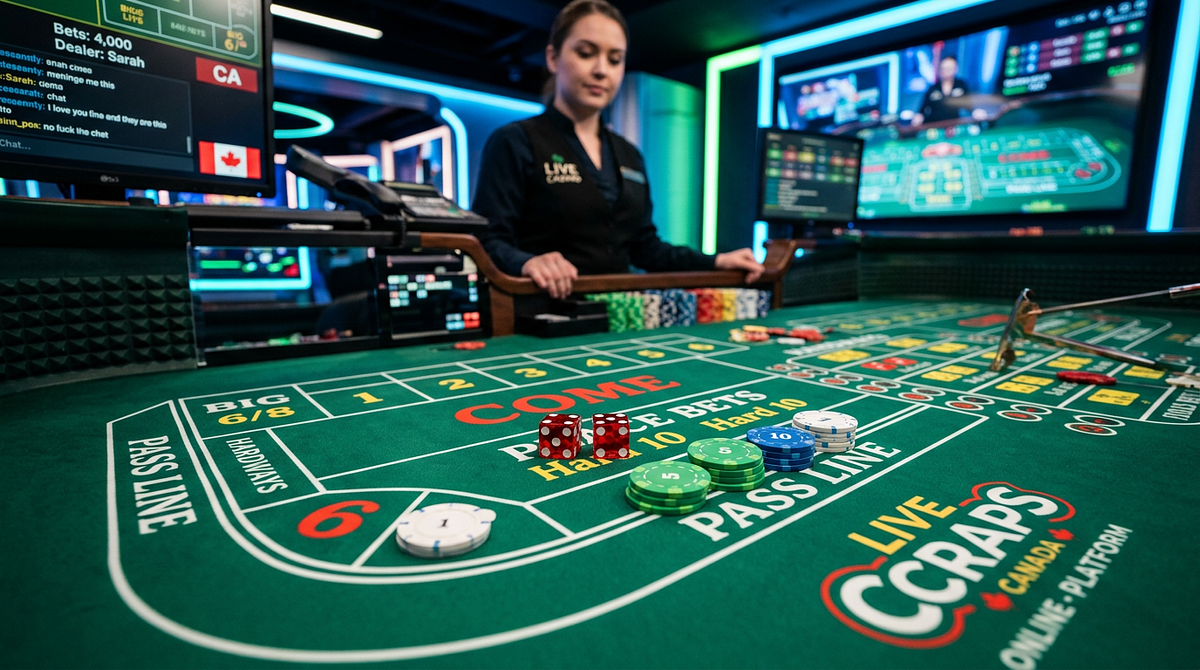
The live dealer format uses a physical dice-shooting device, typically a pneumatic tube or automated shaker rather than a human shooter, to produce each roll. A human presenter narrates outcomes and manages the table in real time. The session streams continuously, and all players at that table share the same betting window. Everyone must place or adjust wagers within the same fixed time interval before the next roll begins.
The reported RTP of the dominant live craps product is 99.17%. That figure is a weighted average across the full layout under optimal play conditions. It doesn’t describe the return on any single wager. Individual bets carry very different house edges, and that aggregate RTP is only achievable if you concentrate your action on the lowest-edge positions. If you want to see how this compares to other table games, our guide to blackjack house edge figures breaks down the same kind of per-bet analysis for that game.
Live dealer minimums are higher than RNG minimums, though they still sit below typical land-based table minimums. That gap is worth factoring into your bankroll planning.
The fairness case for live streamed craps rests on one specific physical fact: the dice roll is a real event happening in a real studio, captured on camera and visible to you in real time. That’s what separates it from RNG, where the outcome is generated computationally. When evaluating any live craps product, check the shooting mechanism, the betting window duration, and the studio provider behind it. Those three things define what you’re actually getting.
How the Shooter Role Is Handled When No Human Rolls the Dice
At a land-based craps table, the shooter role rotates among players. Each shooter handles the physical dice, sets their own pre-roll routine, and controls the pace and rhythm of the game until they seven out. That rotating human role shapes the social experience and supports practices like dice-setting and shooter-tracking.
Neither online format replicates this. In RNG craps, the software produces every roll. In live dealer craps, an automated mechanical device does. No player ever handles or influences the dice.
If you’re coming from land-based craps, you need to let go of the idea that shooter behaviour is worth tracking. Online, that variable simply doesn’t exist, which removes its tactical relevance and changes the social character of the game in ways covered in the section below.
Core Craps Bets and Their House Edges
A standard craps layout has dozens of distinct wager positions, but every bet belongs to one of a small number of categories. The house edge across those categories runs from 0% on the odds bet to nearly 17% on the any-seven bet. That range is the single most important economic fact in the game. Bet selection does more to shape your long-run outcome than any strategy system, ritual, or pattern-recognition approach you’ll come across. Once you understand the edge tiers, you can look at any craps layout, physical or digital, and know exactly what you’re dealing with.
The Low-Edge Line Bets and the Zero-Edge Odds Bet
The pass line, don’t pass, come, and don’t come bets form the low-edge foundation of the craps layout. The pass line and come bets carry a house edge of 1.41%. The don’t pass and don’t come bets carry a house edge of 1.36%.
The difference is small in practical terms, but it has a structural cause: the “don’t” side benefits from a barred outcome on the come-out roll, typically the 12, which turns that result into a push rather than a loss for the house. Some strategy writing frames the “don’t” side as mechanically superior because of this, though a 0.05 percentage-point gap produces negligible differences across a typical session.
The odds bet works on a completely different mathematical basis from every other wager on the layout. Once a point is established, you can place an odds bet behind any of the four line bets. This wager carries a 0% house edge. It pays true odds based on the probability of the point number repeating before a seven appears. No house margin is built into the payout. At online platforms, the maximum odds bet typically ranges from 1x to 5x the original line bet, though the specific limit varies by platform and software provider.
Strategy content that recommends “always take maximum odds” is drawing directly on that 0% edge figure. The recommendation is mathematically sound: putting more of your total money at risk on a zero-edge wager reduces the blended effective house edge across the combined line-plus-odds position. Understanding this lets you evaluate that advice on its merits rather than just taking it on faith.
Place Bets, Buy Bets, and Field Bets
Place bets, buy bets, and field bets sit in the middle tier of the layout’s edge structure. These bet types get highlighted by dealers and layout signage in land-based casinos because they generate more house revenue than line bets. Their edges are higher, and they resolve quickly, producing more decision cycles per hour. The table below maps each bet category across its available numbers, house edge, and payout structure so the tier separation is easy to see.
|
Bet Category |
Numbers Available |
House Edge |
Payout Note |
|---|---|---|---|
|
Place a bet on 6 or 8 |
6, 8 |
1.52% |
Standard payout |
|
Place bet on 5 or 9 |
5, 9 |
4.0% |
Standard payout |
|
Place bet on 4 or 10 |
4, 10 |
6.67% |
Standard payout |
|
Buy bet on 4 or 10 |
4, 10 |
Lower than the place equivalent when vig is favourable |
Pays true 2:1; requires 5% vig on winnings |
|
Buy bet on 5 or 9 |
5, 9 |
Lower than the place equivalent when vig is favourable |
Pays true 3:2; requires 5% vig on winnings |
|
Field bet (double 2 and 12) |
2, 3, 4, 9, 10, 11, 12 |
5.56% |
One-roll bet |
|
Field bet (triple 2 or 12) |
2, 3, 4, 9, 10, 11, 12 |
2.78% |
One-roll bet; check layout for triple rule |
Proposition Bets, Hardways, and the Any-Seven Trap
Proposition bets, hardways, and one-roll centre bets sit at the top of the edge structure on the layout. In land-based casinos, these wagers are positioned at the centre of the table, printed in dense typography, and actively called out by dealers. That’s not because they’re good for the player. It’s because they carry the highest house edges on the table and generate the most revenue per dollar wagered.
The numbers make the disadvantage clear. Hardway 6 and Hardway 8 each carry a house edge of 9.1%. The any-seven bet carries a house edge of 16.67%, the single worst wager on a standard craps layout. That figure shows up in nearly every craps strategy source you’ll find, consistently flagged as the bet to avoid regardless of session context, bankroll size, or table conditions. For context on how this compares to other casino table games, our roulette odds comparison shows how the house edge varies across different roulette bet types in a similar format.
The takeaway for online play is direct. When a digital craps interface visually highlights the centre-layout bets through bright colours, animation, or prominent placement, that design is inherited from the physical table layout. It’s not a signal that those bets carry better odds.
The visual prominence of a wager position on a craps interface has no relationship to its house edge. Once you know the edge figures, you can look at any craps interface, physical or digital, and spot which positions are being visually amplified relative to their actual mathematical standing.
How Playing Online Changes the Behaviour and Etiquette of Craps
Craps has more unwritten social conventions than any other standard casino table game. Those conventions exist because a land-based table is a shared physical space, with multiple players, a crew of dealers, and a set of dice that everyone at the table has a stake in. Moving online doesn’t just change the atmosphere. It removes an entire category of knowledge that land-based guides treat as foundational.
Many craps resources are hard to follow for new players because they spend significant space on conventions that have no digital equivalent. After this section, you’ll be able to identify which parts of any craps guide apply to the format you’re actually playing and which parts only describe a physical table that doesn’t exist online.
The Land-Based Rituals That Disappear Online
Land-based craps customs developed because a live table involves shared physical dice, collective bankroll movement visible to everyone present, and a strong culture of superstition centred on the seven-out, the roll that ends a shooter’s turn and resolves pass line bets against most players. These conditions produced a set of behavioural norms enforced partly by dealers and partly by social pressure from other players. The following conventions have no digital equivalent.
- The seven taboos: Land-based players and dealers avoid saying the number “seven” aloud once a point is established, treating the word itself as bad luck.
- The back-wall requirement: A physical roll must hit the opposite back wall to count as valid, a rule that has no software analog.
- Hands off the layout: Players must keep their hands clear once the dice are in motion, a rule enforced by dealers to prevent interference.
- Chip placement etiquette: Only the dealer moves chips into certain layout positions; players must set chips down rather than hand them across.
Dealer Mispay Risk and Bet-Resolution Accuracy
A standard land-based craps table runs with multiple dealers simultaneously calculating and paying dozens of distinct wagers after each roll. That process happens fast and under pressure, and it produces a real category of risk: dealer mispays that go unnoticed by players who aren’t tracking their own bets closely. The mispay can go either way, but inattentive players are more likely to absorb an underpayment without catching it.
In online craps, whether RNG or live dealer, bet resolution is handled entirely by software. The calculation is deterministic and applied the same way to every wager on every roll. Mispays don’t happen in this environment. That’s a genuine structural advantage of playing online, and it gets little attention in comparison content, probably because it favours the digital experience over the more atmospheric physical one.
If you’re weighing whether to play online or travel to a physical casino, bet-resolution accuracy is a real factor worth considering alongside pace and atmosphere. Don’t assume the online format is inferior on fairness grounds.
Banking and Payment Realities for Canadian Players
Regulatory access tells you whether a platform can legally serve you as a Canadian resident. It doesn’t tell you whether that platform handles your money without hidden costs. A site that accepts Canadian registrations but holds accounts in US dollars or euros introduces a currency conversion cost at every deposit and withdrawal, a cost that adds up across sessions regardless of how you play.
Two specific features define a genuinely Canadian-facing platform: native CA$ account denomination and support for domestic deposit methods. Checking for these two things is a more reliable test of a “Canadian-friendly” claim than taking that label at face value.
Canadian Dollar Account Support and Domestic Deposit Methods
Native Canadian dollar accounting means deposits, wagers, and withdrawals are all denominated in CA$ without any forced conversion at any stage. A platform that displays CA$ balances but settles transactions in another currency before converting back is not offering native CA$ accounting. It’s putting a display layer over a foreign-currency account, and the conversion spread is a real cost to you.
The dominant domestic deposit method for Canadian online players is the bank-to-bank e-transfer network, commonly known as Interac. This method clears through the domestic banking system directly, without routing through international card processors. That routing distinction matters because international card processors frequently decline gambling-related transactions from Canadian-issued cards, making Interac the more reliable option for funding an online account.
Credit and debit cards are still available as a secondary deposit option at many Canadian-facing platforms, but their failure rate on gambling transactions is well known across the market. A declined card transaction doesn’t always produce a clear error message, which can create confusion about whether the problem is with the platform or the card issuer.
Alternative deposit methods, including prepaid vouchers, e-wallets, and cryptocurrency, show up more often at offshore-licensed sites than at the provincially regulated Ontario market. Before you look at any other feature of a platform, confirm that it offers CA$ denomination and supports the domestic e-transfer rail.
Recommended Platform Categories for Canadian Craps Players
The categories below are organised by objective differences drawn from the regulatory, format, and banking analysis in the preceding sections, not by commercial preference. Each category represents a distinct structural tier you’ll encounter as a Canadian player. Your job is to match your province, bankroll, and format preference to the tier that fits those constraints. Every category is assessed against five criteria: (1) regulatory tier, (2) availability of both RNG and live dealer craps, (3) CA$ account support, (4) domestic deposit rail availability, and (5) minimum stake range.
Platform Category Comparison
Each row below represents a distinct category of platform available to Canadian craps players. The columns map directly to the five evaluation criteria above, allowing a like-for-like structural comparison across tiers.
|
Platform Category |
Regulatory Tier |
Live Craps Available |
RNG Craps Available |
CA$ Accounts |
Domestic E-Transfer |
Minimum Wager |
|---|---|---|---|---|---|---|
|
Provincially licensed operator (e.g., Ontario iGaming-registered) |
Highest: AGCO/iGaming Ontario regulated; private operators registered since April 2022 |
Available in Ontario via registered operators; not available through equivalent regulated frameworks in most other provinces |
Available; selection varies by operator |
Yes: native CA$ denomination standard |
Yes: Interac e-Transfer supported within the Ontario-regulated market |
Approximately CA$1–CA$5 per round |
|
Offshore-licensed, Canadian-focused operator |
Mid-tier: licensed in jurisdictions such as Malta (MGA), Gibraltar, or Kahnawake; not AGCO-registered |
Generally available; Evolution Gaming live craps is accessible in most configurations |
Yes: typically broad RNG craps catalogue |
Yes: CA$ accounts standard for Canadian-focused operators |
Yes: Interac e-Transfer is commonly supported as the primary deposit rail |
Approximately CA$1–CA$5 per round (RNG); CA$5–CA$10 (live dealer) |
|
Offshore-licensed, international operator |
Lower-mid: licensed in Curaçao or similar permissive jurisdictions; Canadian players accepted but not the primary market |
Variable: live craps present on some platforms; absent or geo-restricted on others |
Yes: typically available, though catalogue depth varies |
Variable: some offer CA$ accounts; others default to USD with conversion |
Inconsistent: Interac support is less common; card and e-wallet methods are more prevalent |
Approximately CA$0.50–CA$5 per round (RNG); CA$5–CA$25 (live dealer where available) |
|
Crypto-native offshore operator |
Lowest: typically Curaçao-licensed or operating under minimal regulatory oversight; no AGCO registration |
Available on larger crypto platforms via Evolution or proprietary provably fair variants |
Yes: including provably fair RNG craps variants |
No: accounts denominated in BTC, ETH, or stablecoins; CA$ conversion required externally |
No: Interac not supported; deposits via cryptocurrency wallet only |
Approximately CA$0.10 equivalent per round (RNG); CA$1 equivalent (live dealer) |
A Balanced Evaluation of Each Category
The sharpest dividing line across all four platform tiers isn’t regulatory status or catalogue depth. It’s whether the platform treats CA$ as a native account currency or as a display layer over a foreign-denominated account. That distinction adds up silently across every session, independent of anything that happens at the table.
For Ontario residents, the AGCO-registered tier is the only one that combines domestic regulatory recourse with native CA$ accounting and Interac e-Transfer as a standard rail. No other tier can fully replicate that combination. Players based in Ontario can find a full breakdown of registered operators and their game catalogues in our guide to online casinos available in Ontario. See how European and American roulette odds compare.
We check operator terms, licences and payment details against the casino's own pages and update this content when they change. Read our editorial policy, our transparency statement, or report an error. If gambling stops being fun, see our responsible gambling resources.