


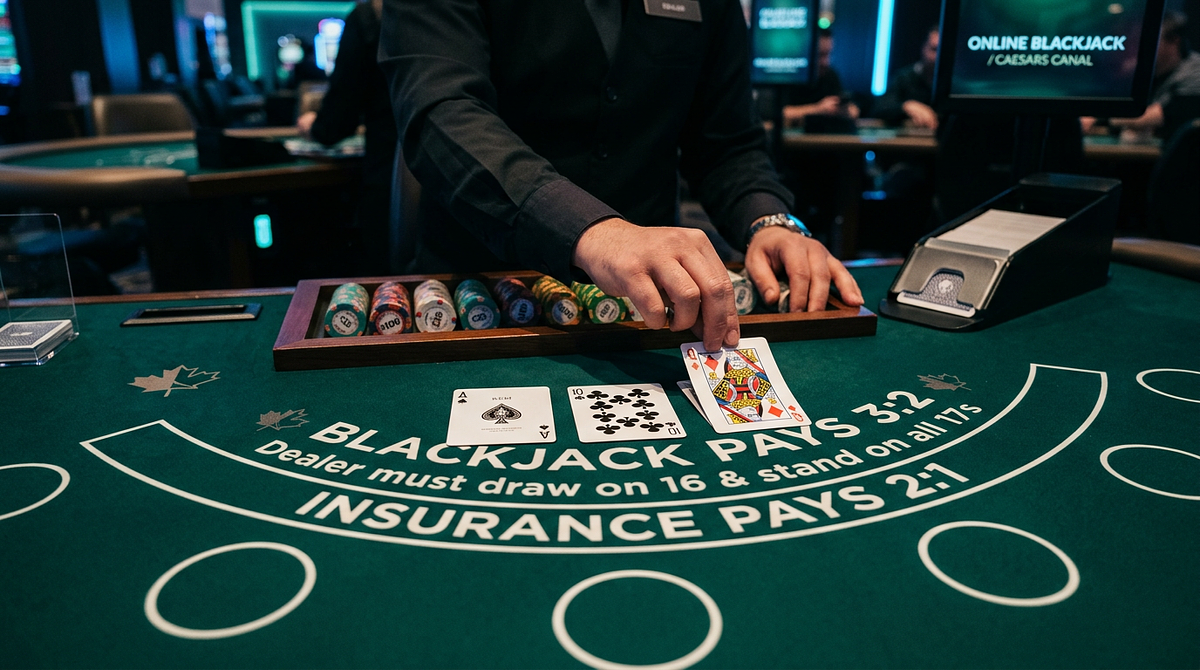
The house edge in blackjack is set by a small number of well-defined rules, and each one shifts your expected return by a measurable percentage. This article breaks down every major rule variable — payout ratio, deck count, soft 17 handling, doubling and splitting restrictions, surrender availability, and basic strategy — by its exact percentage impact, using figures that apply to games available to Canadian online players.
The Baseline House Edge and Why Rule Sets Matter
The house edge in blackjack is not a fixed number. It’s a range — roughly 0.36% to 2.48% — set by the specific rules at the table and by whether you’re playing basic strategy correctly. The player-acts-first rule creates a raw structural disadvantage of about 8%, which player-favorable rules and correct play push down into the sub-2% range. Each section of this article isolates one rule variable and shows its additive effect on that baseline. A blackjack table’s rule card isn’t some opaque casino policy. It’s a sum of measurable adjustments, each one shifting the edge in a specific direction.
How the Player-Acts-First Structural Disadvantage Sets the Ceiling
The house advantage in blackjack comes from one sequencing rule: you have to finish your hand before the dealer plays. When you bust, you lose your bet immediately, regardless of what the dealer would have drawn. If both you and the dealer would have busted in the same round, the house still takes your money. That asymmetry creates a raw structural disadvantage of about 8% before any compensating rules kick in.
Every player-favorable rule — 3:2 payouts on naturals, the ability to double down, splitting pairs, and surrender — is a mathematical offset to that fixed structural disadvantage. These rules aren’t casino generosity. They bring the effective edge down from the raw 8% ceiling toward the sub-2% range. Remove any one of them and the gap widens. When a table is marketed as “player-friendly,” the real question is how many of those offsets are still in place.
How the Blackjack Payout Ratio Changes the House Edge
The payout on a natural blackjack — an ace paired with any ten-value card on the initial deal — is the single biggest rule-based factor affecting the house edge. Moving from a 3:2 payout to a 6:5 payout increases the house edge by about 1.39%, according to Wizard of Odds’ rule-variation analysis. That one change is larger than the combined impact of most other unfavorable rules a table might carry. A table offering double after split, late surrender, and dealer stands on soft 17 but paying 6:5 on naturals will still have a higher effective edge than a plain 3:2 table with none of those concessions. The payout ratio is the first thing to check before looking at anything else.
Why 6:5 Tables Often Appear on Single-Deck Games
Single-deck blackjack under basic strategy with a 3:2 payout produces a house edge of about 0.17% — the lowest available in the standard game. Casinos run a deliberate trade-off: they market the single-deck format as player-favorable, then pair it with a 6:5 payout that adds a 1.39% penalty. That penalty doesn’t just reduce the deck-count advantage. It reverses it entirely. A single-deck game paying 6:5 carries a higher effective edge than a six-deck game paying 3:2, even though the deck count looks better on paper. Deck count and payout ratio aren’t independent variables. Evaluating one without the other gives you a misleading picture of what the table costs. On Ontario online casino platforms, single-deck blackjack listings frequently carry the 6:5 condition, which makes the headline deck count a poor proxy for the game’s real house edge.
How the Number of Decks Affects the House Edge
Adding decks to the shoe increases the house edge in a consistent, measurable direction. Moving from a single deck to an eight-deck shoe increases the house edge by about 0.50% to 0.563%, with all other rules held constant. The reason is straightforward: more decks reduce how often naturals occur per hand and dilute the effect of favorable card removal, which benefits the player more than the dealer. With fewer naturals relative to total hands, you collect the 3:2 premium less often, and the advantage of knowing which cards have left the shoe shrinks. Canadian online tables typically use six- or eight-deck shoes combined with continuous shuffling, so they start from a measurably worse baseline than the theoretical single-deck ideal. That gap is now something you can put a number on rather than estimate.
Quantified Deck-Count Impact
The table below compares deck configurations against a fixed rule baseline: dealer stands on soft 17, double after split allowed, blackjack pays 3:2, basic strategy applied.
| Deck Configuration | Approximate House Edge Adjustment vs. Single Deck |
|---|---|
| 1 deck | Baseline (0.00%) |
| 6 decks | +0.54% |
| 8 decks | +0.50% to +0.563% |
How the Soft 17 Rule Shifts the House Edge
Whether the dealer hits or stands on a soft 17 — a hand totaling 17 that includes an ace counted as 11 — is one of the most consistently variable rules across Canadian online blackjack tables. Dealer hitting on soft 17 (H17) increases the house edge by about 0.22% compared to dealer standing on soft 17 (S17). The reason is simple: when the dealer holds a soft 17, hitting carries no real bust risk, because the ace can drop to a value of 1 if the next card would push the total above 21. That gives the dealer an extra chance to improve a marginal hand into an 18, 19, 20, or 21. The soft 17 policy is a standard disclosure on any credible online blackjack table, and when all other rules are equal, an S17 table will cost you less than an H17 table by that 0.22% margin.
How Doubling and Splitting Restrictions Alter the House Edge
Once you’ve accounted for payout ratio, deck count, and the soft 17 rule, the doubling and splitting conditions account for most of the remaining variance in house edge between otherwise similar games. Each restriction removes a piece of expected value you’d otherwise capture by pressing a mathematical advantage at the right moment. These rules aren’t minor details. Each one has a specific, measurable cost, and stacking two or three of them can push a table from favorable to unfavorable without any change to the payout ratio or deck count. The restrictions that show up most often on Canadian online tables fall into four categories, each covered separately below.
Double Down Restrictions
The player-favorable baseline is being able to double down on any two cards. When a table restricts doubling to hard totals of 10 or 11 only, the house edge increases by about 0.18% to 0.21%. The lost value comes from situations where doubling on 9, on soft totals like soft 13 through soft 18, or on other two-card totals would have captured extra value against a weak dealer upcard — spots where you have a structural advantage but can’t press it.
When reading a table’s rule card, “double on any two cards” confirms the favorable baseline. A restriction to “10/11 only” signals a cost roughly comparable to the dealer hitting on soft 17, which adds about 0.22% to the house edge. Treating those two restrictions as similar in weight is a useful rule of thumb for comparing tables.
Double After Split
Allowing double after split (DAS) is player-favorable. Prohibiting it increases the house edge by about 0.14%. DAS matters when a split produces a hand where doubling is the correct play against the dealer’s upcard. For example, splitting a pair of 8s and receiving a 2 or 3 against a weak dealer card creates a spot where doubling captures extra expected value. Without DAS, that option is gone regardless of how strong the resulting hand is. Basic strategy charts are built differently for DAS-allowed and no-DAS tables, so confirming this rule before using a strategy chart is necessary for accuracy.
Splitting Aces and Re-Splitting Restrictions
The following restrictions on ace-splitting each carry a separate, additive cost to your expected value.
No re-splitting of aces adds about 0.07% to 0.08% to the house edge. Under standard rules, if you split aces and one of the resulting hands pairs with another ace, you can re-split. When that option is removed, you’re forced to play two aces as a single total, giving up the additional splitting opportunity.
No hitting split aces adds about 0.18% to the house edge. Under this restriction, you receive exactly one card on each split ace and can’t draw further, even when the resulting total is weak. An ace paired with a 2 gives you a soft 13, and you have no recourse. This restriction is common across online blackjack variants and carries a real cost because it eliminates all post-split decision-making on the most strategically valuable pair in the game. Combined with no re-splitting of aces, these two restrictions together add between 0.25% and 0.26% to the house edge.
Surrender Availability
Surrender comes in two forms with very different impacts on the house edge. Late surrender is offered after the dealer checks for blackjack. It lets you forfeit half your bet on hands where your expected loss exceeds 50% — mainly hard 15 and hard 16 against strong dealer upcards. Removing late surrender when it would otherwise be offered increases the house edge by about 0.07% to 0.08%.
Early surrender is offered before the dealer checks for blackjack, which makes it considerably more valuable. You can exit a losing hand even when the dealer ends up holding a natural. Its availability reduces the house edge by about 0.39%, putting it among the most impactful individual rules in the game. That’s comparable in scale — though opposite in direction — to the penalty imposed by a 6:5 payout. Early surrender is rare on Canadian online tables for exactly that reason.
When reading a table’s rule card, the difference between “late surrender” and “early surrender” determines whether the rule is a modest benefit or a substantial one. A table offering early surrender deserves serious weight in any comparison, because its edge reduction rivals the cost of the most punishing payout change in the game.
How Basic Strategy Interacts with the Rule Set
Basic strategy is the mathematically correct play — hit, stand, double, split, or surrender — for every combination of player total and dealer upcard under a specific rule set. Playing it correctly brings the house edge down to its minimum possible value for that rule set. No rule can be exploited beyond what basic strategy already captures without card counting, and card counting isn’t viable on the continuously shuffled games that dominate Canadian online casinos. Under favorable rule conditions — six decks, S17, DAS, 3:2 payout, late surrender — the effective house edge under basic strategy sits between about 0.36% and 0.5%. The house edge figures operators publish assume perfect play. The rule set and your execution are inseparable, and a favorable rule set only delivers its stated edge when you play basic strategy without deviation.
The Cost of Deviating from Basic Strategy
Each individual deviation from basic strategy adds about 0.1% to 0.5% to the effective house edge, depending on how often the mistake occurs and how costly that specific hand is. The most common and expensive errors are instinct-based: standing on 16 against a dealer 10, refusing to split 8s against a strong upcard, and taking insurance. These decisions come up often enough that their cumulative drag on expected return adds up fast.
A player using a partially memorized basic strategy on a nominally favorable table — theoretical edge 0.43% — may face an effective edge of 1% or higher. That’s worse than a rule-restricted table played with disciplined, correct strategy. The practical takeaway is that your skill-adjusted expected loss is the number that matters, not the theoretical house edge on the rule card. Hunting for a favorable rule set does nothing for you mathematically unless you’re also playing the correct strategy for that specific rule set.
Using a House Edge Calculator to Evaluate Custom Rule Sets
For any table configuration not covered by the fixed examples in this article, publicly available blackjack house-edge calculators will give you a precise answer. These tools — hosted on established gambling mathematics reference sites — accept custom rule inputs including deck count, soft 17 policy, double-after-split permission, re-split rules, surrender type, and payout ratio. The calculator returns the exact basic-strategy house edge for that specific combination of rules.
The practical approach is to read the rule card for a table you’re considering, enter each parameter into the calculator, and note the output before you start playing. This works for any rule configuration you encounter, not just the reference examples used throughout this article.
Comparing Player-Favorable and Casino-Favorable Rule Sets Side by Side
Each rule variation covered in the preceding sections produces a measurable, additive shift in the house edge. Those individual figures can be pulled together into a single reference that separates player-favorable from casino-favorable variations and ranks them by absolute size. This lets you compare any table’s rule card against a common scale: a rule near the top of the list carries more weight than several rules combined near the bottom. The table below aggregates the rule impacts covered above, ordered by absolute effect on the house edge.
| Rule Variation | Direction | Approximate House Edge Impact |
|---|---|---|
| Blackjack pays 6:5 (vs. 3:2) | Casino-favorable | +1.39% |
| Early surrender available | Player-favorable | −0.39% |
| 8 decks (vs. 1 deck) | Casino-favorable | +0.50% to +0.61% |
| Dealer hits soft 17 (H17) | Casino-favorable | +0.21% to +0.22% |
| Double down restricted to 10/11 only | Casino-favorable | +0.18% to +0.21% |
| No hitting split aces | Casino-favorable | +0.18% |
| No double after split (no DAS) | Casino-favorable | +0.14% |
| Late surrender removed | Casino-favorable | +0.08% |
| No re-splitting aces | Casino-favorable | +0.07% to +0.08% |
The Effective House Edge on a Reference Canadian Online Blackjack Table
A six-deck table where the dealer stands on soft 17, double after split is permitted, blackjack pays 3:2, late surrender is available, and basic strategy is applied correctly produces a house edge of about 0.43%. This is a realistic best-case scenario for player-favorable conditions at Canadian online casinos and a useful reference point for evaluating any other table. Players in provinces with competitive regulated markets — for example, those exploring British Columbia online casino options — may find a wider range of table configurations than players in territories with fewer licensed operators.
Individual rule changes against this baseline shift the edge in measurable steps. Switching the payout from 3:2 to 6:5 alone pushes the effective edge above roughly 1.8% — a change that exceeds the combined impact of most other unfavorable rules. Switching from S17 to H17 while keeping all other favorable rules moves the edge to about 0.64% to 0.65%, which is narrower but still a real deterioration. These two examples show that the 0.43% reference edge isn’t stable against single-rule changes. The payout ratio and soft 17 policy each carry enough weight to substantially change what the game costs you. Any table you find on a Canadian online platform can be evaluated by starting from the 0.43% reference and applying the per-rule adjustments covered in the sections above.
Choosing a Blackjack Table by Its Rule Card
The single most damaging rule a Canadian online table can carry is a 6:5 payout on naturals — and it’s also the one most easily overlooked when a listing leads with “single-deck” as its headline feature. That 1.39% penalty doesn’t just chip away at the edge. It reverses the deck-count advantage entirely, leaving a single-deck 6:5 game in worse shape than a six-deck 3:2 table with none of the other concessions. Once you’ve confirmed the payout is 3:2, the remaining rules fall into a clear priority order: the soft 17 policy costs 0.22% when the dealer hits rather than stands, doubling restrictions and the absence of DAS together can add another 0.32% or more, and early surrender — rare as it is on Canadian platforms — carries an edge reduction of 0.39% that rivals the payout ratio in size. The reference configuration of six decks, S17, DAS, 3:2, and late surrender lands at about 0.43% under correct basic strategy, but that figure is only as good as the execution behind it. A partially memorized chart on a nominally favorable table can push the effective edge past 1%, which is worse than a rule-restricted game played with discipline. If you want to verify the exact edge of any specific table before sitting down, a house-edge calculator that accepts custom rule inputs will give you a precise number for any combination you encounter. Ontario players can put this strategy into practice directly at Evolution’s live dealer blackjack tables.
We check operator terms, licences and payment details against the casino's own pages and update this content when they change. Read our editorial policy, our transparency statement, or report an error. If gambling stops being fun, see our responsible gambling resources.