

RTP and house edge are two ways of expressing the same number. Whatever percentage a game doesn’t return to players is kept by the house, so knowing one figure makes the other a simple subtraction. This page explains what each term measures, how to convert between them, and what the numbers typically look like across common game types. By the end, you’ll be able to read game statistics confidently and compare options on your own.
What Return to Player Represents
Return to player (RTP) is the percentage of total wagers a game pays back to players over a very large number of plays. It’s the figure you’ll see in a game’s published specs or disclosure. The percentage is written from the player’s perspective: it describes what comes back, not what the house keeps. That’s why it shows up consistently in game documentation and promotional materials.
RTP is calculated across hundreds of thousands or millions of spins or hands, not across a single session or a short run of play. Because individual outcomes are random, results in any given session can deviate significantly from the stated percentage in either direction. The figure only converges on its stated value at that scale. So when you see an advertised RTP, it describes the game’s long-run statistical behavior, not a guarantee about what will happen in your next session.
RTP is the standard disclosure metric for online slots. It appears in game information panels and regulatory filings for that format. The industry settled on this framing for player-facing contexts because it describes what returns to the player rather than what the house keeps. The underlying math is identical either way. When you see an RTP figure, you’re reading one of two ways to express the same fact, not a separate metric from the house edge.
What House Edge Represents
House edge is the built-in mathematical advantage the casino holds on every wager, expressed as a percentage of the amount staked. It describes the same relationship as RTP, but from the operator’s side. Where RTP states what the game gives back, house edge states what the game keeps. They’re two perspectives on one number.
House edge is the percentage of each wager the casino statistically keeps as profit over a very large number of plays. On a game with a 3% house edge, the casino expects to keep €3 of every €100 wagered over an extended run. Like RTP, this is a long-run statistical outcome, not a prediction for any individual session. A player can win or lose well outside that percentage in any given sitting. When a house edge figure is published for a game, it describes that game’s payback profile. You could state the same fact as an RTP, because the two are just different ways of expressing the same number.
House edge is the standard term for table games like blackjack, roulette, and baccarat, while RTP is more common for online slots. This is a difference in industry convention, not in math. Both figures are calculated the same way and measure the same thing. A player who sees house edge at a table and RTP on a slot game is reading two different words for one figure. Converting between them requires the same simple arithmetic in either direction.
The Mathematical Formula Connecting the Two Figures
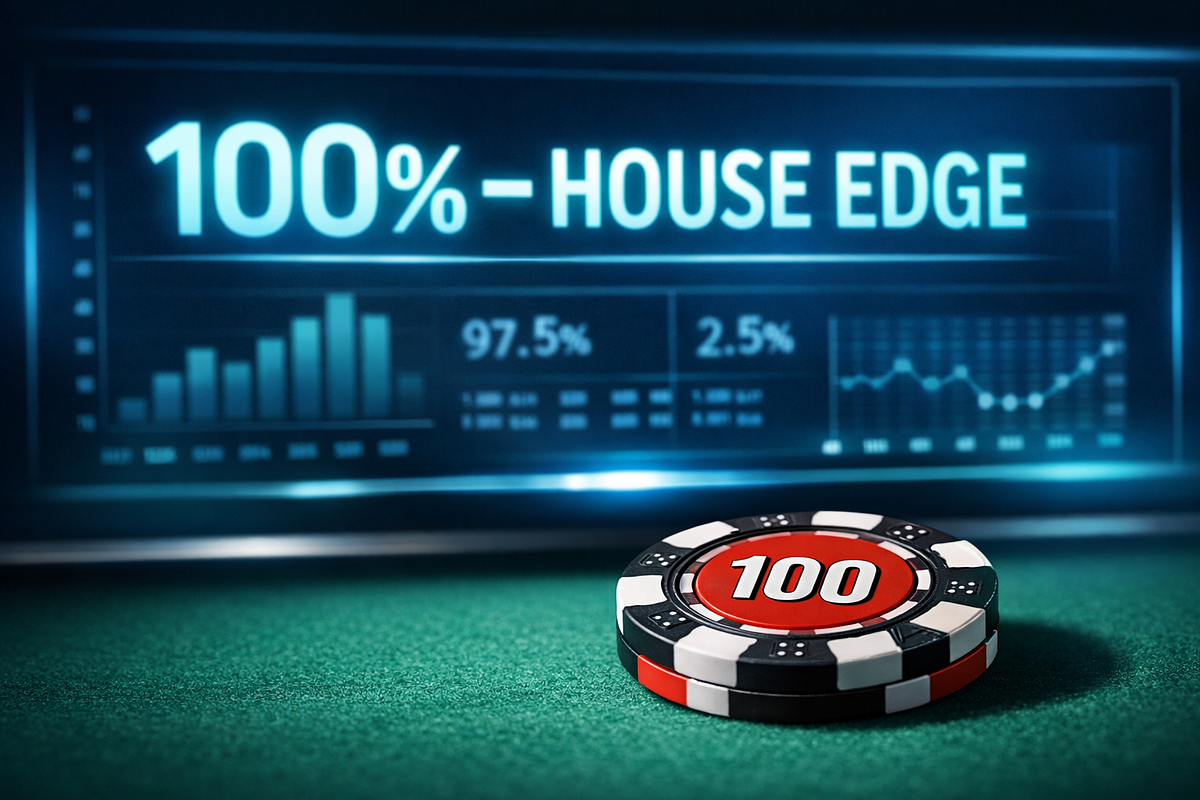
RTP and house edge are not two separate measurements. They’re two expressions of the same underlying figure. Every euro wagered either returns to the player or stays with the house, so the two percentages always add up to exactly 100%. That’s the foundation both metrics rest on.
The formula works the same way in either direction. To convert RTP into house edge, subtract the RTP from 100%: House Edge = 100% − RTP. To convert house edge into RTP, subtract the house edge from 100%: RTP = 100% − House Edge. The logic is straightforward: a wagered sum can only go to the player or stay with the house, so the two shares must add up to the whole. In practice, this means if you see either figure in a game’s published information, you can work out the other instantly with one subtraction, no additional data needed.
The examples below apply the conversion to specific figures you’ll commonly see in game information. Each row confirms that the two figures sum to 100%.
| RTP | House Edge | Conversion Applied |
|---|---|---|
| 97% | 3% | 100% − 97% = 3% |
| 96% | 4% | 100% − 96% = 4% |
| 95% | 5% | 100% − 95% = 5% |
How the Two Figures Vary Across Game Categories
RTP and house edge aren’t the same across every game. Different categories carry meaningfully different figures, and the spread between the lowest and highest values is wide enough to have a real effect on long-run payback. These differences follow directly from how each game is structured.
Table games generally sit at the lower end of the house edge spectrum. The figures depend on the game rules, the specific bet type, and, where strategy applies, how closely the player follows optimal play. A game’s name alone doesn’t tell you the house edge, because the figure can shift substantially depending on which bet you place or which rule variant is in use. The baccarat tie bet and the banker bet, for example, sit at opposite ends of the range within the same game. The table below shows representative figures across common table game bets.
| Game / Bet Type | RTP | House Edge |
|---|---|---|
| Blackjack with optimal strategy | Up to 99.5% | As low as 0.5% |
| Baccarat banker bet | 98.94% | 1.06% |
| Baccarat player bet | 98.76% | 1.24% |
| Baccarat tie bet | Approximately 85.64% | Approximately 14.36% |
| European single-zero roulette | 97.3% | 2.7% |
| American double-zero roulette | 94.74% | 5.26% |
| French roulette even-money bets with La Partage | 98.65% | 1.35% |
| Craps pass line bet | 98.59% | 1.41% |
| Craps pass line with maximum odds | 99.7%–99.8% | 0.2%–0.3% |
| Video poker with perfect strategy | Up to 99.5% | As low as 0.5% |
| Full-pay Jacks or Better video poker | 99.54% | 0.46% |
Slot machines have a much wider spread than most table games. House edges run from roughly 2% to 15%, putting RTPs in a corresponding range of about 85% to 98%. That range reflects real differences in game mathematics, jackpot structures, and the operating costs built into each machine’s design.
Online slots generally return more to players than equivalent land-based machines, which follows from the lower overhead costs of running a digital product. Progressive jackpot slots sit at the higher-house-edge end of the slot spectrum, averaging around 10% (an RTP of roughly 90%), because a portion of every wager goes into the jackpot pool rather than through standard payouts.
Two slot machines with similar themes can carry very different underlying math. If you can convert between RTP and house edge, you can read any published figure and immediately understand what it means for long-run payback, regardless of which metric the game’s documentation uses.
Reading Any Published Figure with Confidence
RTP and house edge are two expressions of the same number. Whichever one a game or regulator publishes, you can get the other with one subtraction from 100. That works the same way across every game category and bet type. But the number you end up with has a specific, limited meaning worth keeping in mind.
Neither RTP nor house edge predicts what will happen in a single session or even across many sessions of ordinary length. Both figures describe statistical behavior across an extremely large number of plays, in practice hundreds of thousands to millions of individual rounds. Short-run variance can push actual results well outside the stated percentage in either direction, and that’s normal, not a sign that the published figure is wrong. A 96% RTP doesn’t mean you’ll get back 96 cents on every euro you wager. It’s a long-run property of the game’s math, not a promise attached to any particular playing period.
RTP and house edge are two ways of saying the same thing. A game that keeps 4% of wagers over the long run is equally described by a 4% house edge and a 96% RTP. Which figure gets published is a matter of industry convention, not a difference in the underlying information. Once you know to subtract either figure from 100 to get the other, any published number is fully readable on its own. You’ll never again see one figure and feel like the other is missing.
Reading Casino Math with One Formula in Hand
Knowing that RTP and house edge are inverse expressions of the same number clears up the confusion that comes from different game categories using different metrics. You can encounter either figure in any context and know what it describes: a long-run statistical property of the game’s design, not a prediction about any individual session. The vocabulary changes by convention. The underlying fact doesn’t.
Written by Arthur Crowson · Published August 4, 2026 · Last updated October 7, 2026
We check operator terms, licences and payment details against the casino's own pages and update this content when they change. Read our editorial policy, our transparency statement, or report an error. If gambling stops being fun, see our responsible gambling resources.