

What does “provably fair” mean in online gambling, and how does it work? This article explains the cryptographic verification system behind the term, how it compares to traditional third-party auditing, and what to look for when deciding whether a platform is using it genuinely or just as a marketing label. By the end, you’ll have enough context to evaluate provably fair claims on your own and make better decisions about the platforms you use.
Provably fair is a cryptographic verification system used in online gambling, most commonly on crypto casino platforms. It lets players check whether a game outcome was generated according to the stated algorithm and wasn’t altered after a bet was placed. Instead of relying on a third-party auditor to certify a platform’s random number generator periodically, the model lets players verify individual rounds themselves. What that means in practice, and how to tell whether a platform’s use of the label is genuine or just surface-level branding, is what this article covers.
The Verification Model Behind Provably Fair Systems
Provably fair is a cryptographic verification system that lets a player confirm whether a specific game result was generated according to the stated algorithm and wasn’t altered after the bet was placed. The system moves the basis of trust away from periodic institutional certification by an external body on behalf of all players and toward direct player-side verification of individual rounds. That means a player doesn’t have to take the operator’s word for it or wait for an audit report. The math behind a single round is available for inspection. The sections below explain how that verification works and where its limits are.
What Provably Fair Actually Verifies
A provably fair system is designed to prove one specific thing: that the outcome of a given round matched the algorithm the operator committed to before the bet, and wasn’t changed after the bet was placed. It doesn’t assess the operator’s broader conduct, financial position, or regulatory standing. Understanding that boundary matters just as much as understanding what the system does prove.
Provably fair does not guarantee any of the following:
- A winning outcome: the system verifies process integrity, not whether a player’s result is favorable.
- Regulatory compliance: the label is not a substitute for a gambling license issued by a recognized jurisdiction.
- Platform security: cryptographic verification of round outcomes is not the same as a security audit of the operator’s systems or software.
- Payout fulfillment: a verified result does not oblige or guarantee that the operator will pay out winnings.
Why This Verification Model Matters to Players
In the traditional online casino model, randomness assurance is handled by third-party testing bodies like eCOGRA, which audit an operator’s random number generator and certify that it behaves acceptably across a large statistical sample. A player trusting that model is trusting that the certifying body did its audit correctly and that the operator’s system hasn’t changed since the audit was completed.
Provably fair replaces that chain of institutional trust with a mathematical check the player can run themselves on a specific round at any time after it concludes. The data for a single round either matches the pre-committed hash or it doesn’t.
What this changes for the player is what can be confirmed independently. A player can’t use provably fair to determine whether outcomes will be favorable over time, or whether the house edge is set at a particular level. What they can confirm is narrower and more precise: whether the result of a specific round was produced by the algorithm the operator committed to before the bet, without post-bet manipulation.
The Three Core Variables in Every Provably Fair Round
Every provably fair round is produced by combining three distinct inputs: one generated by the operator, one supplied or approved by the player, and one that increments automatically with each successive bet. No single party controls all three. That split is the structural basis for verifiability, because it means neither the operator nor the player can unilaterally determine the outcome before it’s produced.
The Role of Each Input
Each of the three inputs occupies a different position in the outcome-generation process, and each contributes a different guarantee to the verification chain. Remove any one of them and a specific part of that chain collapses: without the operator’s input, there’s nothing to commit to before the round; without the player’s input, the operator could pre-calculate results; without the counter, the same seed combination would produce identical outcomes every round.
| Variable | Origin | Function in the Round | Why It Matters for Verification |
|---|---|---|---|
| Server seed | Generated by the operator before the round begins | Forms the operator-side component of the hash input that determines the outcome | Its hash is published before the round, committing the operator to a fixed value that cannot be changed without the mismatch becoming detectable |
| Client seed | Provided or approved by the player | Combines with the server seed to produce a result the operator could not have pre-calculated alone | Because the operator does not know the client seed in advance, it cannot select a server seed that forces a predetermined outcome |
| Nonce | A counter incremented by the system with each bet | Ensures that the same server seed and client seed pair produces a unique result for every individual round | Its sequential, visible value allows the player to confirm which round a given result belongs to and detect if values have been reused or manipulated |
How Separation of Control Prevents Manipulation
The operator commits to its seed before the player’s input is known. Because the server seed is hashed and published before the round, the operator can’t alter it in response to what the player does. Any change to the seed produces a different hash, breaking the verification chain immediately.
The player’s seed modifies the final output in a way the operator can’t anticipate. If the operator knew the client seed before the round, it could calculate every future outcome and select server seeds accordingly. Documented cases show this isn’t a theoretical risk: when an operator gains advance knowledge of the client seed, the separation of control the model depends on is gone in practice, even if the system still carries the label.
The nonce closes a separate gap. Without an incrementing counter, the same seed pair would generate the same result every round, making the system predictable after a single observation. The nonce’s sequential nature also means its value is independently checkable, giving the player a way to confirm that each round was processed in order and that no round was silently repeated or skipped.
A system where one party controls all three inputs is not meaningfully provably fair, regardless of how it’s labeled. The CS:GO Diamonds case illustrates this directly: the operator used predetermined nonce values, a player-side variable, giving it advance knowledge of all future outcomes while the provably fair label remained in place. Verifiability is a structural property that depends on genuine separation of control, not on the presence of the label alone.
The Commit-Reveal Mechanism
The commit-reveal model is the procedural backbone that turns the three variables, server seed, client seed, and nonce, into something a player can independently verify. Before a round begins, the operator commits to a specific server seed value by publishing a hash of it. That published hash is the operator’s binding promise. After the round concludes, the operator reveals the original server seed so the player can recompute the hash and confirm the two values match. The sequence is what makes verification possible: without a commitment made before the round and a reveal made after it, there’s nothing for the player to check against.
The Sequence From Commit to Verification
Each step in the commit-reveal flow depends on the one before it, and the order can’t be reversed without breaking the verification chain. The pre-round hash must exist before the player acts; the reveal must come after the outcome is settled. The sequence runs as follows:
- Operator hashes the server seed: Before the round starts, the casino generates a server seed and runs it through a cryptographic hash function, producing a fixed-length hash string.
- Hash is published to the player: The resulting hash is shown to the player before any bet is placed, committing the operator to that specific underlying value.
- Round is played: The game outcome is generated using the committed server seed combined with the player’s client seed and the current nonce.
- Operator reveals the original server seed: Once the round is complete, the casino discloses the unhashed server seed that was used.
- Player recomputes and confirms: The player hashes the revealed server seed using the same algorithm and checks whether the output matches the hash that was published before the round.
Why Pre-Committing Binds the Operator
Publishing the hash before the round is the load-bearing step in the entire model. A cryptographic hash function is one-way: given the hash output, it’s not computationally feasible to work backwards to the original input. This means the operator can’t alter the server seed after publishing its hash. Any change to the underlying value produces a different hash, which the player would detect immediately upon recomputation.
The commitment is a mathematical constraint, not a matter of trust or policy. Once the hash is published, the operator is bound to the server seed that produced it. No subsequent adjustment to that seed can go undetected, because the pre-round hash remains on record as the reference point.
If a platform reveals a result without having published a pre-round hash, the verification chain doesn’t exist. There’s no reference point to check the revealed value against, so the player has no basis for confirming that the disclosed seed was the one actually used during the round.
If the operator reveals a server seed that doesn’t reproduce the published hash when recomputed, the chain is broken at the verification step. Either failure, no pre-round hash or a mismatch on recomputation, means the commit-reveal model hasn’t been applied in a way that supports genuine player-side verification.
The Cryptographic Function That Makes Verification Possible
Provably fair systems depend on a specific class of cryptographic hash function to produce the fixed-length fingerprints that anchor the commit-reveal process. SHA-256 is the function most commonly used in these systems, with HMAC-SHA256 also appearing as a variant across different platform setups. Both produce a condensed, fixed-length representation of any input, a property that makes them directly applicable to committing to a server seed before a round begins. The function is what converts a raw seed value into the published hash the player sees before placing a bet.
Properties That Make the Hash Function Suitable
The commit-reveal model only works because the hash function used has a specific set of cryptographic properties. Without those properties, a published hash wouldn’t constitute a meaningful commitment. An operator could alter the underlying seed after the fact, or a player could work backwards from the hash to determine the seed before the round concludes. The properties below are what prevent both outcomes.
- Fixed-length output: SHA-256 always produces a 256-bit digest regardless of the size of the input, so the published hash reveals nothing about the length or structure of the server seed it represents.
- One-way (irreversible) design: The function produces a condensed representation of the input that cannot be used to reconstruct the original value.
- Infeasibility of reverse-engineering: SHA-256 cannot be reverse-engineered with currently available technology, so a player who holds only the pre-round hash has no practical means of deriving the server seed before it is revealed.
How Players Recompute and Confirm Results
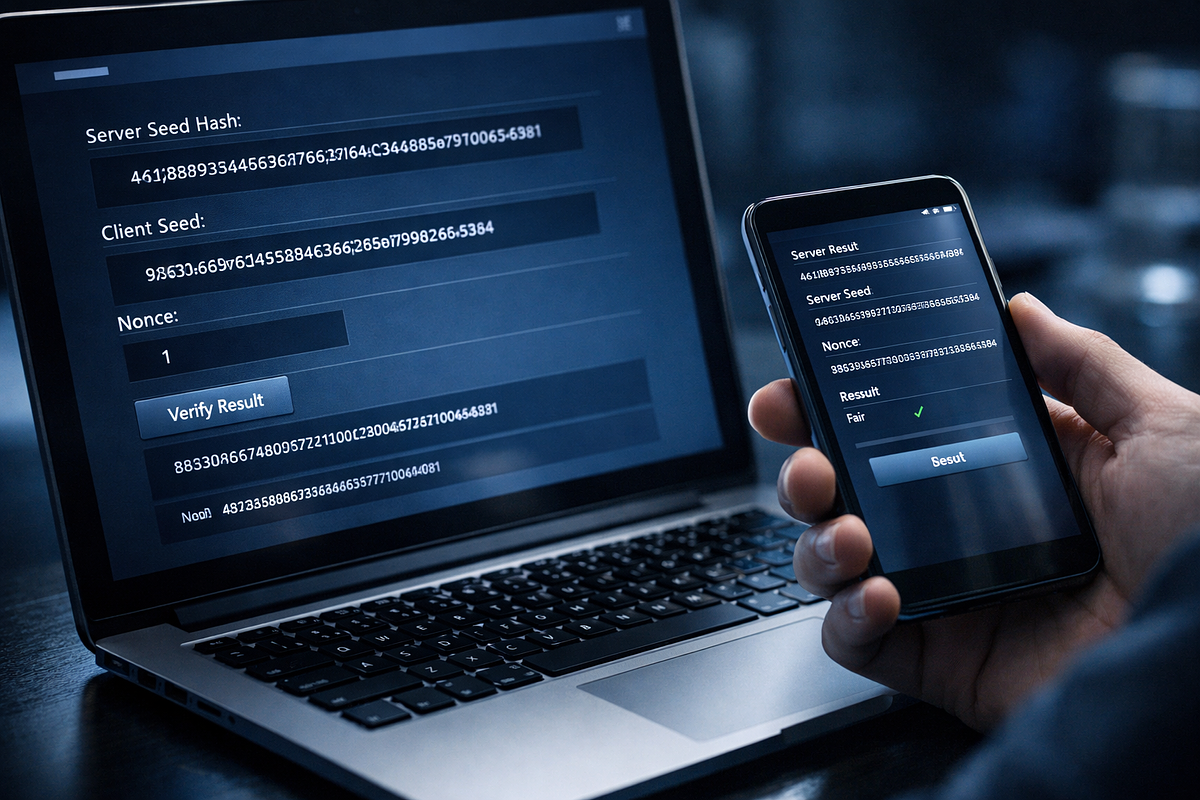
To verify a result, the player takes the values revealed after the round, the server seed, the client seed, and the nonce, and runs them through the same SHA-256 function the operator used before the round began. If the output matches the hash the operator published before the bet was placed, the result is confirmed as unaltered.
This doesn’t require specialized software. Publicly available SHA-256 hash calculators, such as the one provided by Xorbin, accept the relevant inputs and return the hash output directly in a browser. Many platforms also build a verifier interface into their own site, letting players paste the revealed values without leaving the platform.
A platform that doesn’t expose the server seed, client seed, and nonce after a round gives the player no values to recompute. Without those inputs, running a hash calculator produces nothing meaningful, and the verification chain is structurally absent regardless of what the platform calls its system.
The provably fair label is only as meaningful as the data the platform makes available. Where all three values are published alongside the pre-round hash, a player can confirm the result independently. Where any of those values are withheld, the label is a marketing claim rather than a verifiable guarantee.
Provably Fair Compared to Traditional Randomness Certification
Traditional online casinos handle randomness assurance through third-party testing bodies that audit the operator’s random number generator periodically. Players get no direct window into individual round outcomes. Assurance is delivered indirectly through certification that the system behaved acceptably during the audit period. The provably fair model flips this by letting any player verify the outcome of a specific round themselves, without relying on an intermediary. The two models answer structurally different questions: one confirms system-level behavior over time, the other confirms the integrity of a single event at the moment it occurs.
Institutional Verification Versus Player-Side Verification
The traditional model and the provably fair model don’t compete on the same axis. Traditional certification addresses whether an operator’s RNG produces statistically acceptable output across a large sample. Provably fair addresses whether one specific outcome was generated according to the stated algorithm and wasn’t altered after the bet was placed. The table below maps the two models across the dimensions where they differ most directly.
| Dimension | Traditional RNG Model | Provably Fair Model |
|---|---|---|
| Who performs verification | Independent testing laboratories such as eCOGRA and Gaming Laboratories International (GLI) | The player, directly |
| Frequency of verification | Periodic auditing of the RNG system | Per-round, on demand |
| Regulatory framing | Certification against jurisdictional randomness standards applied to licensed operators | Not a substitute for a gambling license |
| Transparency to the individual player | Indirect, via published certification | Direct, via recomputation of the hash |
| Typical operator context | Licensed traditional online casinos | More common in crypto-focused platforms |
What Each Model Can and Cannot Prove
Traditional RNG certification shows that an operator’s random number generator produces statistically random output across a large sample of results and that the system behaves acceptably over time. The audit confirms system-level integrity during the period under review, not the integrity of any individual round a player experienced.
Provably fair demonstrates something narrower and more specific: that one particular outcome matched the algorithm stated before the round began and wasn’t changed after the bet was placed. The player can recompute the hash themselves using the revealed server seed, their client seed, and the nonce, and confirm the result directly.
Neither model proves that the player will win. Statistical randomness across a sample and per-round cryptographic verification both describe the generation process, not the distribution of outcomes to any individual player.
The two models are not mutually exclusive. A platform can hold a gambling license, carry third-party RNG certification, and simultaneously offer provably fair mechanics on a subset of its game titles. Certification and player-side verification address different questions and can coexist within the same operator’s product range.
Application Across Different Game Types
Provably fair doesn’t apply equally to all gambling formats. How well it fits depends on how directly a game outcome can be derived from a single hashed number. Some game categories map onto the model cleanly, while others involve layered outcome parameters that complicate things, and certain formats fall outside the model’s scope entirely.
The degree of fit is determined by game structure, not by whether a platform chooses to apply the label. A game that produces one numeric outcome per round is a natural candidate. A game that produces dozens of interdependent visual outcomes from a single seed is a harder case. A game whose result depends on a real-world event is outside the model regardless of how it’s labeled.
Games Where the Model Applies Cleanly
Simple probability-based games, where each round produces a single numeric outcome derived directly from the combined seeds and nonce, are the clearest use case for provably fair mechanics. In these formats, the hashed number maps to the result without intermediate transformation layers, so the player can recompute the outcome independently and confirm it matches what the platform reported.
- Dice — a single number between 0 and 100 is generated per roll, mapping directly to a win or loss against the player’s chosen target
- Crash — one multiplier value is derived from the hash per round, determining the point at which the game ends
- Mines — mine positions are assigned from the hash output in a single derivation step, with no secondary transformation required
- Plinko — each ball drop resolves to a single slot position derived from the hash, with no layered outcome parameters
Games Where the Model Is More Limited
Reel-based games like slots are harder to put under provably fair mechanics because a single spin produces multiple interdependent visual outcomes, including symbol positions, payline evaluations, and bonus triggers, each of which may involve additional logic applied on top of the raw random number. The hash can verify the seed used to initiate the spin, but the chain from that seed to every visible symbol on every reel involves transformation steps that aren’t always exposed to the player.
Sports betting falls outside the model’s scope entirely. The outcome of a sporting event is determined by real-world activity, not by a number derived from cryptographic inputs. No seed-and-hash mechanism can verify whether a match result was fair.
When a platform labels a complex game as provably fair, look for what specifically is being verified. A platform may verify only the raw random seed used to initialize the game, while the full sequence of visual outcomes, the symbols displayed, the bonus states triggered, is produced by additional logic that sits outside the verification chain. Verifying the seed and verifying the complete visual output are not the same thing.
The provably fair label on a slots title or a live-event product carries less inherent meaning than the same label on a dice or crash game. In simpler formats, the label and the mechanism match closely. In more complex formats, look for documentation of exactly which component is being hashed and verified before treating the label as equivalent assurance.
Limits, Misuse, and How to Recognize Genuine Implementation
The provably fair label appears on a growing number of platforms, but its presence alone doesn’t confirm that the underlying mechanism is functioning as described. Documented cases exist where platforms kept the label while structurally undermining the model it depends on. The misuse patterns that have been recorded share a common feature: one party, the operator, gains control over variables that the model requires to be independent. The sections below identify the specific structural failures that characterize these cases, and the observable signals that separate a working setup from a decorative one.
Common Ways the Framework Is Misapplied
Documented misuse typically involves collapsing the separation of control between the three inputs, server seed, client seed, and nonce, so that the operator can determine outcomes in advance while the system continues to carry the provably fair label. When a single party controls more than one of these variables, the independence that makes verification meaningful no longer exists.
- Operator-controlled nonce values: CS:GO Diamonds was documented using predetermined nonce values at a time when nonces should have been randomly generated by the player each roll, giving the operator advance knowledge of all future outcomes.
- Operator knowledge of the client seed: If the operator knows the client seed before the round resolves, they can predict future outcomes before they happen, directly defeating the purpose of the player-side input.
- Absence of a pre-round hash: A platform that reveals results without having published a server-side hash before the round began has not committed to any value in advance, which breaks the verification chain entirely.
What the Label Tells You, and What It Does Not
Provably fair shifts the basis of trust from institutional certification to math a player can run themselves, but that shift only means something when the platform exposes the values required for verification. Understanding the mechanism lets you look past the label and assess whether a given platform publishes a pre-round hash, permits player influence over the client seed, and discloses all three inputs after the round. Those are the conditions that determine whether the claim is structural or decorative.
Written by Arthur Crowson · Published August 8, 2026 · Last updated October 7, 2026
We check operator terms, licences and payment details against the casino's own pages and update this content when they change. Read our editorial policy, our transparency statement, or report an error. If gambling stops being fun, see our responsible gambling resources.