

“Licensed in Ontario” means something specific. It’s a defined regulatory status under a provincial framework, not a general quality label or a foreign license that accepts Ontario players. This guide explains what that status requires, how it differs from other legal claims sites commonly make, and how to check whether a platform genuinely holds it. By the end, you’ll have enough information to assess any online casino’s licensing claims with confidence.
When you land on an Ontario casino site and see it claim to be “licensed in Ontario,” the answer is more specific than most sites let on. That status is conferred by a provincial framework, and it’s that status, not a site’s appearance or foreign license, that determines which consumer protections apply to your play. This article covers what that status requires, how it differs from other legal claims a site might make, and how to verify whether a platform actually holds it.
The Provincial Regulatory Framework Behind an Ontario License
Ontario launched a regulated private-sector iGaming market on April 4, 2022, under Ontario Regulation 517/21 under the Alcohol, Cannabis and Gaming Regulation and Public Protection Act, 2019. This framework lets private online casino operators compete in an open regulated market, a structure no other Canadian province currently uses. “Licensed in Ontario” refers to a defined regulatory status under this provincial framework, not a marketing descriptor or quality claim. To understand what that status means, you need to know which bodies grant it and what conditions must be met.
The Two Bodies That Make a Site “Licensed”
Legal operation in Ontario’s iGaming market requires two separate regulatory steps, handled by two separate bodies. The Alcohol and Gaming Commission of Ontario (AGCO) handles registration and sets the standards operators must meet. iGaming Ontario (iGO), a subsidiary of the AGCO, enters into commercial operating agreements with those registered operators. A site needs both conditions satisfied at the same time. AGCO registration alone, or an iGO operating agreement alone, is not enough for legal operation.
| Regulatory Body | Role in the Ontario Market | What It Controls |
|---|---|---|
| Alcohol and Gaming Commission of Ontario (AGCO) | Provincial gaming regulator | Operator registration; Registrar’s Standards for Internet Gaming; ongoing regulatory compliance and enforcement |
| iGaming Ontario (iGO) | Provincial iGaming conducting entity; AGCO subsidiary | Commercial operating agreements with private operators; conducting and managing the regulated market |
How Ontario’s Model Compares in Canada
Ontario and Alberta are the Canadian provinces where private-sector online casino operators can legally serve residents through a competitive regulated market. Every other province runs a government monopoly for online gambling, meaning a single government entity controls what residents can access. Ontario’s open market means multiple private brands can legally advertise to and serve Ontario residents at the same time, all under the same provincial framework. Each of those brands holds the same two-body regulated status under the provincial framework, rather than operating outside it.
What Makes an Operator Legally Licensed Under the Ontario Framework
Being “licensed in Ontario” is not a single credential issued by one authority. It’s a two-stage regulatory status that requires an operator to satisfy two separate, sequential conditions under Ontario’s provincial framework. Either condition alone is not enough for legal operation. An operator may hold a license from a foreign jurisdiction, or maintain a Canadian corporate entity, without satisfying either Ontario-specific requirement. Keep that two-stage test in mind whenever you read a site’s regulatory claims.
The Two-Stage Legal Requirement
Both stages are required, and they happen in order. An operator must first complete registration with the AGCO against its published Registrar’s Standards for Internet Gaming, then sign a commercial operating agreement with iGaming Ontario (iGO) before serving any Ontario player. A site that has completed AGCO registration but hasn’t signed an iGO operating agreement is not legally live for Ontario play, regardless of how it describes its regulatory status in marketing materials.
- AGCO Registration: The operator applies to the AGCO and is assessed against the Registrar’s Standards for Internet Gaming. Registration is granted only after the AGCO determines the operator meets those published standards.
- iGO Operating Agreement: The operator signs a commercial operating agreement with iGaming Ontario, the AGCO’s subsidiary responsible for conducting and managing the regulated market, before it can accept wagers from Ontario residents.
The Cost and Commercial Barrier to Entry
The AGCO charges a regulatory fee of CA$100,000 annually per gaming site, and that fee must be received by the AGCO before an application is processed. All regulatory fees are non-refundable. The application guide also notes that additional costs, including investigation fees and ongoing regulatory cost-recovery charges, may apply, and those amounts could be significantly greater than the base CA$100,000 fee. This financial threshold helps explain why Ontario’s regulated market is made up of established operators with the capital and compliance infrastructure to absorb upfront, non-recoverable costs, rather than small or anonymous sites. The size of that barrier reflects the scale of the operators that have entered the regulated market.
Player Protections Activated by Ontario Registration
A defined set of player protections applies only to platforms that hold regulated status under Ontario’s provincial framework. They don’t extend to offshore or foreign-licensed sites that serve Ontario residents without that status. These protections are set out in the AGCO’s Registrar’s Standards for Internet Gaming, which came into force on April 4, 2022, and compliance with those standards is a condition of continued operation, not a voluntary commitment. Because the standards are published and enforced by the regulator, these protections are not features operators choose to offer. They are baseline requirements tied to the operator’s legal ability to serve Ontario players.
Game Fairness and Integrity Standards
All games on regulated Ontario platforms must be audited and tested for fairness by third-party agencies approved by the AGCO. That testing requirement is a condition of continued registration, so an operator that fails to meet it risks losing the ability to operate in the province. On a regulated Ontario site, a fairness claim is backed by an external testing regime with real regulatory consequences. On an unregulated site, the same claim is self-asserted by the operator, with no external body verifying it and no Ontario regulatory consequence if the assertion is false.
Responsible Gambling Tools and Support Access
Regulated platforms are required to include a defined set of responsible gambling tools and to make access to ConnexOntario, the province’s designated public gambling support service, visible and accessible on the site. These tools are baseline features of every regulated platform, not optional add-ons that vary by operator. The required responsible gambling features include the following.
- Self-exclusion program: A common voluntary self-exclusion program must be provided through iGaming Ontario, with available term lengths that include six months and one year.
- Deposit limits: Players can set limits on the amount they deposit over defined periods. The Registrar’s Standards specify that available periods must include 24 hours, 7 days, and one month.
- Time limits: Players can set limits on the duration of their gaming sessions, with the same minimum period options, 24 hours, 7 days, and one month, required by the standards.
- Public support service access: Information about ConnexOntario, the province’s designated gambling support service, must be available, visible, and accessible on every regulated platform.
Anti-Money-Laundering and Dispute Resolution
Regulated platforms are subject to anti-money-laundering protocols set out in the AGCO’s Registrar’s Standards for Internet Gaming. Those obligations are externally defined and enforced, not left to each operator to determine on their own. When a player on a regulated site can’t resolve a complaint directly with the operator, there’s a defined escalation path through the AGCO. On an unregulated site, no equivalent external escalation route exists under Ontario’s framework. The resolution process ends with the operator itself, or with a foreign regulator that has no jurisdiction over Ontario players.
Age and Location Verification
Regulated Ontario platforms are required to verify that players are at least 19 years old before allowing real-money play. Players must also be physically located within Ontario at the time of play, not merely resident there. Licensed platforms use geolocation technology to enforce that physical location requirement in real time. The geolocation check is what keeps the site within the boundaries of its regulated status. Its presence on a platform is a direct sign that the operator is maintaining compliance with the provincial framework’s geographic scope conditions.
Distinguishing Ontario-Regulated Sites From Offshore Platforms
Many sites accessible to Ontario residents hold licenses issued by foreign jurisdictions and actively market their services to Canadian players. A foreign license, regardless of how well-known the issuing body is, does not constitute Ontario-regulated status and does not extend the protections of Ontario’s provincial framework to the player using the site. Brand recognition, site design, and the reputation of a foreign licensing authority are separate from whether an operator has satisfied Ontario’s specific registration requirements. The regulatory status that governs an Ontario resident’s protections is determined by provincial law, not by an operator’s licensing history elsewhere.
Ontario-Regulated Versus Foreign-Licensed Platforms
The two categories are different in terms of regulatory oversight, applicable player protections, and legal standing for the Ontario resident. A foreign license may be entirely legitimate within its home jurisdiction, but that legitimacy doesn’t transfer. The Ontario framework’s protections are activated only by AGCO registration and a signed operating agreement with iGaming Ontario, and neither condition is satisfied by holding a license from another country’s regulator.
| Dimension | Ontario-Regulated Platform | Foreign-Licensed Platform |
|---|---|---|
| Regulatory authority over the operator | The Alcohol and Gaming Commission of Ontario (AGCO) and iGaming Ontario (iGO), operating under Ontario’s Registrar’s Standards for Internet Gaming | A foreign licensing body in the operator’s home jurisdiction; no Ontario regulatory authority holds jurisdiction over the operator |
| Player protections that apply | The full set of protections defined by the AGCO’s Registrar’s Standards for Internet Gaming, including game fairness auditing, responsible gambling tools, and anti-money-laundering protocols | Protections, if any, are defined by the foreign jurisdiction’s rules; the Ontario framework’s protections do not apply to the Ontario resident on that platform |
| Dispute escalation route for Ontario players | A defined escalation path through the AGCO when a complaint can’t be resolved directly with the operator | No Ontario regulatory escalation path exists; resolution is limited to the operator itself or the foreign regulator, which has no jurisdiction over the Ontario player’s situation |
| Legal standing for the Ontario resident | The operator is legally authorised to serve Ontario residents under the provincial framework | The operator is not authorised under Ontario’s regulated framework; legal standing for Ontario residents is not established under provincial law |
Enforcement Posture Toward Unregulated Activity
The AGCO holds regulatory oversight responsibility for all gaming activities in Ontario, including private iGaming operators, suppliers, and iGaming Ontario itself. The AGCO has documented an active strategy to address the unregulated iGaming market, including collaboration with international jurisdictions, as recorded in its annual reporting. The province treats the regulated/unregulated boundary as an active enforcement matter, not a passive classification. The AGCO enforces standards across Ontario’s legal gaming market and has continued to develop its approach to unregulated activity targeting Ontario residents.
How to Visually Verify an Ontario-Regulated Site
Ontario’s regulated iGaming market has a designated visual identifier that authorized platforms display, and that identifier is the practical verification signal available to players. A site’s design quality, brand recognition, or marketing language does not confirm regulated status under the provincial framework. The presence or absence of the designated marker gives you a clear, binary answer. Performing that check takes seconds.
The Designated Verification Signal
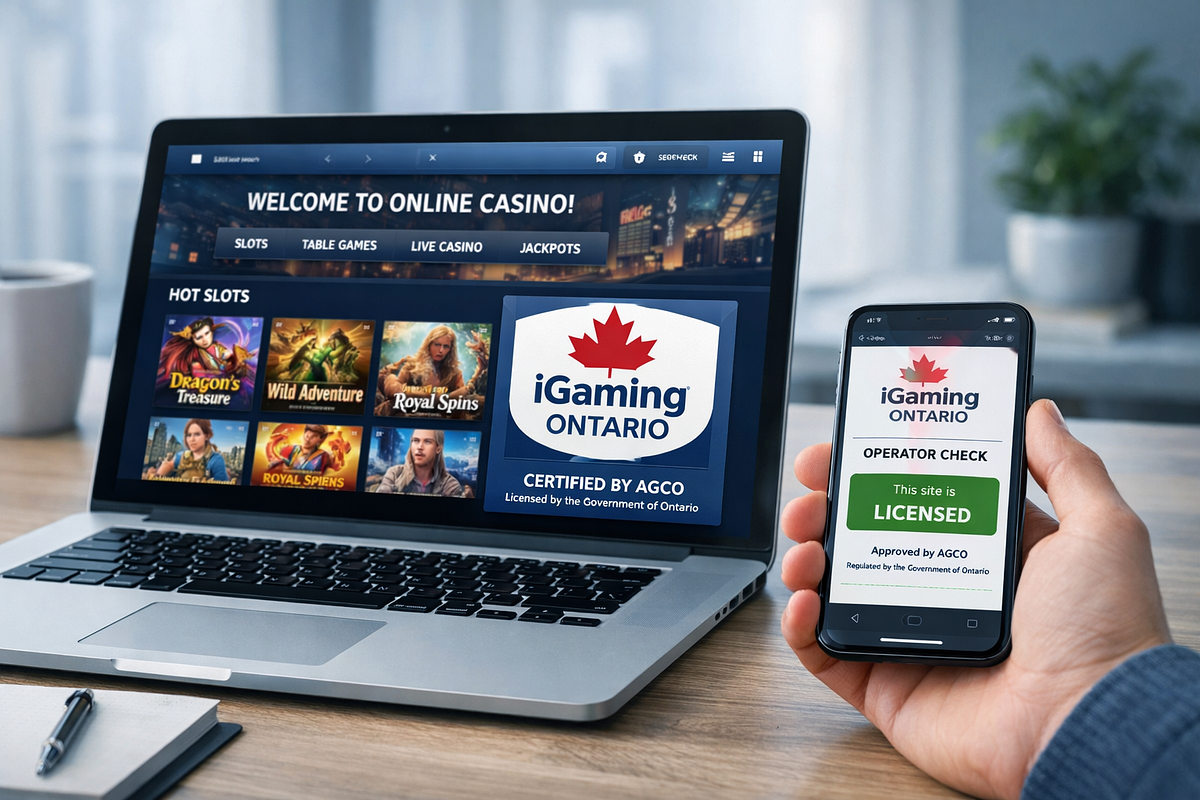
The iGaming Ontario logo is the designated marker that authorized platforms display to confirm their regulated status. It appears across authorized sites as a visible confirmation that the operator has met the province’s two-stage authorization requirement. Its presence is the primary visual check you can perform before depositing. The following practical checks confirm a site’s Ontario-regulated status.
- iGO logo presence: Look for the iGaming Ontario logo displayed on the site. If a site claims Ontario authorization but doesn’t show the iGO logo, that’s a direct inconsistency between the site’s stated status and its visible identifiers.
- Consistency between stated licensing and visible identifiers: If a site claims to be licensed or authorized in Ontario but does not display the iGO logo, treat this as a signal that the claimed status is unverified.
- Authorized operator list: iGaming Ontario maintains a record of operators that have signed operating agreements and are authorized to serve Ontario players. Checking whether the site appears on that published list gives you a second, independent confirmation of regulated status.
Written by Arthur Crowson · Published July 23, 2026 · Last updated October 7, 2026
We check operator terms, licences and payment details against the casino's own pages and update this content when they change. Read our editorial policy, our transparency statement, or report an error. If gambling stops being fun, see our responsible gambling resources.