


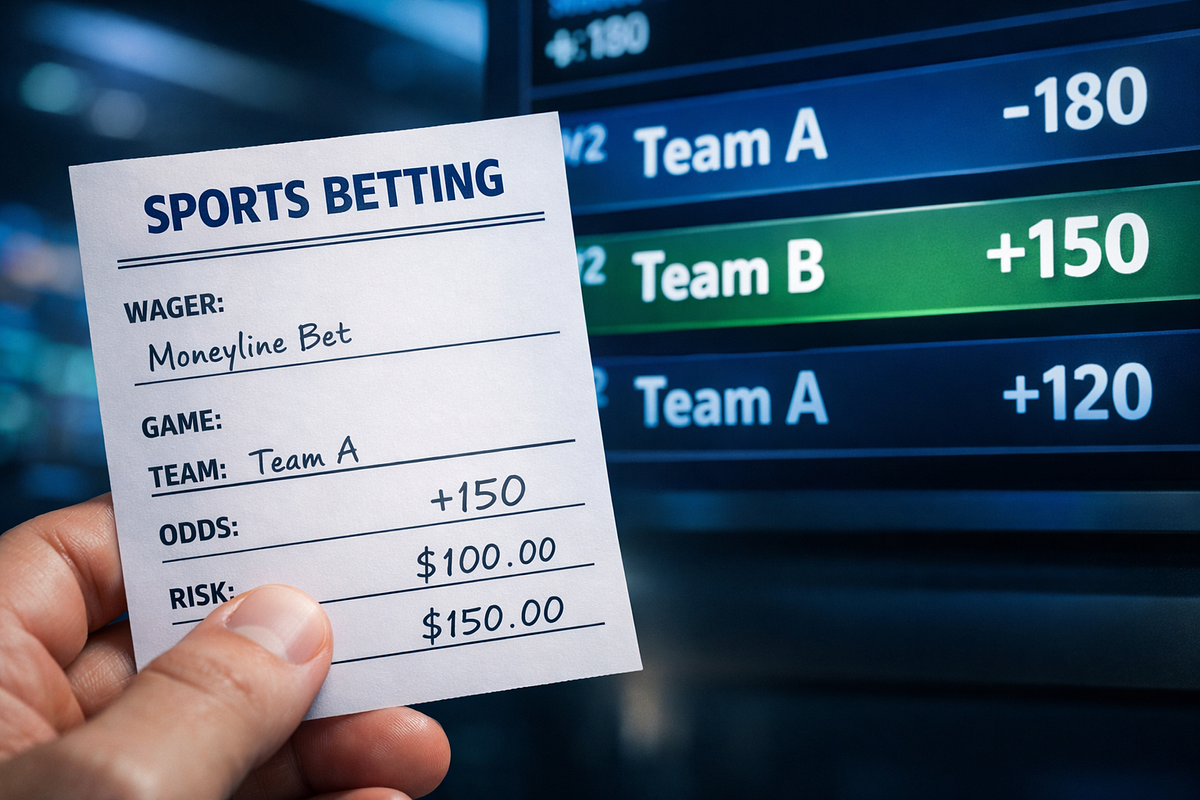
Moneyline betting comes down to one simple idea: pick a team to win, and the odds tell you what a correct bet pays out. Those odds also reflect how likely the market thinks each outcome is, which is why reading them correctly matters right from the start. This guide covers how American and decimal odds work, how to spot favourites and underdogs, how to calculate returns, and how the moneyline works across the sports Canadian bettors follow most. By the end, you’ll be able to read a moneyline confidently and decide whether a given bet makes sense for you.
Moneyline betting is the simplest form of sports wagering: pick a team to win, and the odds determine how much a correct bet pays out. Those odds do more than set the payout. The plus or minus number attached to each team also tells you the market’s estimate of how likely that outcome is, which is why reading the format correctly is the first skill sports betting requires. This guide covers how to read American and decimal odds, identify favourites and underdogs, calculate returns, and recognize how the moneyline works differently across the sports Canadian bettors follow.
What a Moneyline Bet Is
A moneyline bet is a wager on the outright winner of a game or match. The winning team or player just needs to be credited with the official win. There’s no requirement to win by a specific margin or cover a point spread. The moneyline is the foundational bet type in sports wagering, and more complex wagers like spreads, totals, and parlays are all built on or derived from this same basic question: who wins? Understanding the moneyline first makes every other bet type easier to follow, because each one is a variation of that same binary win/loss outcome.
The official result’s credited winner determines how a moneyline bet settles, regardless of the score margin. A team that wins by one goal and a team that wins by five produce the same moneyline outcome. This is different from a spread wager, where the margin of victory determines whether the bet wins or loses, and from a totals wager, where the combined score of both sides is what matters. Because the moneyline reduces the result to a simple win or loss, sportsbooks price it using odds that reflect the estimated probability of that outcome directly, without any adjustment for margin.
At most Canadian sportsbooks, moneyline bets in hockey settle on the final result after overtime and, where applicable, a shootout. That means the full game result, not just regulation, determines the outcome. Soccer works differently: standard moneylines in soccer settle on the 90-minute regulation result, so a match that goes to extra time or penalties doesn’t change the moneyline settlement. The rule varies by sport and by individual market, so check the sportsbook’s stated settlement terms for each market before placing a wager. It prevents misreading a result after the fact.
Reading American Odds, Favourites and Underdogs
American odds are the default display format on private Canadian sportsbooks. The format uses a single number, either positive or negative, to communicate two things at once: which side the market considers more likely to win, and how the payout is structured relative to a fixed reference amount. That reference amount is $100 CAD, and every number in the format is anchored to it. Payout calculations build directly from this reference, but the sign alone is enough to identify the favourite and the underdog before you do any math.
A negative moneyline number identifies the favourite. The number represents how much you need to stake to win $100 in profit. At -200, a $200 stake returns $100 in profit. The larger the negative number, the heavier the favourite and the smaller the profit relative to the amount risked. A line of -400 signals a much stronger favourite than -110, and the return shrinks accordingly.
A positive moneyline number identifies the underdog. The number represents the profit earned on a $100 stake. At +165, a $100 stake returns $165 in profit. The larger the positive number, the longer the odds and the greater the potential return relative to the stake. Here’s a simple way to keep both signs straight: the minus sign tells you what you must risk to win a fixed $100, while the plus sign tells you what you win from a fixed $100 risk.
Every moneyline number corresponds to an implied probability, which is the market’s estimate of how likely that outcome is to occur. The table below shows how the sign and size of the odds translate into both an implied win probability and a profit figure on a $100 CAD stake.
| American Odds | Implied Win Probability | Profit on $100 Stake |
|---|---|---|
| -200 | 66.7% | $50 |
| +200 | 33.3% | $200 |
Calculating Payouts Step by Step
Once you can read a moneyline number, the next step is converting it into a dollar figure. The calculation method is different depending on whether the odds are negative or positive, but both formulas use $100 as their reference point. Negative odds tell you how much you must stake to profit $100. Positive odds tell you how much you profit on a $100 stake. Working through each formula separately keeps the math clean and prevents the two from getting mixed up.
For negative odds, the profit formula is: profit = (stake ÷ odds figure) × 100. At -200, a $100 stake produces $50 in profit. The original $100 is returned alongside it, so the total payout is $150. One thing worth understanding from this math: a winning record on heavy favourites doesn’t automatically mean you’re profitable. Each individual win returns less than the stake risked, so losses on the remaining bets can outweigh the accumulated profits even when wins outnumber losses.
For positive odds, the profit formula is: profit = stake × (odds figure ÷ 100). At +200, a $100 stake produces $200 in profit, for a total payout of $300. Longer underdogs return more per dollar risked, but they win less often. The implied probability figure attached to any positive odds line tells you exactly how much less often the market expects that outcome to occur.
Consider a bettor who places five $100 moneyline bets at -250 odds each, staking $500 in total, and wins three of them. Each winning bet at -250 returns $40 in profit, so three wins produce $120 in total profit. The two losses cost $200 in stakes, leaving the bettor down $80 overall despite a 3-2 record. A winning record on heavy favourites is not the same as a profitable position. The odds figure attached to each bet determines whether the wins are worth enough to offset the losses.
Decimal Odds and the Provincial Lottery Format
Provincial lottery sports products in Canada, including PROLINE+ and Sport Select, display odds in decimal format, while private sportsbooks operating in Canada default to American odds. A Canadian bettor will encounter both formats depending on which platform they use. Knowing how each format works lets you read a line correctly no matter where it appears.
A decimal odds figure represents the total return per dollar staked, with the original stake already included in that number. To calculate profit alone, the formula is: profit = stake × (odds − 1). On a CAD $100 wager at odds of 1.90, that works out to $90 in profit, which is the $100 stake multiplied by 0.90. The decimal figure works as a single total-return multiplier, combining both the likelihood signal and the payout signal into one number.
The same underlying market can be expressed in either format, and the two notations carry the same information about the price. Recognizing that lets you compare lines across platforms that display odds differently.
| Format | Typical Display Location | Example Notation | What the Number Represents |
|---|---|---|---|
| American odds | Private sportsbooks | -110, +150 | Amount to stake for $100 profit (negative) or profit on a $100 stake (positive) |
| Decimal odds | Provincial lottery sports products | 1.90, 2.50 | Total return per $1 staked, including the original stake |
Moneyline Versus Point Spread
The point spread is the moneyline’s structural counterpart. Where a moneyline asks which team wins, a spread wager asks which team wins by how much. In low-scoring sports, the spread takes a fixed form tied to the typical scoring pattern of that sport rather than varying game by game. Knowing which question a given market is asking is the first step in reading any betting board correctly.
A spread wager requires the favourite to win by more than a specified margin, or the underdog to lose by less than that margin, or win outright. A moneyline, by contrast, settles solely on which team wins, regardless of the final score. Knowing whether a market is asking “who wins” or “by how much” tells you which result is relevant to your wager.
Certain sports use standardised spreads that reflect the narrow winning margins typical of those games, rather than lines that shift based on the specific matchup.
| Sport | Spread Name | Standard Line |
|---|---|---|
| Hockey | Puck line | -1.5 / +1.5 goals |
| Baseball | Run line | -1.5 / +1.5 runs |
How the Moneyline Behaves Across Sports Popular in Canada
The moneyline doesn’t work exactly the same way in every sport. It depends on whether a tie is a possible regulation outcome and whether the market settles on the full result including overtime or on regulation alone. Canadian bettors will encounter two distinct versions: the two-way moneyline and the three-way moneyline. The sections below explain where each appears and what causes the odds to shift before a game begins.
In hockey, baseball, and both Canadian and American gridiron football at the professional level, the standard moneyline is a two-way market. There’s one price for each side to win outright, with overtime included in the settled result. Overtime rules in these sports effectively eliminate the possibility of a tie as a final outcome, so the market never needs to price one. For the bettor, this means the outcome is binary: one side wins and the other loses, with no third result to account for.
A three-way moneyline offers three separately priced outcomes: home win, away win, or draw. It settles on the 90-minute regulation result, not after extra time or penalties. Draws happen often enough in soccer regulation to warrant their own price, which is why this format is standard for the sport. Some hockey markets also offer a three-way version that treats a regulation tie as a distinct outcome, separate from the overtime result. When you see three prices instead of two, that’s a signal the market settles differently than a standard two-way moneyline.
Moneyline odds aren’t fixed the moment a sportsbook posts them. They adjust continuously in response to new information and shifts in betting activity up to game time. Several recurring factors move a moneyline between posting and the opening whistle:
- Injury news: a player ruled in or out shifts the market’s estimate of each side’s win probability, often producing a measurable price change on both sides of the market.
- Weather conditions: outdoor sports and some indoor sports are sensitive to conditions that affect scoring or player performance, and books adjust prices accordingly.
- Betting volume imbalance: when heavy money lands on one side, the sportsbook adjusts the price on that side to rebalance its exposure across both outcomes.
The Vig and What It Costs the Bettor
The vig, short for vigorish, is the margin a sportsbook builds into every market it prices. It’s the reason the combined implied probabilities of both sides of a two-outcome market always add up to more than 100%. A bettor who reads odds without accounting for the vig treats the prices as a direct reflection of true win probability. A bettor who understands the vig knows the prices reflect true probability plus the book’s margin on top.
On a two-way market where each side has a genuine 50% chance of winning, a fair price for both sides would be +100, meaning a $100 stake returns $100 in profit. A sportsbook instead prices both sides at -110, requiring a $110 stake to win $100 in profit. At -110, the implied probability of each side is approximately 52.4%, so the two sides together imply a combined probability of roughly 104.8%. The excess above 100% is the vig. Because of that excess, a bettor wagering on -110/-110 markets must win more than 50% of their bets over time just to break even, not exactly 50%.
Parlays Built From Moneyline Selections
A parlay is a single wager that combines multiple individual selections into one ticket. Every selection on the ticket must win for the parlay to pay out. One losing leg voids the entire wager. Moneyline picks are the most common building block for parlays because each leg produces a clean binary outcome: the selected team either wins or it doesn’t. This makes moneyline legs straightforward to combine, which is why parlays are frequently assembled from them.
A parlay’s payout is calculated by converting each leg’s odds to their decimal equivalent and then multiplying those figures together. That’s why the combined return grows larger with each additional leg. A four-leg parlay of moderate favourites can pay out considerably more than any single leg on the ticket would on its own. At the same time, the probability of all legs winning is lower than the probability of any individual leg winning, because each additional leg introduces another condition that must be met for the ticket to cash.
The Canadian Regulatory Context and Responsible Play
Single-event sports betting became legal across Canada on August 27, 2021, when Criminal Code amendments under the Safe and Regulated Sports Betting Act came into force. Before that date, provincial lottery products offered only parlay-based sports wagering. Single-game moneyline bets were not available through any regulated channel. Both private sportsbooks and provincial lottery sports products now operate in the Canadian market. Anyone new to wagering should confirm the minimum legal age and available support resources that apply in their province before placing a bet.
Reading Your Next Moneyline With Confidence
The plus/minus convention and the $100 anchor do the same job at the same time: they encode the market’s probability estimate and the attached payout in a single number. Once you can read that number in both directions, identifying the implied likelihood and the return on a given stake, you can interpret any moneyline board you encounter, in any sport, on any Canadian platform, and judge whether the price matches your own read of the game.
Written by Arthur Crowson · Published August 10, 2026 · Last updated October 11, 2026
We check operator terms, licences and payment details against the casino's own pages and update this content when they change. Read our editorial policy, our transparency statement, or report an error. If gambling stops being fun, see our responsible gambling resources.