

Interac withdrawals from online casinos take longer than deposits because of a basic asymmetry in how the network handles money going in versus money going out. Deposits clear in minutes. Withdrawals can take hours or days, and most of that wait happens on the casino’s side, not inside the banking system. This page breaks down where the delays happen, from internal casino processing and compliance checks to banking-hours scheduling, so you can tell whether a pending payout is stuck or just working through a normal queue.
The Deposit-to-Withdrawal Asymmetry
The same network moves money in both directions between a player’s bank account and a casino. But a deposit and a withdrawal behave very differently in practice. A deposit clears in seconds to minutes. A withdrawal on that same network can take hours to days. That gap isn’t a quirk of the network. It’s a structural feature of how casinos handle each direction of the transaction.
Once a casino approves a withdrawal and releases the funds, the network moves them in minutes, just as fast as it moves a deposit. The wait a player experiences is almost entirely the time the casino takes to reach that approval step.
The direction of the transaction explains why. A deposit is a push: the player’s bank initiates the transfer and the casino accepts it automatically, with no manual review needed on the operator’s side. A withdrawal is a request: the player asks the casino to send money, and the casino has to review that request, approve it, and fund the outgoing transfer before anything touches the network. The network is idle during all of that time.
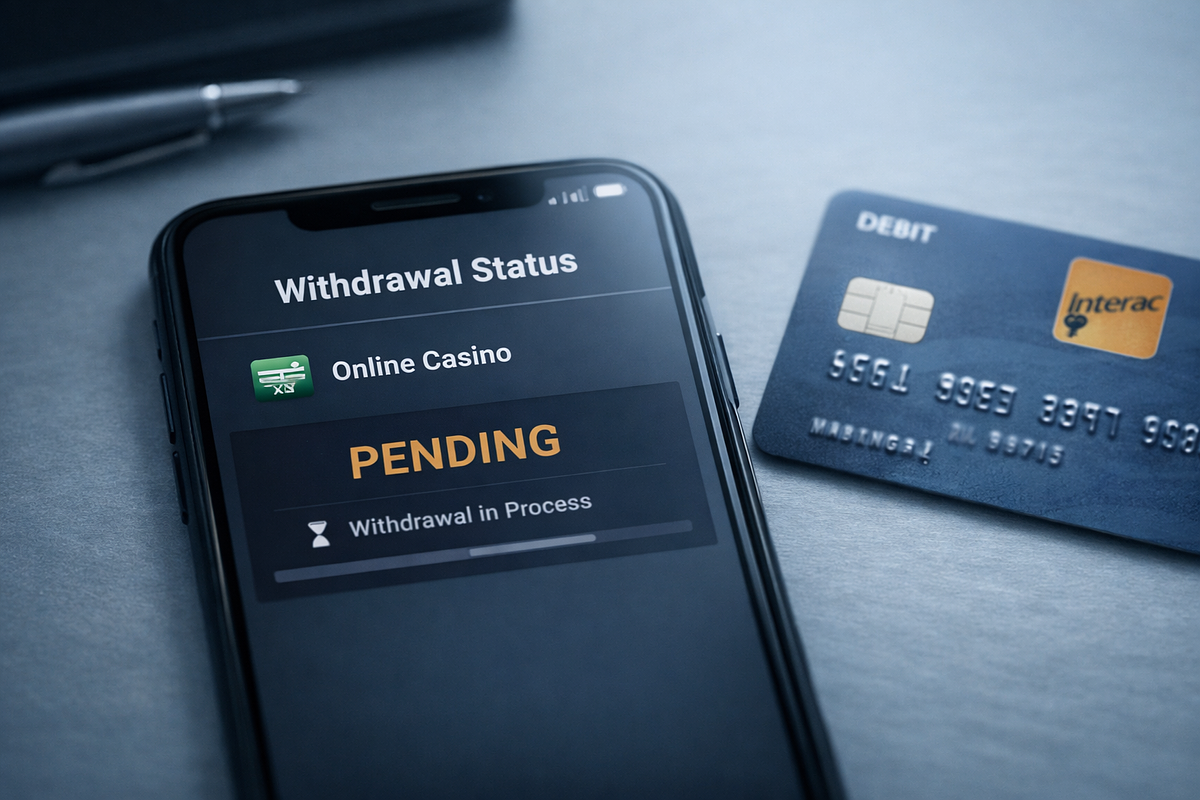
This reframes what a “pending” status actually means. When a withdrawal shows as pending, it hasn’t left the casino’s internal queue yet. It hasn’t reached the network at all. The delay is inside the operator, not on the banking rails.
Deposit speeds are broadly similar across payment methods. The real differences show up on the withdrawal side. Here’s how Interac compares to other options available to Canadian players.
| Payment Method Category | Typical Deposit Speed | Typical Withdrawal Speed |
|---|---|---|
| Credit card | Instant to minutes | 3–5 business days |
| E-wallet | Instant to minutes | 24–48 hours |
| Interac e-Transfer | Seconds to minutes | Hours to days |
Identity Verification as the First-Withdrawal Bottleneck
The biggest reason a first payout is slow is identity verification, not the payment network. Regulated operators are required by their licensing conditions to confirm who a player is before releasing funds, and that check happens at the withdrawal stage, not the deposit stage.
Identity verification here refers to the Know Your Customer process, or KYC. It requires a player to submit documents confirming their identity and address before the operator will release funds to their bank account. Operators don’t have to complete KYC checks before accepting a deposit, which is why a player can fund an account instantly and then hit a wait when trying to withdraw for the first time.
The review is a manual document check carried out by a compliance team working standard business hours. Because a human analyst has to examine the submitted documents and approve the account, the delay is measured in business days, not clock hours. KYC verification adds one to three business days to a first payout, depending on the operator’s staffing and queue volume at the time of submission.
A slow first withdrawal and a slow second withdrawal are not the same thing. Verification is a one-time gate: once a compliance team has approved an account, later withdrawals don’t repeat the same document review. If a second or third payout is slow, the cause is somewhere else, such as the operator’s internal processing window, an anti-money-laundering review, or a timing issue like a weekend submission. Players who complete KYC at registration, rather than waiting until their first withdrawal request, cut this delay out of the first payout entirely.
Anti-Money-Laundering Review Triggers
Identity verification isn’t the only compliance layer that can hold a withdrawal. Anti-money-laundering review sits on top of KYC and works independently of it. Unlike identity verification, which applies to all first withdrawals, AML review only kicks in when specific characteristics of a withdrawal request hit defined thresholds or raise pattern flags.
AML review is a manual check carried out by a compliance analyst, not an automated release. When it triggers, the payout is held in a queue until that analyst has reviewed the account’s transaction history and cleared the request. A delay on an otherwise verified account points to something about that specific withdrawal, not a standing problem with the account. The documented triggers are:
- Amount threshold: Withdrawals above approximately C$3,000–C$5,000 can prompt a manual AML security check, regardless of whether the account is fully verified.
- Deposit-withdrawal mismatch: Requesting a payout to a different payment method than the one used to fund the account triggers manual AML review, because the change in fund destination is treated as a pattern inconsistency.
- Pattern anomalies: A withdrawal amount that doesn’t match the account’s established deposit history can flag a pattern-anomaly review, even when the absolute amount falls below the standard threshold.
Casino Internal Processing Windows
Once identity verification and any compliance checks are done, the withdrawal doesn’t move immediately to the network. The casino’s finance team still has to review, approve, and fund the transaction before handing it off. This internal processing window is separate from network transfer time, and it’s the single biggest factor that separates fast-paying operators from slow ones.
Internal processing time is the gap between when a player submits a withdrawal request and when the casino releases the funds to the Interac network. The network isn’t involved during this interval. The transaction sits entirely within the operator’s systems, waiting for a finance team to act on it.
Across Canadian operators, this window varies widely. At the fastest end, some operators release funds in under one hour. At the slowest end, the same step can take up to five full business days. Tested withdrawal times across reviewed Canadian platforms reflect this spread, ranging from a matter of hours at quicker operators to one to three business days at others, with the full five-day ceiling appearing at the slowest.
This is why two players using the same payment network can report completely different wait times. One player’s payout arrives the same day; another waits most of a working week. The network is identical in both cases. What’s different is the operator’s internal window. When you compare operators on payout speed, you’re really comparing this internal window, not the Interac network itself.
A withdrawal involves two separate intervals, not one. The first is the operator’s internal processing step, which sits entirely under the casino’s control. The second is the interbank transfer itself, which only begins after the casino releases the funds to the network.
These two intervals are independent. At BetVictor Canada, for example, a third-party summary describes an internal processing step of four to six hours, followed by a further two to four business days for the funds to arrive via Interac transfer. The operator’s own page states that withdrawals generally process within 48 hours, with higher-value transfers taking three to five days. Both figures reflect the combined total of the two intervals, not either one alone.
A payout marked as “processing” is still inside the casino’s internal window. It hasn’t been released to the network yet, and the operator still controls it. A payout marked as “sent” has cleared the internal step and is now moving through the interbank transfer. Only the first status is still under the casino’s control.
Timing Factors That Extend the Queue
How long a player actually waits depends heavily on when the withdrawal request enters the operator’s processing queue. A request with the same nominal processing window can resolve in hours or stretch across multiple days depending on when it was submitted.
Casino finance teams process withdrawal requests during standard business hours. A request submitted outside those hours doesn’t start moving through the approval workflow until staff return. It just sits in the queue. Requests submitted on weekends or statutory holidays face the longest wait, because the next processing window may be two or more days away. This queuing effect can double or triple the effective wait for a request that would otherwise clear within the same business day.
A payout that appears stuck over a weekend isn’t blocked or flagged. It’s waiting for the next scheduled processing window to open. No action is needed from the player, and the delay doesn’t mean anything is wrong with the request. The timing factors that determine whether a submission lands inside or outside an active processing window are:
- Weekend submission: requests entering the queue from Friday evening through Sunday, which wait until the operator’s finance team resumes on Monday morning.
- Holiday submission: requests entering the queue on statutory holidays, which wait until the next working business day.
- Off-hours submission: requests submitted outside the operator’s finance-team working hours on an otherwise standard business day, which wait until the start of the next working shift.
Bank-Side Limits and Structural Constraints
Even when a casino releases a payout without delay, the player’s own bank can impose transfer caps that break a single payout into multiple instalments sent across separate days. On top of that, the payment network has no reversal mechanism, which shapes how operators handle outgoing transactions before they reach the network.
Canadian banks set their own daily sending limits on the transfer network, and those limits can sit well below the amounts many players request. Third-party sources cite C$3,000 per 24 hours as the commonly applied Interac e-Transfer daily cap at major banks such as TD and CIBC, though some credit unions offer higher daily limits. When a payout exceeds the applicable daily cap, the casino can’t send the full amount in one transfer. It has to dispatch the funds in separate instalments on successive days, even when the casino’s own processing is complete and no compliance review is active.
Operators also apply their own casino-side daily payout caps, which are separate from whatever limit the player’s bank enforces. When both caps are in play, the lower of the two determines how quickly the full amount arrives. A player who receives C$3,000 on day one and the remainder on day two hasn’t encountered an error. The transfer was split because the combined caps make a single-instalment payout impossible. It’s a mechanical consequence of layered limits, not a sign that something went wrong.
The transfer network doesn’t support chargebacks. Interac’s own FAQ confirms that once a deposit has been made, “there is no way to reverse the transaction,” and that the sender must arrange any remedy directly with the recipient. This is a structural difference from credit card rails, where an issuer can initiate a reversal after the fact.
Because a completed transfer can’t be clawed back, operators can’t rely on post-transfer recovery as a fraud-mitigation tool. Instead, they front-load their fraud checks, completing the review before the funds leave their account rather than after. That sequencing adds time to the outbound side of the transaction. A withdrawal on a chargeback-capable rail such as a credit card can, in principle, be partially backstopped by a reversal mechanism. A withdrawal on this network cannot. The additional pre-release scrutiny is a direct consequence of that design, not a sign of operator inefficiency.
Reading a Pending Payout for What It Actually Is
The gap between deposit and withdrawal speed isn’t a network limitation. It’s a consequence of where control over the transaction sits at each stage. When a withdrawal shows as pending, the funds haven’t left the operator’s systems yet. The network isn’t slow. The casino just hasn’t released the payment. Knowing that lets you accurately identify where a delay is coming from and whether it actually needs your attention.
Written by Arthur Crowson · Published August 8, 2026 · Last updated October 7, 2026
We check operator terms, licences and payment details against the casino's own pages and update this content when they change. Read our editorial policy, our transparency statement, or report an error. If gambling stops being fun, see our responsible gambling resources.