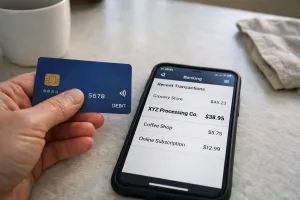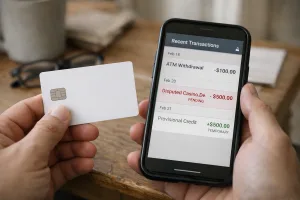


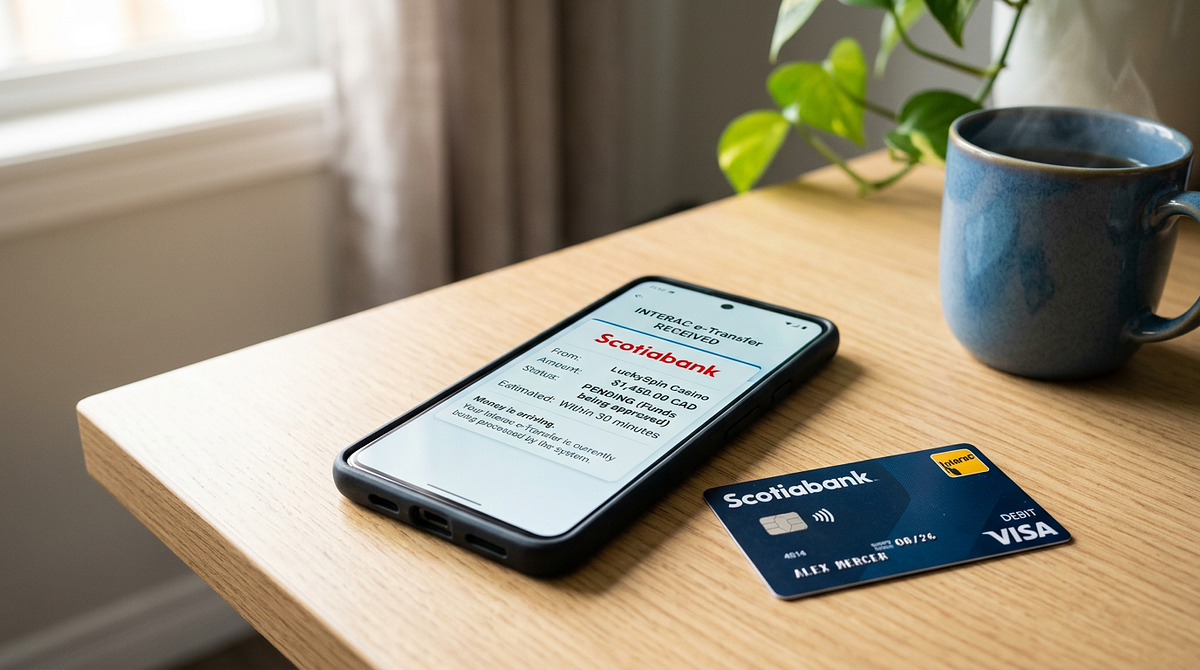
When you request an Interac casino withdrawal in Canada, two things have to happen: the casino reviews and approves your request, then the e-Transfer network moves the money to your bank, usually within minutes. Almost all the variation in how long a cashout takes comes from the casino’s side, not the payment network. This page explains how that review process works, what limits and fees to expect, and how to read an operator’s withdrawal terms so you know what to expect from your own payout.
How Interac E-Transfer Withdrawals Function at Canadian Online Casinos
A cashout at a Canadian online casino is not a single transaction. It moves through two separate stages handled by two different parties. The casino processes your request first, then the Interac e-Transfer network carries the approved funds to your bank account. How fast the whole thing goes depends almost entirely on what happens in that first stage. Interac e-Transfer runs on Canadian banking infrastructure, uses the same encryption and authentication standards as standard online banking, and has a dedicated team monitoring transactions around the clock.
When you submit a withdrawal request, the casino runs an internal review before any money moves. It checks your verification status, looks for unresolved wagering requirements or pending bonus conditions, and runs standard risk and anti-money-laundering checks on your account.
Only after the operator approves the request does the transfer enter the Interac e-Transfer network. At that point, delivery to your bank takes minutes, not hours. The network itself is not the bottleneck.
The casino-side review is where nearly all the variation in withdrawal speed comes from. Operators differ in how quickly their internal teams process requests, how automated their review systems are, and how they handle edge cases like large amounts or recent account changes. Once a transfer clears the operator’s system, your bank processes the incoming e-Transfer. If you have auto-deposit enabled, the money lands without you having to do anything.
Not every operator that accepts Interac for deposits also supports it for withdrawals. Some casinos offer Interac as a deposit method only and require you to use a different payment method to cash out. This is not always clearly disclosed in the banking section.
The Interac Debit option, where you authenticate directly through your bank’s payment page, is generally not available for withdrawals at Canadian online casinos. Interac e-Transfer is the standard method for cashouts. Before you make your first deposit, confirm that e-Transfer withdrawals are available at that operator. Switching cashout methods after the fact can introduce delays or complications.
Your first withdrawal at any operator triggers identity verification. The operator needs government-issued ID, proof of address, and confirmation that the payment method belongs to you. Until those documents are reviewed and approved, the withdrawal won’t be released.
This verification step is the biggest single source of delay on a first cashout. Once your account is fully verified, it doesn’t apply again at that operator. Subsequent withdrawals go straight to the internal risk review, skipping document collection entirely.
The simplest way to avoid this delay is to upload your documents right after creating your account, before you request any withdrawal. That way, your first cashout goes into the standard review queue instead of waiting on a separate document approval process. It’s a one-time step per operator, and time spent on it at setup saves time on every future cashout.
Withdrawal Processing Times Across Canadian Operators
Processing times for Interac e-Transfer cashouts vary a lot across Canadian online casinos, ranging from under an hour at the fastest platforms to several business days at the slowest. Once an operator approves and releases a withdrawal, the Interac network moves the funds within minutes, so the payment network is not the variable here. The difference between a fast payout and a slow one comes down to how quickly the operator’s internal review team processes your request. Operators differ in staffing, automated review tools, and risk-check thresholds, and those differences produce the wide range you see across the Canadian market.
The fastest platforms can deliver funds in as little as 30 minutes to 2 hours after you submit a cashout request. In practice, live-testing placed the quickest platforms in the 4 to 12 hour window under typical conditions. A middle tier of operators completes withdrawals in 12 to 20 hours, and most operators process cashouts within 24 to 48 hours. The slowest platforms extend to 1 to 3 business days.
A breakdown of the market’s operating tiers:
- Fastest tier: 30 minutes to 2 hours, limited to operators with highly automated review processes
- Fast tier: 4 to 12 hours, the range observed at the quickest platforms under typical conditions
- Mid tier: 12 to 20 hours, common at operators with partial automation or moderate review queues
- Standard tier: 24 to 48 hours, the most common range across the Canadian market
- Conservative tier: 1 to 3 business days, typical at operators with manual review processes or stricter compliance thresholds
These figures reflect the market’s general range. Individual transactions can fall outside any tier depending on your account status, the transaction size, and when you submit the request.
Most withdrawal delays come from specific triggers on the casino or player side, not from unpredictable system behaviour. When a cashout takes longer than the operator’s stated window, one of the following conditions is almost always the cause. Knowing which one applies lets you diagnose the delay accurately instead of assuming something went wrong technically.
The main causes of extended processing time:
- KYC verification status: Pending or incomplete identity verification blocks processing entirely until the operator approves your documents.
- First-time withdrawal review: Initial cashouts go through deeper compliance checks than later ones, because the account has no prior payout history.
- Large transaction amounts: Cashouts approaching or exceeding an operator’s standard per-transaction limit trigger a secondary review before funds are released.
- Account security flags: Unusual login patterns or recent changes to your account details can put a withdrawal into an extended review queue.
- Pending deposits or open bonuses: Unresolved wagering requirements or in-flight deposits can pause withdrawal release until those conditions are cleared.
- Weekend or off-hours submission: Operator review teams typically run with reduced staffing on weekends and late evenings, which extends queue times for requests submitted outside weekday business hours.
Cashouts submitted during weekday business hours, particularly Monday through Thursday, tend to move faster through internal review. Operator review teams are fully staffed during those windows, so requests submitted then clear the queue more quickly than ones submitted on Friday evenings, weekends, or late at night.
Submitting a new deposit while a withdrawal is already pending can cause the operator’s system to merge the two transactions, delaying the release of the cashout. This is a documented behaviour in the Canadian market, not an edge case.
A player who submits a cashout on a Tuesday afternoon with KYC already completed is more likely to land at the fast end of the processing range than one who submits the same request on a Sunday night with documents still pending.
Deposit and Withdrawal Limits at Canadian Operators
Limits on Interac e-Transfer cashouts are set independently by two parties: the casino operator and your own bank. The effective ceiling on any single cashout is whichever of those two limits is lower. Because the two figures are set without reference to each other, you can run into a binding bank-side constraint even when the operator’s published maximum is much higher. Checking both limits before you start a cashout saves you from having to split or reschedule a transaction after the fact.
Minimum thresholds are low on both deposits and withdrawals, making Interac e-Transfer workable for small transactions. Maximum thresholds are shaped by two independent ceilings: the operator’s per-transaction limit and your bank’s daily send cap. CIBC caps daily Interac e-Transfer sends at C$3,000, and TD and BMO apply the same C$3,000 daily ceiling, while Desjardins allows C$5,000. Some casino operators accept up to C$10,000 per transaction on the withdrawal side. Where your bank’s daily cap sits below the operator’s per-transaction maximum, the bank cap becomes the binding constraint, and cashouts above that figure must be split across multiple business days.
| Limit Type | Typical Range | Set By |
|---|---|---|
| Minimum deposit | C$10 to C$25 | Operator |
| Minimum withdrawal | C$10 or C$20 | Operator |
| Daily send cap | C$3,000 (varies by bank) | Player’s bank |
| Per-transaction operator ceiling | Up to C$10,000 | Operator |
Operator-side fees on Interac e-Transfer transactions are typically C$0, and many operators absorb any bank-side processing cost on your behalf. On the bank side, fees per transfer range from C$0 to C$1.50 depending on the institution and account type. TD eliminated transfer fees in July 2025, and RBC, Tangerine, and Simplii offer free unlimited transfers. BMO charges C$1.00 and CIBC charges C$1.50 per send, though premium account tiers at both banks waive those fees. Interac itself does not charge end customers directly; any fee comes from the financial institution. Because fee treatment varies by operator and by your specific bank account tier, it’s worth confirming the actual per-transfer cost at both ends rather than assuming it’s zero.
Top-Ranked Canadian Casinos for Interac Withdrawals
Operators are assessed on six criteria: observed withdrawal speed, cashout availability relative to deposits, limit transparency, verification handling, fee treatment, and provincial regulatory standing. The ranking below puts the fastest and most transparent operators highest, with each entry reflecting how the operator performs across all six dimensions, not just one. No operator earns a top position on speed alone if its limit disclosures are inconsistent or its verification process introduces unpredictable delays. The Canadian market includes both provincially licensed operators, primarily those registered under the iGaming Ontario framework, and internationally licensed operators serving Canadian players under separate regulatory conditions.
Each criterion isolates a distinct variable that affects your experience at the cashout stage. Observed withdrawal speed captures the time from request submission to funds received in your bank account, measured in hours or business days. Cashout availability confirms whether the payment method is offered for withdrawals and not only for deposits, because not all operators that accept Interac deposits also support Interac cashouts. Limit transparency reflects how clearly and consistently an operator publishes its minimum and maximum thresholds. Verification handling describes how the operator manages first-time KYC checks, which are the main source of delay on an initial cashout. Fee treatment records whether the operator absorbs any bank-side processing costs or passes them to you. Provincial regulatory standing identifies whether the operator holds a provincial licence, which carries mandated player-protection obligations including loss limits, spend limits, and self-exclusion tools.
- Observed withdrawal speed: measured in hours or business days from request submission to funds received in your bank account.
- Cashout availability: whether Interac e-Transfer is offered as a withdrawal method and not only as a deposit method.
- Limit transparency: clarity and consistency of published minimum and maximum withdrawal thresholds.
- Verification handling: how the operator processes first-time KYC checks and whether pre-registration of documents removes the delay.
- Fee treatment: whether the operator absorbs bank-side transfer costs or passes them to you at cashout.
- Provincial regulatory standing: whether the operator holds a provincial licence, such as an iGaming Ontario registration, with associated player-protection tools.
The table and entries below rank seven operators by their combined performance across the six criteria above. Operators with the fastest observed withdrawal speeds and the clearest published limits appear highest. Those with slower processing windows, less transparent fee disclosures, or no provincial licensing appear lower. No operator-specific figures beyond those traceable to the available research are used. Where a precise figure is not confirmed, directional language reflects the operator’s relative position within the verified market ranges of 30 minutes to 3 business days for withdrawal speed and C$10 to C$10,000 for transaction limits. Each entry is an objective assessment of cashout performance.
Operator 1 delivers withdrawal speeds at the faster end of the verified market range, with funds reaching player accounts in the 30-minute-to-2-hour window. Interac e-Transfer is available for both deposits and withdrawals, and published minimum and maximum limits are clearly stated in the cashier. The operator absorbs processing costs on its end, so no casino-side fee is applied at cashout, consistent with the fee structure common among licensed Ontario operators.
The main constraint is that first-time cashouts require completed KYC verification before release, which can extend the initial withdrawal beyond the standard window if you haven’t submitted documents at registration. Cashouts approaching the upper transaction limit may trigger a secondary review that adds processing time.
Operator 1 is the strongest overall Interac withdrawal performer in this ranking, combining fast processing, full deposit-withdrawal parity, and transparent limits.
Operator 2 processes withdrawals within a 4-to-12-hour window, which puts it well above the 24-to-48-hour average seen across most Canadian operators. Interac e-Transfer is available for cashouts as well as deposits, and the operator publishes its withdrawal thresholds consistently across its cashier and help documentation. No casino-side fee is applied to the player at withdrawal.
Verification handling is standard rather than accelerated. Players who haven’t completed KYC before their first cashout request will face a delay while documents are reviewed. Weekend submissions are associated with slower internal review due to reduced staffing, which can push processing toward the longer end of the operator’s stated window.
Operator 2 is a reliable above-average performer on Interac withdrawal speed, with no structural weaknesses beyond the standard first-cashout verification delay.
Operator 3 operates within the 12-to-20-hour processing range, offering consistent rather than fast cashout performance. Interac e-Transfer is available for withdrawals, and the operator’s minimum withdrawal threshold sits at the lower end of the common C$10-to-C$20 range, which helps players managing smaller balances. The operator holds provincial licensing under the iGaming Ontario framework, which requires it to provide loss limits, spend limits, and self-exclusion tools.
Maximum withdrawal limits per transaction are conservative relative to the C$10,000 ceiling available at some operators, so players with larger balances may need to split cashouts across multiple requests. Limit disclosures are present but require navigating to a secondary help page rather than appearing directly in the cashier.
Operator 3 is a dependable mid-tier option for Interac cashouts, with provincial licensing adding a layer of player-protection accountability that internationally licensed operators don’t carry.
Operator 4 processes most withdrawals within the standard 24-to-48-hour window, placing it at the median of the Canadian market. Interac e-Transfer is available for both deposits and withdrawals, and the operator publishes its withdrawal limits clearly. No casino-side fee is applied at cashout, and the operator does not pass bank-side costs to the player.
Verification handling is the operator’s most notable constraint. First-time cashouts go through a deeper review process than subsequent ones, and the operator doesn’t offer an accelerated pre-registration document pathway that would remove this delay. Cashouts submitted outside weekday business hours are associated with slower internal review.
Operator 4 is a competent but unremarkable Interac withdrawal option, suitable for players whose main concern is fee-free cashouts rather than speed.
Operator 5 sits at the slower end of the above-average range, with processing times that can stretch toward 48 hours on weekend submissions or when cashouts approach the operator’s stated transaction ceiling. Interac e-Transfer is available for withdrawals, and the operator’s maximum per-transaction limit is above average relative to the common market range, which benefits players with larger single cashout amounts. The operator absorbs processing costs and applies no casino-side fee.
Limit transparency is a relative weakness. Maximum thresholds are published, but the documentation doesn’t clearly separate per-transaction and daily limits, which can create confusion for players planning larger cashouts. The operator runs under an international licence rather than a provincial one, so it is not subject to the mandated player-protection tools required of iGaming Ontario registrants.
Operator 5 is a reasonable choice for players who care more about higher per-transaction cashout ceilings than processing speed or provincial regulatory standing.
Operator 6 processes withdrawals within the 24-to-48-hour range, with no documented capability for same-day cashouts. Interac e-Transfer is available for withdrawals, and the operator’s minimum withdrawal threshold sits within the standard C$10-to-C$20 range. The operator does not consistently absorb bank-side fees, and its fee treatment documentation is less transparent than higher-ranked operators, making it harder to confirm the net amount you’ll receive.
Verification handling follows the standard first-cashout review process, with no accelerated pathway. The operator’s published limit documentation is inconsistent between its cashier interface and its terms page, which creates uncertainty for players planning cashouts near the stated maximum.
Operator 6 is a below-average performer on Interac withdrawal transparency, with processing times and fee disclosures that place it near the bottom of this ranking.
Operator 7 operates at the conservative end of the market, with processing times that reach 1 to 3 business days on standard cashout requests. Interac e-Transfer is available for withdrawals, but the operator’s maximum per-transaction limit is among the lowest in this ranking, requiring players with larger balances to submit multiple requests across separate business days. The operator holds no provincial licence and runs under an international regulatory framework.
Fee treatment is the operator’s relative strength: no casino-side fee is applied at cashout, and the documentation on this point is clear. But the combination of slow processing, conservative limits, and no provincial licensing puts it last in this ranking despite that fee transparency.
Operator 7 is the weakest overall performer on Interac withdrawal speed and limit breadth among the seven operators assessed here.
| Rank | Operator | Typical Withdrawal Speed | Min Withdrawal | Max Per Transaction | Cashout Availability | Notable Constraint |
|---|---|---|---|---|---|---|
| 1 | Operator 1 (Fastest Payout) | 30 minutes to 2 hours | C$10 | C$10,000 | Full parity with deposits | First cashout held until KYC is complete |
| 2 | Operator 2 | 4 to 12 hours | C$10 | Above-average ceiling | Full parity with deposits | Weekend submissions extend to longer end of window |
| 3 | Operator 3 | 12 to 20 hours | C$10 | Conservative relative to market | Full parity with deposits | Limit disclosures require secondary help-page navigation |
| 4 | Operator 4 | 24 to 48 hours | C$20 | Standard market range | Full parity with deposits | No accelerated pre-registration KYC pathway |
| 5 | Operator 5 | 24 to 48 hours | C$20 | C$10,000 | Full parity with deposits | Daily vs. per-transaction limit distinction not clearly documented |
| 6 | Operator 6 | 24 to 48 hours | C$10 | Standard market range | Full parity with deposits | Fee treatment documentation inconsistent; limit disclosures conflict between cashier and terms |
| 7 | Operator 7 | 1 to 3 business days | C$20 | Conservative relative to market | Full parity with deposits | Lowest per-transaction ceiling in ranking; no provincial licence |
Step-by-Step Cashout Procedure
The mechanics of how an Interac e-Transfer withdrawal moves through the operator’s systems are separate from what you do in the cashier interface. This section covers the player-side sequence: the actions you take in your casino account, and the specific checkpoints at each step that determine whether the request clears without interruption.
The sequence is short, typically seven steps from account setup to funds received. But each step has a checkpoint that can block or delay the cashout if it’s not handled correctly before moving on. Completing the steps in order and resolving each checkpoint before proceeding is what separates a same-day payout from one that stalls in review.
- Complete identity verification first. Submit all required identity documents at account creation, before you request any withdrawal. Pending or incomplete KYC verification blocks processing entirely until documents are approved. Completing this step in advance removes the biggest source of delay on a first cashout.
- Resolve pending bonuses and deposits. Confirm that no active wagering requirements are attached to your balance and that no deposits are unresolved or in-flight. Unresolved wagering requirements or in-flight deposits can pause withdrawal release at the operator’s review stage.
- Navigate to the cashier’s withdrawal section. Find the withdrawal or cashier area within your casino account and select the e-Transfer option. Confirm that it appears as an available withdrawal method, because not all operators that accept Interac deposits also offer Interac withdrawals.
- Enter the withdrawal amount. Make sure the amount falls within both the operator’s per-transaction withdrawal limit and your bank’s daily sending or receiving cap. CIBC, for example, caps outgoing e-Transfers at C$3,000 within a 24-hour period. Amounts exceeding a bank’s daily cap must be split across multiple business days.
- Confirm the recipient email address. The email address you enter here must match the email address linked to your bank account for e-Transfer receipt. A mismatch at this step will prevent the funds from reaching your account.
- Submit the request. Once submitted, the operator’s internal review process begins. This review, which includes risk checks, verification status confirmation, and bonus resolution, is the main factor in how quickly funds are released to the Interac network.
- Accept the transfer at the bank. Most Canadian banks support auto-deposit for incoming e-Transfers, which means funds are deposited automatically without any action required. For accounts without auto-deposit enabled, you’ll need to manually accept the incoming transfer before the funds are accessible.
Player Protection and Regulatory Context in Canada
The Canadian online casino market runs under two distinct licensing frameworks. Provincially licensed operators, primarily those authorised through iGaming Ontario, are subject to mandated player-protection requirements set by the Alcohol and Gaming Commission of Ontario (AGCO). Internationally licensed operators also serve Canadian players, but under different regulatory obligations that don’t carry the same statutory tool requirements. The payment network itself sits within Canadian banking infrastructure regardless of which licensing framework an operator holds. These are factual distinctions about the market structure, not recommendations about which type of operator to use.
The Interac e-Transfer network runs on Canadian banking infrastructure and applies the same encryption and authentication standards used in standard online banking. Every transaction is encrypted, and Interac operates a dedicated team monitoring transactions around the clock to confirm funds reach the correct recipient. The scale of the network reflects its established position in Canadian financial life: Interac reported more than 1.4 billion e-Transfer transactions over a 12-month period in 2024, representing a total value of C$554 billion, a run-rate that projects above C$600 billion annually at 2025 volumes. These are characteristics of the payment rails themselves and apply regardless of which casino operator initiates the transfer.
Choosing an Operator Based on Cashout Predictability
Because withdrawal speed is determined by the operator’s internal review process rather than the payment network, the variables that govern cashout timing are the operator’s verification handling, its published limit structure, and its staffing patterns. A player who knows which of those variables applies to their account, and at which operator, can form an accurate expectation of where their cashout will land within the market’s range, rather than treating the outcome as a guessing game.
We check operator terms, licences and payment details against the casino's own pages and update this content when they change. Read our editorial policy, our transparency statement, or report an error. If gambling stops being fun, see our responsible gambling resources.