


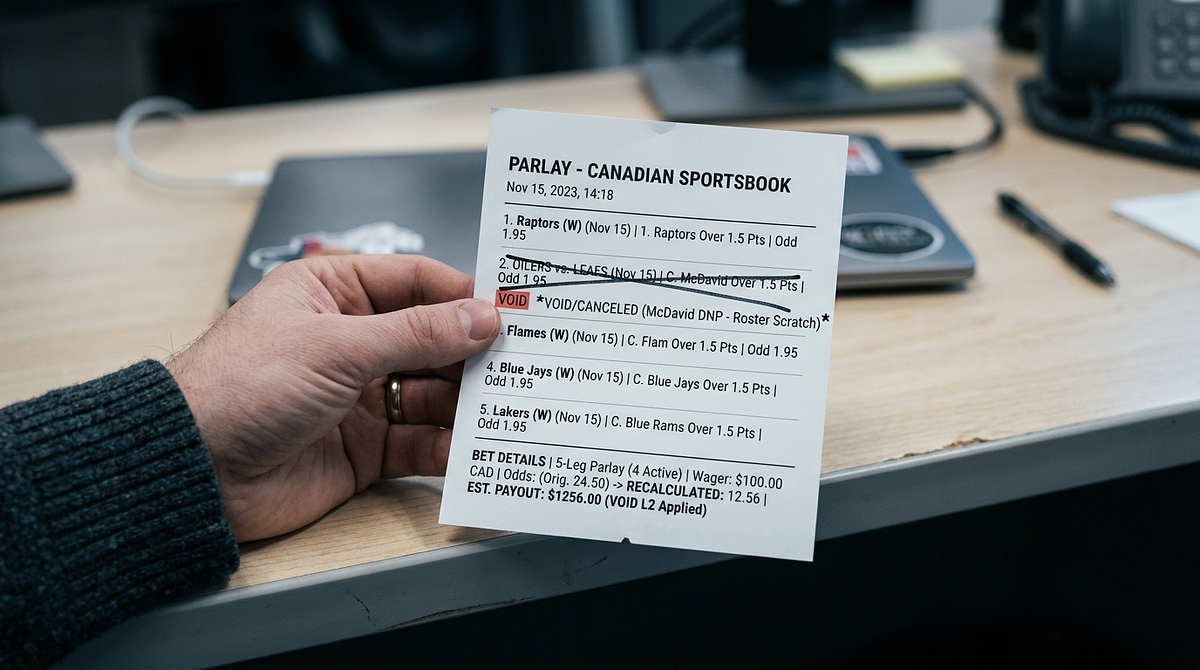
Canadian sportsbooks can void a winning parlay bet, and it happens more often than most bettors expect. Whether a void is allowed comes down to two things: provincial regulations and the operator’s own terms of service. This article explains when a void is permitted, how those two layers work together, and what happens to your bet when only one leg of a parlay is affected instead of the whole ticket.
The Direct Answer on Void Authority in the Canadian Market
Licensed sportsbooks in Canada can void a winning parlay, but they can’t do it whenever they feel like it. Voiding is only allowed under specific conditions, and those conditions come from two places: a regulatory layer set by provincial authorities and a contractual layer written into each operator’s terms of service. When a void happens, figuring out which layer drove the decision is the first step in knowing whether it was handled correctly.
The Regulatory Layer Behind Void Decisions
In Canada, provincial regulation sets the framework that licensed operators must follow when voiding or settling bets. Operators don’t get to ignore those requirements. The foundation for this framework came from federal legislation: Bill C-218, the Safe and Regulated Sports Betting Act, amended the Criminal Code to legalize single-event sports betting across Canada. The House of Commons passed it on 17 February 2021, and the Senate followed on 22 June 2021. The legislation gave each province and territory responsibility for setting its own rules and approving platforms within its jurisdiction. Ontario acted on that authority by launching its regulated online market on 4 April 2022 under iGaming Ontario, a subsidiary of the Alcohol and Gaming Commission of Ontario (AGCO). By the 2023-2024 annual report, iGaming Ontario had licensed 49 operators running more than 80 gaming sites. In practice, when an operator voids a bet, it’s often enforcing a rule it didn’t fully write. The outer boundary of what it must or must not do was drawn by the provincial regulator.
The Contractual Layer in Operator Terms of Service
On top of provincial rules, each licensed operator publishes terms of service that spell out how voiding works at the bet-slip level. Those terms cover what events trigger a void, whether the entire parlay is cancelled or just the affected leg is removed and the remaining odds are recalculated, and how those rules apply across different bet types. Provincial regulation sets the outer boundary of what operators can do; terms of service handle the day-to-day details within that boundary. When you get a void notice, this two-layer structure lets you figure out whether the void was driven by a regulatory requirement the operator had to follow or by a specific clause the operator wrote into its own rulebook. That distinction matters because it tells you where to direct any challenge.
Triggering Conditions That Cause a Void
Voids aren’t random. They’re triggered by specific events that fall into two broad categories: macro-level events affecting the game itself (like abandonment or circumstances that make the market impossible to settle), and micro-level events affecting a single participant (like a last-minute scratch, an in-game injury, or a failure to log meaningful playing time). Operational input errors form a third category, governed by a separate rule typically limited to a specific time window. Each category has different implications for how a parlay is adjusted.
Game-Level Triggers
Game-level triggers happen when the event itself can’t produce a settleable outcome. Abandoned games and other unforeseen circumstances that prevent a contest from reaching a resolvable conclusion are the main examples. When a game can’t be settled, the market built on that game can’t be settled either, so the bet is voided and the stake is returned. At least one operator’s published rules extend this to venue changes, stating that all bets are void if a scheduled venue changes after a wager is placed. A void tied to a game-level trigger is a market-integrity outcome. The operator isn’t making a judgment call against the bettor; it’s responding to the fact that there’s no settleable event.
Player-Level Triggers
Player-level triggers cover three situations: a player scratched from the lineup before the game begins, an in-game injury that prevents meaningful participation, and the edge case where a player is officially listed as active by the league but doesn’t log any snaps or meaningful playing time during the contest.
That third situation deserves attention because a league’s roster designation and an operator’s settlement rules measure different things. A league marks a player “active” based on its own roster rules; an operator’s terms of service may require actual participation as the condition for settling a player-prop market. Those two standards don’t always match. One documented case involved ESPN Bet voiding an entire winning parlay because a player held official active status but recorded no snaps. That settlement decision departed from the leg-only recalculation standard that other operators apply in the same situation.
The practical takeaway: the standard that governs any player-prop leg is the operator’s own settlement rule, not the league’s active designation. Reading the operator’s terms before placing a player-prop leg in a parlay is the only way to know which standard applies.
Operational Input Errors
Operational input errors are a separate category where the void originates on the operator’s side, not from an event outcome. This covers situations where the sportsbook entered incorrect odds, incorrect market parameters, or an incorrect selection on a bet slip. At least one Canadian operator’s published policy (Great Canadian Entertainment’s sportsbook FAQ) limits this type of void to the window before the patron leaves the betting counter, meaning the error must be caught and corrected before the transaction is complete.
That time boundary matters when you’re evaluating a claimed input-error void. If an operator uses an input-error rationale to void a bet that was already fully transacted and the patron had left the counter, that falls outside the stated scope of the published policy. You can compare the timing of the claimed error against the operator’s own stated window to check whether the void was applied within its permitted boundaries.
Whole-Parlay Void Versus Single-Leg Void and Recalculation
When a voiding event hits one leg of a parlay, what happens to the rest of the bet depends entirely on which rule the operator applies: remove the affected leg and recalculate, or void the entire bet. Single-leg voiding with recalculation is the more common industry standard, but it’s not universal. Same-game parlay products often follow a stricter whole-bet-void rule that’s stated explicitly in operator terms. When you get a settlement notice, you need to identify which rule was applied before deciding whether the settlement matched the operator’s published terms.
The Standard Industry Treatment
Across most operators and most parlay types, when one leg is voided, that leg is removed and the remaining legs’ combined odds are recalculated to settle the bet. The payout is based on the remaining legs’ odds only; the voided leg is treated as if it was never on the slip. Hard Rock’s published policy states this directly: parlays have the affected leg voided while the rest of the bet stands. A parlay doesn’t automatically die when one leg is scratched under this standard. So if you receive a recalculated payout rather than a full refund, that’s a legitimate settlement, not an arbitrary change to the original terms.
When the Whole Parlay Is Voided Instead
Two situations produce a whole-parlay void rather than a leg-only removal. The first is a same-game parlay product, where operator terms often state that a voided or pushed leg voids or pushes the entire bet. Caesars’ published rule states that if any leg of a same-game parlay is made void or settles as a push, the whole bet becomes a void or a push. The second is an operator-discretionary decision applied outside the same-game parlay context, where the operator’s interpretation of participation criteria, rather than a league roster designation, drives the settlement outcome.
| Dimension | Variant 1: Same-Game Parlay Void Rule | Variant 2: Operator-Discretionary Whole-Parlay Void |
|---|---|---|
| Triggering event | Any leg voided or settled as a push within a same-game parlay | Player officially listed as active by the league but failing to log snaps or meaningful participation |
| Scope of void | Entire same-game parlay bet is voided or pushed | Entire parlay voided, not just the affected leg |
| Where the rule lives | Operator terms of service for same-game parlay products | Operator’s interpretation of “officially active” versus actual participation in its settlement rules |
| Reader interpretation cue | Check whether the product is labelled as a same-game parlay. If so, any leg void kills the whole bet per stated terms. | Compare the operator’s settlement criterion (participation) against the league’s roster designation (active listing). A whole-parlay void here may fall outside the leg-only standard other operators apply. |
Asymmetry Between Winning and Losing Bets
After a void, most bettors want to know whether the operator would have applied the same rules if the bet had been losing. Published operator terms don’t include an explicit statement that voiding rules apply the same way regardless of outcome. What they do contain is trigger language written around events (a scratch, an abandonment, an input error) rather than around the projected value of the bet. With that framing in mind, you can open your operator’s terms of service and test the specific void you experienced against the framework described in this article.
What Terms of Service Actually Specify
Published terms from multiple operators describe voiding triggers in event-neutral language. The condition that activates a void is the status of the event or participant, not whether the affected bet is a winner or a loser. A scratched player, an abandoned game, or a venue change triggers a void because the event condition is met. The same clause applies whether the bet was heading toward a CAD 12 return or a CAD 1,200 return.
This gives you a direct test to apply to any void notice. If the reason stated in the notice matches a clause in the terms that describes an event-neutral trigger (participation failure, game abandonment, input error before the bettor leaves the window), the void is consistent with the published terms. If the stated reason doesn’t map to any such clause, or if the only apparent difference between the voided bet and comparable settled bets is that this one was a winner, the void falls outside what event-neutral language supports. At that point, the question shifts from a general sense of unfairness to a specific comparison between the operator’s stated trigger and the clause it would need to invoke.
Recourse When a Winning Bet Is Voided
When a sportsbook voids a winning parlay, you have three distinct escalation paths available, each suited to a different type of dispute. The right path depends on whether you’re disputing how the operator applied its own terms, whether the operator followed the rules set by the applicable provincial regulator, or whether you need to preserve evidence to support either of those challenges. These paths don’t overlap, and sending a complaint to the wrong channel will likely get you nowhere. A void is one outcome; a parlay insurance payout falling through because of one of these same trigger conditions is another, related headache.
Escalation Paths Available to Canadian Bettors
A dispute about how an operator applied its own terms to a specific bet (for example, whether it correctly identified a void trigger, or whether it voided the entire parlay when only a single leg should have been removed) belongs in the operator’s internal complaint process. A dispute about whether the operator’s conduct breached the licensing framework it operates under (for example, whether a void decision was fair, reasonable, and made in good faith as required under Ontario’s Registrar’s Standards) belongs with the applicable provincial regulator. A claim that the terms of service themselves are unfair sits in a different category and isn’t resolved through either of those channels alone.
- Operator internal review: The operator’s internal complaint process is the first stop when the dispute is about how the operator applied its own published terms to a specific bet. The AGCO notes that most igaming disputes can best be resolved by contacting the customer service department of the regulated site directly.
- Provincial regulator complaint: If the operator’s internal process doesn’t resolve the matter and the dispute is about whether the operator broke the rules it’s licensed under, you can file a complaint with the applicable provincial regulator. In Ontario, the AGCO accepts complaints through its iAGCO online portal. The regulator can issue penalties if it finds rules have been broken, though issuing a penalty doesn’t itself resolve the underlying dispute with the operator.
- Written record preservation: Before or alongside either of the above steps, keep bet-slip screenshots, settlement or void notices, and any correspondence with the operator. Any escalation, whether to the operator or to a provincial regulator, depends on documentary evidence that the void occurred and on what grounds it was communicated.
We check operator terms, licences and payment details against the casino's own pages and update this content when they change. Read our editorial policy, our transparency statement, or report an error. If gambling stops being fun, see our responsible gambling resources.