


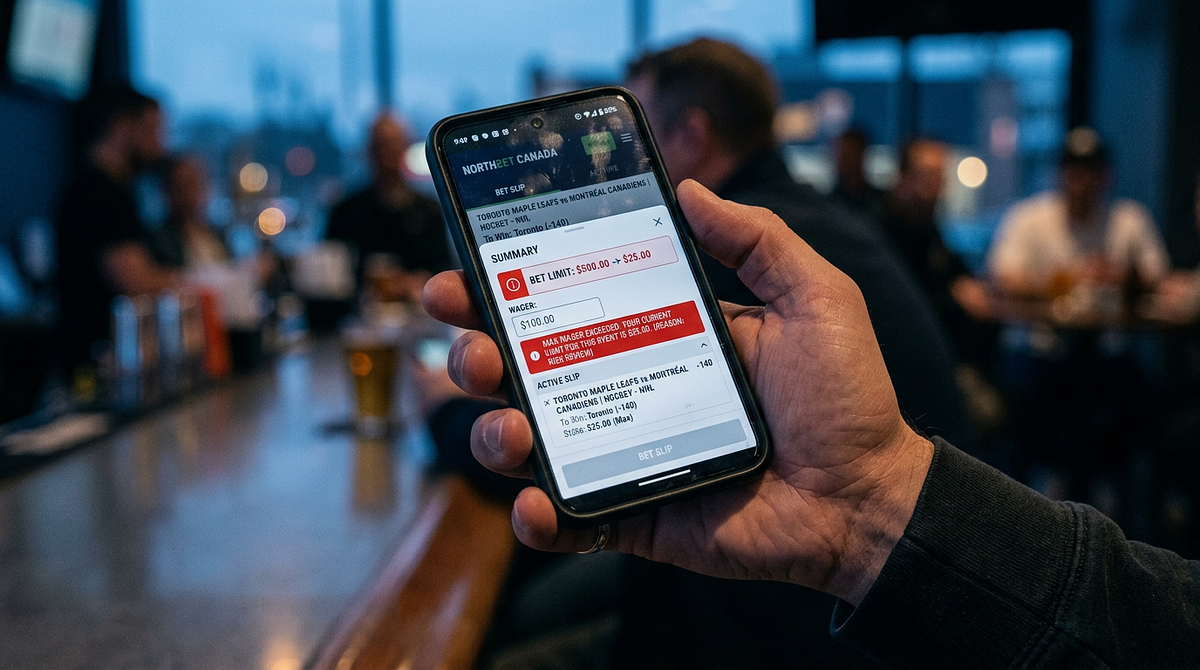
Canadian sportsbooks limit winning accounts because they’re commercial businesses built around a mathematical margin, and consistent winners eat into that margin. This article explains how that business model works, what betting patterns tend to trigger account restrictions, how limits are typically applied, and what Canada’s post-2021 regulatory framework says about the practice. By the end, you’ll have enough context to understand what’s happening if your stakes get reduced and to make smarter decisions about how you bet going forward.
The Sportsbook Business Model and Why It Sets the Rules
A regulated Canadian sportsbook is a private commercial business licensed under provincial authority. It’s not a public service that has to accept every bet on equal terms. Its profitability depends on a mathematical margin built into the odds it publishes, and that margin has to hold up across a large volume of bets to produce consistent revenue. Account limiting follows directly from that structure: when a bettor’s results threaten the margin the book relies on, restricting that account is a rational business response, not a punitive one.
The Vig as the Book’s Structural Edge
The vig (also called juice or margin) is the commission a sportsbook collects by pricing both sides of a market so the combined implied probabilities add up to more than 100%. On a standard two-sided market priced at -110 on each side, the book’s gross margin sits at roughly 4.54%. That fraction is the book’s entire structural advantage on a single wager.
The model works because it runs across a high volume of bets where the average bettor wins at roughly the rate the odds imply. When that holds, the book collects its margin reliably on every market it prices. A consistent winner breaks that condition. They’re extracting value at a rate the model wasn’t designed to handle. Account limiting isn’t a reaction to one big loss. It’s a defence of a thin margin that depends on bettors, in aggregate, performing no better than the odds predict. Any bettor who consistently beats that expectation falls outside the population the book’s revenue model was built around.
Where the Book’s Edge Is Weakest
The book’s confidence in its own pricing isn’t the same across all market types. Markets with heavy public volume and higher built-in margins give the book more room to absorb variance. Markets with thinner margins and more sharp bettors leave the book more exposed to informed action. That’s what drives selective limiting: the book applies tighter stake caps where its edge is thinnest and keeps full limits where its structural advantage is largest.
| Market Category | Book’s Perceived Edge | Typical Limiting Approach |
|---|---|---|
| Player props-style markets | Lower: thinner margins, more sharp participation, lines more susceptible to informed pricing | Reduced limits applied more readily; winning accounts face stake caps here first |
| Multi-leg combination markets (parlays) | Higher: compounding vig across legs increases the book’s aggregate margin significantly | Full stake capability more commonly retained; book is comfortable accepting size |
| Long-horizon outcome markets (futures) | Higher: wider spreads and longer settlement windows increase the book’s built-in margin | Full stake capability more commonly retained; book absorbs recreational and sharp action alike |
What Triggers a Sportsbook to Restrict an Account
Account monitoring across regulated Canadian operators is continuous and automated. Restriction decisions are driven by patterns that build up across multiple wagers, not any single bet. The systems in use build a behavioural profile over time, and it’s that profile that triggers a flag. The sections below cover the specific patterns those monitoring systems are designed to detect.
Beating the Closing Line Consistently
Closing line value (CLV) is the gap between the odds a bettor got at the time of placement and the final odds the market settled at just before the event started. When a bettor consistently gets prices that the market later corrects away from, it shows they’re finding mispriced lines before the book or the broader market does. That’s a direct signal of positive expected value over time.
CLV is a leading indicator, which means a book’s monitoring system can flag an account based on CLV even when that account is showing a net loss. Realised profit is a lagging measure. CLV reflects the quality of the decisions being made, regardless of short-run variance. An account that’s down on the month but consistently beating closing lines is, from the book’s perspective, a future liability rather than a current one.
One documented case shows how quickly pattern-based flagging can kick in: an account was restricted after roughly CAD $500 in net profit over about 60 bets across two weeks. The speed of that restriction reflects that the book’s system was responding to the CLV pattern in those bets, not simply to the dollar amount won.
Arbitrage and Cross-Book Betting Patterns
Arbitrage betting means placing offsetting wagers across two or more sportsbooks on the same event to lock in a guaranteed profit from a price gap between the books. Because the profit is mathematically certain regardless of the outcome, arbitrage bettors extract value from the book without any of the variance the book’s model depends on.
The mechanical signals a book’s system picks up include unusually precise stake sizing calibrated to a specific margin, wagers placed immediately after a line moves at a competing operator, and bets on obscure market sides at times inconsistent with typical recreational activity. A bettor who isn’t consciously arbitraging can still produce a pattern that looks identical to one who is. For example, a bettor who shops lines aggressively and acts quickly on value will generate similar timing and sizing signals. The book’s monitoring system doesn’t need to establish intent. The behavioural fingerprint alone is enough to trigger a restriction.
Correlated and Sharp Betting Patterns
Correlated betting patterns are clusters of wagers placed on outcomes that share an underlying causal factor. For instance, repeatedly backing the same team’s total points across multiple game formats where the same offensive conditions drive both results. Sharp patterns are behavioural tendencies that mirror known professional bettor activity: entering markets early before lines have been stress-tested by volume, targeting stale lines that haven’t yet adjusted to new information, or placing wagers in a way that’s consistent with coordinated action across multiple accounts.
A book’s monitoring system compares an account’s behaviour against historical profiles that correlate with negative expected value for the operator. When an account’s activity closely matches those profiles (on dimensions like market entry timing, stake consistency, and selection type) the system applies the “sharp” classification based on observable behaviour. A bettor doesn’t self-identify as sharp. The label is assigned by the book’s pattern-matching logic, and it carries direct consequences for stake limits regardless of whether the bettor thinks of their own approach as professional or recreational.
How Restrictions Are Applied in Practice
Account limiting in the regulated Canadian market is rarely a single event. The more common pattern is a gradual reduction of maximum stake exposure, applied over time and across selected markets rather than as an immediate blanket lockout. The two sections below explain how that progression unfolds week by week and why the same restriction rarely applies uniformly across every market type on the same account. Reduced stakes aren’t the endpoint for every sharp bettor, either. In some cases, a sportsbook will void the parlay outright rather than limit future action.
The Progressive Stake Reduction Pattern
Maximum stake reductions typically unfold over weeks rather than arriving as an immediate account closure. One documented case saw a bettor’s maximum wager drop from CAD $400 to CAD $25 within three weeks, and on some platforms restrictions can compress the ceiling further, to as little as CAD $5 per bet. Some operators do this through a stake factor mechanism, where a factor of 0.5 means the account can wager only up to half the operator-set maximum. That lets the book dial exposure down gradually rather than in a single step. An account showing early-stage restrictions isn’t necessarily at its floor. The phased pattern is a structural feature of how books manage exposure, not a binary on/off state.
- Early stage: Account operates at or near full limits while the book accumulates enough behavioural data to classify the account.
- Reduction stage: Maximum stake is cut, often through a stake factor adjustment, with the ceiling dropping progressively across subsequent weeks.
- Floor stage: The maximum reaches a nominal level. Documented cases show figures as low as CAD $5 per bet. At this point the account stays open but is effectively neutralised as a source of meaningful exposure for the bettor.
- Full lockout: In some cases the progression ends in a complete restriction, though this outcome is less common than an indefinite floor limit.
Selective Limits by Market Type
A restriction applied to one market type on an account doesn’t automatically extend to all markets. An account may keep its full stake capability on higher-margin markets (such as parlays or futures, where the book’s built-in edge is wider) while facing sharp reductions on markets where the book judges its pricing advantage to be thinnest, such as player props. This selective application is a diagnostic signal in itself. When a bettor sees that one category of market has been capped while another remains untouched, the book has effectively communicated where it thinks the account holds an edge over its lines. The distinction isn’t arbitrary. It reflects the book’s internal assessment of which markets are most exposed to informed action from that specific account. A bettor can face meaningfully different effective limits on the same platform depending solely on which market type they’re trying to access.
The Canadian Regulatory Context
Canada’s regulated sports betting market took shape in the early 2020s after federal legislation transferred authority over single-event wagering to the provinces and territories. Provincial regulators now licence and oversee operators within their jurisdictions, setting the conditions under which those operators can legally accept wagers from Canadian residents. The two subsections below cover the legal basis for that framework and the scope of discretion it gives to licensed operators regarding individual accounts.
The Legal Basis for Single-Event Wagering
Single-event sports betting in Canada was legalised through Bill C-218, which received Royal Assent on 30 June 2021 and came into force on 27 August 2021. The legislation amended paragraph 207(4)(b) of the Criminal Code, permitting provinces and territories to conduct and manage single-event betting on any sporting event. Ontario’s market operates under the oversight of the Alcohol and Gaming Commission of Ontario (AGCO), which requires licensed operators to meet standards for game integrity, player protection, and responsible gambling. The AGCO framework shows how provincial oversight works in practice: operators must satisfy a regulator’s conditions to keep their licence, but those operators remain private commercial entities, not public utilities. That distinction matters for bettors because the rights and expectations that apply to a public service don’t automatically extend to a commercial licence holder.
The Boundaries of Operator Discretion
Within the Canadian regulated framework, licensed sportsbooks are legally permitted to refuse service or restrict individual accounts. They are not obligated to accept every wager a customer places. That discretion is built into the commercial relationship between a private operator and its customers. Canadian coverage of the practice reflects two framings: some characterise account restriction as a legitimate business protection mechanism that lets operators manage exposure to unprofitable customers, while others (including coverage by the CBC) frame it as a consumer fairness concern resembling a system tilted against winning bettors. Both framings appear in the public record. For bettors, recognising that restriction is legally permitted reframes what recourse realistically exists. The avenue isn’t a legal challenge to the practice itself but an understanding of what triggers it. The regulatory gap between licensed and unlicensed providers is illustrated by enforcement action in Manitoba, where the Canadian Lottery Coalition obtained a court ruling in January 2025 prohibiting offshore operator Bodog from offering or advertising online gambling in the province. That outcome was only possible because the licensed market exists as a defined legal category.
Behavioural Patterns That Extend Account Lifespan
Restriction is triggered by pattern recognition, so the behaviours that delay it are those that produce a profile less distinguishable from a recreational bettor. The book’s monitoring systems don’t evaluate individual wagers in isolation. They build a cumulative behavioural profile across an account’s full history. An account whose aggregate behaviour looks like a recreational bettor’s profile is harder for those systems to classify as a sharp, and that classification is what starts the restriction sequence. The behaviours that delay pattern recognition are those that introduce noise into the dimensions the system reads most closely.
Behavioural Signatures the Book Reads
The book’s monitoring systems build a profile of each account across several dimensions at once: how consistently stakes are sized, when bets are placed relative to when a market opens, which markets an account selects, and whether those selections look recreational or professional. Two accounts placing an identical wager on the same line can receive different treatment because the surrounding behavioural context (the account’s full profile across all those dimensions) differs between them. A bet placed by an account that otherwise shows varied stakes, mixed market selection, and no systematic early-market timing reads differently to the system than the same bet placed by an account whose profile is uniformly sharp across every dimension.
- Stake-size variation: Accounts that vary their stake amounts produce a less consistent sizing signature. That contrasts with the precise, repeatable stake sizing that the book’s systems associate with arbitrage and professional betting patterns.
- Timing relative to market open: Betting immediately at or after market open is a signal the book reads as sharp behaviour, because professional bettors exploit stale opening lines before the market corrects. Accounts that avoid this timing pattern produce a profile less consistent with that signal.
- Market mix: Accounts that place wagers across recreational markets alongside sharper plays present a mixed selection profile. A profile concentrated exclusively in markets where sharp bettors operate (such as early-week NFL spreads or specific player props) is more legible to the system as professional in character.
- Recreational-versus-sharp character of selections: The book’s systems compare account behaviour against profiles that historically correlate with negative expected value for the book. Selections that mirror known professional tendencies, such as early market entry or exploitation of stale lines, contribute to a sharp classification. Selections that don’t share those tendencies dilute that signal.
We check operator terms, licences and payment details against the casino's own pages and update this content when they change. Read our editorial policy, our transparency statement, or report an error. If gambling stops being fun, see our responsible gambling resources.