

This page explains how Interac casino deposits work in Canada, covering two routes that move money directly from your bank account to your casino account through Canada’s domestic payment network. Knowing how each route works, and where the handoffs between the bank, the network, and the casino happen, makes it easier to understand timing, read deposit and withdrawal limits correctly, and know what to expect at each stage. By the end, you’ll be able to tell which route your deposit method uses and what that means for your experience from funding through to withdrawal.
At its core, an Interac casino deposit is a mechanics question: money moves from a bank account to a casino account through a domestic payment network that runs two deposit routes. Which route is in play, and where each handoff between the bank, the network, and the casino occurs, affects how you read timing signals, interpret limits, and understand what happens at withdrawal.
The Two Interac Deposit Variants Available at Canadian Casino Cashiers
Canadian casino cashiers offer two deposit routes. Both run on the same domestic payment network, both pull money directly from your bank account, and neither exposes your banking credentials to the casino. Where they differ is in how you authenticate and in which direction the money moves between your bank and the casino. You need to understand this difference before the deposit steps, timing, and withdrawal path covered in the rest of this article will make sense.
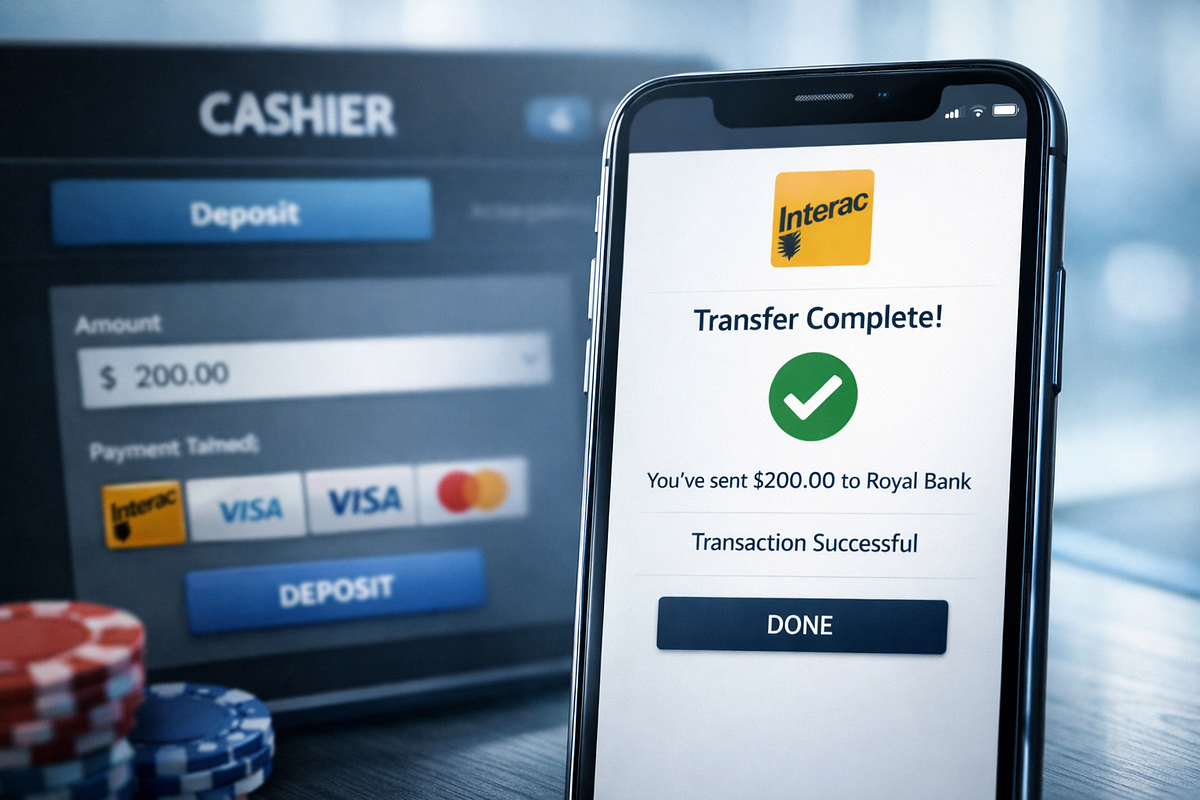
With the push-based route, you initiate the transfer yourself. The casino gives you a recipient email address and a reference code, and you log into your own online banking to authorize and send the funds. The Interac network routes the payment notification to the casino, which then credits your account. Because you’re sending from inside your own bank’s authenticated environment, the casino never touches your banking credentials.
This matters when a deposit seems stuck. The delay almost always sits between your bank sending the funds and the casino receiving the network notification, not inside the casino’s own system. Knowing which handoff is involved tells you whether to follow up with your bank or with the casino’s support team. The push-based route also works for withdrawals, so the same path that funds a deposit can route a payout back to you.
The pull-based redirect route works differently. The casino redirects you to your bank’s online portal, you authenticate once inside that portal, and the funds move back to the casino in a single confirmed transaction. Unlike the push-based route, where you independently log in and send money, the redirect keeps the transaction inside one continuous session from start to finish.
The redirect route is deposit-only. It doesn’t support withdrawals, so the deposit and withdrawal paths aren’t symmetrical when you use this method. If you deposit via the redirect route, any payout will come through the push-based e-Transfer route or a separate payout product. Knowing this in advance prevents the wrong assumption that your withdrawal will mirror your deposit method. The redirect route also doesn’t require an email address or reference code from the casino, because the fund movement is triggered by the redirect rather than by you sending a transfer.
The table below compares both routes across the same dimensions, so you can see the differences in authentication, fund movement, and withdrawal support at a glance.
| Dimension | Variant 1 (Push-Based Transfer) | Variant 2 (Pull-Based Redirect) |
|---|---|---|
| Authentication location | Player’s own online banking portal | Bank portal via casino redirect |
| Direction of fund movement | Player pushes funds to casino | Casino pulls funds from player’s bank |
| Typical processing speed | Typically instant | Typically instant |
| Supports withdrawals | Yes | No |
| Requires email/reference code | Yes | No |
The End-to-End Deposit Flow from Cashier to Credited Balance
An Interac deposit follows a fixed sequence of handoffs between four parties: the casino cashier, you, your bank, and the Interac network. Each handoff has a clear start and end point, and the steps can’t be reordered because each one depends on the previous one completing successfully. Knowing where each handoff sits tells you who’s responsible when a deposit stalls or fails. A delay at the bank authentication step points to a different fix than a delay at the casino’s end.
Each step in the sequence produces a distinct change in state. Your deposit isn’t just “in progress” in some vague sense; it’s at a specific, identifiable point in the chain. If your bank confirms the transfer was sent, that means the handoff to the Interac network has happened, even if your casino balance hasn’t updated yet. Knowing which step has completed and which hasn’t tells you whether to wait, refresh, or contact someone.
- Select the payment method in the cashier, Open the casino’s deposit tab and choose either Interac e-Transfer or Interac Online. This choice sets the authentication path and direction of fund movement for the rest of the sequence.
- Enter the deposit amount and confirm cashier details, Enter the CAD amount and review the method-specific details: a recipient email address and reference code for e-Transfer, or a redirect prompt for Interac Online.
- Authenticate at the bank side, For e-Transfer, log into your own online banking and authorize the send. For Interac Online, the casino redirects you directly to your bank’s portal, where authentication completes within that single session.
- Confirm the transfer and receive the network notification, You confirm the transaction, and the Interac network sends a payment notification to the casino, signaling that the funds have been authorized and are on their way.
- Casino credits the account, The casino receives the network notification and adds the deposit to your account balance. The deposit is complete at this point.
Interac deposits are typically instant, meaning your balance updates within minutes of confirming the transfer at the bank. The Interac network itself isn’t the source of delays. The small window of variability sits at one of three specific handoff points.
- Network notification routing, The signal from the Interac network to the casino can carry a brief lag. This doesn’t mean the deposit failed.
- Bank-side processing, Your bank processes the authorization before the notification leaves its environment. This is usually immediate but can vary by institution.
- Casino ingestion, The casino’s system has to receive and process the incoming notification before your balance updates. Most operators do this within minutes.
If your bank’s interface confirms the transfer was sent, the deposit has cleared the bank-side handoff and is moving normally through the network. A genuine failure that doesn’t resolve within the expected window can then be directed to the right party: your bank if the transfer was never authorized, or the casino’s support team if the notification was received but your balance wasn’t updated.
Deposit Limits Set by the Banking Side
The real ceiling on any Interac deposit is set by your bank, not the casino. The casino’s posted deposit maximum is a second constraint that only matters when it falls below your bank’s own limit. When the two conflict, the bank’s limit wins. If you treat the casino’s stated maximum as the binding figure, you’ll misread why a large deposit fails.
Daily transfer ceilings are risk controls set by your bank and applied to all outgoing transfers from your personal account. They’re not casino-specific rules, and the Interac network doesn’t set them. Interac sets a network-level maximum of up to C$25,000 per transfer, but individual banks apply their own, typically lower, ceilings to personal accounts before any casino limit comes into play.
For personal accounts at major Canadian banks, daily sending limits commonly run between C$2,000 and C$3,000. Tangerine, for example, publishes a daily sending limit of C$3,000. Some Ontario-facing casino operators accept per-transaction amounts up to C$10,000, but that casino-side threshold is only reachable if your bank’s ceiling allows a transfer that large.
If you try to deposit above your bank’s daily ceiling, the transfer will fail or you’ll need to split it across multiple days. That failure comes from the bank, not the casino cashier. The right fix is to contact your bank to request a temporary or permanent limit increase, not to ask the casino to raise its posted maximum, which has no effect on your bank’s limit.
Minimum deposit thresholds are set by the casino operator, not the Interac network. Typical minimums start at C$10, and some operators accept deposits as low as C$1 or C$5. These figures vary by operator, so the minimum is something to confirm at each cashier rather than a fixed feature of the payment network.
The minimum threshold also interacts with promotional conditions. A deposit that meets the operator’s stated minimum may still fall short of what’s needed to trigger a welcome bonus or reload offer. The figure to check is the promotional qualifying amount in the operator’s bonus terms, which is often higher than the deposit minimum.
Fee Structure at Each Layer of the Flow
Fees on an Interac casino deposit can come from two places: your bank and the casino operator. Because these two layers operate independently, a deduction can come from either side without the other being involved. Knowing which layer is responsible for a given charge lets you read an unexpected deduction correctly and ask the right party about it.
Whether your bank charges for sending an Interac e-Transfer depends on your specific account type, not on the Interac network. The network passes a small infrastructure cost to banks (C$0.04 for transfers between accounts at the same institution and C$0.08 for transfers between different institutions), but banks absorb that cost and it doesn’t show up as a line item for personal account holders. What does vary is whether your bank passes its own per-send fee on to you.
| Institution Category | Fee per Send on Basic Account | Fee on Modern/Unlimited Accounts |
|---|---|---|
| TD Bank | C$0.50 (amounts up to C$100); C$1.00 (amounts over C$100) | C$0 on All-Inclusive and Unlimited Chequing accounts |
| RBC | C$0 up to 999 transactions per month; C$1.00 per transaction beyond 999 | C$0 (free and unlimited on all RBC personal chequing accounts within the 999-transaction threshold) |
| CIBC | C$1.50 per send or request | C$0 on CIBC Smart Accounts, Everyday Chequing Account, Smart Start enrolment, and for clients aged 65 and older on any CIBC chequing account |
| Tangerine | C$0 (no per-send fee on Chequing Account) | C$0 (no per-send fee) |
| Simplii Financial | C$0 (no per-send fee on standard sends) | C$0 (no per-send fee) |
Canadian casino operators consistently absorb the cost of processing Interac deposits, so the deposit fee at the casino layer is C$0 across the market. Withdrawals don’t follow the same pattern uniformly: where operators do charge, withdrawal fees range from C$0 to C$4 depending on the operator.
This gap between deposit and withdrawal fees is where most misattributed deductions come from. If you’ve never paid a fee on a deposit, you might assume the same applies to payouts. When you see a small amount withheld from a withdrawal, it’s more likely coming from the casino side than the bank. Check the operator’s cashier terms to confirm the withdrawal fee, not your bank’s fee schedule, because the two layers set their charges independently and what the casino does on deposits tells you nothing about what it does on withdrawals.
The Withdrawal Flow and How It Mirrors, Or Diverges From, the Deposit Path
Withdrawals from a Canadian online casino account go through the push-based Interac e-Transfer route only. The pull-based redirect route (Interac Online) is deposit-only and plays no part in payouts. Some operators also offer a separate direct-payout product called Interac eCashout, which routes funds straight to your bank account without generating an emailed transfer notification. The two payout mechanisms feel different at the receiving end, but both run on the same domestic payment network.
Your first withdrawal triggers a mandatory identity verification step, commonly called Know Your Customer (KYC), under Canadian regulatory requirements for casino disbursement reporting. This typically adds one to three business days to your first payout. It’s a one-time requirement, not a recurring one. Once your account is fully verified, subsequent withdrawals don’t repeat this delay.
Withdrawals in the C$3,000 to C$5,000 range may trigger an additional anti-money-laundering review under FINTRAC-aligned compliance obligations, which can extend processing time beyond the standard KYC window. This review applies to the specific transaction that crosses the threshold, not to your account permanently.
A slow first payout is almost always the KYC step, not a sign of a systemic operator problem. Once verification is done, subsequent payouts reflect the operator’s standard processing time. Ontario and Alberta are the only fully regulated commercial online casino markets in Canada as of the current data, with Alberta in the process of building a comparable framework. KYC requirements apply within those regulated environments and are consistent with national disbursement reporting standards.
Once identity verification is complete, casino-side processing for withdrawals typically runs 24 to 48 hours at most operators. Some operators extend that window to up to five business days (BetMGM is one example cited in operator-level data), making payout speed a function of operator policy rather than network capacity.
The Interac network itself is fast. The payment rails don’t introduce meaningful delay once the casino releases the funds. Any wait beyond the network’s near-instant transfer time sits entirely in the operator’s internal queue and review process. When you compare payout speeds across operators, you’re comparing operator processing policies, not the performance of the payment method itself.
Two opt-in features change what you experience when a payout arrives. The first is Autodeposit, a bank-side setting that removes the need to manually accept an incoming e-Transfer notification. Funds deposit to your registered account automatically without any action from you. The second is Interac eCashout, an operator-side product available at some casinos that routes the payout directly to your bank account without generating an email transfer at all.
These are separate products with different points of control. Autodeposit is configured inside your own banking app. eCashout is offered or withheld at the operator’s discretion. If you haven’t enrolled in Autodeposit and your operator doesn’t offer eCashout, you’ll receive an email notification requiring manual acceptance. If your operator uses eCashout, you’ll receive no email, which is the expected behavior of that product, not an error in the payout process.
Security Model and Bonus Eligibility Considerations
The Interac network is built so that your banking credentials stay inside your bank’s environment at every point in the deposit flow. The casino’s servers never handle them. Funds travel across encrypted banking rails that operate separately from the casino’s infrastructure. Interac deposits are consistently included in bonus-eligible deposit methods at Canadian-facing operators, while certain e-wallet families are routinely excluded from those same promotional terms.
When a deposit completes, only the payment notification and reference data pass between the casino and the Interac network. Your actual banking credentials, including login details, passwords, and account authentication, stay inside your bank’s authenticated environment throughout the transaction and are never sent to the casino’s servers.
Funds move across encrypted banking rails that are separate from the casino’s infrastructure. The casino receives a network notification confirming the transfer. It does not receive or store the credentials you used to authorize it.
This means the right security question on the deposit side is not whether the casino handles your banking credentials (it doesn’t). The right question on the withdrawal side is whether the casino handles your personal identifying data for payout verification (it does, as part of the identity verification process required before funds are released). Keeping these two data categories separate prevents you from either overstating the deposit-side risk or overlooking the account-verification data the operator does hold.
Promotional terms at Canadian-facing casino operators consistently list Interac among the eligible deposit methods for welcome offers and ongoing promotions. Certain e-wallet families appear on exclusion lists in those same terms, meaning a player who deposits through an excluded method loses the associated offer even if every other qualifying condition is met.
This reflects operator-level term-setting rather than any guarantee built into the Interac network itself. Read the eligible-method clause in each operator’s promotional terms before depositing, because individual operators can adjust their lists. In practice, Interac appears on the eligible side of that clause across the broad range of Canadian-facing operators, making it a reliable default assumption, but one that still warrants per-operator confirmation before you make a qualifying deposit.
Written by Arthur Crowson · Published August 8, 2026 · Last updated October 7, 2026
We check operator terms, licences and payment details against the casino's own pages and update this content when they change. Read our editorial policy, our transparency statement, or report an error. If gambling stops being fun, see our responsible gambling resources.