

Checking whether a casino payment page is secure comes down to a small set of signals you can see in your browser and verify through public records. Some signals confirm that data passing between your device and the site is encrypted. Others confirm that the operator is accountable to a real regulatory authority. This article covers both: what to look for, where to find it, and which patterns mean a page isn’t safe for entering financial details.
Encryption Signals in the Browser Address Bar
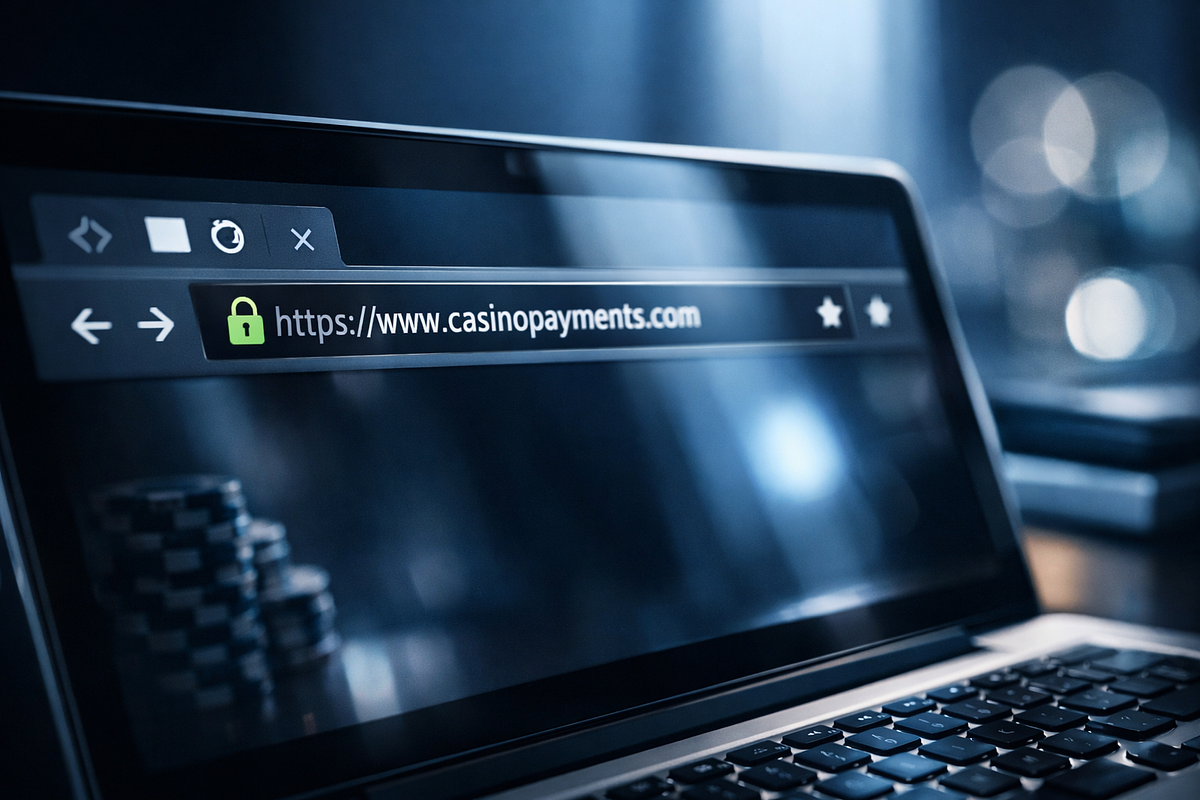
Encryption encodes data as it travels between your device and a casino’s servers, so anyone who intercepts it can’t read it. The browser address bar is the first place to check before you type in any financial information. Two signals appear there when encryption is active, and both need to be present at the same time. If either one is missing, the page isn’t safe to use, no matter how polished the site looks.
The encrypted protocol prefix at the start of the URL and the closed padlock icon next to it are the two visible signals that confirm the connection is encrypted. Both need to be there, not just one. The prefix tells you which protocol the site is using; the padlock confirms your browser successfully established an encrypted connection under that protocol. When both are present, data you send is encoded and can’t be read by a third party who intercepts it. If either signal is missing, or if a warning icon has replaced the padlock, don’t submit financial data on that page.
- Protocol prefix: Confirm the URL starts with the encrypted prefix, not the unencrypted alternative.
- Padlock state: Confirm the padlock icon is closed, not open, broken, or replaced by a warning symbol.
- No browser warning: Confirm the browser hasn’t displayed a security warning or “Not Secure” label for the page.
- Consistent URL: Confirm the address shown matches the casino’s known domain and hasn’t changed to an unfamiliar domain on the payment page.
Clicking the padlock shows you the certificate details underneath. This lets you verify not just that encryption is present, but that it was issued to the entity actually running the site. The certificate view shows the issuing Certificate Authority, the validity period, and the name of the entity the certificate was issued to. Certificates have a defined lifespan. DigiCert, for example, caps newly issued public TLS certificates at 199 days from February 2026 onward. An expired certificate is a direct security risk, regardless of how credible the site otherwise looks. A valid padlock is a starting point, not a final answer. The certificate’s issuer, validity dates, and named holder are what tell you whether the encryption actually means something.
| Dimension | Standard Certificate (Domain Validation) | Highest-Assurance Certificate (Extended Validation) |
|---|---|---|
| Verification depth | Confirms domain control only | Confirms identity, legal status, business registration, and physical address |
| Information displayed to user | Padlock and HTTPS; no operator identity shown | Padlock and HTTPS; operator’s verified legal name accessible via certificate details |
| Trust signal for payment pages | Floor-level signal; confirms encrypted channel but not operator identity | Confirms both encrypted channel and that the named operator has been identity-verified |
Regulatory Licensing and Where to Confirm It
A valid operating license from a recognized gambling regulator is the second major safety signal to check on a casino payment page, alongside encryption. Unlike encryption, which protects data in transit, a license binds the operator to enforceable rules covering player fund segregation, game fairness, and data protection. Legitimate operators display their license information in the website footer, which is where you should start. Each disclosure should include a license number and the issuing regulator’s logo, and both can be verified against the regulator’s public database.
Not all licenses carry equal weight. Recognized regulators hold operators to real standards, and their presence on a site means the operator has agreed to be accountable under an enforceable legal framework. A legitimate license disclosure includes both a license number and the regulator’s logo. You can cross-reference the license number against the regulator’s public database to confirm it’s currently active and issued to the operator named on the site. That shifts the question from whether a site looks professional to whether the operator is on record with an authority that can impose sanctions, suspend operations, or revoke the license entirely.
| Regulatory Authority | Jurisdiction | Verification Method |
|---|---|---|
| Malta Gaming Authority (MGA) | Malta (EU) | Public Licensee Register at mga.org.mt, searchable by licensee name, authorisation status, URL, or gaming service |
| UK Gambling Commission (UKGC) | Great Britain | Register of gambling businesses at gamblingcommission.gov.uk/public-register/businesses, searchable by business name, trading name, or domain name; returns licence status, account name, and regulatory actions |
| Gibraltar Regulatory Authority | Gibraltar | Public register lookup via the Gibraltar Regulatory Authority’s official site |
A logo or license number in a footer is a claim, not a confirmation. To actually verify it, enter the license number into the issuing regulator’s public register and check that the operator name on the site matches the licensed entity on record. The regulator’s database shows the current status of the license: active, suspended, or revoked, along with the legal name of the licensed entity. A footer logo with no matching active entry in the regulator’s register is a stronger warning sign than no logo at all, because it points to a deliberate attempt to appear licensed rather than a simple omission.
- License number: Confirm the number displayed in the footer appears in the regulator’s register and is not expired, revoked, or suspended.
- Operator name: Confirm the legal entity name returned by the register matches the operator name presented on the casino site.
- License status: Confirm the status field shows the license as currently active, not lapsed, surrendered, forfeited, or pending.
- Regulatory actions: Check whether the register entry includes any recorded sanctions, settlements, or enforcement actions against the operator.
Recognized Payment Methods and Independent Security Layers
The payment methods shown on a casino’s cashier page carry their own security significance, separate from the site’s encryption. Recognized providers apply their own fraud-detection and encryption controls to every transaction they process, creating a layer of protection that runs independently from the casino’s own systems. Their willingness to be listed on a cashier page also means the operator has passed those providers’ own onboarding and due-diligence checks. A compliance standard governs how card data is stored, processed, and transmitted on any legitimate payment page, and independent certification bodies audit platform integrity at the operator level.
The types of payment providers that appear on a legitimate casino cashier, including major card networks, established e-wallets, and regulated bank-transfer intermediaries, each apply independent security controls to transactions. That adds a second layer of protection the casino operator doesn’t control or configure. Each category also vets the operators it works with before allowing its brand to appear on their cashier pages, so their presence tells you the operator has passed a third-party check from an institution you can independently recognize.
The mix of accepted payment methods is itself a legitimacy signal. A cashier that only offers untraceable or obscure payment routes removes the chargeback protection that recognized providers guarantee and eliminates the transaction traceability that regulated channels require. That absence is a warning, not a convenience feature.
| Provider Category | Independent Security Layer | Trust Signal for the Reader |
|---|---|---|
| Major card networks (e.g., Visa) | Fraud detection, chargeback rights, network-level encryption | Operator has passed card network merchant onboarding requirements |
| Established e-wallets (e.g., PayPal, Skrill, Neteller) | Account-level fraud monitoring, buyer protection, independent encryption | Operator has passed e-wallet provider’s merchant verification checks |
| Regulated bank-transfer intermediaries | Regulatory oversight of fund flows, transaction traceability | Operator operates within a traceable, regulated payment channel |
Legitimate operators follow the Payment Card Industry Data Security Standard (PCI DSS), the compliance framework that defines how card data must be stored, processed, and transmitted. The current version, PCI DSS v4.0, was published on 31 March 2022 by the PCI Security Standards Council and requires specific technical controls including data encryption at rest, network segmentation, and access controls. Some casinos also carry certifications from independent iGaming certification bodies. eCOGRA, for example, issues its eGAP seal to operators that meet ongoing player-safety and operational standards, and is authorized to provide accredited ISO/IEC 27001 certifications in certain jurisdictions. PCI DSS compliance disclosures and certification seals like the eCOGRA eGAP seal are typically shown alongside the license in the site footer, so your inspection doesn’t stop at the browser address bar. The footer is where you can spot operator-level compliance claims and check them against the issuing body’s public records.
Red Flags That Indicate an Unsafe or Fraudulent Payment Page
Some warning signs don’t just mean a protection is missing. They actively signal that the page is operating outside the boundaries of a legitimate, licensed platform. Attacks on gambling platforms rose 37% year-over-year as of 2025, with API endpoints targeting payment systems among the documented vectors. That means a suspicious pattern on a payment page is more likely to be a deliberate exploit than an oversight. The red flags below aren’t things to weigh against reassuring signals elsewhere on the site. Any one of them is enough reason to abandon the transaction.
Some patterns on a payment page aren’t ambiguous. They point directly to an insecure, unlicensed, or fraudulent operation, and the right response to any one of them is to close the page without submitting financial details. Requests for payment to personal accounts take the transaction outside the operator’s own accounting systems and strip away any fraud protection a regulated payment provider would otherwise apply. A cashier that only accepts untraceable payment routes eliminates the chargeback protection that card networks and regulated e-wallets provide. Hidden or unexplained fees signal the absence of the disclosure discipline that licensing bodies require of legitimate operators. Licensed casinos are required to present payment terms transparently as a condition of their authorization. Together, these patterns suggest the operator either can’t meet the onboarding requirements of regulated payment providers or is deliberately avoiding the accountability those providers impose.
- No HTTPS prefix or missing/warning padlock icon: The transport layer is unencrypted, meaning any financial data you submit is readable to third parties in transit.
- Payment directed to a personal account: Bypasses the operator’s accounting controls and removes all provider-level fraud protection from the transaction.
- Only untraceable payment methods accepted: Eliminates chargeback rights and makes fund recovery impossible if the transaction is disputed.
- No recognizable payment gateways on the cashier page: Indicates the operator hasn’t passed the merchant onboarding checks that established card networks and e-wallet providers require.
- Hidden or unexplained fees: Contradicts the transparent disclosure requirements imposed on operators by recognized licensing authorities.
- Regulatory logo in the footer with no matching active entry in the regulator’s public register: A deliberate misrepresentation of licensed status, which is a stronger warning than no logo at all because it implies intentional deception.
- Expired SSL certificate: Signals that the operator isn’t maintaining the minimum technical upkeep required to protect payment data, regardless of how professional the surrounding page looks.
Player-Side Practices That Complement Page-Level Checks
A payment page that passes every browser-level and regulatory check can still be the entry point for financial loss if your account credentials have been compromised or you’re on an untrusted network. Payment page verification addresses the operator’s side of the transaction. It doesn’t secure the connection from your end. Security here follows a shared-responsibility model: the operator controls the server environment, and you control the account and the network. The practices below close the gap that page-level checks can’t reach.
Your account credentials and the network you connect from are two attack surfaces that no amount of server-side encryption or regulatory licensing can protect on your behalf. Multi-factor authentication blocks credential-reuse attacks by requiring a second verification step even when a password has been exposed in an unrelated breach. Unique passwords stop a compromise on one platform from cascading into access on another. Transacting only over trusted, private networks removes the possibility of a man-in-the-middle interception that would otherwise sit between your device and an otherwise secure server.
- Enable two-factor authentication (2FA): Activate 2FA on the casino account so that a stolen or leaked password alone isn’t enough for an attacker to get in.
- Use a unique password for each gambling account: A password used exclusively for one account can’t be used in a breach-chain attack originating from a different compromised service.
- Avoid public or untrusted Wi-Fi when transacting: Making deposits or withdrawals over an unverified network exposes the session to man-in-the-middle interception regardless of the page’s own encryption status.
- Keep device software and browsers updated: Current software closes known vulnerabilities that attackers use to intercept or manipulate data at the device level before it reaches an encrypted channel.
Verifying a Payment Page Before Your Next Deposit
Payment page security isn’t about gut feeling or how professional a site looks. It’s about verifiable evidence available in your browser and in public regulatory records before you enter any financial data. Once you know what each signal confirms and what its absence means, you have a solid basis for judgment that doesn’t depend on appearances. Apply that same verification habit to every new cashier page you encounter.
Written by Arthur Crowson · Published August 10, 2026 · Last updated October 7, 2026
We check operator terms, licences and payment details against the casino's own pages and update this content when they change. Read our editorial policy, our transparency statement, or report an error. If gambling stops being fun, see our responsible gambling resources.