

Casino identity verification in Canada is governed by federal anti-money-laundering law, not by individual operator policy. When a Canadian casino asks for documents at account opening, at withdrawal, or after a large transaction, that request reflects a legal obligation tied to specific dollar thresholds and reporting rules. This page explains what KYC and AML mean, how they differ, and how both connect to player protection. By the end, you’ll know what triggers a verification request, which documents typically satisfy it, and what the process is designed to prevent.
The Canadian Regulatory Framework Behind Casino Identity Checks
Canadian casino identity verification is grounded in federal law, not operator policy. One statute anchors the framework and applies uniformly across the country. It sets out what casinos must do and names the national body responsible for enforcing it. Casinos are explicitly listed as reporting entities under this law, which means their verification requests are legal requirements, not business choices. The two concepts introduced here, the federal law and the enforcement body, form the foundation on which all verification requirements rest.
Why the Federal AML Statute Exists and What It Requires of Casinos
The Proceeds of Crime (Money Laundering) and Terrorist Financing Act, commonly called the PCMLTFA, is the federal law that governs anti-money-laundering obligations in Canada. Parliament passed it in 2000, and it also created the national financial intelligence body that oversees compliance. The Act lists casinos and gaming establishments as reporting entities, which comes with three core obligations: reporting suspicious transactions to the regulator regardless of amount, reporting large cash transactions of CAD $10,000 or more, and reporting electronic funds transfers of CAD $10,000 or more.
When you know these obligations come from statute rather than operator preference, a verification request from a licensed casino makes more sense. The casino isn’t asking for your documents because it wants to. It’s fulfilling a legal duty set by Parliament. The PCMLTFA prohibits casinos from opening an account for anyone whose identity can’t be verified under the regulations, and it prohibits paying out funds before that verification is done. A verification request is a condition of lawful operation.
The Role of the National Financial Intelligence Regulator
The Financial Transactions and Reports Analysis Centre of Canada, known as FINTRAC, was created under the PCMLTFA in 2000 as Canada’s dedicated AML supervisor. It publishes compliance guidance, examines reporting entities to check whether they’re following the law, and can issue financial penalties to those that aren’t. Since June 2019, FINTRAC has been required to publicly name every person or entity that receives such a penalty, which keeps accountability visible across regulated sectors.
FINTRAC actively supervises the casino sector. In December 2019, it published an alert identifying money laundering patterns observed in casino-related underground banking schemes, drawing on disclosures FINTRAC had sent to law enforcement. That alert shows the regulator watches casino-specific activity and issues targeted guidance for the sector. Because all licensed Canadian operators are subject to the same FINTRAC examination standards and guidance, the verification process you encounter at one licensed casino will be structurally consistent with what you’d find at another.
KYC and AML, Two Terms, One Compliance Framework
KYC and AML come up together so often in casino compliance discussions that people treat them as the same thing. They’re related, but they’re not the same. KYC is part of AML, not a synonym for it. AML is the overarching legal regime. KYC is the identity-verification piece within it. Keeping that distinction clear helps you understand what a casino is doing when it asks for documents or puts a hold on your account.
What KYC Covers and What AML Covers
KYC refers specifically to confirming who a customer is. Under the PCMLTFA framework administered by FINTRAC, this means verifying a person’s identity at account opening and again when certain transactions or trigger events occur. When a casino asks for a passport scan or a utility bill, that’s KYC.
AML is the broader regime that contains KYC but goes beyond it. It includes ongoing transaction monitoring after an account is open, the obligation to file reports on suspicious transactions and large cash receipts, continuous customer due diligence as account behaviour changes, and the enforcement powers FINTRAC holds over reporting entities. A document request is a KYC event. An account review, a payment hold, or a suspicious transaction report is an AML event that may have nothing to do with whether identity was ever in question.
The table below maps each term across four dimensions so the distinction is clear before the article covers thresholds and verification methods.
| Dimension | KYC | AML |
|---|---|---|
| Primary function | Confirm the identity of a customer | Detect, deter, and report money laundering and terrorist financing |
| When it applies | At account opening and at defined trigger events | Continuously, from account opening through all subsequent activity |
| Typical player-facing action | Document submission request (photo ID, credit file, or dual-source check) | Account hold, payment delay, transaction review, or report filed with FINTRAC |
| Scope relative to the other | A component within the AML framework | The overarching legal regime that contains KYC |
Why Player Accounts Sit Inside This Combined Framework
Under FINTRAC’s requirements, a casino cannot open an account for any person, corporation, or other entity unless it can verify that party’s identity under the regulations. The same rule applies to payouts: a casino cannot release funds from an account before identity verification is complete. These aren’t internal casino policies added on top of account creation. They are the legal conditions that allow the account to exist and the funds within it to be paid out.
That matters for how you read a verification request. A document check at sign-up or before a withdrawal isn’t an obstacle the casino chose to insert. It’s the step that legally allows the account and the transaction to go ahead. The combined KYC and AML framework, identity confirmation at the start and ongoing monitoring after that, is the structure every regulated casino account in Canada operates within.
Transaction Thresholds That Trigger Mandatory Verification
Canadian casinos don’t verify identity for every transaction. Federal regulations set specific dollar amounts at which verification becomes mandatory, and those amounts vary by transaction type. A suspicious transaction requires verification regardless of size, even when it would otherwise fall below an exemption threshold. The table below lists the specific figures for each transaction category.
Federal Threshold Structure by Transaction Type
Thresholds are set nationally under the PCMLTFA and apply to all reporting entities classified as casinos. A single transaction can hit a threshold on its own, or multiple transactions can reach it together under the 24-hour aggregation rule, which treats transactions made within a 24-hour window as a single transaction for reporting purposes. Suspicious transactions override threshold-based exemptions: a casino must verify identity and file a report regardless of the amount involved.
| Transaction Type | Threshold (CAD) | Verification Required |
|---|---|---|
| Large cash receipt | $10,000 or more | Yes, 24-hour aggregation rule applies |
| Casino disbursement | $10,000 or more | Yes, Casino Disbursement Report required |
| Credit extension | $3,000 or more | Yes |
| Receipt of funds | $3,000 or more | Yes |
| Foreign currency exchange | $3,000 or more | Yes |
| Electronic funds transfer (initiation or final receipt of international EFT) | $1,000 or more | Yes |
| Suspicious transaction | Any amount | Yes, no minimum threshold; exemptions do not apply |
Provincial-Level Trigger Variations
Provincial regulators can set stricter requirements than the federal minimums, and several have. In British Columbia, the BC Lottery Corporation requires casinos to verify the identity of any player who reaches $3,000 or more in aggregated buy-in transactions or disbursements within a single day. That’s well below the federal $10,000 cash threshold, so a BC player may be asked for ID where federal law alone wouldn’t yet require it.
Alberta’s regulated iGaming market is scheduled to launch on 13 July 2026, governed by the Alberta Gaming, Liquor and Cannabis authority under a two-agency model that mirrors the conduct-and-manage structure used in Ontario. The AGLC framework is expected to carry its own player identification requirements, which may differ from the federal baseline the same way BC’s rules do.
The practical takeaway for players is that the threshold at which a casino asks for ID may reflect the province’s rules rather than the federal ones. If you’re in a province with stricter requirements, you’ll hit the verification point earlier than the federal tier structure alone would suggest.
Accepted Identity Verification Methods
Federal regulation, not individual operator policy, defines which identity verification methods Canadian casinos may use. FINTRAC’s compliance guidance under the PCMLTFA sets out a specific list of acceptable methods, and casinos must use one of them. They can’t substitute their own alternatives. So any document or information a casino asks for during account opening comes from a federally prescribed list, not from the operator’s own preferences.
The Three Federally Accepted Verification Methods
The three methods are alternatives: a casino applies whichever one the customer can satisfy. All three are designed to produce the same level of confidence in the person’s identity. No single method is preferred over another by regulation. The choice depends on what documentation or information the customer can provide at the time of verification.
| Method | What It Requires | Key Constraint |
|---|---|---|
| Government-issued photo identification | An authentic, valid, and current photo ID issued by a federal, provincial, or territorial government (or foreign equivalent), bearing the person’s name, photo, and a unique identifying number | Municipal government-issued photo IDs are not acceptable. When the person is not physically present, the casino must have a documented process to authenticate the document, such as mobile document scanning combined with facial recognition or live video comparison. |
| Credit file | A Canadian credit file that confirms the person’s identity | The credit file must have been in existence for at least six months at the time it is used for verification. |
| Dual-process | Two independent sources of information: one confirming the person’s name and address, the other confirming their name and date of birth or name and deposit or credit account | Requires a Canadian credit file that has been in existence for at least 6 months, or a product from a Canadian credit bureau containing two trade lines each in existence for at least 6 months. |
Provincial Overlays on Document Acceptance
Alberta’s regulated iGaming framework requires operators to collect a specific set of data at account creation: full legal name exactly as it appears on FINTRAC-compliant government-issued identification, date of birth, physical residential address, a secure login identifier, and contact details. Provincial healthcare cards are not accepted as identity documents within that framework, even though they’re issued by a provincial government and carry the holder’s name and date of birth.
That exclusion points to something players need to understand: a document that works for healthcare access, age verification at a pharmacy, or other provincial purposes doesn’t automatically qualify for casino KYC. The casino’s obligation is to use documents that meet the federal verification standard as interpreted within the applicable provincial framework, and those two criteria don’t always produce the same list of acceptable documents.
Record Retention and Regulator Access
Verification records collected at account opening aren’t discarded once the account is active. Reporting entities are required to make those records available to FINTRAC within 30 days of a request. That means the casino must keep the records in a retrievable form throughout the period it’s legally required to hold them.
For players, the implication is straightforward: the identity documents and information you submit during signup become part of a retained compliance record that a federal regulator can compel the casino to produce. Verification is a continuing regulatory obligation, not a one-time exchange that ends once your account is open.
How Identity Verification Delivers Player Protection
Identity verification under Canada’s anti-money-laundering framework is a compliance obligation, but the same checks that satisfy federal law also produce practical protections for the account holder. The document and data requirements casinos must meet serve several player-facing functions that run in parallel with their regulatory purpose.
Underage Gambling Prevention and Account Integrity
When a casino verifies identity before opening an account, it confirms that the applicant is a real, named adult whose documents match the person presenting them. That single step stops a minor from creating an account under their own details, because government-issued photo ID must be authentic, valid, and current, a standard a minor’s documents can’t meet for an adult-only platform. The same check stops a third party from opening an account in someone else’s name, because the document ties the account to a specific, verified individual rather than to whoever supplies a username and password.
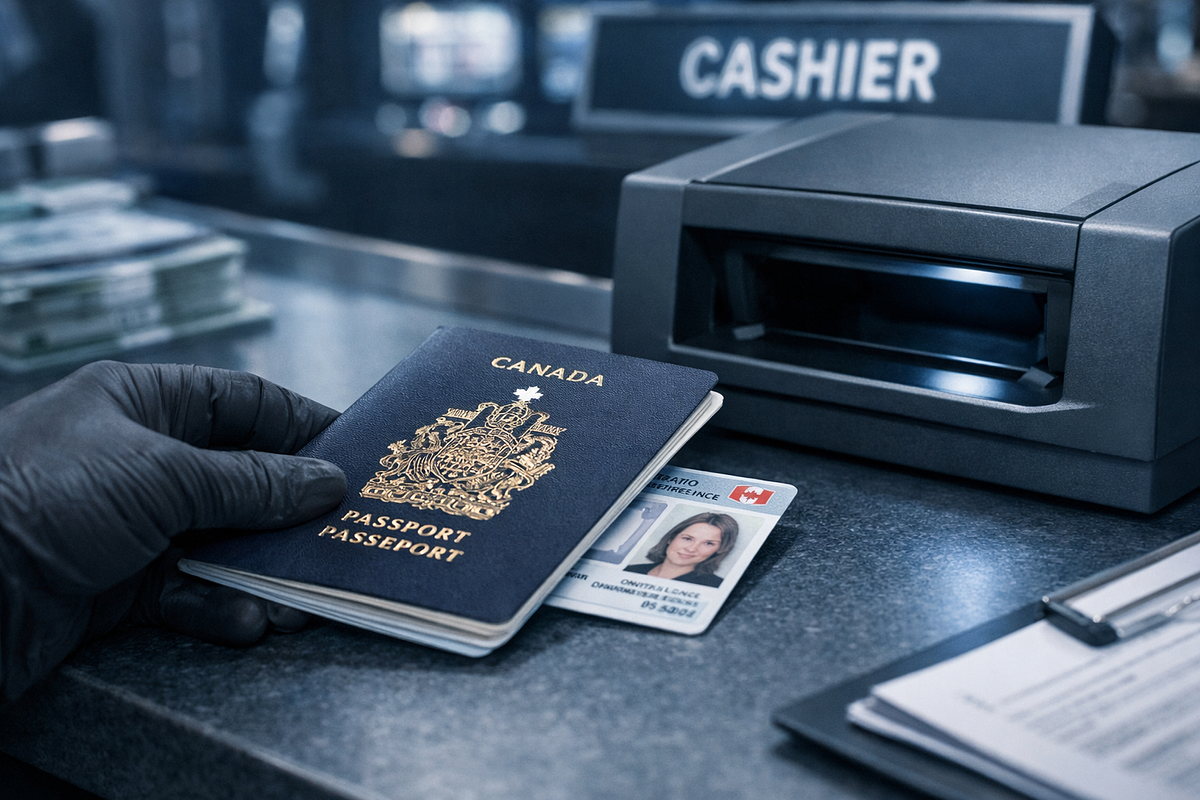
The request to upload a passport or driver’s licence isn’t a separate security layer added on top of compliance. It is the compliance check, and it’s the same action that stops someone else from registering under your identity. Account takeover attempts fail where the attacker can’t produce documents that match the account holder’s verified record. The friction and the protection are the same thing.
Fraud Prevention, Money Laundering Defence, and Suspicious Activity Signals
KYC establishes who the account holder is. The broader AML framework then monitors what that account does over time. Transaction monitoring runs continuously against the account’s activity, and casinos are required to report suspicious transactions to FINTRAC regardless of the amount involved. That means monitoring isn’t limited to large cash events but applies to any pattern that raises a concern.
FINTRAC publishes sector-specific money laundering and terrorist financing indicators for casinos, describing observable patterns that may signal suspicious activity. These indicators are framed as potential red flags rather than proof of wrongdoing, and they inform the internal rules casinos apply when deciding whether to hold a transaction or ask for more documentation. When you encounter an account hold or an unexpected request for further verification, that’s more likely to reflect an automated monitoring rule responding to a transaction pattern than an accusation directed at you personally. Knowing that, you can respond by providing the requested information rather than treating it as an adverse finding.
Intersections With Safer Gambling and Responsible Play Frameworks
Responsible-gambling tools only work if the casino knows, with certainty, who is operating the account. Self-exclusion registers, deposit limits, and cross-operator recognition of an excluded player all require that the account and the person are confirmed to be the same. Without verified identity, a self-excluded player can register again under a different email address or alias, and the exclusion has no way to follow them.
KYC closes that gap. Because the verification process ties an account to a specific, document-confirmed individual, a deposit limit applies to that person across any account they hold with the operator, and a self-exclusion entered on one platform can be matched against new registrations at other operators who share the same verified identity data. Safer-gambling controls are only as effective as the identity layer beneath them. If the account and the person aren’t confirmed to be the same, the controls protect an account rather than a human being.
Reading a Verification Request With Informed Judgment
When a Canadian casino requests identity documents, that request is doing three things at once: satisfying a legal compliance requirement, supporting financial crime prevention, and protecting your account. A player who understands that can read any verification prompt for what it actually is: a threshold-triggered statutory requirement, a condition of lawful account operation, and the same layer that makes responsible-gambling controls enforceable against a real person rather than an anonymous session.
Written by Arthur Crowson · Published July 29, 2026 · Last updated October 7, 2026
We check operator terms, licences and payment details against the casino's own pages and update this content when they change. Read our editorial policy, our transparency statement, or report an error. If gambling stops being fun, see our responsible gambling resources.