

When a casino app asks for your fingerprint or face scan instead of a password, convenience, privacy, and account security all become relevant at the same time. Unlike a forgotten or stolen password, a compromised biometric identifier can’t simply be changed, which makes the underlying technology worth understanding before you opt in. This page explains how authentication architecture determines whether your biometric data stays on your device or gets sent to and stored by the operator, and what that difference means for your privacy and risk exposure. By the end, you’ll have enough information to decide whether biometric login is the right choice for your casino accounts.
How Biometric Authentication Functions in Casino Environments
Biometric authentication reaches casino users in two distinct environments: online account access through personal devices, and identity checks at physical gaming floors and cashier cages. Each environment runs on a different technical architecture, which means the data captured, who holds it, and what risks come with it are quite different between the two. The sections below look at the specific modalities and contexts that produce those differences.
Facial recognition and fingerprint scanning are the two methods a casino account holder most commonly encounters. At the sensor level, facial recognition builds a mathematical template from the geometric relationships between facial landmarks: the distances between eyes, the contour of a jaw, the position of a nose bridge. Fingerprint scanning builds a comparable template from the ridge patterns in a fingerprint. Neither method stores a raw photograph or image file in its working form. What the system retains and compares is the template, which is a numerical representation of those measurements.
That distinction matters when you’re reading an operator’s privacy policy. Many policies separate “biometric identifier” (typically defined as the template itself) from “biometric information,” which may cover a broader set of data derived from the biometric capture. The category a piece of data falls into determines which legal protections apply to it, so knowing what a template is, and that it’s not the same as a stored photograph, helps you interpret what an operator is actually committing to protect.
At the user experience level, both methods work the same way: a scan replaces a typed password. Below that surface, they differ in false-acceptance and false-rejection rates, in resistance to spoofing, and in the sensor hardware available across the range of devices casino users carry. A mid-range Android handset and a current-generation iPhone don’t offer equivalent fingerprint or facial sensor capabilities, which affects both accuracy and security in practice.
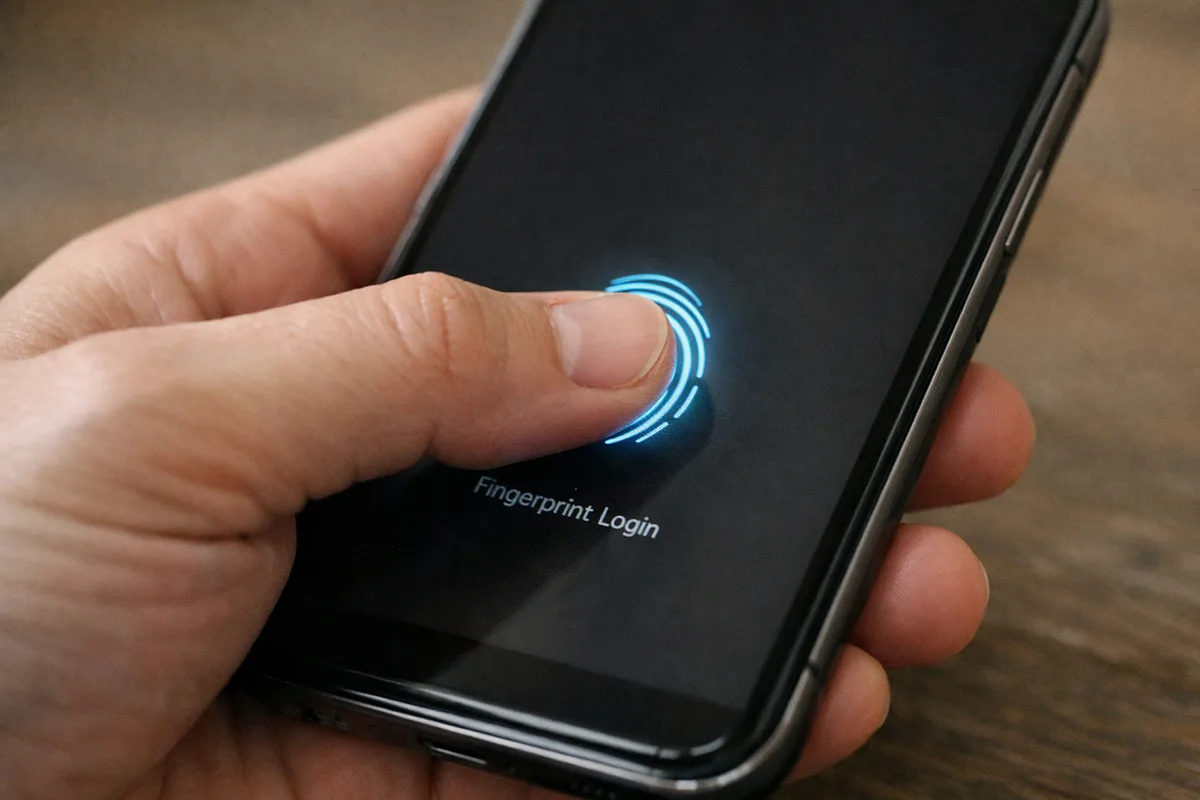
Online account login and physical venue identity checks are technically and legally separate, even when a single operator runs both. When a player enables biometric login on a casino app, they actively enroll a biometric identifier: they present a face or fingerprint, the device or operator system registers a template, and subsequent logins match against that enrolled template. The player starts the process and, in most setups, can withdraw from it by disabling the feature.
The physical venue context works differently. Genting Casinos UK, for example, runs Live Facial Recognition Technology at its casino locations specifically to identify individuals who have been suspended or barred for responsible gambling reasons. That system compares a person’s facial geometry against a database of persons of interest as they move through the venue. A visitor doesn’t actively enroll in that system the way an app user enrolls for account login. The capture is passive, derived from surveillance footage, and happens regardless of whether the individual has any online account with the same operator.
This matters when you’re reading an operator’s privacy documentation. An operator’s online biometric login policy covers the data flow that begins when a user taps “enable Face ID.” It doesn’t necessarily describe what the same operator’s venue surveillance system captures, retains, or shares. The two policies may be published separately, may reference different legal bases for processing, and may carry different retention periods. A player who reads only the app privacy notice and concludes they understand the operator’s full biometric data practices has read an incomplete picture.
The Convenience Case for Biometric Login
Biometric login on casino platforms removes a step that most users already skip on their phones: typing a password. It replaces that step with a gesture they perform dozens of times a day. That familiarity is the source of its appeal, and it’s a genuine one. Convenience, though, is a property of the user experience, not of the authentication architecture beneath it, and the two don’t always move together.
The concrete shifts biometric login produces are well-established. Password reset flows disappear because the credential is the user’s physical characteristic rather than a string they need to remember and periodically change. App resumption after backgrounding becomes near-instant, because the device authenticates the user in the same motion as unlocking the screen. Login screen abandonment, a measurable problem for mobile operators, falls when the barrier to entry is a fingerprint press rather than a keyboard sequence. Password reuse risk across the user’s other accounts is also removed, because there’s no password to reuse.
Operator marketing that describes login as “seamless” or “one-touch” is accurately describing this user experience. What that language doesn’t describe is the underlying authentication architecture: whether the biometric stays on the device, travels to a server, or is matched against a stored template held by the operator. The user experience description and the architectural description are independent, and operators aren’t required to address both in their marketing copy.
The convenience gains from biometric login are real. They don’t, by themselves, mean that the underlying setup is more secure or more private than a strong password combined with two-factor authentication. Security and privacy depend on what happens to the biometric data after the user’s finger leaves the sensor, not on how fast the login screen clears.
A passkey is a specific authentication technology built on public-private key cryptography. When a user enrolls a passkey, the device generates a key pair: a private key that never leaves the device and a public key that the operator’s server stores. At login, the device uses the private key to sign a challenge issued by the server, and the server verifies the signature using the public key it holds. The biometric (a fingerprint or face scan) is used locally to unlock the private key on the device. The operator receives a cryptographic proof of identity, not a biometric sample.
This architecture is meaningfully different from a system in which the operator receives, stores, or matches a biometric template. In a passkey-backed login, a breach of the operator’s servers can’t expose the user’s fingerprint or facial geometry, because the operator never held either. The operator’s data is limited to the public key, which has no value to an attacker without the corresponding private key on the user’s device.
Passkey adoption across iGaming operators is uneven. Stake has fully implemented passkey support across its global casino and sportsbook platforms using the FIDO standard, making it one of the first major iGaming operators to go passwordless. BetRivers offers biometric login as a convenience feature but doesn’t yet offer full passkey support. DraftKings doesn’t offer passkeys and secures accounts with password-based authentication.
This variation matters because the phrase “biometric login” appears in operator communications across all three categories. On a passkey-backed platform, that phrase describes a device-local system in which the operator holds no biometric data. On a platform offering biometric login without passkey support, the same phrase may describe a system in which the biometric interaction unlocks a conventional credential stored elsewhere, or one in which biometric data moves beyond the device entirely. The privacy footprint of these two systems is not equivalent, and the marketing language used to describe them often is.
Device-Local Versus Server-Side Biometric Verification
The most consequential technical distinction for assessing the privacy implications of biometric casino login is where the biometric template is stored and where matching occurs: on the user’s own device, or on the operator’s infrastructure. This is invisible at the login screen. The user experience looks identical in both cases. The underlying architecture, though, determines your actual risk exposure in the event of a data breach or a change in the operator’s data practices.
In a device-local architecture, the biometric template (the mathematical representation of a fingerprint or facial geometry) is stored inside a secure enclave on the user’s phone or laptop. When the user authenticates, the device uses the biometric scan to unlock a credential held locally: a stored password, an authentication token, or the private key of a passkey. That credential is what the device transmits to the operator. The operator receives the credential, not the biometric data itself, and never stores or matches the biometric template on its own systems.
This changes how you should interpret operator data breach news. If an operator whose login system is device-local suffers a breach of its user database, that breach can’t expose fingerprint or facial templates, because the operator never held them. The biometric data remained on each user’s device throughout. The breach is limited to whatever credentials and account data the operator did store.
Operator documentation gives you a practical signal for identifying this architecture. Language describing login as “using your device’s biometric” or referencing passkeys points to a device-local setup. Documentation that describes uploading a selfie or a fingerprint scan to the operator for verification describes a different architecture entirely.
In a server-side architecture, the operator receives biometric data directly (a facial image, a facial geometry template, or a fingerprint scan) and stores it on its own infrastructure, either as raw data or converted into a template. Every subsequent login requires the user to transmit a fresh biometric sample, which the operator’s systems match against the stored template. The operator’s data holdings therefore include biometric identifiers at rest.
This changes the threat model in a specific way: biometric identifiers can’t be rotated after compromise. A breached password can be reset. A breached facial geometry template can’t be replaced, because the underlying physical characteristic stays constant. Any future system relying on the same biometric modality is exposed by the same compromise, indefinitely.
A single operator can combine both architectures in different flows. Age verification and identity verification at account opening are commonly server-side events: the operator receives and retains a facial image or document-plus-selfie submission to satisfy regulatory identity checks, even when that same operator uses device-local biometrics for routine daily login. This means a user who has enabled device-local biometric login may still have submitted biometric data server-side during account registration.
Understanding this sharpens how you read consent screens. A prompt asking the user to scan their face “for verification” describes a server-side data transfer to the operator. A prompt asking to enable biometric login using the device describes a device-local unlock flow. The two requests carry structurally different data flows and different retention implications, even when they appear in the same onboarding sequence.
Privacy Risks Specific to Biometric Data
Biometric identifiers sit in a different risk category from every other credential type because they can’t be replaced after compromise. A password, a payment card number, and a one-time token all share one property that a fingerprint template or facial geometry doesn’t: they can be revoked and reissued. That permanent, non-replaceable quality changes both the severity of a breach and the standard you should apply when evaluating how an operator handles, retains, and protects biometric data.
When a password is compromised, the fix is straightforward: the user resets it, and the old credential becomes worthless. When a payment card is compromised, the issuer cancels the card and issues a new number. Neither of those remediation paths exists for a biometric identifier. A person whose facial geometry template is exposed in a data breach can’t be issued a new face. The same fingerprint that was compromised today will remain the same fingerprint on every device and platform the person uses for the rest of their life.
This permanence extends the time horizon of harm indefinitely. Biometric data compromised at any point can be used against the individual across any future system that relies on the same modality, including systems that don’t yet exist at the time of the breach. A credential stolen today may be irrelevant in five years. A biometric template stolen today remains exploitable in five years, twenty years, or whenever a new system that matches against that modality is deployed.
That time horizon changes how you should read retention policy language. A casino operator’s privacy notice may state a five-year retention period for biometric data using the same sentence structure it uses for password hashes or transaction logs. The words look equivalent on paper, but they’re not. A five-year retention window for a password hash covers a credential that can be rotated at any time. A five-year retention window for a biometric template covers a permanent identifier that can’t be rotated at all. Treat any retention period for biometric data as a minimum exposure window, not a maximum one.
Biometric sensors aren’t tamper-proof, and the assumption that a biometric modality is inherently more secure than a password isn’t supported by the research record. Machine-learning researchers have produced synthetic fingerprints, referred to in the literature as MasterPrints, that can match a broad range of real fingerprints. The spoofing capability comes from the partial nature of fingerprint sensor reads on small touchscreen sensors, which capture only a portion of the fingerprint and therefore create a larger matching surface for a well-constructed synthetic template.
In practice, fingerprint authentication on a low-quality sensor with no liveness detection can be defeated by a synthetic artifact, not by obtaining the target’s actual fingerprint. The security of biometric login is therefore a function of sensor quality, the presence and rigor of liveness detection, and the underlying authentication architecture, not of the modality label itself.
When an operator claims that biometric login is more secure than a password, that claim is only as strong as the weakest component in the chain. A device-local biometric unlock backed by a passkey on a high-quality sensor with liveness detection carries a meaningfully different risk profile from a server-side fingerprint match on a low-resolution sensor with no liveness check. “Biometric login” is a category, not a specification.
Physical venue surveillance introduces a biometric exposure pathway that sits entirely outside the account login system. When an operator serves customers across multiple countries, footage captured by cameras at a single physical venue may simultaneously fall under the privacy laws of several jurisdictions: those of the country where the venue is located, those of the countries where the customers filmed are resident, and potentially those of any jurisdiction through which the footage is transmitted or stored.
Unredacted video footage containing identifiable facial data can constitute a cross-border privacy violation even when the camera and the server holding the footage are both located in a single jurisdiction. The technical practice used to address this is CCTV redaction, by which operators obscure or blur identifiable facial features in footage before it is disclosed, transferred between jurisdictions, or shared with third parties such as regulators or law enforcement.
An operator privacy notice that states “our data stays in [jurisdiction]” may be accurate for account data (login credentials, transaction records, identity verification documents) while saying nothing about venue footage, which may travel under a separate data governance framework or no framework at all. Treat account data retention claims and venue footage retention claims as distinct questions, and look for explicit coverage of surveillance footage in any privacy notice before concluding that the operator’s jurisdictional data claim is comprehensive.
Regulatory and Legal Frameworks Governing Biometric Data in Gambling
No single statute governs how a gambling operator collects, stores, and deletes biometric identifiers from end to end. Instead, operators face overlapping obligations drawn from general-purpose privacy law, biometric-specific state statutes, sector-specific gambling technical standards, and financial-institution compliance rules. The applicable layer in any given situation depends on where the customer is located, where the operator is licensed, and how the biometric data is used. The effective compliance floor is set by whichever framework imposes the strictest requirement across all those dimensions.
The European Union’s General Data Protection Regulation applies as a baseline to any operator collecting biometric identifiers from EU-resident customers, treating such data as a special category requiring an explicit legal basis for processing. The California Consumer Privacy Act applies the same baseline function for California residents, granting rights to know, delete, and opt out of the sale of biometric data. Colorado enacted HB24-1130, signed into law on 31 May 2024, which amends the Colorado Privacy Act to add biometric-specific protections: operators must obtain informed consent before gathering biometric data and must maintain written policies covering disclosure, consent, data retention, deletion procedures, and security incident response.
An operator serving customers across these three jurisdictions typically calibrates its consent flow to the strictest applicable standard. That means the consent screen a user encounters before enabling biometric login is a compliance artifact shaped by the most demanding jurisdiction in the operator’s customer base, not a voluntary disclosure. Reading it carefully, particularly the retention period and the stated purpose for collection, gives you direct information about what the operator is legally committed to doing with the biometric identifier.
The Illinois Biometric Information Privacy Act prohibits private entities from collecting biometric identifiers (including facial geometries) without a written release constituting informed consent, a stated purpose for collection, and a disclosed retention period. The statute also requires any entity holding biometric data to publish a written policy establishing a retention schedule and guidelines for permanent destruction, with destruction required when the initial collection purpose has been satisfied or within three years of the individual’s last interaction with the entity, whichever comes first.
The statute has produced concrete litigation against a gambling operator. A class action was filed in November 2019 against the operator of Hollywood Casino in Aurora, Illinois, alleging that video surveillance cameras scanned rewards programme members’ facial geometry without informed consent and without a published data retention policy, both direct violations of the statute’s requirements.
That case sharpens the picture in a specific way: a rewards programme that scans faces at a physical venue is engaged in biometric collection regulated identically to a login system, regardless of how the operator markets the feature. The regulatory exposure doesn’t depend on whether the operator describes the scanning as a security measure, a loyalty benefit, or a responsible gambling tool. Collecting facial geometry triggers the statute’s requirements in each case.
The Federal Trade Commission’s policy statement on biometric information, issued in spring 2023, requires businesses to put in place reasonable privacy and data security measures to protect any biometric information they collect or maintain from unauthorized access. The statement doesn’t set a prescriptive technical standard but establishes that failure to protect biometric data is an unfair or deceptive practice subject to FTC enforcement.
On 30 December 2024, the Department of Justice and the Department of Homeland Security issued a joint Biometric Technology Report providing a major public review of biometric technologies employed by both departments, produced in collaboration with the White House Office of Science and Technology. The report represents the most recent federal-level articulation of biometric best practices and signals the direction of future regulatory expectations for any sector handling biometric identifiers at scale.
The UK Gambling Commission’s Remote Gambling and Software Technical Standards require licensed operators to put in place strong access controls aligned with the ISO/IEC 27001 information security standard. This sector-specific requirement sits alongside, not instead of, general data protection obligations, meaning a UK-licensed operator must satisfy both the Commission’s technical standards and the data protection framework at the same time.
Casinos classified as financial institutions are also subject to the Bank Secrecy Act of 1970, which requires reports on cash transactions exceeding $10,000 in a single day and on any suspicious activity indicative of money laundering. That financial-institution layer is relevant to biometric practices because identity verification, including biometric verification, is part of the know-your-customer infrastructure that supports those reporting obligations. An operator’s biometric practices are therefore shaped simultaneously by consumer privacy law, gambling-sector technical standards, and financial-institution compliance requirements, and the strictest of those frameworks tends to set the effective floor for what the operator must do.
Responsible Gambling and Age Verification Applications
Biometric identifiers serve two distinct operational purposes beyond account login on casino platforms: enforcing self-exclusion commitments and confirming user age at account opening. Each purpose involves a different consent basis, a different retention horizon, and a different legal justification for holding the data.
A biometric-backed self-exclusion scheme works by storing a biometric identifier (typically a facial geometry template) on a register, then matching every subsequent login attempt or physical venue entry against that register. Genting Casinos UK runs Live Facial Recognition Technology at its physical venues specifically to identify individuals suspended or barred for responsible gambling reasons, matching live camera captures against a database of enrolled individuals.
The practical consequence for a player opting into such a scheme is that circumvention by opening a new account under a different email address, or entering a venue under a different name, doesn’t defeat the check. The biometric identifier is tied to the individual’s physical characteristics, not to any account credential or document they can replace.
Opting into a biometric-backed exclusion scheme authorizes the operator to retain the biometric identifier for the full duration of the exclusion period and to run a matching operation at every login or entry attempt during that time. The retention isn’t incidental to the exclusion: it’s the mechanism by which the exclusion functions. A player reading a self-exclusion consent screen should treat it as authorizing ongoing biometric matching, not a one-time identity check.
Facial recognition and document-plus-selfie flows are increasingly used at account opening to confirm that the applicant meets the minimum legal gambling age. In this flow, the user submits a facial image (often alongside a government-issued document) to the operator’s verification system, which processes the data server-side to confirm identity and age.
This is a server-side biometric verification event even when the same operator uses device-local biometrics for day-to-day login after the account is open. The two flows are architecturally separate: the device-local login never transmits a biometric template to the operator, whereas the age verification flow at signup does.
The retention policy governing the signup biometric is typically different from the policy governing ongoing login. Age verification data is generally retained under regulatory recordkeeping obligations (requirements set by gambling licensing conditions or anti-money-laundering rules) rather than being tied to the user’s active session or deleted when the user logs out. This means a player who later switches to device-local biometric login may still have a facial image or template held by the operator under a separate, longer retention schedule anchored to the original verification event rather than to current account activity.
Traditional Authentication Versus Biometric Authentication in Casino Contexts
Password-plus-second-factor authentication and biometric login aren’t interchangeable upgrades from one another. They differ structurally across dimensions that affect what happens when something goes wrong. The comparison below treats each approach at its well-implemented baseline, because the gap between a well-run and a poorly-run version of either system is larger than the gap between the two approaches themselves.
The dimensions below are ones you can act on when evaluating an operator: what happens to the credential after a breach, how much data the operator holds in the first place, whether the identifier can be replaced, how resistant each approach is to spoofing, and how much friction the user absorbs at login. The comparison separates device-local biometric setups (where the biometric template never leaves the user’s device and the operator holds only a public key) from server-side biometric verification, where the operator receives and stores a biometric template or raw biometric sample directly. These two architectures carry different risk profiles even when both are marketed under the same “biometric login” label.
The table below isolates the structural differences to carry into any operator evaluation.
| Dimension | Password + Second Factor | Device-Local Biometric (e.g., Passkey-Backed) | Server-Side Biometric Verification |
|---|---|---|---|
| Reset possibility after compromise | Full reset possible: password and second-factor seed can both be replaced | Passkey credential can be revoked and re-enrolled on a new device; the underlying biometric modality cannot be changed | Not possible: a compromised facial geometry or fingerprint template is a permanent exposure; the individual cannot be issued a new face |
| Operator-side data footprint | Limited: operator holds a password hash and a second-factor seed | Minimal: operator holds only a public key; the biometric template remains on the user’s device | High: operator holds a biometric template or raw biometric data on its own infrastructure |
| Breach exposure of the identifier itself | Hash and second-factor seed exposed; both are replaceable credentials | Biometric template cannot be exposed in an operator breach because the operator never held it | Permanent identifier exposed; compromised biometric data can be used against the individual indefinitely across any future system relying on the same modality |
| Spoofing resistance | Variable: depends on second-factor type; SMS-based factors are weaker than hardware tokens or authenticator apps | Depends on device sensor quality and liveness detection capability | Depends on the server-side matching algorithm and liveness detection; synthetic fingerprint research shows that sensor-level spoofing vulnerabilities exist |
| User experience friction | Higher: requires password entry plus a separate second-factor step | Low: biometric or device PIN replaces both the password and the second-factor step | Variable: typically low at recurring login, higher at initial enrollment when a biometric sample must be submitted to the operator |
Reading Your Casino’s Biometric Policy With Confidence
The meaningful question when evaluating a casino’s biometric login isn’t whether the operator uses biometrics, but where the identifier is stored and matched. That architectural fact (device-local versus server-side) determines whether a breach of the operator’s systems can expose a permanent, non-replaceable identifier or is limited to replaceable credentials. Once you can locate and interpret that distinction in an operator’s privacy documentation, you’re working from the actual risk structure, not from the login screen’s surface appearance.
Written by Arthur Crowson · Published August 28, 2026 · Last updated October 7, 2026
We check operator terms, licences and payment details against the casino's own pages and update this content when they change. Read our editorial policy, our transparency statement, or report an error. If gambling stops being fun, see our responsible gambling resources.