


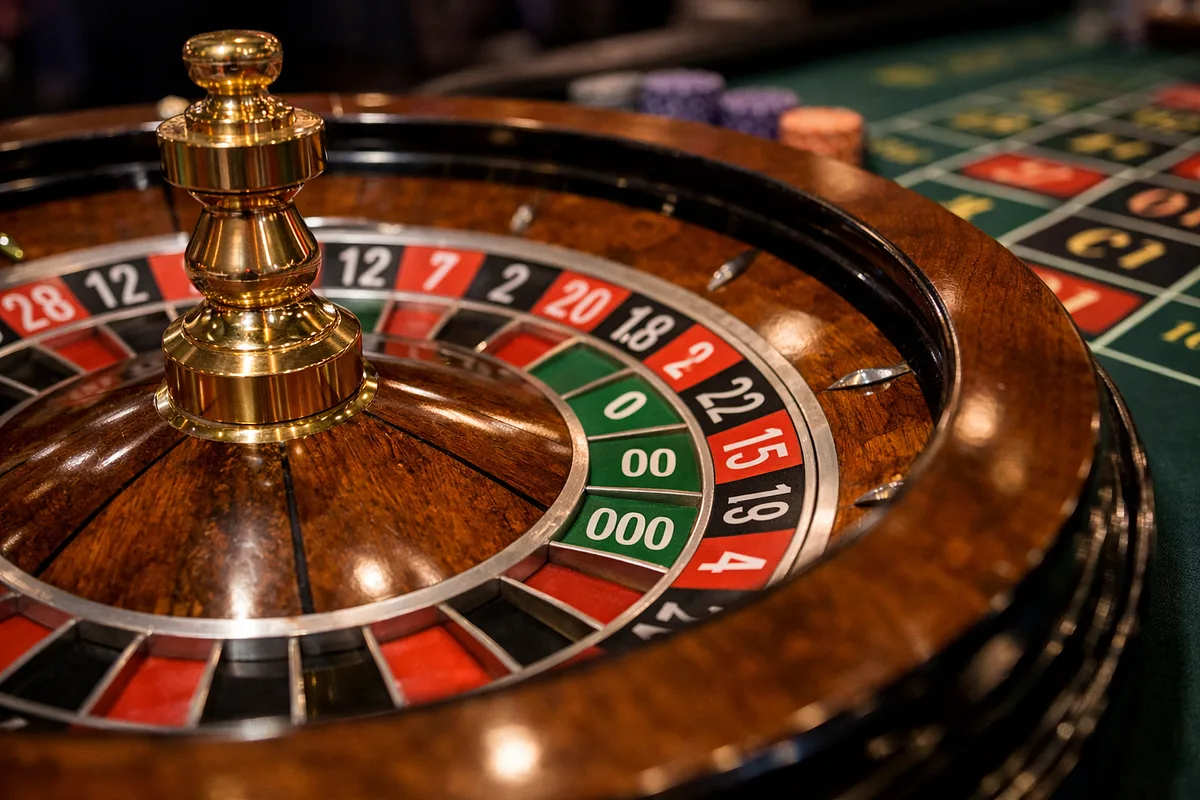
Triple-zero roulette uses a 39-pocket wheel: numbers 1 through 36 plus three green pockets. That third green pocket raises the house edge above what you get on single-zero and double-zero wheels. This article walks through the math behind each variant’s edge, explains how that edge applies across different bet types, and shows what the numbers mean in real session terms. By the end, you’ll have what you need to compare all three roulette formats and decide whether a triple-zero wheel is worth playing.
The Mathematical Basis of the Roulette House Edge
Roulette payouts are built around 36 numbered pockets, but no standard wheel actually stops at 36. Every variant adds at least one zero pocket on top of that, and that mismatch is where the house gets its edge. The payouts stay fixed as if there are only 36 pockets, but the wheel has more. Zero pockets are the only source of the house’s advantage on standard roulette bets. The numbered pockets 1 through 36 contribute nothing to it.
What the House Edge Represents on a Roulette Wheel
The house edge is the percentage of each wager the casino keeps on average over a large number of spins. It comes directly from the ratio of zero pockets to total pockets. The payouts are set as though only 36 pockets exist, so a straight-up bet pays 35-to-1, which reflects 35 losing numbers against 1 winning number in a 36-pocket model. Every pocket added beyond those 36 increases the total without increasing the payout, which tilts the math in the house’s favor. The edge figure is a long-run average, not a guarantee on any single spin. You can win or lose on any given spin regardless of what the edge says.
Why Zero Pockets Are the Only Source of the Edge
On a 36-pocket wheel, the numbered pockets line up perfectly with the payout structure. On a straight-up bet, there are 35 ways to lose and 1 way to win, and the 35-to-1 payout matches that exactly. Each zero pocket breaks that balance by adding one more losing outcome that the payout doesn’t account for. The payout stays at 35-to-1, but your actual odds of winning get worse. Because the edge comes entirely from this mechanism, you can figure out the relative cost of any roulette wheel just by counting its zero pockets. One zero means a lower edge than two, two means a lower edge than three, and so on.
The Edge Figures Across Single-, Double-, and Triple-Zero Wheels
Once you understand the house edge as a ratio of zero pockets to total pockets, the edge for each variant is just basic arithmetic. Every zero pocket you add shifts that ratio in the same direction. The three standard variants, single-zero, double-zero, and triple-zero, each represent one step along that progression.
Deriving the Edge for Each Variant
The formula is the same for all three: divide the number of zero pockets by the total pocket count. The numbered pockets (1 through 36) are identical on every wheel. What changes is how many green pockets sit alongside them. Each green pocket added increases both the numerator and the denominator, which compounds the effect on the ratio. The resulting edges and return-to-player figures are in the table below.
| Variant | Total Pockets | Zero Pockets | House Edge Calculation | House Edge | Return to Player |
|---|---|---|---|---|---|
| Single-zero | 37 | 1 | 1 ÷ 37 | ≈ 2.70% | ≈ 97.30% |
| Double-zero | 38 | 2 | 2 ÷ 38 | ≈ 5.26% | ≈ 94.74% |
| Triple-zero | 39 | 3 | 3 ÷ 39 | ≈ 7.69% | ≈ 92.31% |
How the Edge Scales as Zeros Are Added
Each zero pocket added to the wheel contributes roughly 2.5 percentage points to the house edge. The steps aren’t perfectly uniform: single-zero to double-zero is about 2.56 points, and double-zero to triple-zero is about 2.43 points. But the approximation is close enough to be useful. A hypothetical four-zero wheel with 40 total pockets would produce an edge of 4 ÷ 40, or exactly 10%. Rather than memorizing a separate percentage for each variant, you can estimate any wheel’s edge on the spot by counting its green pockets and dividing by the total pocket count.
How the 7.69% Edge Applies Across Bet Types on a Triple-Zero Wheel
On a triple-zero wheel, the 7.69% house edge applies to nearly all standard bets. That’s a direct result of payouts staying fixed at conventional roulette rates while the total pocket count rises to 39. There’s one narrow exception, and surrender-style rules can also affect even-money bets. Both are covered below.
Uniform Edge Across Standard Bet Categories
On a 39-pocket wheel, standard bets (straight-up, red/black, corners, columns, and streets) all carry the same 7.69% house edge. The payouts stay fixed at the rates built for a 36-pocket wheel. A straight-up bet still pays 35-to-1, but your odds of winning are now 1-in-39 instead of 1-in-37 or 1-in-38. The payout structure returns 36 gross units regardless of which pocket wins, and 36 divided by 39 gives you the 92.31% return-to-player figure. Your probability of winning any bet drops as the denominator grows from 37 to 38 to 39, but the payout doesn’t rise to compensate. Because of this uniformity, the zero count alone gives you a reliable edge estimate for essentially any standard bet on the wheel.
The Combination Bet Exception
One combination bet, covering both green pockets and the first three numbers, carries a house edge of about 7.89% on the triple-zero wheel. That makes it the single worst bet on the wheel. The higher edge comes from the payout assigned to this combination not lining up cleanly with the 39-pocket denominator, which creates a small additional margin above the base 7.69%.
The Effect of Even-Money Rule Variations
Surrender-style rules return half of an even-money wager when any zero lands, which reduces the effective edge on those bets across all three wheel variants. The reduction is proportional in each case, so the triple-zero wheel still carries a higher effective edge than either the single-zero or double-zero wheel, even after the rule is applied. A player on a triple-zero wheel with a surrender-style rule still faces an effective edge on even-money bets that’s higher than the base edge of either alternative without any such rule.
| Variant | Base Edge (Even-Money) | Effective Edge with Surrender-Style Rule |
|---|---|---|
| Single-zero | ≈ 2.70% | ≈ 1.35% |
| Double-zero | ≈ 5.26% | ≈ 2.63% |
| Triple-zero | ≈ 7.69% | ≈ 3.85% |
The Practical Cost of the Added Zero
The house edge is the fraction of each dollar wagered that the casino keeps on average over many spins. Putting the edge figures for each variant into per-wager terms makes the cost of playing a triple-zero wheel concrete. The gaps between variants aren’t equal steps in proportional terms, and those proportional differences are what this section spells out.
Expected Loss per Spin Across Variants
The house edge, expressed as a percentage of each wager, is the best estimate of average loss per spin over a long run of play. It’s not a guarantee for any single spin, but it’s a stable long-run retention rate. The triple-zero edge of about 7.69% is roughly three times the single-zero edge of about 2.70%, and about 1.5 times the double-zero edge of about 5.26%. That puts it among the highest house edges on any standard casino table game. A player making flat wagers on a triple-zero wheel faces an expected long-run loss nearly three times as large per spin as the same wager on a single-zero wheel.
| Variant | Total Pockets | House Edge | Expected Loss per $100 Wagered |
|---|---|---|---|
| Single-zero | 37 | ≈ 2.70% | ≈ $2.70 |
| Double-zero | 38 | ≈ 5.26% | ≈ $5.26 |
| Triple-zero | 39 | ≈ 7.69% | ≈ $7.69 |
We check operator terms, licences and payment details against the casino's own pages and update this content when they change. Read our editorial policy, our transparency statement, or report an error. If gambling stops being fun, see our responsible gambling resources.