

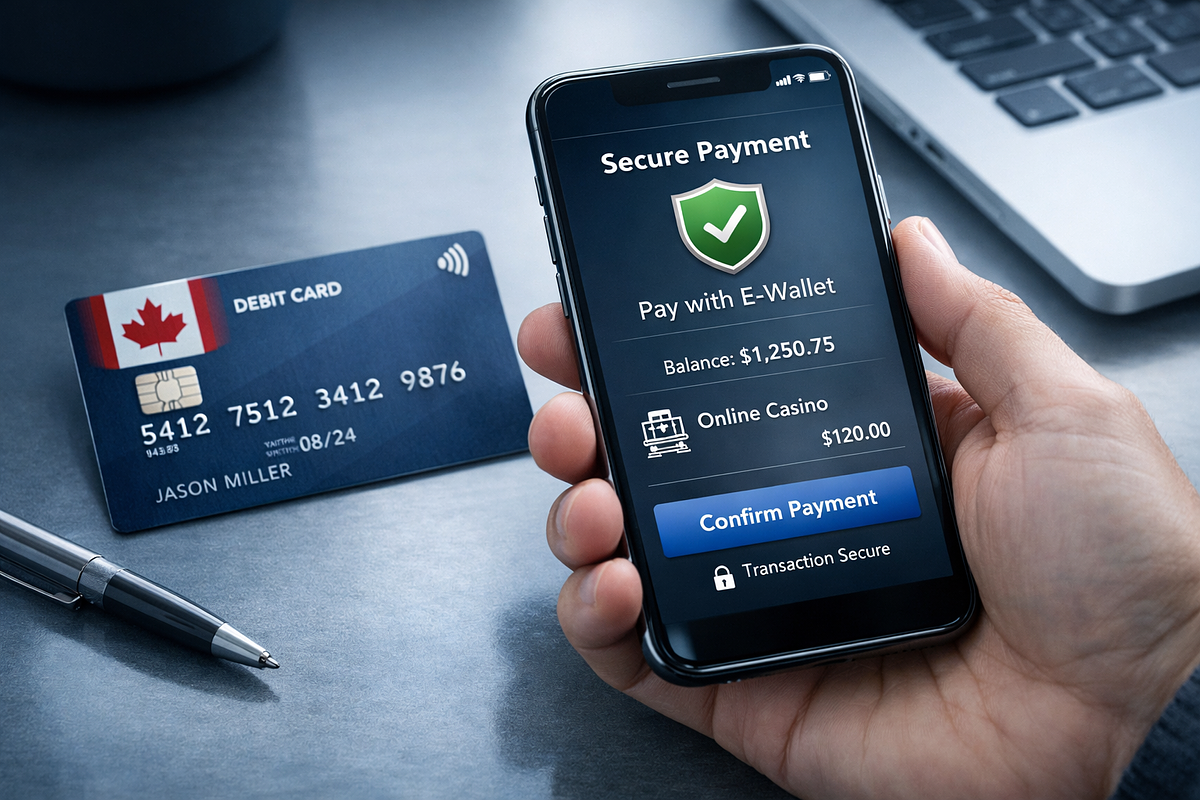
This page covers the pros and cons of using e-wallets at Canadian online casinos and how those factors play out in practice. E-wallets sit between your bank account and the casino, handling deposits and withdrawals without sharing your banking details with the operator. We’ll walk through speed, privacy, security, fees, bonus restrictions, and provincial availability so you can decide whether an e-wallet makes sense for your situation.
Speed of Deposits and Withdrawals Compared to Traditional Banking
Speed is one of the two most common reasons Canadian casino players pick e-wallets over traditional banking. The advantage is real, but it’s not the same at every stage. Deposits and withdrawals work differently, and on the withdrawal side, there’s a step that has nothing to do with the payment method itself. Knowing where the speed gain comes from helps you read operator marketing claims more accurately.
E-wallet deposits at Canadian online casinos process almost instantly once you approve the transfer. That’s because the transaction is a settlement between a pre-funded wallet balance and the casino’s account, not a live pull from your bank. The wallet has already received and cleared your funds, so the wallet-to-casino leg is just a balance adjustment between two accounts on the same payment network. When operators advertise “instant deposits,” that’s what they mean. What that claim doesn’t cover is how long it takes to load money into the wallet in the first place, which depends on your funding method and can take extra time on a first use.
E-wallet withdrawals are faster than bank transfers, but every withdrawal, regardless of payment method, goes through the operator’s internal review before any payment is sent. The payment method sets a floor on how quickly funds can move once they’re released. The operator’s approval process sets the ceiling on when that release happens. If you’re evaluating a “fast withdrawal” claim, treat those two stages separately. The operator stage and the payment-network stage are independent, and only the second is affected by your choice of e-wallet.
The table below shows typical withdrawal speeds by payment method, measured from the point of operator approval.
| Payment Method Category | Typical Withdrawal Speed After Operator Approval |
|---|---|
| Mobile-first e-wallet | Within minutes to 24 hours |
| Multi-currency e-wallet (e.g., Skrill / Neteller tier) | Up to 24 hours |
| Standard e-wallet tier | Up to 24 hours |
| Traditional bank transfer | 1 to 4 business days |
Privacy and Separation from Personal Banking
Privacy ranks alongside speed as one of the two most common reasons Canadian players choose e-wallets for casino transactions. In this context, privacy means keeping your primary bank relationship separate from the casino. It does not mean being anonymous within the payment system. That distinction matters because e-wallets conceal less than many players assume.
An e-wallet sits between your bank account and the casino, so the operator gets a wallet identifier rather than your actual bank details. This has two practical effects: your bank statement shows a transfer to the wallet provider rather than a named casino, and the casino’s records hold only the wallet-level identifier, not your full banking credentials. The wallet provider itself, though, can see both sides of the transaction. It sees the bank account that funded the wallet and the casino account that received the transfer. Privacy from the operator and privacy from the payment chain are not the same.
Keeping your details from the casino doesn’t remove your identity from the payment system. E-wallet providers operating in Canada verify their account holders’ identities under Canadian anti-money-laundering and financial intelligence rules. FINTRAC’s January 2024 Special Bulletin on laundering the proceeds of crime through gambling identifies e-wallets as a vehicle used to move funds through unlicensed offshore gambling sites and back into Canadian financial institutions. That’s why regulators treat wallet providers as obligated reporting entities, not neutral middlemen. If you’re using an e-wallet expecting anonymity, that’s a misread of its compliance position. The wallet operator holds verified identity records regardless of what the casino can see.
Security Features and Transaction Protection
E-wallets used at Canadian casinos rely on a layered security model that combines encryption, tokenization, and account-level authentication. The practical result is that the casino receives a transaction confirmation rather than your raw banking credentials, which keeps your underlying financial accounts separate from the operator.
E-wallet transactions are protected with AES-256 encryption, which secures the data moving between your wallet and the payment network. Tokenization means the casino receives a transaction token instead of your full bank account or card details, so the operator never holds your actual credentials. That’s why casino cashier pages show only partial payment identifiers, a truncated wallet reference rather than a full account number. That’s the direct result of tokenization, not a display choice by the operator. When you see a partial identifier on a cashier page, it confirms your full credential was never sent to the operator.
Access to your wallet is controlled by account-level settings like two-factor authentication, which work independently of whatever security the casino applies on its own platform. Audits of Canadian e-wallet casino accounts found that accounts protected by two-factor authentication held up during phishing incidents, while single-factor accounts were compromised in those same breaches. That finding matters because the encryption protecting your transactions is only as strong as the access controls in front of your wallet account. If you rely on encryption alone without enabling two-factor authentication, your wallet’s security comes down to a single password.
According to Paysafe research, 47% of Ontario players say security is the main reason they prefer digital wallets over other payment methods. That helps explain why e-wallet options are prominently placed on Canadian operator cashier pages. The placement reflects documented player demand in the Ontario market, not a guarantee that every listed e-wallet is available across all provincial licensing contexts.
Fee Structures at Canadian Online Casinos
E-wallet fees at Canadian casinos combine a percentage-based charge with a fixed minimum. The total cost depends on both the withdrawal amount and which party, the wallet provider, the operator, or both, is applying the charge. Because fees can come from either end of the transaction, a casino’s advertised fee policy may not reflect what you’ll actually pay.
Typical e-wallet withdrawal fees at Canadian casinos run from 1% to 2% of the withdrawal amount, with a minimum charge of around CAD $0.99 that kicks in when the percentage calculation falls below that floor. On a small withdrawal, say CAD $20, that minimum fee represents a much higher effective cost than the stated percentage rate suggests. So the flat minimum is the dominant cost driver on small amounts. A casino advertising “low fees” may still have a minimum that takes a bigger bite out of a modest cashout than the headline percentage implies. Larger withdrawals land closer to the stated percentage rate, while small cashouts pay a higher effective rate because of the minimum.
Extra costs come up when your e-wallet account is denominated in a currency other than CAD, because the wallet has to convert funds before or after the transaction settles. Currency conversion fees can be significant on cross-border transactions, and they sit outside the withdrawal fee structure operators typically disclose. A casino quoting zero operator fees on e-wallet withdrawals may still leave you exposed to conversion costs applied by the wallet provider. The true cost of the transaction only becomes clear once you’ve read both the wallet’s own terms and the casino’s cashier disclosures.
Limitations of E-Wallets in the Canadian Casino Context
The practical limitations of e-wallets at Canadian online casinos fall into three categories: bonus eligibility restrictions, provincial availability gaps, and identity verification requirements. Each one affects whether the speed and privacy advantages of e-wallets come through for a given player, and none of them are visible from a cashier page alone.
Several Canadian operators exclude specific e-wallet categories from welcome bonus offers, citing bonus abuse prevention. This matters because an e-wallet appearing on a casino’s cashier page doesn’t guarantee that deposits made through it will qualify for a promotional offer. A player who deposits via an excluded wallet category may complete the transaction successfully but receive no bonus credit. The only way to confirm eligibility is to read the bonus terms and conditions for explicit payment method exclusions before depositing.
Canadian provincial licensing creates uneven e-wallet availability across operators, with Ontario and Quebec showing distinct acceptance patterns. A wallet category that appears on one operator’s cashier page may be missing from another operator licensed under a different provincial framework. That reflects regulatory and commercial decisions made at the provincial level, not any technical limitation of the wallet itself.
| Provincial Jurisdiction | Typical E-Wallet Availability Pattern |
|---|---|
| Ontario | Broader acceptance of international digital wallet categories; operators commonly list multiple e-wallet options including global payment platforms |
| Quebec | More restricted availability; certain international e-wallet categories face withdrawal limitations, with fewer operators listing them as a supported cashout method |
Both the wallet provider and the casino run independent identity verification before you can complete a first withdrawal. The wallet provider’s verification process can take several days depending on jurisdiction, which offsets the speed advantage e-wallets carry in later transactions. The casino’s KYC review runs as a separate layer on top of that, so you need to clear both processes before the wallet’s fast settlement actually becomes your experience. Once both layers are cleared, repeat transactions run at the wallet’s native speed.
Comparing E-Wallet Categories for Canadian Players
E-wallets available to Canadian casino players are not all the same. They vary by device orientation, currency handling, verification model, and compliance posture, while sharing a common baseline of encryption-backed security and settlement speeds that beat bank transfers and credit cards. Knowing where a given e-wallet sits across those attributes explains why certain wallet types show up consistently on regulated Canadian operator cashier pages while others appear only on a narrower set of sites. Provincial licensing adds another layer, with Ontario and Quebec showing distinct availability patterns that can make the same wallet type accessible on one operator and absent on another.
The differences among Canadian-available e-wallets cluster around four dimensions: device orientation, currency handling, verification approach, and compliance strength. These clusters determine which operator types list a given wallet category, because operators match their cashier offerings to their own licensing obligations and bonus-abuse controls. A wallet category with strong AML compliance and multi-currency support tends to appear on internationally licensed operators serving Canadian players, while a domestic direct-payment wallet fits more closely with provincially regulated platforms that focus on CAD settlement and local banking.
| E-Wallet Category | Distinguishing Attribute | Fee Posture | Canadian Availability Signal |
|---|---|---|---|
| Mobile-first e-wallet | App-only interface; no desktop access; transaction approval via mobile device required | Low to no fees on casino deposits and withdrawals at most accepting operators | Accepted at a growing number of licensed Canadian casino sites; not universally listed across all operators |
| Multi-currency e-wallet | Supports multiple currencies within a single account; strong AML compliance posture | Currency conversion fees apply when the account’s base currency differs from CAD | Broadly listed on internationally licensed operators serving Canada; availability varies by province |
| Crypto-adjacent e-wallet | Instant verification model; accepts funding via crypto-linked rails alongside traditional methods | Fee structure varies by funding source; cross-border conversion costs can apply | Present on a narrower set of Canadian-facing operators; less common on provincially regulated platforms |
| Domestic direct-payment e-wallet | Integrated with Canadian banking infrastructure; CAD-native settlement; widely recognised by local banks | Generally low fees; no currency conversion cost for CAD transactions | Strong nationwide acceptance; prominent on both provincially regulated and privately licensed Canadian operators |
Weighing E-Wallets Against Other Canadian Casino Payment Options
The core trade-off for any Canadian player looking at a cashier page is this: the same intermediary layer that gives e-wallets their speed and credential separation also brings fee exposure, bonus eligibility conditions, and compliance obligations that vary by province and operator. Understanding how those trade-offs interact lets you read a specific operator’s cashier offering as a set of actual conditions rather than just a list of features.